
The Holocaust is the murder of six million Jews, two out of every three in Europe, by Nazi Germany and its collaborators between 1933 and 1945, together with millions of others the regime defined as unfit to live. It did not begin with murder. It began with a boycott, a law about civil servants and a bonfire of books, and it moved step by step, each step tested first, through the loss of citizenship, the walled ghettos, the shooting pits of the east, and six camps in Poland built for nothing but killing. This timeline runs from the roots of the hatred to the trials, the diary and the memorials, and one of its seven chapters has no dates in it, because it is about what happened inside the camps.
From the roots of the hatred to the trials and the memorials.
The Holocaust is the murder of six million Jews, two out of every three in Europe, by Nazi Germany and its collaborators between 1933 and 1945, together with millions of others the regime defined as unfit to live. It did not begin with murder. It began with a boycott, a law about civil servants and a bonfire of books, and it moved step by step, each step tested first, through the loss of citizenship, the walled ghettos, the shooting pits of the east, and six camps in Poland built for nothing but killing. This timeline runs from the roots of the hatred to the trials, the diary and the memorials, and one of its seven chapters has no dates in it, because it is about what happened inside the camps.
The hatred was centuries old. What the Nazis added was a state.
From the medieval expulsions to the 1919 postcard.
Darwin never said it. Galton and the eugenicists did, and German doctors carried it out.
Social Darwinism, eugenics, sterilization, euthanasia, the death camps.
No written order to murder the Jews has ever been found. He did not need to write one.
The 1920 program, Mein Kampf, the 1939 prophecy, the Wannsee Conference, and the men who acted on it.
Fear, propaganda, small steps, and a great many people who benefited.
The boycott, the book burning, the Gestapo, the Olympics, the fine.
Not with murder. With laws, one at a time, each one tested first.
From the boycott of April 1933 to Kristallnacht.
To hold the Jews of Poland in one place until the regime decided what to do with them.
The armband, Lodz, Warsaw, the ration, the deportations.
Not in a gas chamber. In pits, with rifles, in the summer of 1941.
Barbarossa, the Einsatzgruppen, Babi Yar.
The murder of every Jew the regime could reach, organized as a state project.
Chelmno, Wannsee, the three Reinhard camps, Auschwitz.
Because the regime, losing the war, put everything it had left into finishing the murder.
Hungary, the death marches, the last liberations.
The SS ran it, the state served it, and thousands of clerks made it work.
Heinrich Himmler, Reinhard Heydrich, Adolf Eichmann, Rudolf Hoss, and the departments behind them.
Six places in occupied Poland built for one purpose. Three of them killed 1.7 million people with fewer than 150 SS men.
Chelmno, Belzec, Sobibor, Treblinka, Majdanek, Auschwitz-Birkenau.
Railways, a factory, a commandant with a pesticide, and a regime that kept expanding it.
From 728 Polish prisoners in 1940 to 1.1 million dead.
Three million people were moved to their deaths on ordinary timetables, and the SS paid a group fare.
The deportations from Germany, the Warsaw Umschlagplatz, the Hungarian spur.
A train, a ramp at the Auschwitz camp, a flick of a doctor's hand, and a shower that was not a shower.
The trains, the selection, the gas chamber, the Sonderkommando.
Roll call in the dark, twelve hours of labor, 1,300 calories, and a bunk shared with three others.
The number, the barracks, the food, the disease.
Roma, disabled people, Soviet prisoners, Poles, gay men, Jehovah's Witnesses, political prisoners: about five million people besides the Jews.
The triangles, the euthanasia program, the prisoners of war.
About 1.5 million Jewish children were murdered. Almost none survived a death camp.
The Kindertransport, Anne Frank, the ramp, Mengele, the Auschwitz children of 1945.
Yes: in Warsaw, in Treblinka, in Sobibor, in Auschwitz, and in the forests. Against an army, without weapons, knowing the end.
The ghetto uprising and the three camp revolts.
A few tens of thousands of people, out of hundreds of millions. Some hid one family; one country rowed its Jews to safety.
The Kindertransport, Denmark, Schindler, Miep Gies.
Bribes, lies, black-market shells, and a typed list.
Krakow, Plaszow, the list, Brunnlitz.
One family, one hiding place, one diary, and how the Holocaust reached the Netherlands.
Frankfurt, Amsterdam, the annex, Auschwitz, Bergen-Belsen, the book.
A great deal, early, from many sources. Believing it was the problem.
Kristallnacht in the papers, the 1942 reports, the Vrba-Wetzler report, Majdanek.
Refugees before the war; bombing during it. Both are still argued.
Evian, the St. Louis, the Kindertransport, the bombing question.
Governments, police forces and neighbors across Europe. The Holocaust needed local hands everywhere it reached.
Vichy, the Ukrainian police at the Babi Yar massacre, the Dutch police at the annex, Hungary's gendarmes.
A record, a new crime, and the end of 'following orders' as a defense.
The opening, the verdicts, the twelve later trials.
It put the survivors on the stand, and it asked whether a clerk could be a murderer.
Vienna 1938, the trains, Hungary 1944, Buenos Aires 1960, Jerusalem 1961.
Displaced persons camps, closed borders, Israel, and decades of silence before anyone would listen.
Liberation, the DP camps, Israel, Night, the Eichmann witnesses.
A Polish Jewish lawyer invented it in 1944 because there was no word for what was happening to his family.
Lemkin, the Genocide Convention, the Universal Declaration, later genocides.
The Nazis' own paperwork, the camps, the photographs, the trials, the survivors, and the perpetrators' confessions.
The evidence runs from the Wannsee Conference minutes to the death books of the Auschwitz camp.
Museums, memorial days, the diary, the memoir, the names.
Yad Vashem, the diary, Night, the Washington museum, January 27th.
A failed farmer who built the SS and ran the Holocaust, and who died without answering for it.
The SS, the Gestapo secret police, Dachau, the Einsatzgruppen, Auschwitz, the cyanide.
Radio in every home, a newspaper in every glass case, a film in every cinema, and a bonfire.
Goebbels, the boycott, the book burning, Der Sturmer, the radio.
Nothing about the Holocaust was new except its scale. The hatred of Jews was centuries old in Europe: expulsions, ghettos, blood libels. In the nineteenth century it was given the costume of science by Social Darwinism and eugenics, which said that some peoples were fit and others were not. In 1918 Germany lost a war and blamed the Jews. In 1929 it lost its jobs and blamed them again. A party that made all of this its program, and said in print what it meant to do, won the largest vote in Germany in 1932.
Jews had been expelled from England in 1290, from France in 1306 and from Spain in 1492, blamed for the Black Death in 1348, and locked into the first walled ghetto in Venice in 1516. By 1900 the old religious hatred had a new form: the claim that Jews were a separate and dangerous race.
LEARN MORESHOW LESSwhy it mattersIDEASThe Nazis did not invent anti-Semitism. They inherited a hatred that was already centuries old and gave it a state, an army and a plan.
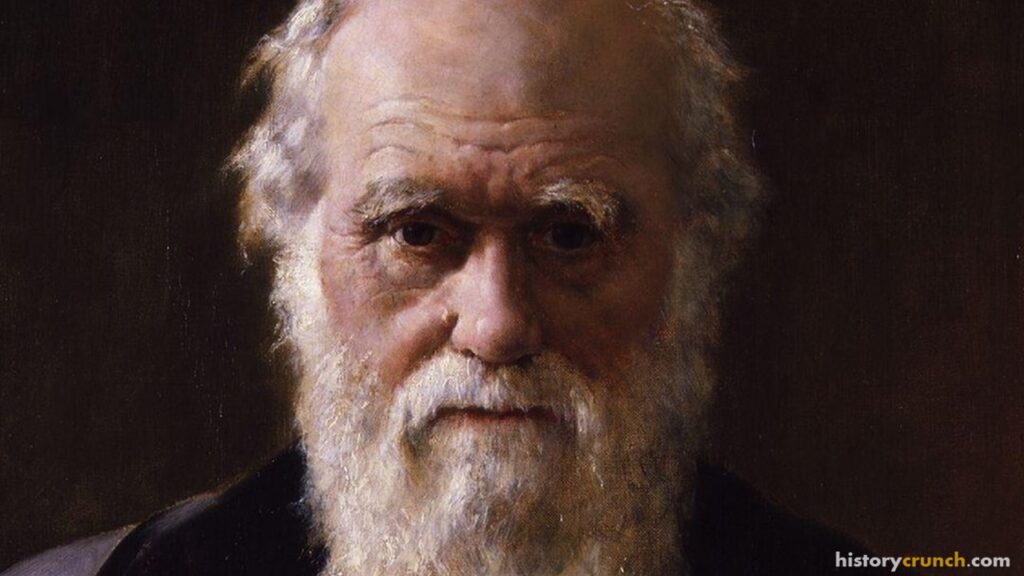
Charles Darwin published On the Origin of Species in 1859 to explain how animal species change. Others applied 'survival of the fittest' to human races, and by 1900 Social Darwinism was being used to argue that some peoples were born to rule and others to disappear.
LEARN MORESHOW LESSwhy it mattersIDEASIt gave racism the costume of science. The Nazis would say that killing the 'unfit' was not cruelty but nature.
Francis Galton, Darwin's cousin, coined the word eugenics in 1883 for the idea of breeding better human beings by encouraging the 'fit' to have children and stopping the 'unfit'. Britain, the United States and Germany all had eugenics movements before 1914; American states passed the first sterilization laws.
LEARN MORESHOW LESSwhy it mattersIDEASGermany did not invent eugenics either. It was the country that practiced it to the end.
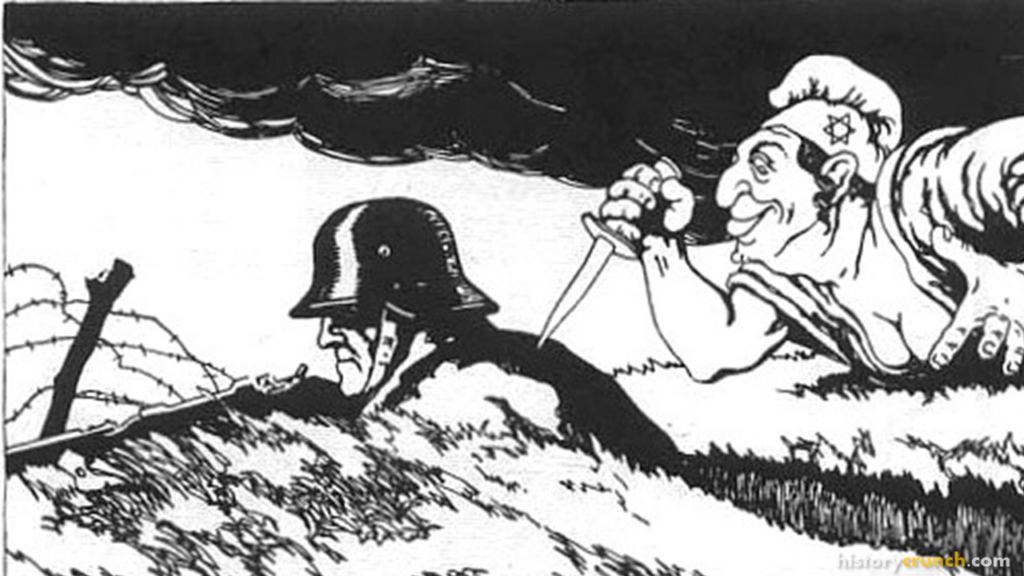
The armistice of November 11th, 1918 came with the German army still on foreign soil, so many Germans never accepted that it had been beaten. The 'stab in the back' myth said Germany had been betrayed at home, and this Austrian postcard from 1919 shows who the myth blamed. About 100,000 German Jews had fought in the war; 12,000 died.
LEARN MORESHOW LESSwhy it matters · key numbersIDEASEvery crisis of the next fifteen years was blamed on the same people. The lie was ready before Hitler was.
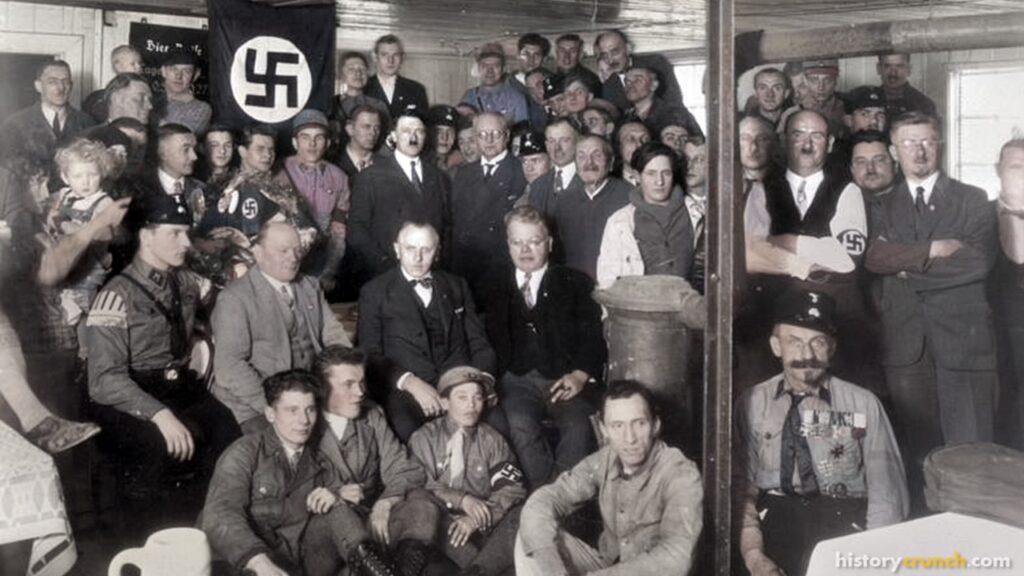
In September 1919 an army corporal named Adolf Hitler, sent to spy on a tiny party in the city of Munich, joined it instead. By 1921 he led it, renamed the National Socialist German Workers' Party, and its 25-point program of 1920 already demanded that no Jew could be a German citizen.
LEARN MORESHOW LESSwhy it matters · 1 key figurePOLITICSFrom its first year the party's aim was to remove the Jews from German life. What changed over twenty years was only how far 'remove' would go.
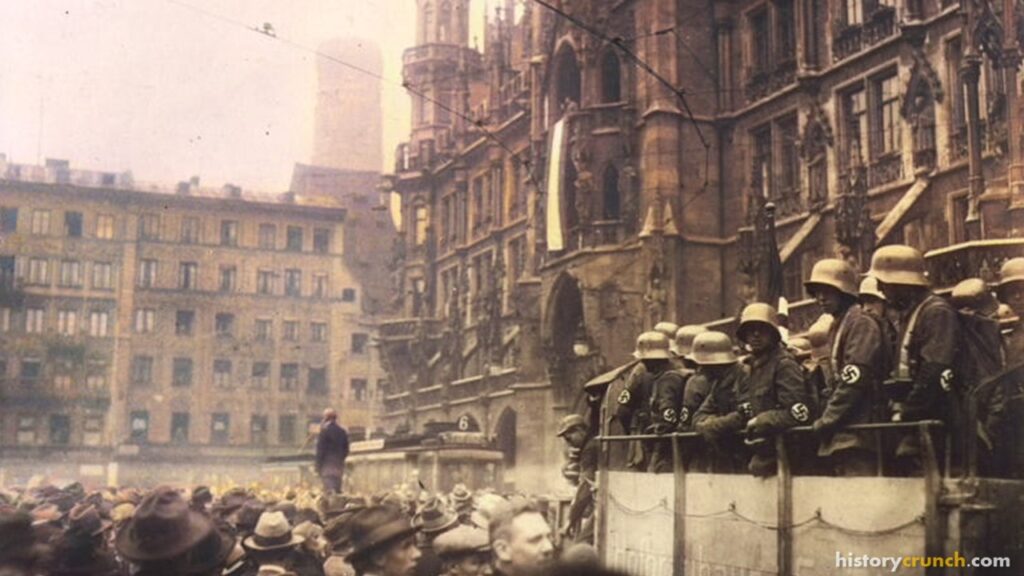
On November 8th and 9th, 1923 Hitler and the SA tried to seize power in Munich. Police fired on the march; sixteen Nazis died. Hitler was tried for treason, used the courtroom to make speeches, and served nine months of a five-year sentence in comfortable rooms at Landsberg, where he dictated Mein Kampf.
LEARN MORESHOW LESSwhy it mattersPOLITICSHe learned that power had to be won by votes, not guns. The next ten years were spent doing exactly that.
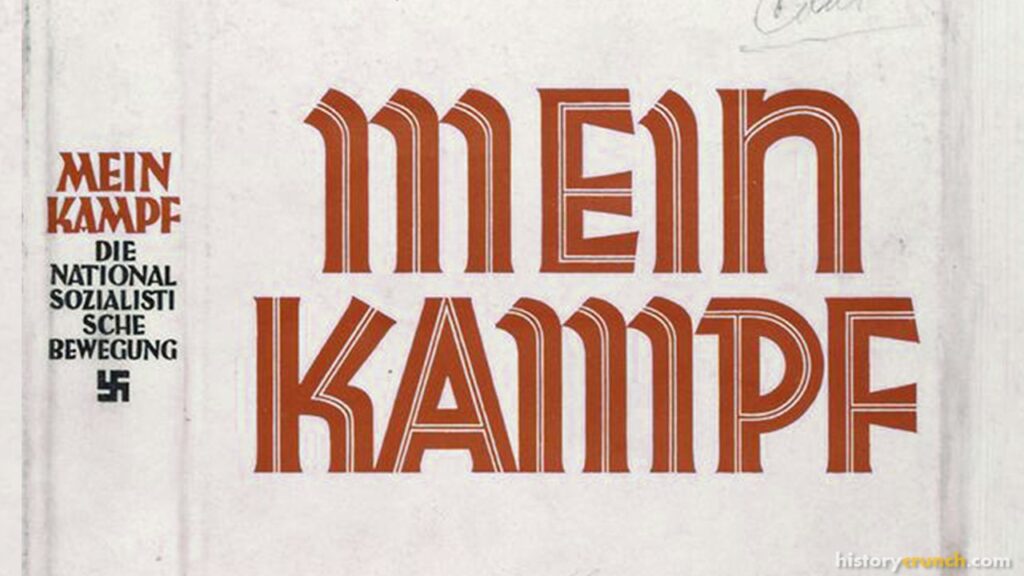
The first volume of Mein Kampf ('My Struggle') appeared in July 1925. It set out everything the regime would later do: anti-Semitism, anti-communism, the Aryan master race, and lebensraum, living space to be taken in the east. It called the Jews a bacillus and a poison. By 1945 about ten million copies were in German homes.
LEARN MORESHOW LESSwhy it matters · a sourceIDEASNobody could say they had not been told. The plan was in print eight years before Hitler took power.
IN THEIR OWN WORDS“If at the beginning of the war and during the war twelve or fifteen thousand of these Hebrew corrupters of the people had been held under poison gas…”
Adolf Hitler, Mein Kampf, volume 2, 1926WHAT TO NOTICERead in 1926 as a rant about the First World War. Read after 1942, it is something else.
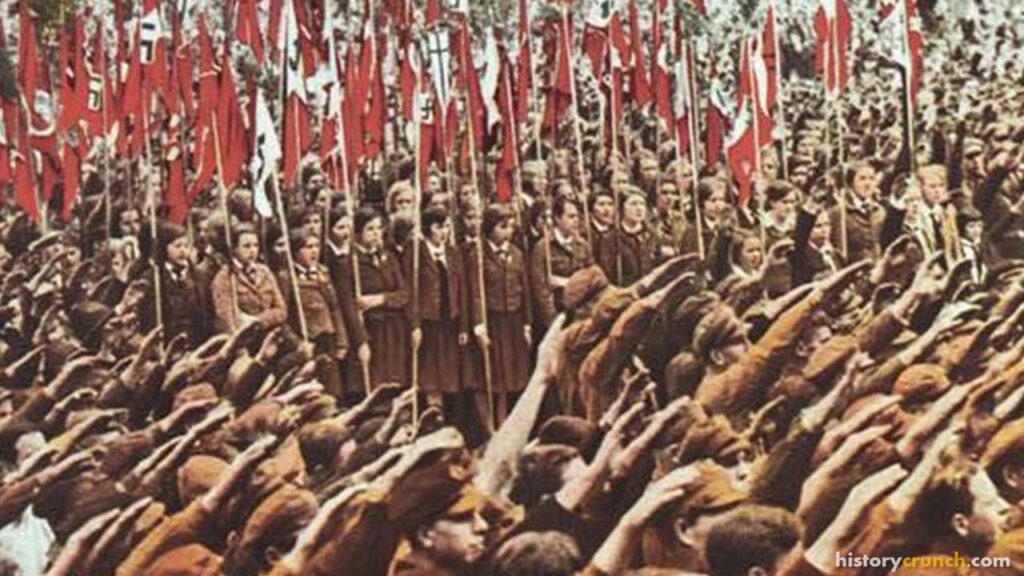
Founded in July 1926 to raise 'Aryan supermen', the Hitler Youth put marching and rifle drill before schoolwork and taught children to report their own parents and teachers. From December 1936 it was the only youth group allowed; from March 1939 membership was compulsory. By then it had about eight million members.
LEARN MORESHOW LESSwhy it matters · key numbersPOLITICSA generation was raised to see Jews as vermin before it was old enough to vote. Many of the camp guards of 1944 had joined at ten.
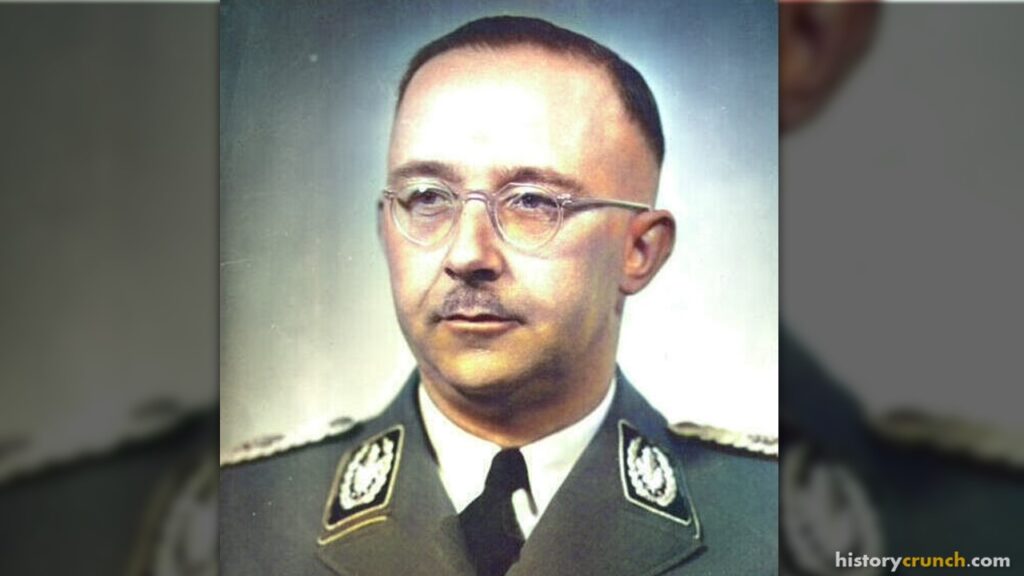
On January 6th, 1929 Heinrich Himmler, a failed chicken farmer of 28, became Reichsfuhrer of the SS, then 290 men who guarded Hitler at rallies. He screened recruits for 'racial purity', separated the SS from the SA, and built it into an organization of a million that would run the police, the camps and the death squads.
LEARN MORESHOW LESSwhy it matters · key numbers · 1 key figurePOLITICSEvery part of the machinery of the Holocaust, from the Gestapo to Auschwitz, would answer to this man.
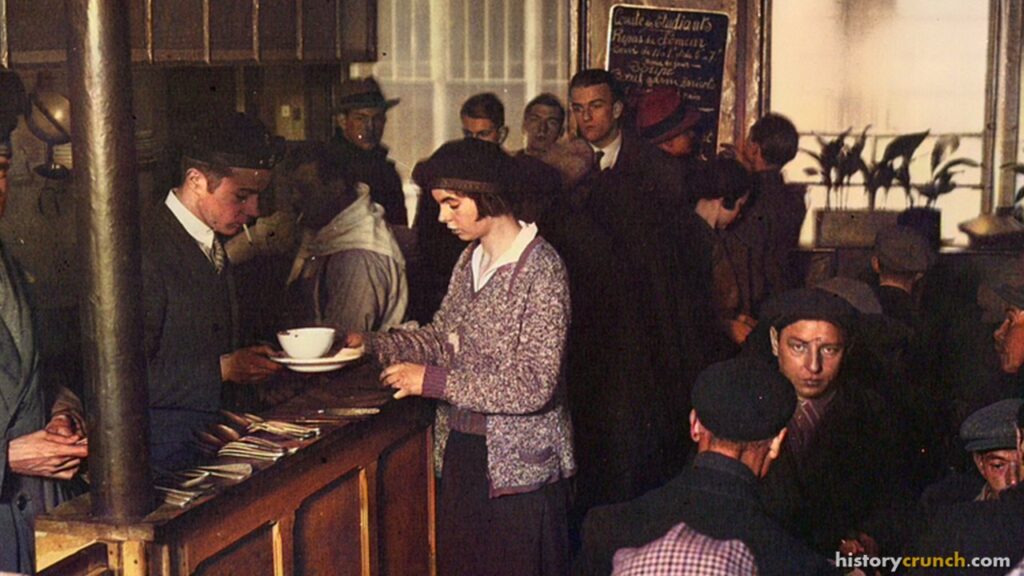
The Wall Street crash of October 1929 pulled the American loans out of Germany. By 1932 six million Germans, one worker in three, had no job. Hitler and Joseph Goebbels blamed the Jews in speech after speech, and the Nazi vote went from 2.6 percent in 1928 to 37 percent in July 1932, the largest party in the Reichstag, the German parliament.
LEARN MORESHOW LESSwhy it matters · key numbersPOLITICSAnti-Semitism had always grown in hard times. This was the hardest time Germany had known, and the party that offered someone to blame won.
Six years in which a modern state, step by legal step, turned its Jewish citizens into outcasts, and tested at each step whether anyone would stop it. The first camp opened seven weeks after Hitler took office, for Germans who objected. The boycott, the civil service law and the book burning came in the first four months; the sterilization law that summer; the Nuremberg Laws in 1935. The persecution was hidden for the Olympics and resumed when the visitors left. In 1938 Austria's Jews were attacked in a week, the world's governments met at Evian and declined to help, and on one night in November the synagogues burned. The Jews were then fined for the damage.
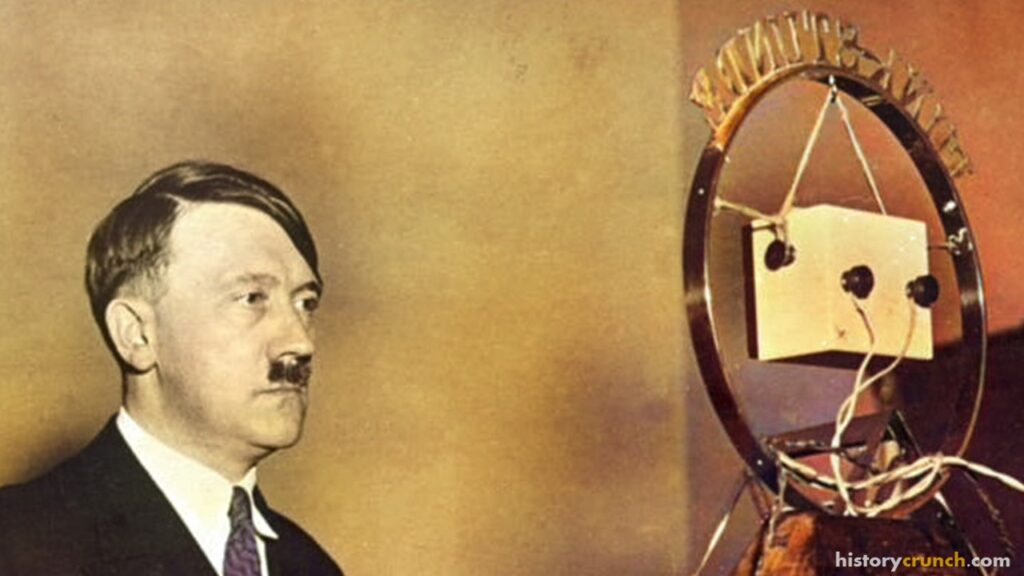
On January 30th, 1933 President Paul von Hindenburg appointed Hitler Chancellor of a coalition government, believing he could be controlled. Joseph Goebbels organized a torch-lit parade of tens of thousands of SA men through Berlin that night. Germany then had about 525,000 Jews, less than one percent of its population.
LEARN MORESHOW LESSwhy it matters · key numbers · 1 key figurePOLITICSThe Holocaust is usually dated from this day. It did not begin with murder; it began with a legal appointment.
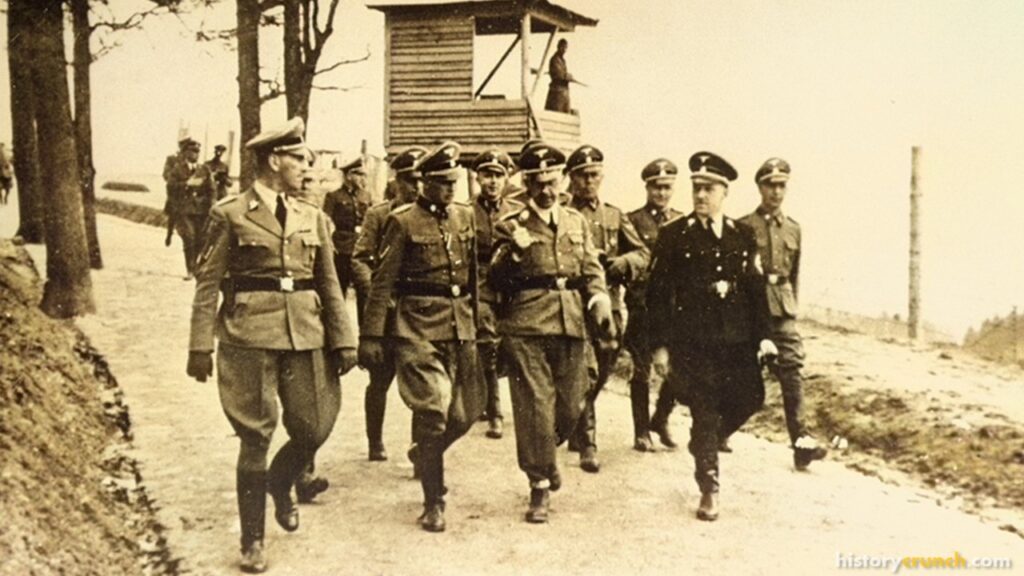
On March 22nd, 1933, seven weeks after Hitler took office, Himmler opened the first concentration camp in a disused munitions factory at Dachau near the city of Munich, for communists and other political prisoners. It became the model and the training school for every camp that followed, and it ran for twelve years, until April 29th, 1945.
LEARN MORESHOW LESSwhy it mattersCAMPSThe camp system began before the war and before the Jews were its main target. It was built to hold anyone the regime disliked.
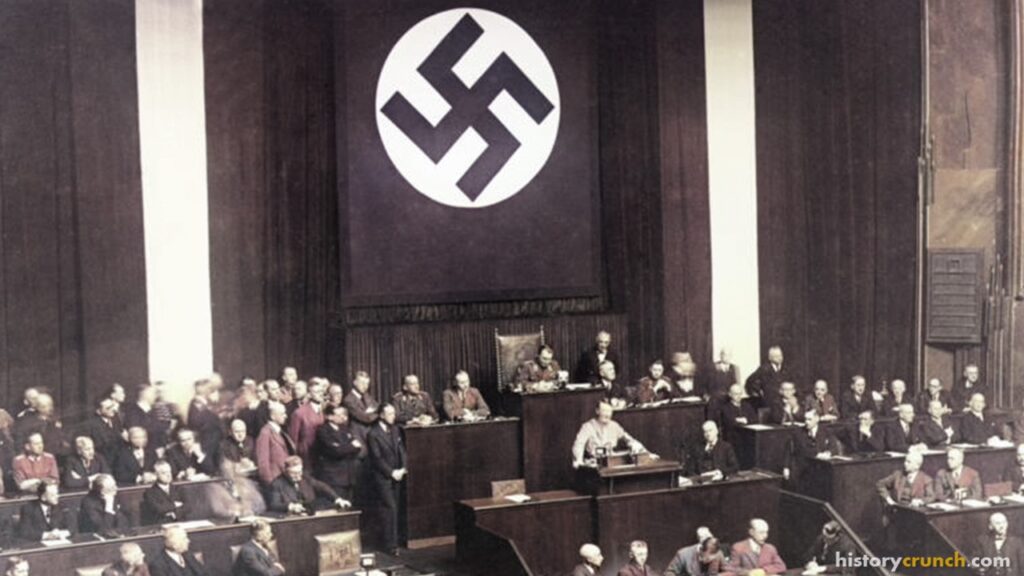
On March 23rd, 1933, with SA men lining the hall, the Reichstag voted Hitler the power to make laws without it. Within four months every other party was banned and the trade unions dissolved. Judges, police and civil servants now served a government that no court or parliament could check.
LEARN MORESHOW LESSwhy it mattersPOLITICSEverything that follows was legal, because from this day the regime wrote the law. There was no one left to say no.
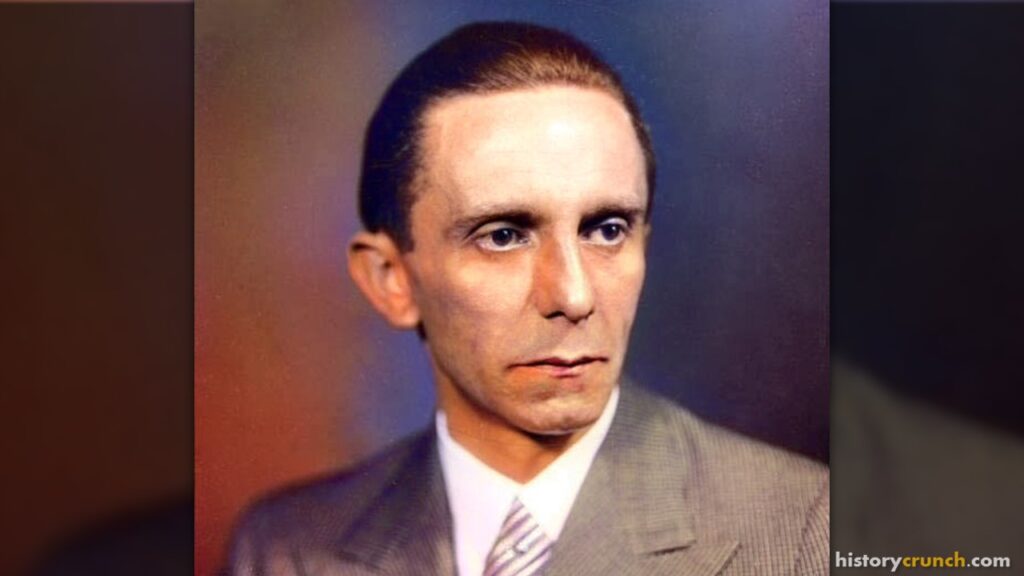
On April 1st, 1933 SA men stood outside Jewish-owned shops, law offices and surgeries across Germany with signs telling Germans not to buy from Jews, and painted stars of David on the windows. It was the regime's first nationwide action against the Jews. On April 7th a new law expelled Jews from the civil service, and the universities and courts followed.
LEARN MORESHOW LESSwhy it matters · 1 key figurePERSECUTIONStep one was economic: take away the living. The pattern of the next six years was set in the first ten weeks.
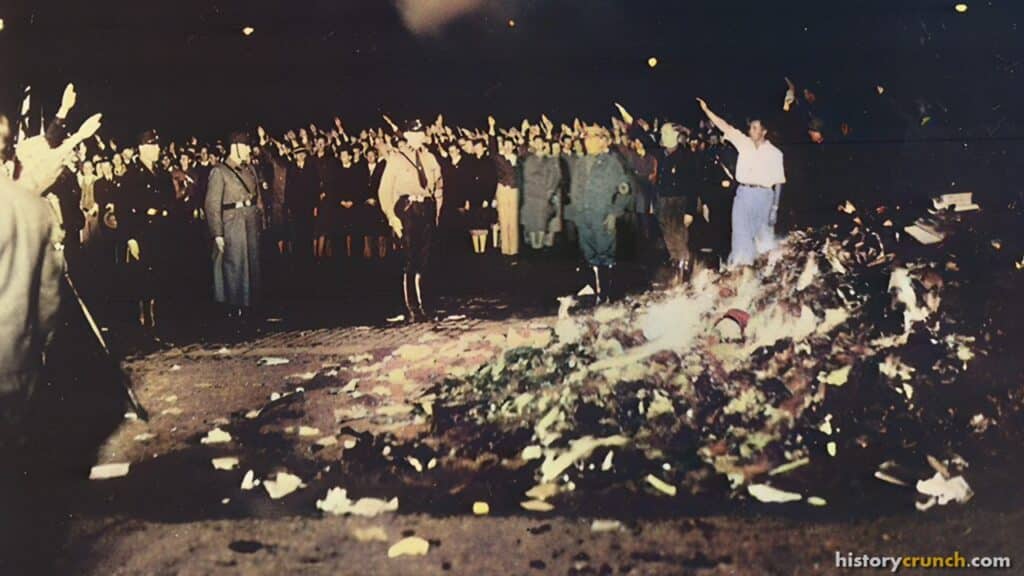
On the night of May 10th, 1933 students in Berlin and thirty other university towns threw about 25,000 books by Jewish, liberal and left-wing authors onto bonfires while Joseph Goebbels spoke. Einstein, Freud, Thomas Mann, Helen Keller and Erich Maria Remarque were among the authors burned.
LEARN MORESHOW LESSwhy it matters · a sourcePERSECUTIONA century earlier the poet Heinrich Heine, himself a German Jew, had written that where books are burned, in the end people are burned too. His books were on the fire.
IN THEIR OWN WORDS“Where they burn books, they will in the end burn people too.”
Heinrich Heine, in his play Almansor, 1821WHAT TO NOTICEHeine was writing about the burning of the Quran in medieval Spain. His line is now carved into the pavement at the Berlin site.
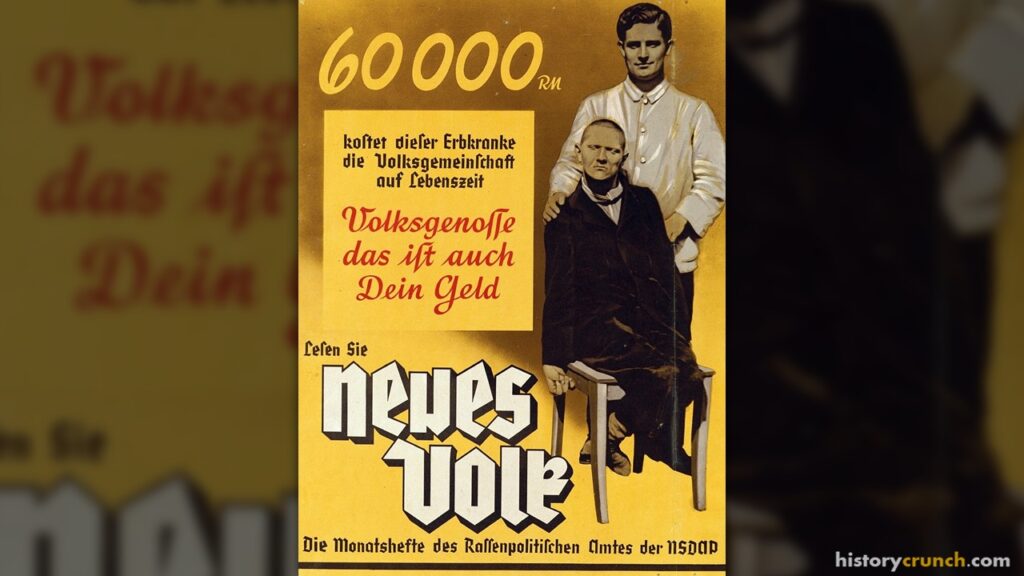
The Law for the Prevention of Hereditarily Diseased Offspring of July 14th, 1933 ordered forced sterilization for people with conditions from schizophrenia and epilepsy to blindness, deafness, 'feeble-mindedness' and alcoholism. Special Hereditary Health Courts heard the cases. About 400,000 Germans were sterilized under it, and several thousand died from the operations.
LEARN MORESHOW LESSwhy it matters · key numbersPERSECUTIONThe regime's first victims were not Jews but disabled Germans. The doctors who ran these courts would run the euthanasia program in 1939.
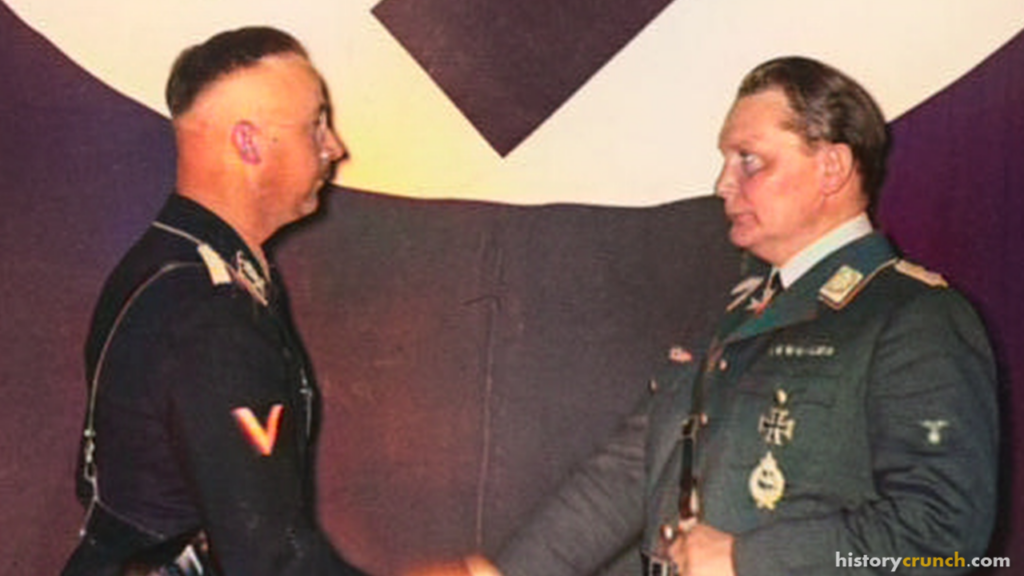
On April 20th, 1934 Goering handed the Gestapo, the secret state police he had founded in Prussia a year earlier, to Himmler. The SS now controlled the camps and the police that filled them. A 1936 law put the Gestapo outside the courts: no judge could review an arrest or a sentence of 'protective custody'.
LEARN MORESHOW LESSwhy it matters · 2 key figuresPOLITICSA police force nobody could question, run by the man who ran the camps. Fear did the rest; the Gestapo never had more than 16,000 officers for 66 million Germans, and relied on neighbors informing.
Announced at the party rally in Nuremberg on September 15th, 1935, two laws stripped German Jews of their rights. The Reich Citizenship Law made them subjects rather than citizens; the Law for the Protection of German Blood and German Honor banned marriage and relationships between Jews and 'persons of German blood'. A November decree defined a Jew by grandparents, not by belief, so that Christians with Jewish grandparents were caught too.
LEARN MORESHOW LESSwhy it matters · a sourcePERSECUTIONPersecution now had a legal definition of who was a Jew. Every later step, from the yellow star to the deportation lists, used it.
IN THEIR OWN WORDS“Marriages between Jews and subjects of the state of German or related blood are forbidden.”
Law for the Protection of German Blood and German Honor, Article 1, September 15th, 1935
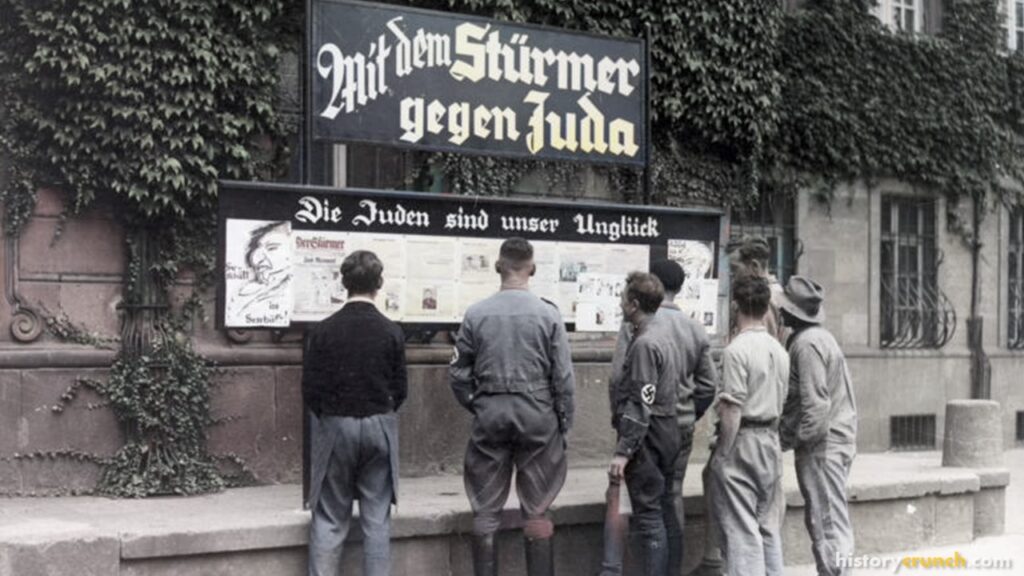
Julius Streicher's weekly Der Sturmer ('The Stormer') was displayed in glass cases in towns across Germany by 1935, where anyone walking past could read it. It printed cartoons of Jews as vermin, poisoners and child-murderers under the slogan 'The Jews are our misfortune', and sold up to 480,000 copies a week. Streicher was hanged after the Nuremberg trials in 1946 for it.
LEARN MORESHOW LESSwhy it matters · key numbersPERSECUTIONTen years of this, in every town, made the unthinkable ordinary. The Nuremberg judges ruled that words alone could be a crime against humanity.
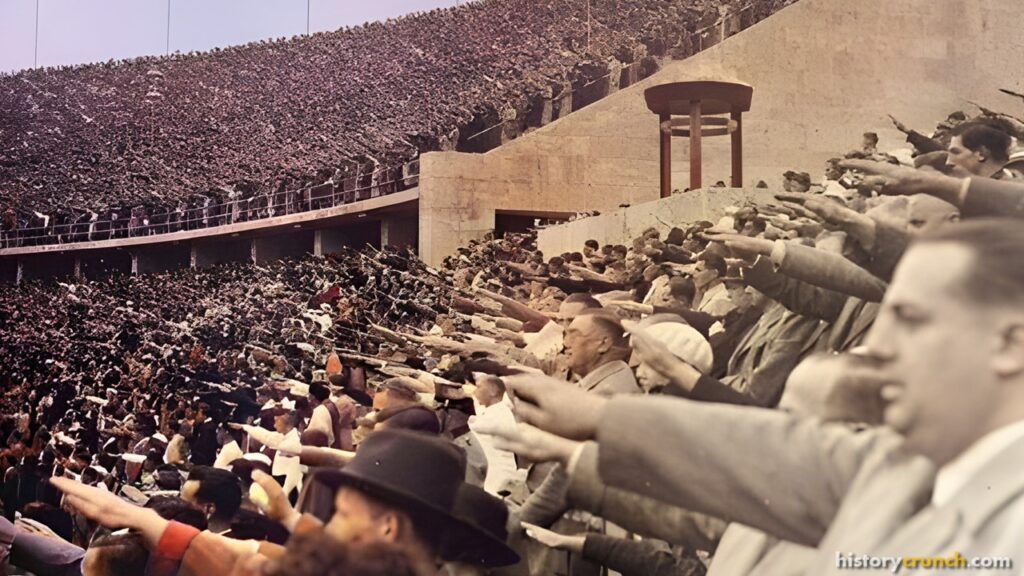
For the Berlin Olympics of August 1936 the 'Jews not wanted' signs came down, Der Sturmer left the display cases, and the arrests paused. Foreign visitors, including American journalists, went home saying the stories had been exaggerated. When the visitors left the signs went back up.
LEARN MORESHOW LESSwhy it mattersPERSECUTIONThe regime knew exactly what the world would object to, and knew how briefly it needed to hide it.
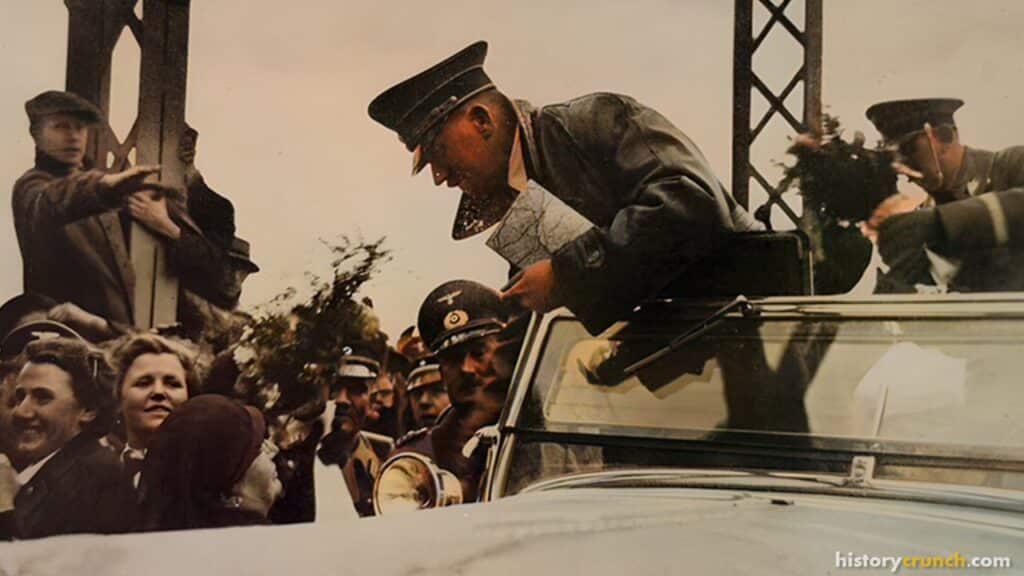
Germany absorbed Austria on March 13th, 1938. Vienna's 185,000 Jews were beaten, robbed and made to scrub pavements on their knees within days; five years of German persecution was repeated in five months. Adolf Eichmann set up a Central Office for Jewish Emigration in Vienna that stripped Jews of their property and pushed them out of the country.
LEARN MORESHOW LESSwhy it matters · key numbersPERSECUTIONEichmann's Vienna office was the model: process people like paperwork. He would use the same system to deport them in 1941.
At President Franklin Roosevelt's suggestion, delegates from 32 countries met at Evian in France from July 6th to 15th, 1938 to discuss the Jewish refugees. Almost every country explained why it could take no more; only the Dominican Republic offered to. The Nazi newspapers reported with satisfaction that nobody else wanted the Jews either.
LEARN MORESHOW LESSwhy it matters · a debateWORLDBetween 1933 and 1939 the question was still emigration. Evian showed the Jews of Germany that there was nowhere to go.
Could the world have saved Germany's Jews in 1938?
Yes. The regime still wanted them gone, not dead; the numbers, about 300,000 by 1938, were small; and every country at Evian had room.
Partly. The Depression, immigration laws and anti-Semitism at home made large-scale rescue politically impossible, and no one in 1938 imagined murder.
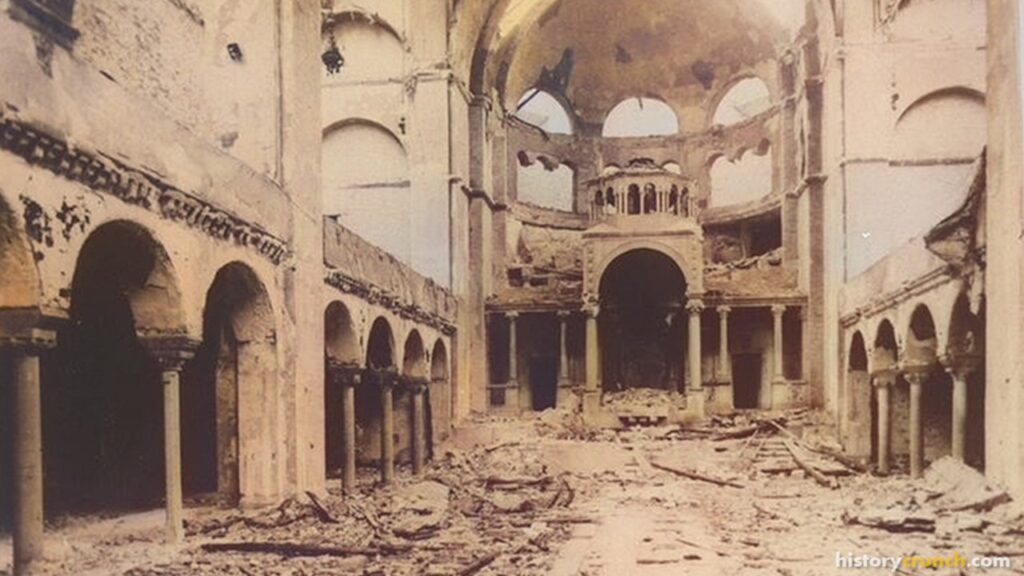
On the night of November 9th to 10th, 1938, after a Jewish teenager shot a German diplomat in Paris, SA men and party members across Germany and Austria burned more than 1,400 synagogues, smashed 7,500 Jewish shops and killed 91 people. Some 30,000 Jewish men were sent to the camps at Dachau, Buchenwald and Sachsenhausen. The broken shop glass gave it its name, the Night of Broken Glass.
LEARN MORESHOW LESSwhy it matters · key numbersPERSECUTIONThis was the shift from discrimination to violence, in public, with the police watching. Nobody in Germany could pretend afterwards not to know.
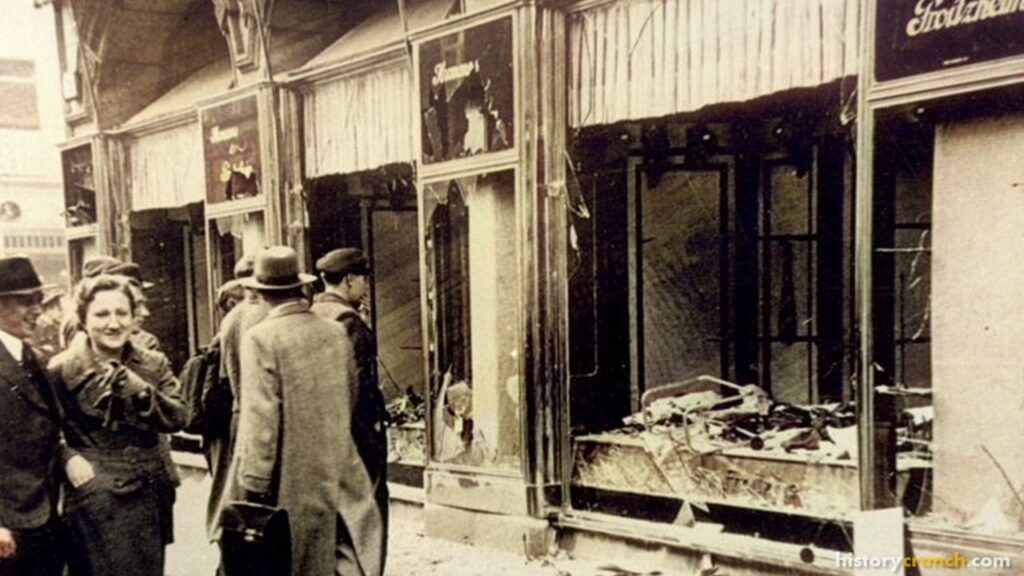
On November 12th, 1938 Hermann Goering fined the Jewish community one billion Reichsmarks for Kristallnacht, seized their insurance payouts for the state, and ordered Jews out of German economic life altogether: no shops, no trades, no jobs. By the end of the month Jewish children were expelled from German schools and Jews were barred from theaters, cinemas and swimming pools.
LEARN MORESHOW LESSwhy it matters · key numbers · 1 key figurePERSECUTIONThe victims paid for the attack on them. By the end of 1938 a German Jew could not earn, learn or go out, and the regime's own word for what was left was 'emigration'.
The first train of Jewish children from Germany reached Harwich in England on December 2nd, 1938. Over the next nine months Britain took in nearly 10,000 children under seventeen, without their parents, who mostly did not survive to see them again. About 150,000 of Germany's Jews had emigrated by 1938; the Kristallnacht attack on the synagogues sent another 100,000 in the year that followed.
LEARN MORESHOW LESSwhy it matters · key numbersRESISTANCEThe world would take children and not their parents. Most of the parents were murdered within five years.
The war gave the regime three million Polish Jews and then the Jews of the Soviet Union, and a war to hide the killing in. The first victims of the gas were disabled Germans, in 1939. The Jews of Poland were marked, then walled into ghettos and starved. In June 1941 the Einsatzgruppen followed the army into the Soviet Union and shot half a million people by the end of the year, 33,771 of them in two days at Babi Yar. In the autumn Zyklon B was tested at Auschwitz, the deportation trains began to run from Germany, and the first camp built only to kill opened at Chelmno.
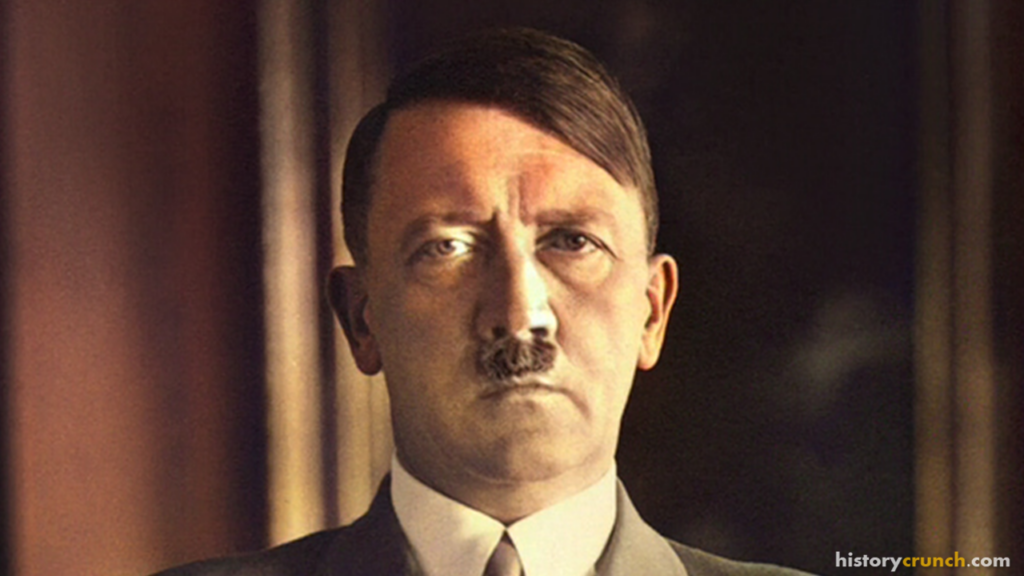
In a speech to the Reichstag, the German parliament, on January 30th, 1939, the sixth anniversary of his taking power, Hitler said that if 'international Jewry' plunged the nations into another world war, the result would not be the victory of the Jews but 'the annihilation of the Jewish race in Europe'. He quoted the line back proudly in 1942, when it was being carried out.
LEARN MORESHOW LESSwhy it matters · a source · 1 key figureIDEASHe said it in public, on the radio, seven months before the war. Historians argue over whether it was a plan or a threat; either way, it was the outcome.
IN THEIR OWN WORDS“…the result will not be the Bolshevization of the earth, and thus the victory of Jewry, but the annihilation of the Jewish race in Europe.”
Adolf Hitler, Reichstag speech, January 30th, 1939
On May 13th, 1939 the liner St. Louis left Hamburg for Havana with 937 Jewish refugees who had bought Cuban landing permits. Cuba canceled the permits; the United States and Canada refused to take the ship. It sailed back to Europe in June, and Britain, France, Belgium and the Netherlands each took a share. About 250 of the passengers were later murdered in the countries the Germans then overran.
LEARN MORESHOW LESSwhy it matters · key numbersWORLDThe refugees could see the lights of Miami from the deck. The rules of every safe country said no.
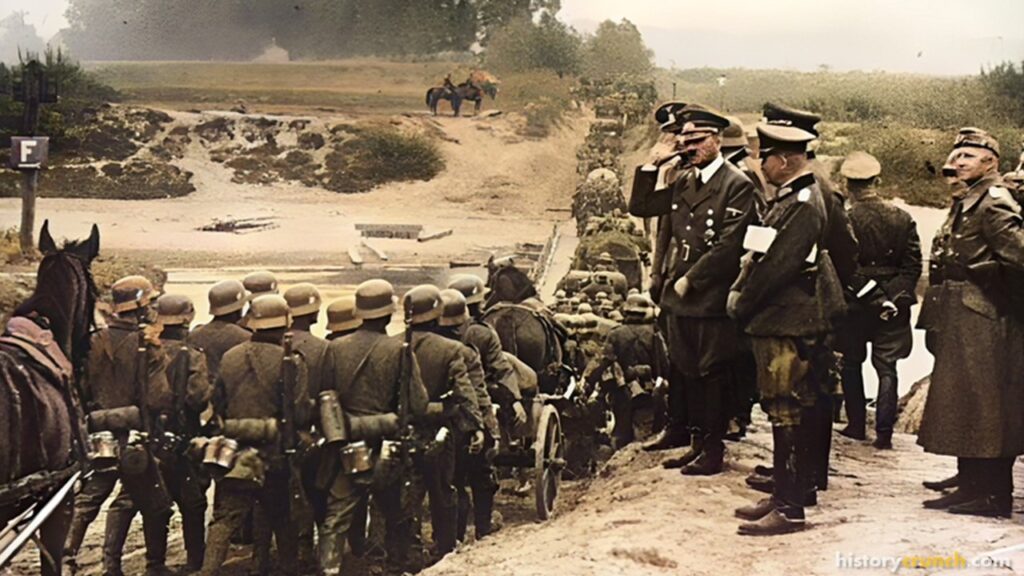
The war began on September 1st, 1939. Within a month Germany controlled the western half of Poland and about two million of its 3.3 million Jews, the largest Jewish population in Europe. Einsatzgruppen followed the army in and shot thousands of Polish priests, teachers, nobles and Jews that autumn. Poland was to be lebensraum, cleared for German settlers.
LEARN MORESHOW LESSwhy it matters · key numbersWORLDBefore the war the regime had 300,000 Jews to get rid of. After it, millions, and a war to hide it in.
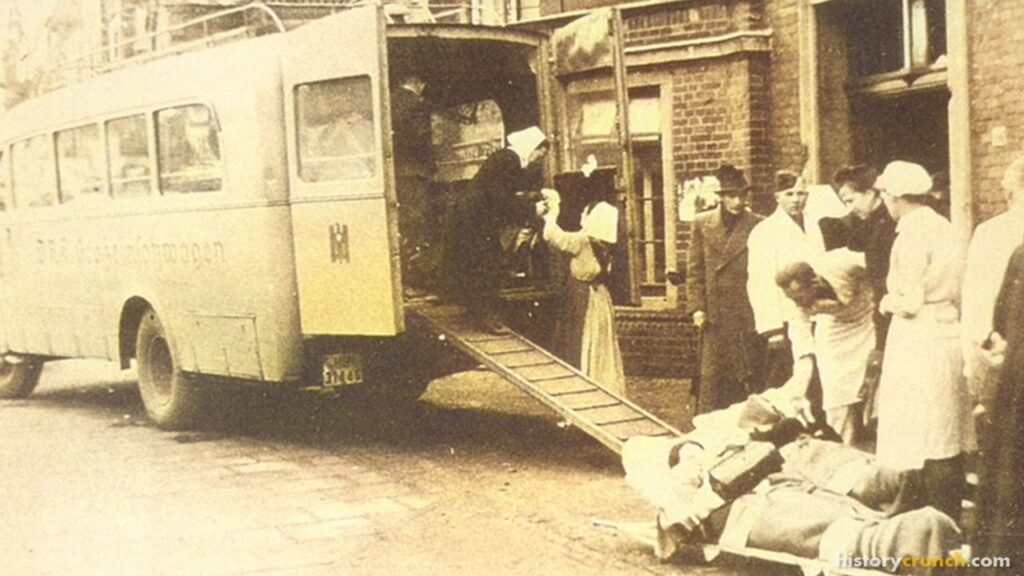
In October 1939 Hitler signed a note on his private letterhead, backdated to September 1st, authorizing doctors to grant a 'mercy death' to patients judged incurable. Under the program, run from an office at Tiergartenstrasse 4 in Berlin and so called T4, doctors condemned patients on paper without seeing them. Buses took the chosen to six killing centers such as Hadamar and Grafeneck, where they were gassed with carbon monoxide in rooms disguised as showers, and families received false death certificates.
LEARN MORESHOW LESSwhy it matters · 1 key figureMURDERThe gas chamber disguised as a shower was invented here, for disabled Germans. The men who built it went on to build the death camps at Belzec, Sobibor and Treblinka.
From November 23rd, 1939 every Jew in occupied Poland over the age of ten had to wear a white armband with a blue Star of David on the right arm. Jewish shops were marked, Jews were barred from trains and pavements, and any German could seize a Jew off the street for labor.
LEARN MORESHOW LESSwhy it mattersPERSECUTIONMarking came before confining. Once every Jew could be identified at a glance, the ghetto walls could go up.
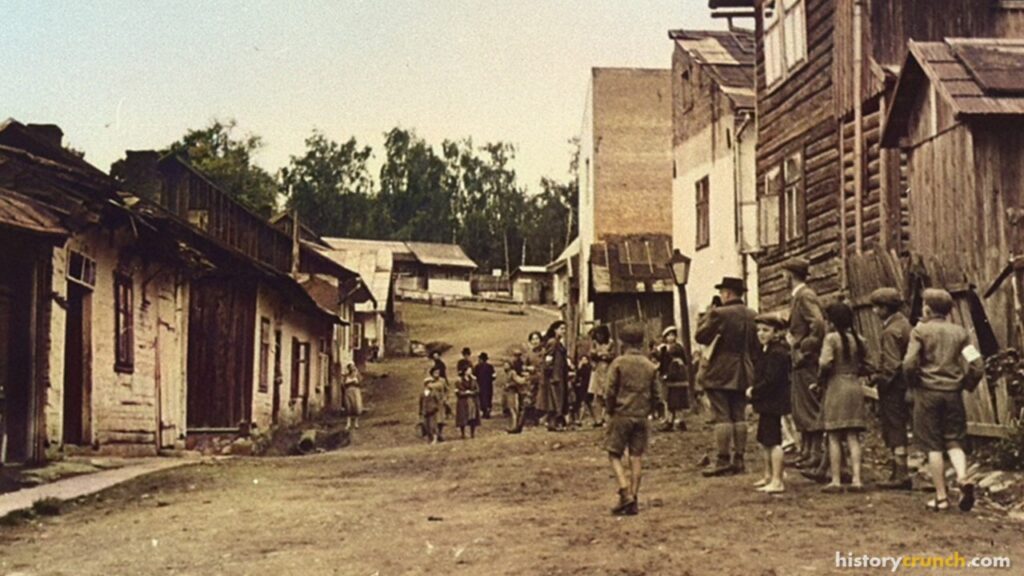
On April 30th, 1940 the ghetto in Lodz, Poland's second city, was sealed with about 160,000 Jews inside four square kilometers of the poorest district, most of it without running water or sewers. It was run as a workshop for the German army and lasted longer than any other, until August 1944. Over 800 ghettos would be set up across occupied Europe.
LEARN MORESHOW LESSwhy it matters · key numbersDEPORTATIONThe ghetto was a holding pen and a labor camp at once. About one in five of Lodz's Jews died inside it before the deportations even began.
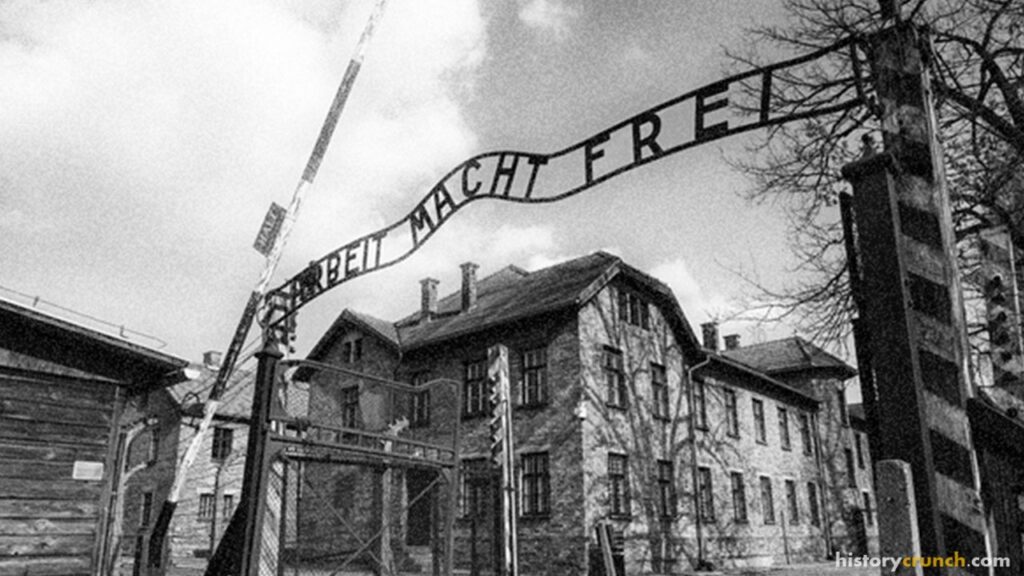
On June 14th, 1940 the first transport, 728 Polish political prisoners, arrived at a converted Polish army barracks at Oswiecim, which the Germans called Auschwitz. The commandant, Rudolf Hoss, had trained at the Dachau camp. The site was chosen for its railway junction. The gate carried the words Arbeit Macht Frei, work sets you free.
LEARN MORESHOW LESSwhy it mattersCAMPSIt opened as a prison for Poles. In five years it became the largest killing site in human history.
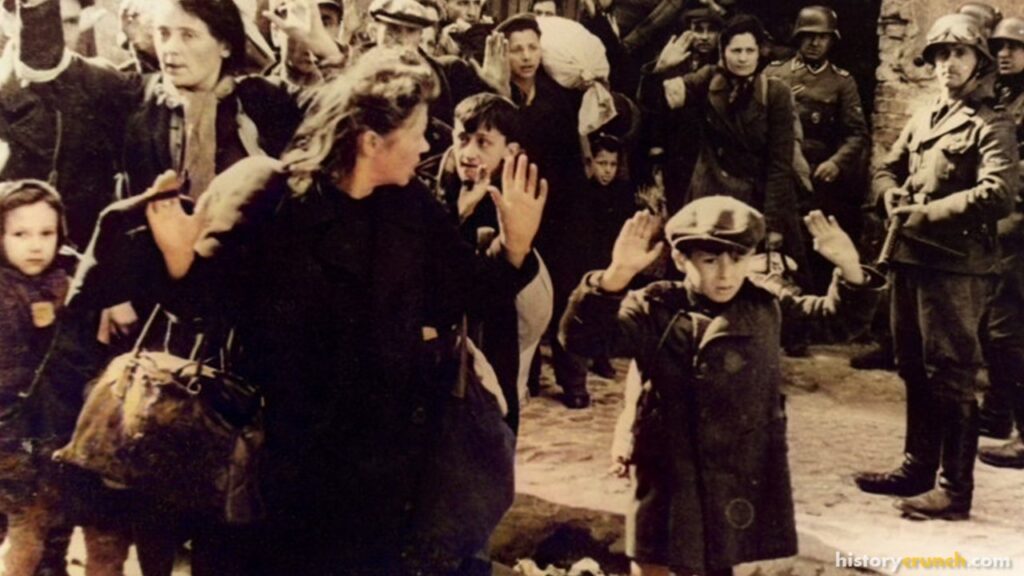
On November 16th, 1940 a three-meter brick wall topped with glass closed around about 400,000 Jews, thirty percent of Warsaw's population, on 2.4 percent of its land. The official ration was about 180 calories a day. Some 83,000 people died inside the walls of hunger and typhus before the deportations to the Treblinka death camp began in 1942.
LEARN MORESHOW LESSwhy it matters · key numbersDEPORTATIONThe largest ghetto in Europe. Children crawled through holes in the wall to smuggle food; the Germans shot them when they caught them.
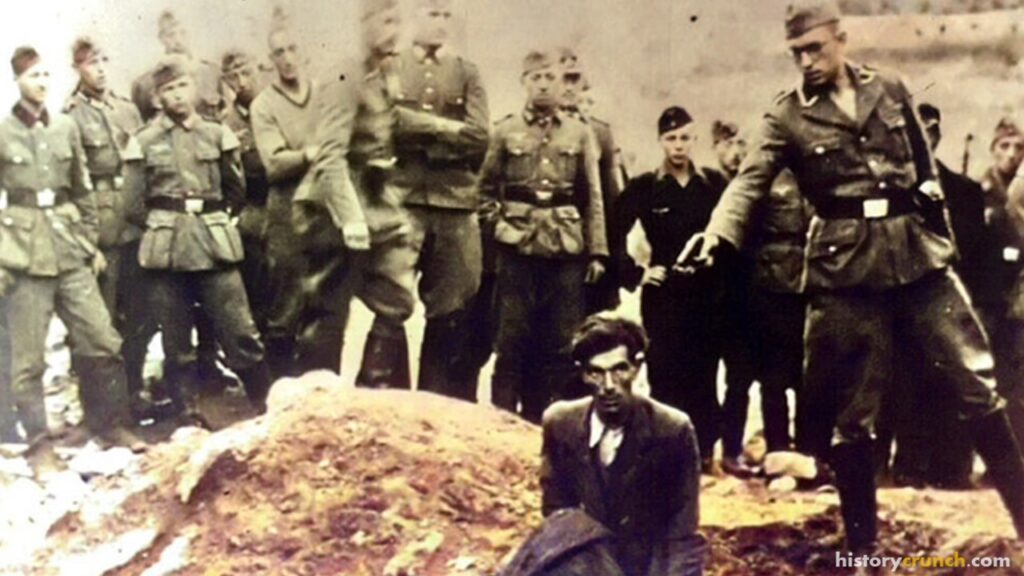
When Germany invaded the Soviet Union on June 22nd, 1941, four Einsatzgruppen of about 3,000 men followed the army with orders to shoot Jews, communist officials and Roma. At first they shot men; by August, women and children too. Helped by police battalions and local collaborators, they had shot about half a million people by the end of 1941 at the edges of pits, and about two million by the end of the war.
LEARN MORESHOW LESSwhy it matters · key numbersMURDERThis is the Holocaust by bullets. Before a single death camp opened, the SS was already murdering thousands a day in the east.
On August 3rd, 1941 Bishop Clemens von Galen of Munster denounced the killing of hospital patients from his pulpit and named the killing centers. Copies of the sermon were passed hand to hand and dropped by the RAF. On August 24th Hitler halted the official program, after about 70,000 deaths. The killing went on quietly in hospitals until 1945, by starvation and injection, and the T4 staff were sent to Poland to build death camps.
LEARN MORESHOW LESSwhy it matters · key numbers · a sourceRESISTANCEPublic protest worked, once, when the victims were German. Nobody in Germany protested for the Jews in the same way.
IN THEIR OWN WORDS“Are you, am I, only free to live so long as we are productive?”
Bishop Clemens von Galen, sermon at Munster, August 3rd, 1941
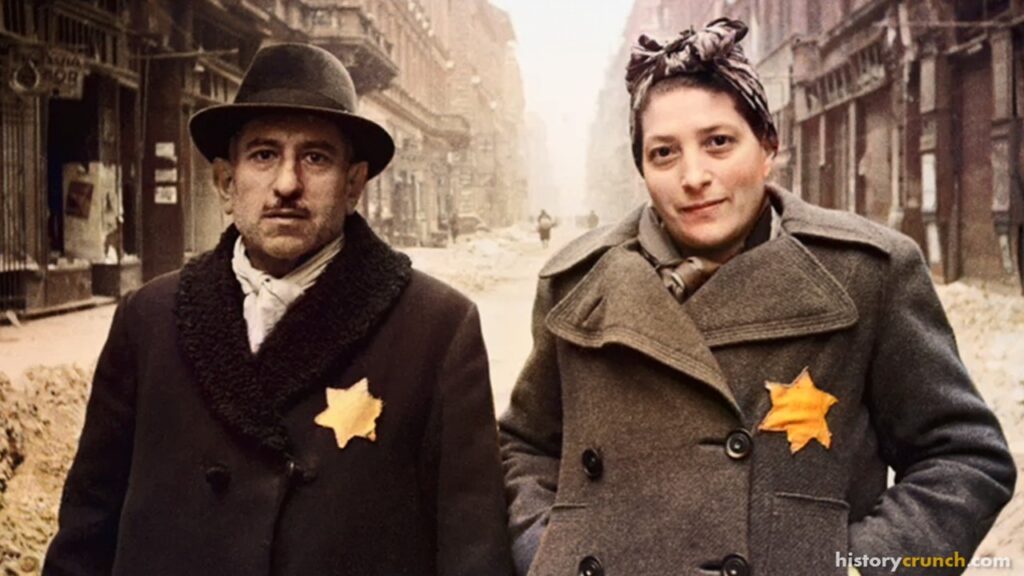
From September 1st, 1941 every Jew in Germany over the age of six had to wear a yellow six-pointed star marked 'Jude' sewn onto the left breast of their clothing, bought with their own ration points. The Netherlands, France and Belgium followed in 1942. It was the last step before deportation, which began six weeks later.
LEARN MORESHOW LESSwhy it mattersPERSECUTIONThe star made a Jew visible to every policeman and every neighbor. It was the deportation list, worn.
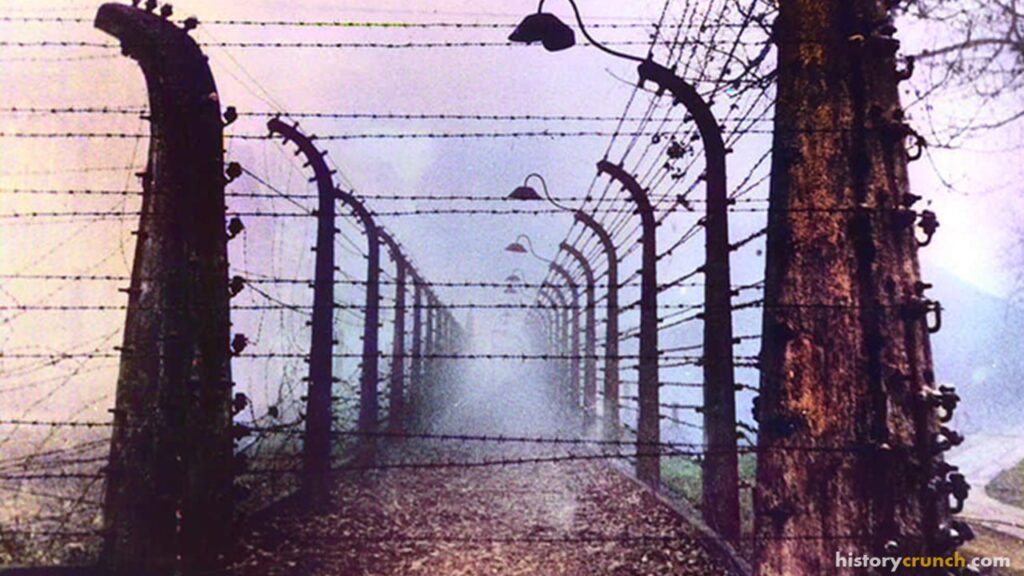
In early September 1941 SS men at Auschwitz sealed about 600 Soviet prisoners of war and 250 sick prisoners in the cellar of Block 11 and threw in Zyklon B, a cyanide pesticide used to fumigate the barracks. It killed them all overnight. Hoss had found a method faster than carbon monoxide, and his camp had a chemical supplier.
LEARN MORESHOW LESSwhy it mattersMURDERA pesticide for lice became the instrument for a million murders. The test was on Soviet soldiers, whose deaths nobody counted.
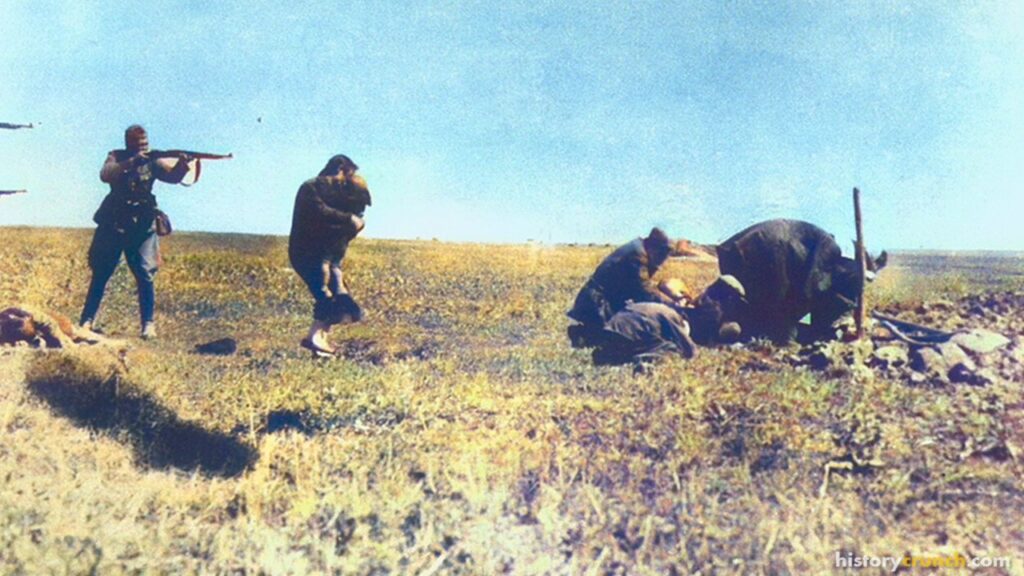
On September 29th and 30th, 1941, ten days after taking Kiev, Einsatzgruppe C and Ukrainian auxiliary police shot 33,771 Jews in a ravine outside the city called Babi Yar. The victims had been ordered to report for resettlement with their documents and valuables. They were made to undress and lie face down on those already shot. It is the largest single massacre of the Holocaust.
LEARN MORESHOW LESSwhy it matters · key numbersMURDERTwo days, one ravine, 33,771 people. The number is exact because the shooters reported it to Berlin.
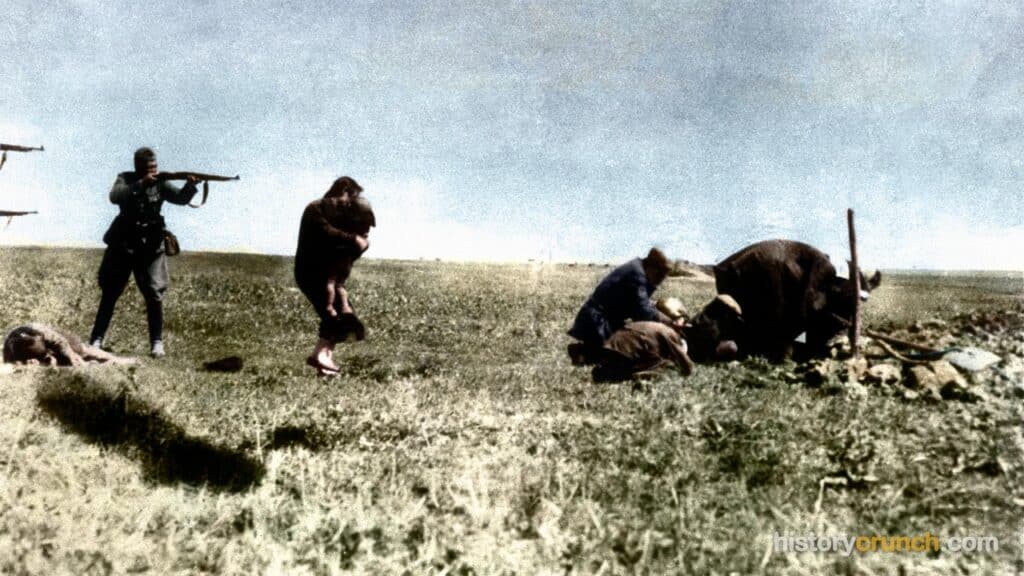
On October 15th, 1941 the first trains of German Jews left Berlin, Vienna and Prague for the Lodz ghetto, a thousand people to a train. Adolf Eichmann's department in the Gestapo, the secret police, section IV B4, wrote the timetables and the Reich Railways charged a group fare. Emigration was banned a week later, on October 23rd. There was now no way out of Germany.
LEARN MORESHOW LESSwhy it matters · 1 key figureDEPORTATIONThe regime had spent eight years trying to push the Jews out. From this month it was pulling them in, to be killed.
On December 8th, 1941 killing began at Chelmno, fifty kilometers from Lodz, where Jews and Roma from the ghetto were loaded into the backs of sealed vans and killed with the exhaust as the vans drove to a forest. About 150,000 people died there. It was the first place built only to kill, and it was working six weeks before the Wannsee Conference.
LEARN MORESHOW LESSwhy it matters · key numbersMURDERThe industrial murder of the Jews did not start with a decision in a villa. It started in a truck.
Fifteen men in a villa, four camps built only to kill, and the two deadliest years in Jewish history. Wannsee in January 1942 organized what had already begun. Belzec, Sobibor and Treblinka, built by the staff of the euthanasia program, killed 1.7 million people in twenty months with fewer than 150 SS men between them. Auschwitz opened four crematoria that could kill and burn 4,400 people a day. The Warsaw Ghetto was emptied into Treblinka in eight weeks, and the survivors fought for twenty-eight days. Prisoners rose at Treblinka and at Sobibor, and the SS answered by shooting 42,000 people in two days.
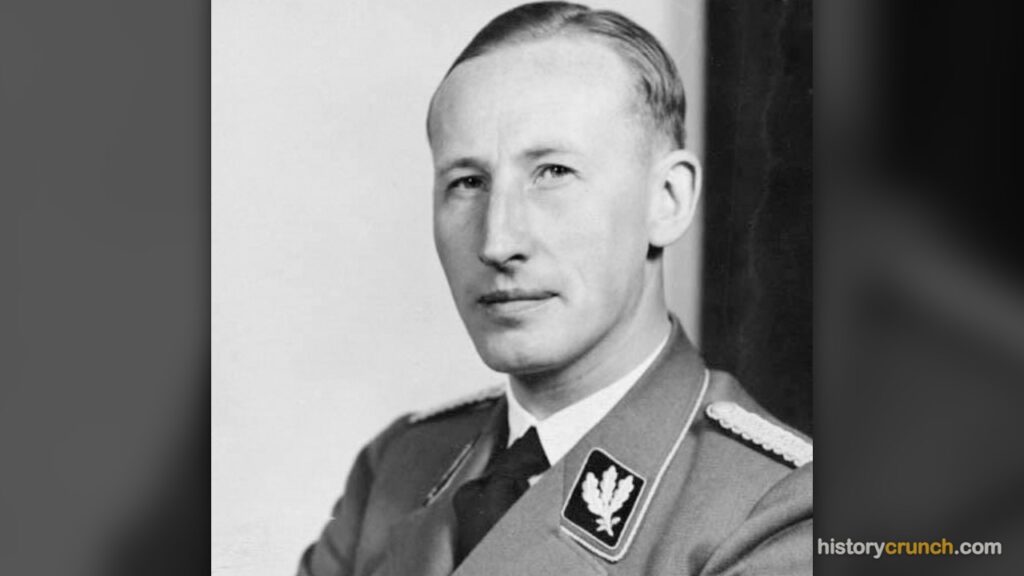
On January 20th, 1942 Reinhard Heydrich, Heinrich Himmler's deputy, chaired a ninety-minute meeting of fifteen senior officials at a villa on Lake Wannsee outside Berlin to coordinate the 'final solution of the Jewish question'. The minutes, taken by Adolf Eichmann, listed eleven million Jews country by country, including those of Britain and neutral Ireland, and spoke of 'evacuation to the east'. Eight of the fifteen men had doctorates.
LEARN MORESHOW LESSwhy it matters · key numbers · a sourcePOLITICSNot the decision to kill, which had been taken, but the moment the whole German state was told to join in. The one surviving copy of the minutes is the clearest document of the Holocaust.
IN THEIR OWN WORDS“Europe will be combed through from west to east.”
Minutes of the Wannsee Conference, January 20th, 1942
Belzec began gassing on March 17th, 1942, the first of the three Operation Reinhard camps built by the T4 euthanasia staff in eastern Poland to kill the Jews of the Polish ghettos. Victims were gassed with engine exhaust within hours of arrival. About 434,000 people were murdered there in nine months. Of all who entered, two are known to have survived.
LEARN MORESHOW LESSwhy it matters · key numbersMURDERBelzec was not a camp. There were no barracks for prisoners, because nobody was meant to live past the afternoon.
Sobibor began operating in May 1942 in a forest beside a railway in eastern Poland. Some 170,000 people were murdered there with engine exhaust. The camp was so small and the process so practiced that a transport could be emptied, undressed, gassed and buried in about two hours. Jews from the Netherlands, France and Slovakia were sent there as well as from Poland.
LEARN MORESHOW LESSwhy it matters · key numbersMURDERThree camps, fewer than 150 SS men in all, and 1.7 million dead in twenty months. The system needed almost no one.
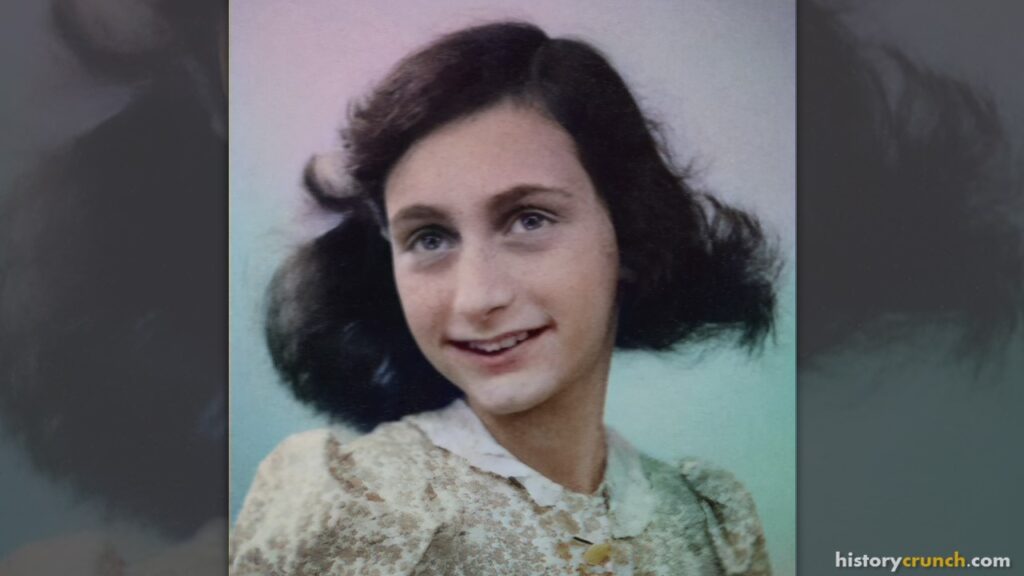
On July 6th, 1942, three weeks after her thirteenth birthday and the day after her sister Margot was ordered to report for a labor camp, Anne Frank and her family moved into rooms hidden behind a bookcase at her father's business on the Prinsengracht in Amsterdam. Four more people joined them. Six of Otto Frank's employees kept them fed for two years. Anne had been keeping a diary since June 12th.
LEARN MORESHOW LESSwhy it matters · 1 key figureLIFEThe most read account of the Holocaust was written by a girl who never saw a camp until the last seven months of her life.
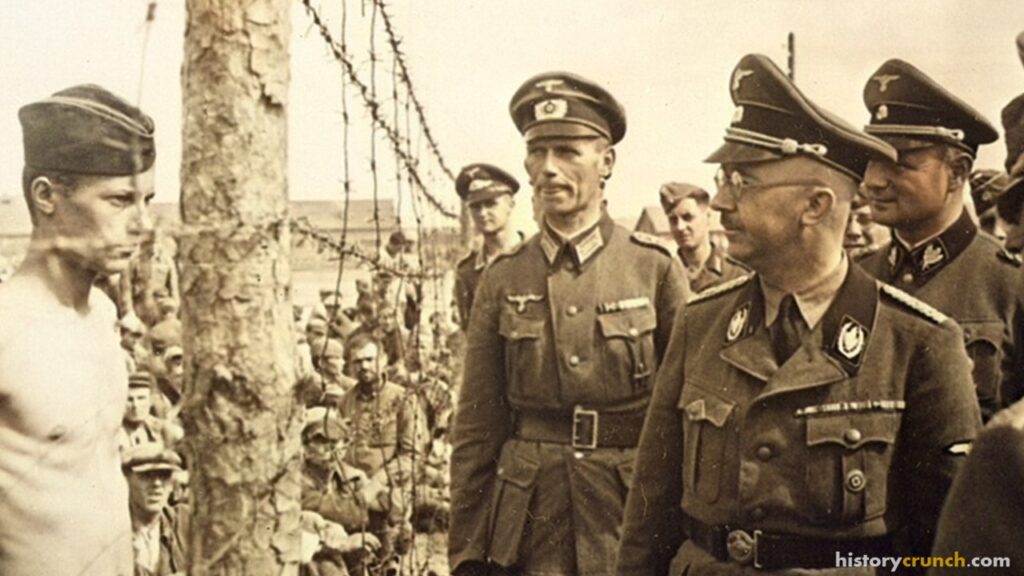
On July 17th and 18th, 1942 Heinrich Himmler inspected Auschwitz, watched a transport of Dutch Jews selected and gassed in a converted farmhouse at Birkenau, toured the IG Farben site, and ordered the camp expanded. He promoted Hoss to lieutenant colonel. The two farmhouses, the 'little red house' and the 'little white house', were the camp's gas chambers until the crematoria were built.
LEARN MORESHOW LESSwhy it matters · 1 key figureMURDERThe head of the SS saw it done and asked for more. Responsibility ran to the top, in person.
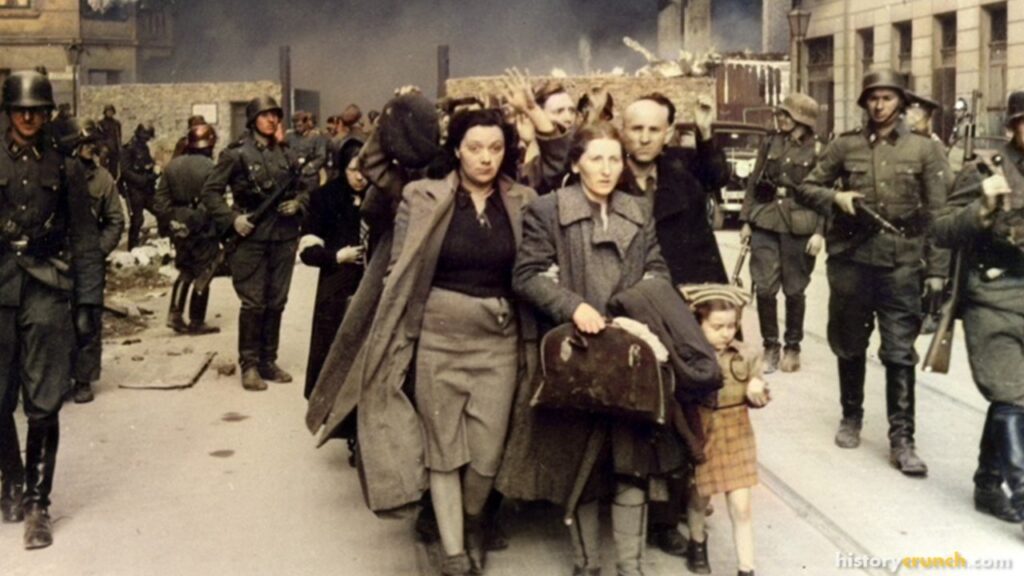
Beginning July 22nd, 1942, the SS took about 265,000 Jews from the Warsaw Ghetto to the Treblinka death camp in eight weeks, up to 7,000 a day, from a loading yard called the Umschlagplatz. Adam Czerniakow, head of the ghetto's Jewish council, killed himself on the second day rather than sign the orders for children. Janusz Korczak, who ran an orphanage, walked to the train with his 190 children rather than accept an offer of escape.
LEARN MORESHOW LESSwhy it matters · key numbersDEPORTATIONIn fifty-two days the largest Jewish community in Europe was reduced from 380,000 to 60,000. The survivors decided to fight.
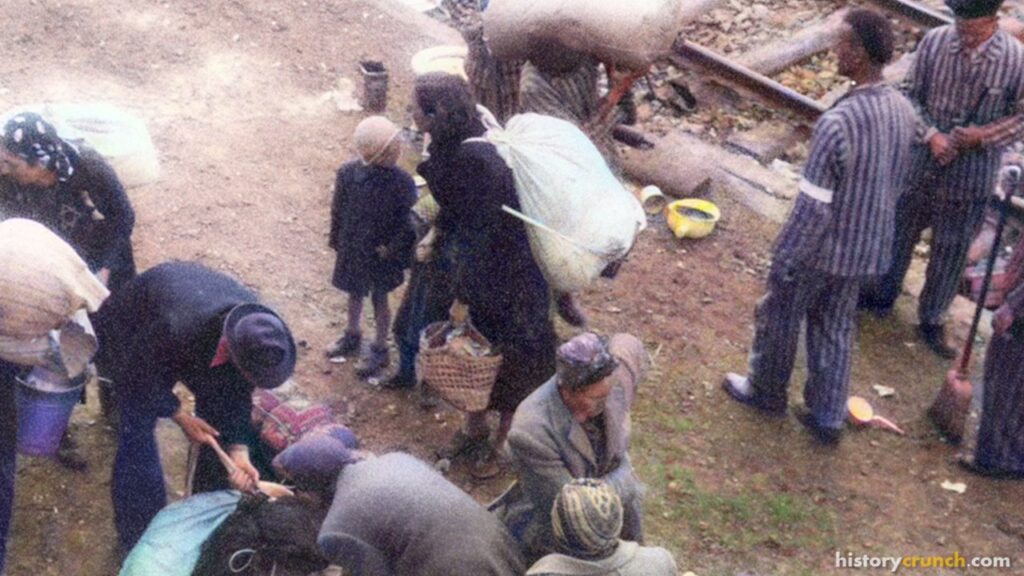
Treblinka, eighty kilometers from Warsaw, received its first transport on July 23rd, 1942. In thirteen months about 900,000 people were murdered there by a staff of about forty Germans and a hundred Ukrainian guards. Arriving trains pulled into a fake station with a painted clock and painted timetables. The gas chambers, fed by a tank engine, could kill 2,000 people at a time.
LEARN MORESHOW LESSwhy it matters · key numbersMURDERSecond only to Auschwitz in its dead, and nearly unknown, because it was designed to leave nothing: no survivors, no buildings, no records. It was ploughed under in 1943.
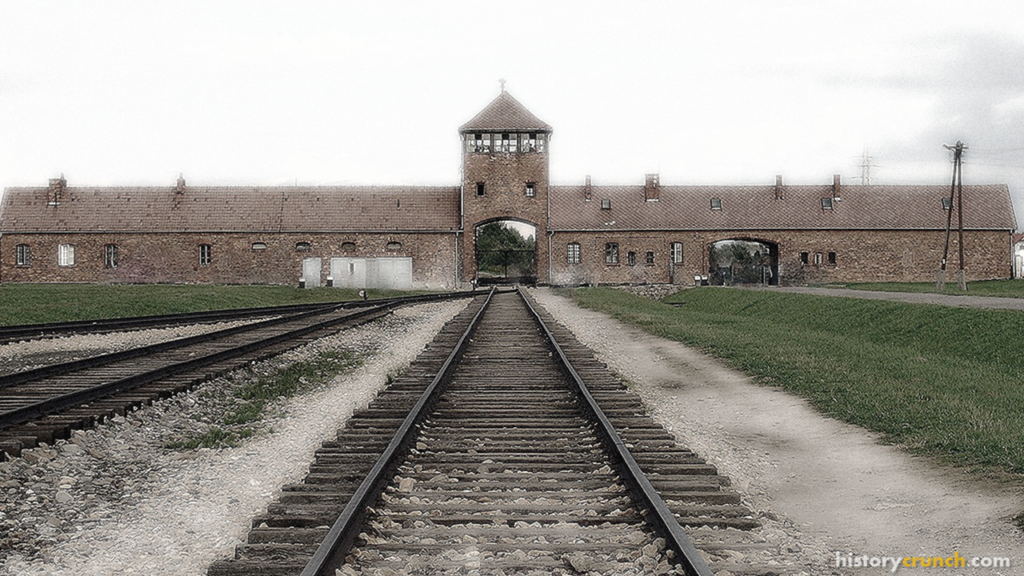
In October 1942 the chemical company IG Farben opened a camp at Monowitz, seven kilometers from Auschwitz, to house the slave labor building its synthetic rubber and fuel plant. Prisoners who could no longer work were sent back to Birkenau to be gassed; the average survival at the site was about three months. Primo Levi, sent there in 1944, survived to write about it. The plant never produced any rubber.
LEARN MORESHOW LESSwhy it matters · key numbersCAMPSGerman business used the camps too. IG Farben paid the SS by the prisoner per day, and its directors stood trial at Nuremberg in 1947.
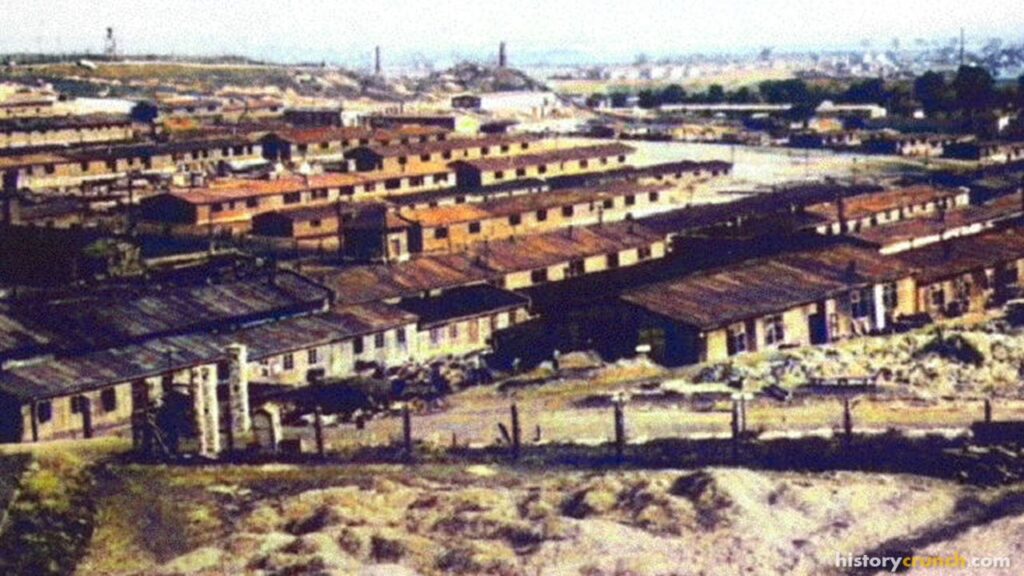
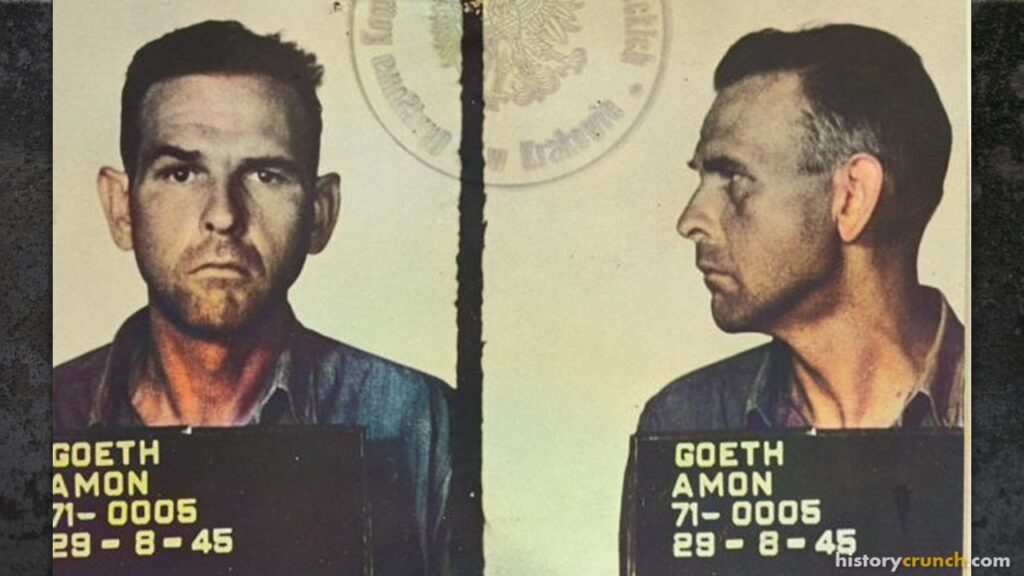
On March 13th and 14th, 1943 the SS under Amon Goth emptied the Krakow ghetto, shooting about 2,000 people in its streets and sending the rest to Auschwitz or to the new Plaszow labor camp, which Goth commanded. Goth shot prisoners from his balcony for sport. Oskar Schindler, a Nazi Party member who ran an enamelware factory nearby, bribed him to let his thousand Jewish workers live in a sub-camp beside the factory instead.
LEARN MORESHOW LESSwhy it matters · 1 key figureCAMPSSchindler had come to Krakow to get rich on cheap Jewish labor. Somewhere in 1943 he began spending the money to keep them alive.
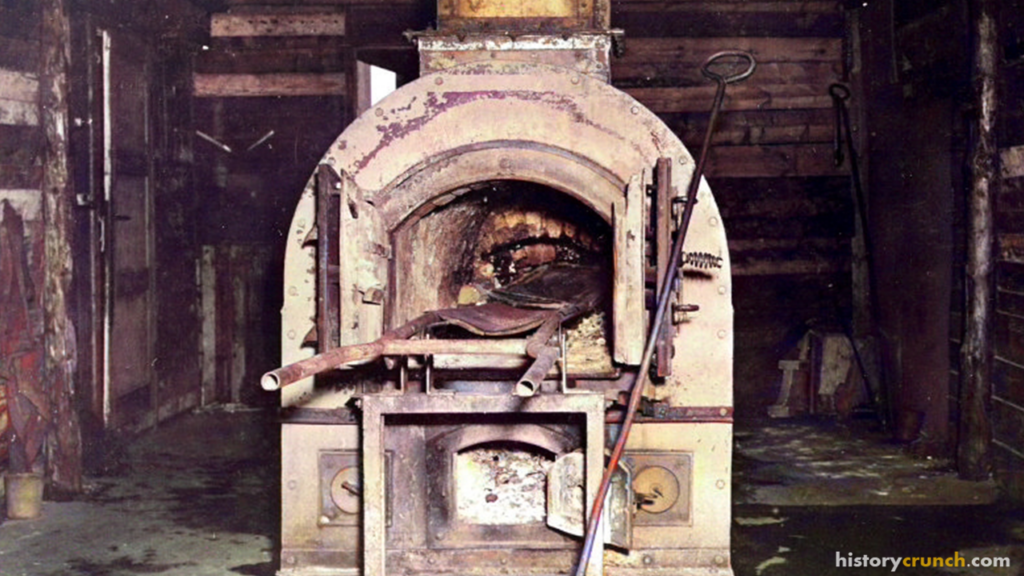
Between March 22nd and June 25th, 1943 four purpose-built killing installations opened at Birkenau, each with an undressing room, a gas chamber and a row of ovens under one roof, designed by German engineers and built by a firm from Erfurt. Together they could kill and burn more than 4,000 people a day. Most of the 1.1 million people murdered at Auschwitz died in them.
LEARN MORESHOW LESSwhy it matters · key numbersMURDERThis is what industrial murder means: a building with an architect, a contractor and a maintenance schedule, whose only product was ash.
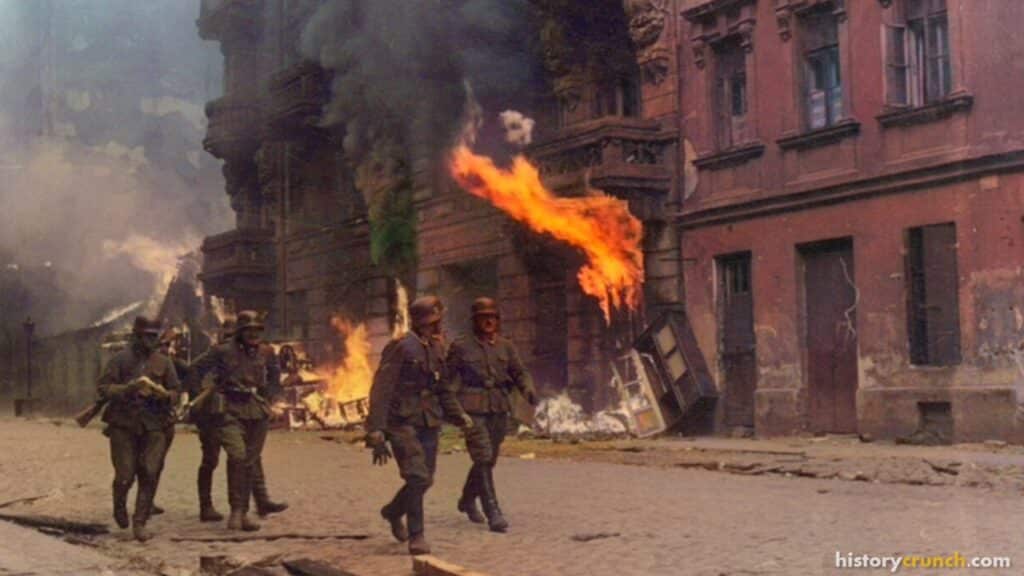
On April 19th, 1943, the eve of Passover, SS troops entered the Warsaw Ghetto to deport its last 60,000 people and were driven out by about 750 fighters of the Jewish Combat Organization with pistols, grenades and petrol bombs. General Jurgen Stroop burned the ghetto block by block. Its commander, Mordechai Anielewicz, aged 24, died in his bunker on May 8th. Stroop declared it over on May 16th by blowing up the Great Synagogue. About 13,000 Jews died; 17 Germans.
LEARN MORESHOW LESSwhy it matters · key numbers · a sourceRESISTANCEThe largest Jewish revolt of the war, fought by people who knew they would lose. It held out longer than Poland had in 1939.
IN THEIR OWN WORDS“The Jewish quarter of Warsaw is no more!”
Jurgen Stroop, title of his report to Himmler, May 16th, 1943WHAT TO NOTICEThe report, bound in leather with 52 photographs, was used as evidence at Nuremberg and at Stroop's own trial. He was hanged in Warsaw in 1952.
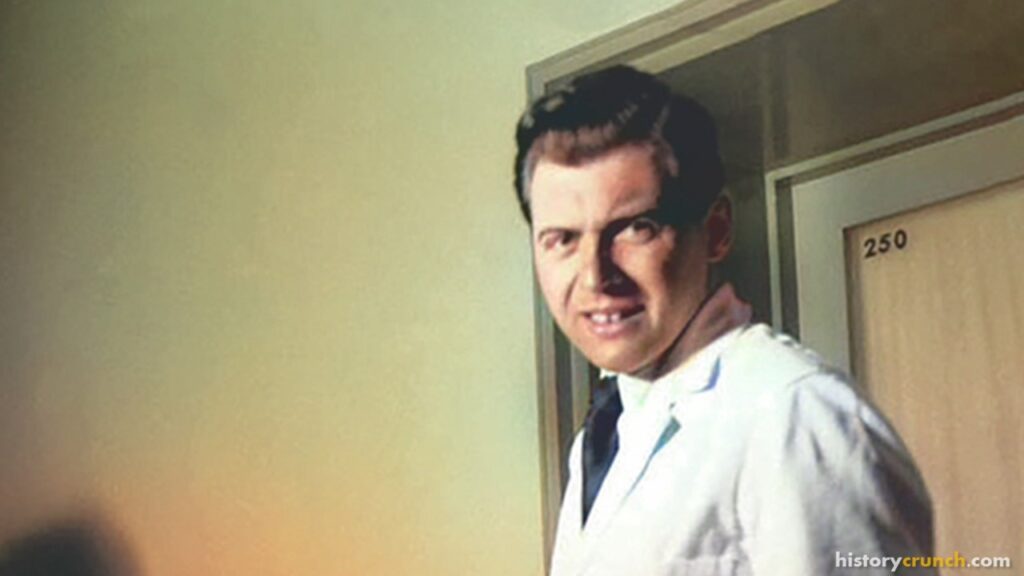
Josef Mengele, a 32-year-old SS doctor with a doctorate in genetics, arrived at Auschwitz on May 30th, 1943. He stood on the ramp at selections, humming opera, and picked twins, dwarfs and people with unusual eyes for experiments in a laboratory beside the crematoria. He infected one twin to compare with the other, injected dye into children's eyes, and killed subjects with chloroform to the heart when he wanted to dissect them. Prisoners called him the Angel of Death.
LEARN MORESHOW LESSwhy it matters · 1 key figureCAMPSThe camp doctors had taken the Hippocratic oath. Mengele fled in January 1945, lived under false names in South America, and died in 1979 without ever standing trial.
On August 2nd, 1943 prisoners at Treblinka who had been kept alive to sort clothing and burn bodies stole weapons from the armoury, set the camp on fire and broke through the fence. About 300 of the 700 got out; most were hunted down, and around 70 survived the war. The Germans dismantled the camp within months, built a farmhouse on the site and ploughed the ground.
LEARN MORESHOW LESSwhy it matters · key numbersRESISTANCEAlmost everything known about Treblinka comes from these seventy people. Without the revolt there would have been no witnesses at all.
Warned by a German diplomat of a round-up planned for the night of October 1st, 1943, Danes hid their Jewish neighbors in homes, hospitals and churches and then ferried more than 7,200 of Denmark's 7,800 Jews across the sound to neutral Sweden in fishing boats over three weeks. The Germans caught about 470, who were sent to Theresienstadt; Danish pressure kept almost all of them alive.
LEARN MORESHOW LESSwhy it matters · key numbersRESISTANCEThe largest rescue of the Holocaust. It shows what one country could do when it decided to, and how few did.
On October 14th, 1943 prisoners at Sobibor, led by a captured Soviet Jewish officer, Alexander Pechersky, lured eleven SS men one by one into workshops and killed them with axes and knives, then rushed the gates through the minefield. About 300 broke out and around 50 survived the war. Heinrich Himmler closed the camp, had it leveled and planted with pines.
LEARN MORESHOW LESSwhy it matters · key numbersRESISTANCETwo death camps rose in ten weeks. The SS answer was to shoot every Jewish prisoner left in the Lublin district.
On November 3rd and 4th, 1943, after the revolts at Treblinka and Sobibor, the SS shot about 42,000 Jewish prisoners at the Majdanek, Poniatowa and Trawniki camps in trenches they had been made to dig, with dance music played over loudspeakers to cover the sound. It was the largest German shooting operation of the war. Operation Reinhard was declared complete; about 1.7 million Polish Jews were dead.
LEARN MORESHOW LESSwhy it matters · key numbersMURDERThe code name was Erntefest, harvest festival. By the end of 1943 the Jews of Poland, three million people in 1939, had almost ceased to exist.
A chapter with no dates in it. What happened between the train and the chimney: the freight car, the ramp, the doctor's hand, the room with the numbered hooks and the fake showers, and the prisoners forced to empty it afterwards. And what a day was like for the one in four chosen to work: the number instead of a name, the stable built for 52 horses holding 400 people, the 1,300 calories, the typhus, the warehouses of belongings the prisoners called Canada. And who else was there besides the Jews, wearing the other colors of triangle.
Deportees traveled in freight cars built for cattle, 125 to 135 people to a car, with no food, no water, one bucket and a slit for air. Journeys from Greece or France took up to a week, and the old and the very young often died on the way. Victims were told to label their luggage so it could follow them, which was a lie to keep them calm.
LEARN MORESHOW LESSwhy it matters · key numbersDEPORTATIONThe railways of Europe carried about three million people to the camps on ordinary timetables. The SS paid a group fare; children under ten went half price.
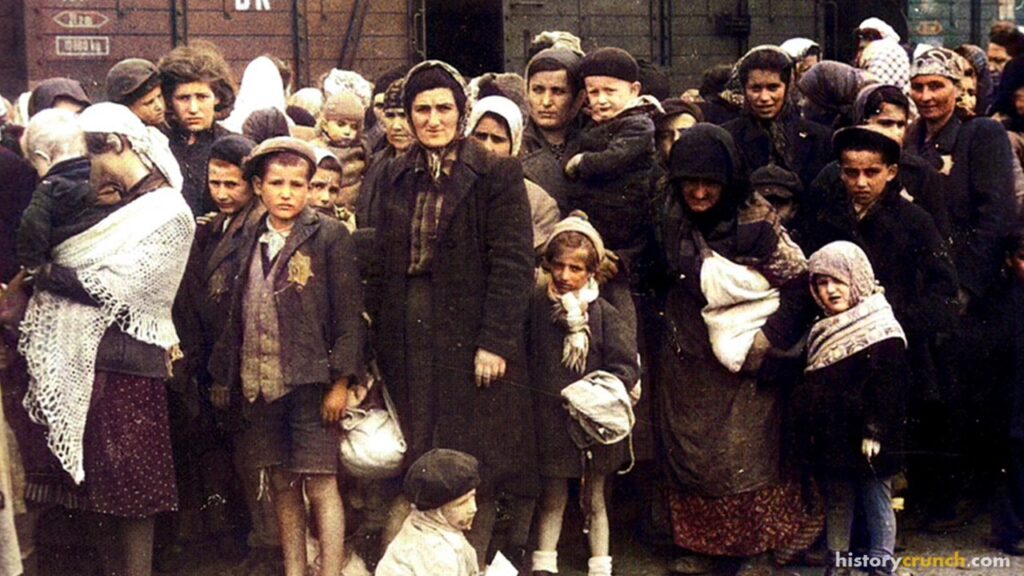
At Auschwitz an SS doctor met each transport and sent each person left or right with a flick of the hand: one way to the gas chamber, the other to labor. About three in four of every transport were sent to die at once, and children, the old, the sick and mothers holding infants went almost without exception. Families separated on the ramp usually never saw each other again.
LEARN MORESHOW LESSwhy it matters · key numbersMURDERIt took a few seconds per person and decided everything. Most people never knew which line they had been put in.
Those selected to die were led into an undressing room with numbered hooks and benches and told to remember their hook number and tie their shoes together for after the shower. The chamber beyond had fake shower heads. Once the door was sealed, Zyklon B pellets were dropped through openings in the roof; death took up to twenty minutes. The Reinhard camps used engine exhaust instead.
LEARN MORESHOW LESSwhy it mattersMURDERThe deception was deliberate and rehearsed, because a calm crowd was easier to handle than a frightened one. Every detail, down to the towels, was a lie.
Jewish prisoners were forced to empty the gas chambers, cut the hair, pull gold teeth, and burn the bodies in the ovens or in open pits. They were housed apart, fed better, and killed and replaced every few months so no witness would live. Several buried written accounts in jars near the crematoria; some were dug up after the war and can be read today.
LEARN MORESHOW LESSwhy it mattersMURDERThe SS made the victims run the machinery of their own murder. The buried writings are the only eyewitness accounts from inside the gas chambers.
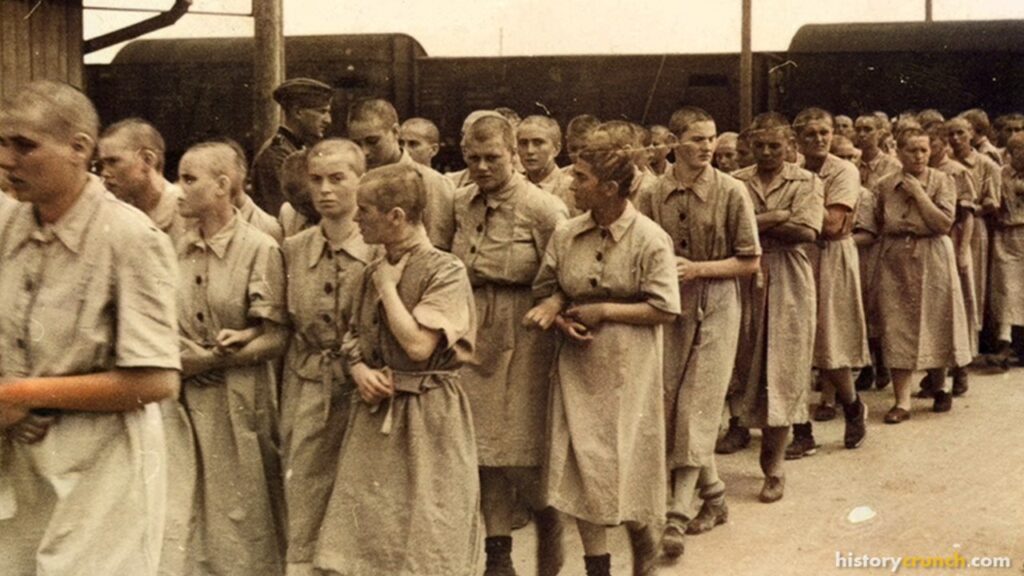
Those chosen for labor were stripped, shaved, showered for real, tattooed with a number on the left forearm (at Auschwitz only), and given striped clothing, wooden clogs and a colored triangle showing why they were there. From then on they were called by number. Belongings, photographs and names were gone in an hour.
LEARN MORESHOW LESSwhy it mattersLIFEThe point of the first hour was to make a person into a unit. Survivors say that losing their name was the moment they understood where they were.
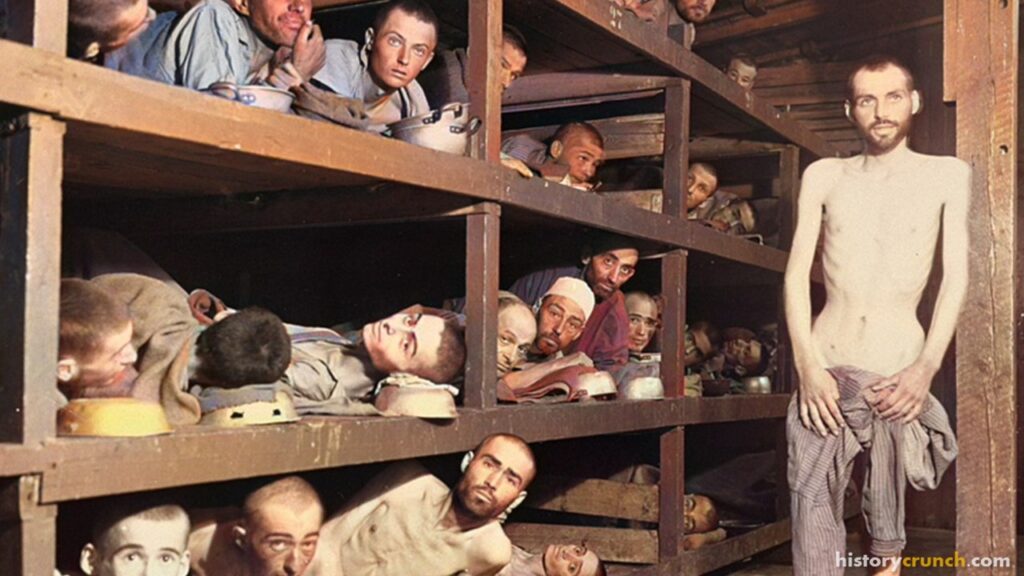
At Birkenau the barracks were prefabricated army horse stables built for 52 horses and holding over 400 people, on three-tier wooden bunks with four or more to a level, one stove that did not heat them, and a bucket. Later a latrine block was built: a concrete slab with holes, used at set times under guard, with no privacy and no paper. Lice, rats and mud were everywhere.
LEARN MORESHOW LESSwhy it matters · key numbersLIFEDisease killed as many as the guards did. A barrack was designed so that the winter would do the work.
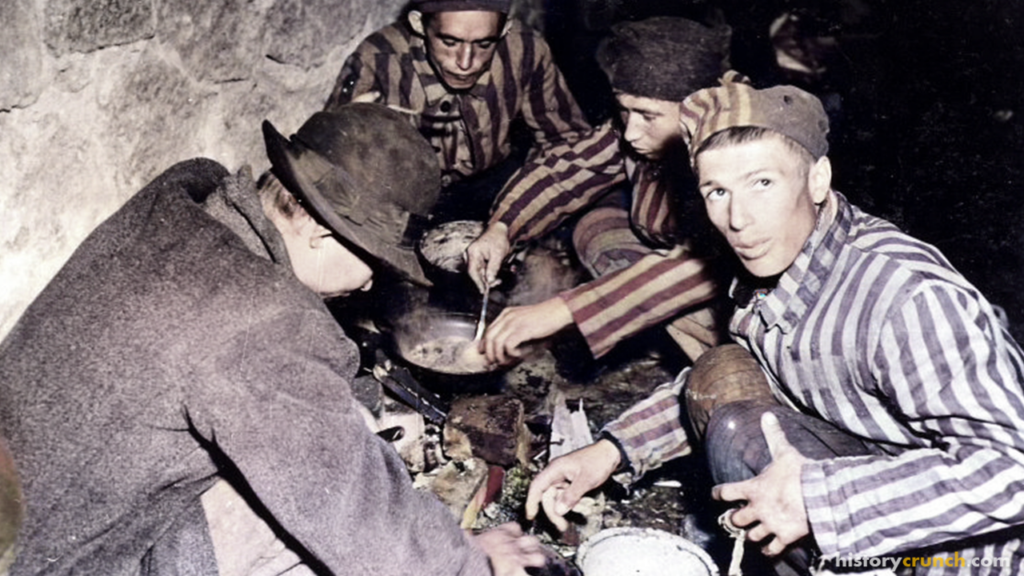
Ersatz coffee in the morning; about a litre of watery turnip soup at noon; a piece of bread, sometimes with a scrape of margarine, at night. Roughly 1,300 calories for eleven or twelve hours of heavy labor, so that a prisoner lost weight every day. Those who reached the last stage of starvation were called Muselmanner by the others, and did not last.
LEARN MORESHOW LESSwhy it matters · key numbersLIFEThe ration was set so that an able-bodied prisoner would be worked to death in about three months. That was the design, not an accident.
Lice carried typhus through the crowded blocks; dysentery, tuberculosis and scabies followed. There was almost no medicine. The camp infirmary was itself a selection site: an SS doctor went through it regularly and sent anyone too sick to work to the gas. Prisoners hid illness for as long as they could stand.
LEARN MORESHOW LESSwhy it mattersLIFEBeing ill was a death sentence in itself. Anne Frank, Margot Frank and Elie Wiesel's father all died of camp disease, not the gas chamber.
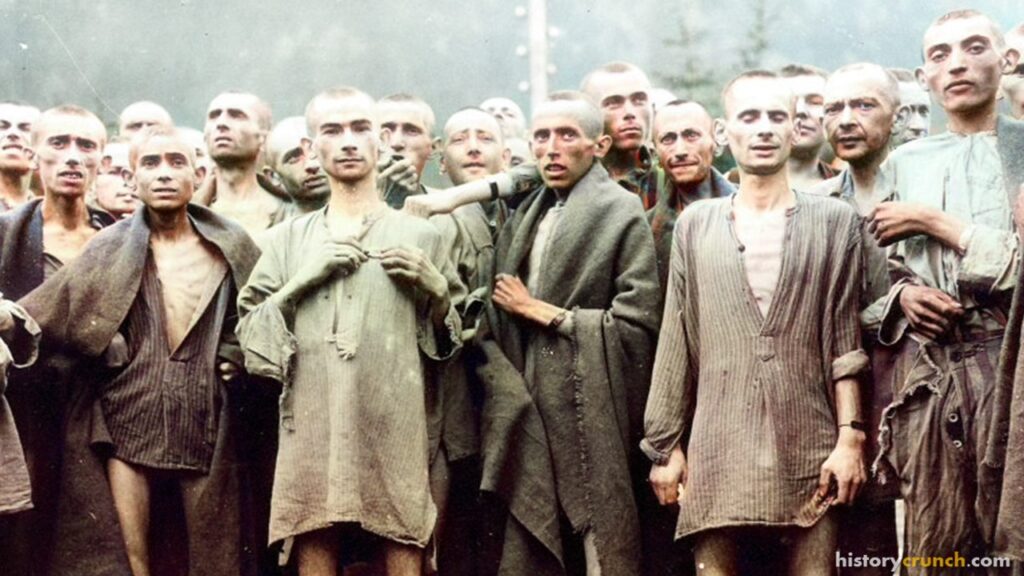
Everything the victims brought was sorted in thirty warehouses at Birkenau that prisoners named Canada, a country they imagined as rich and safe. Clothes, spectacles, shoes, suitcases, hair, gold teeth and prams were sorted and shipped to Germany. When the Soviets arrived they found 370,000 men's suits, 837,000 women's garments and seven tons of human hair the SS had not had time to send.
LEARN MORESHOW LESSwhy it matters · key numbersLIFEThe Holocaust was also a robbery. The hair went to a felt factory; the gold went to the Reichsbank.
Alongside six million Jews, the Nazis murdered up to 500,000 Roma and Sinti, about 250,000 disabled people, over three million Soviet prisoners of war by starvation and shooting, about 1.8 million non-Jewish Poles, and thousands of gay men, Jehovah's Witnesses, and political and religious prisoners. Each group wore a different colored triangle: yellow for Jews, red for politicals, pink for gay men, purple for Jehovah's Witnesses, black or brown for Roma.
LEARN MORESHOW LESSwhy it matters · key numbersMURDERThe Holocaust was aimed at the Jews above all, and it consumed everyone the regime had defined as outside the nation.
The killing was fastest in the final year. Germany occupied Hungary in March 1944 and sent 437,000 of its Jews to Auschwitz in eight weeks, while the Allies landed in Normandy and argued about bombing the railway. The Soviets found Majdanek intact in July. In November Heinrich Himmler ordered the gas chambers dismantled to hide the evidence, and in January the camps were marched west through the snow. Auschwitz was freed on January 27th, 1945; Anne Frank died at Bergen-Belsen a few weeks later; Buchenwald and Dachau were freed in April. Himmler bit a cyanide capsule in May. Six million Jews, two in every three in Europe, were dead.
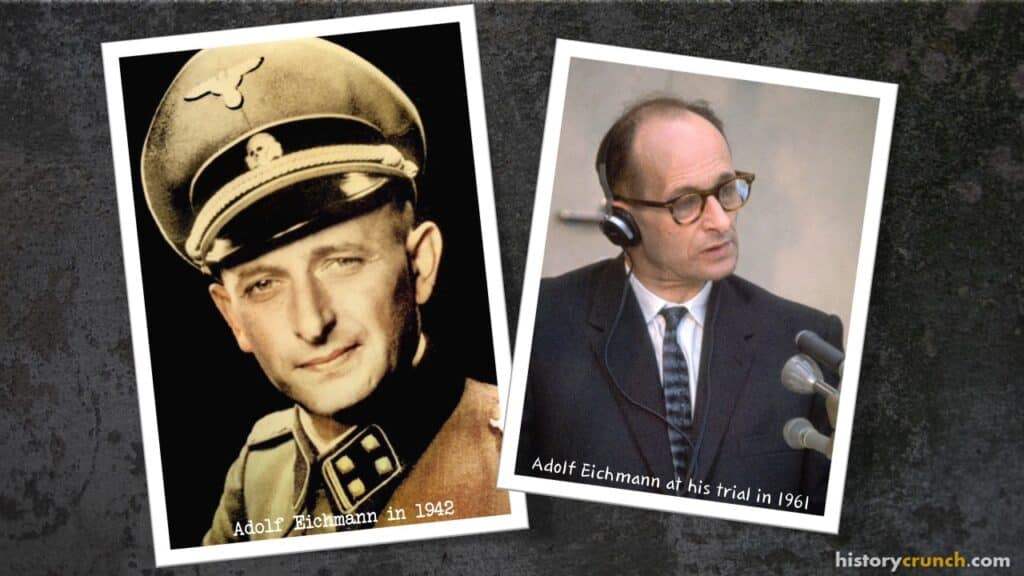
On March 19th, 1944 German troops occupied Hungary, an ally that had been trying to leave the war. Hungary held the last large Jewish community in Europe, about 725,000 people who had been persecuted but not deported. Adolf Eichmann arrived in Budapest the same day with a staff of 150 to organize their removal.
LEARN MORESHOW LESSwhy it matters · key numbersWORLDIn the spring of 1944, with the war clearly lost, the regime spent trains and men it could not spare on murdering Hungary's Jews. The killing had become the point.
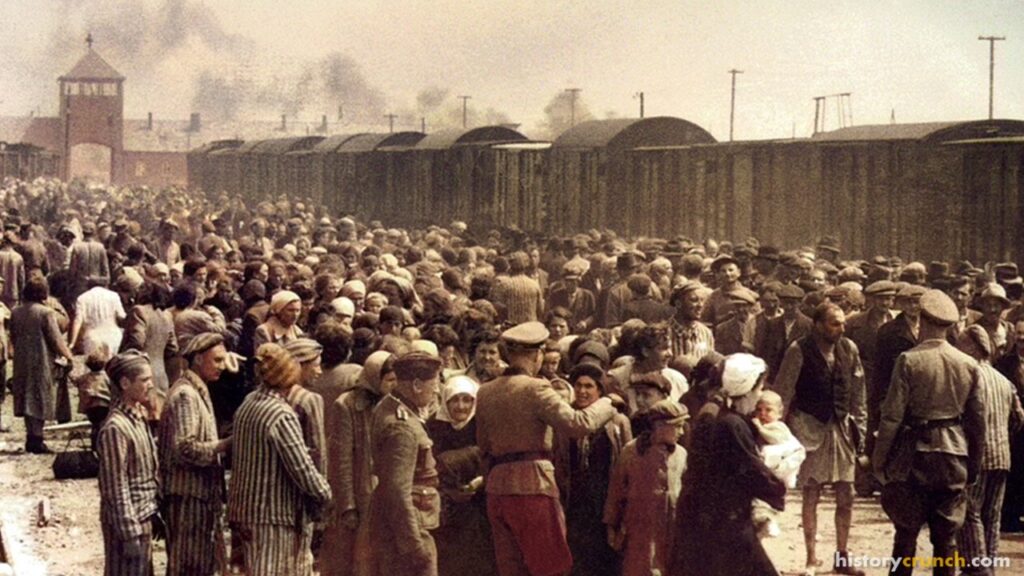
Between May 15th and July 9th, 1944, 437,000 Hungarian Jews were sent to Auschwitz-Birkenau in 147 trains, up to 12,000 people a day. A new rail spur ran straight into the camp. About three in four were gassed on arrival, more than the crematoria could burn, so bodies were burned in pits. Fifteen-year-old Elie Wiesel arrived from Sighet in May and watched his mother and sister Tzipora sent to the left.
LEARN MORESHOW LESSwhy it matters · key numbers · 1 key figureDEPORTATIONThe deadliest eight weeks in the history of Auschwitz. Nearly one in three of everyone killed there died in this one summer.
The Allies landed in Normandy on June 6th, 1944. Auschwitz was at its most murderous the same month. Two escaped prisoners, Rudolf Vrba and Alfred Wetzler, had reached Slovakia in April with a detailed report on the camp, and Allied reconnaissance planes photographed Birkenau in the summer. American bombers hit the Monowitz factory in August and September, but the gas chambers and rail lines were never bombed.
LEARN MORESHOW LESSwhy it matters · a debateWORLDWhether the Allies should have bombed Auschwitz is still argued. What is not argued is that by mid-1944 they knew.
Should the Allies have bombed Auschwitz?
Yes. The camp was within bomber range, the rail lines were known, and even a delay of weeks in the summer of 1944 would have saved tens of thousands of Hungarian Jews.
No, or not usefully. Bombing would have killed prisoners, the SS could shoot as fast as it gassed, and the Allied commanders held that winning the war fastest would save the most lives.
Soviet troops reached Majdanek, on the edge of Lublin, on July 23rd, 1944 so fast that the SS had no time to destroy it. They found gas chambers, ovens with bones still in them, and a warehouse of 800,000 pairs of shoes. Soviet and Western journalists were shown the camp in August; many newspaper readers, remembering the invented atrocity stories of 1914, did not believe the reports.
LEARN MORESHOW LESSwhy it matters · key numbersLIBERATIONThe first proof, intact, of what the camps were. It was photographed and printed, and much of the world still did not take it in.
On the morning of August 4th, 1944 an SS sergeant and Dutch policemen entered the annex, most likely after a tip that has never been traced, and arrested the eight people hiding there. Miep Gies, one of the helpers, gathered Anne's diary and papers from the floor and locked them in a drawer. On September 3rd the Franks were on the last transport to leave the Netherlands for the Auschwitz camp, 1,019 people.
LEARN MORESHOW LESSwhy it matters · 1 key figureLIFETwo years and one month of hiding. Of the eight, only Otto Frank came back.
On October 7th, 1944 the Sonderkommando of Crematorium IV at the Auschwitz camp, knowing they were about to be killed, attacked the SS with hammers and stones and blew up the building with explosives smuggled out of a munitions plant, a few grains at a time, by Jewish women prisoners. About 450 prisoners died in the fighting and afterwards. Four of the women, including 23-year-old Roza Robota, were hanged in January 1945.
LEARN MORESHOW LESSwhy it mattersRESISTANCEThe only armed uprising at Auschwitz, and it destroyed one of the four killing installations for good.
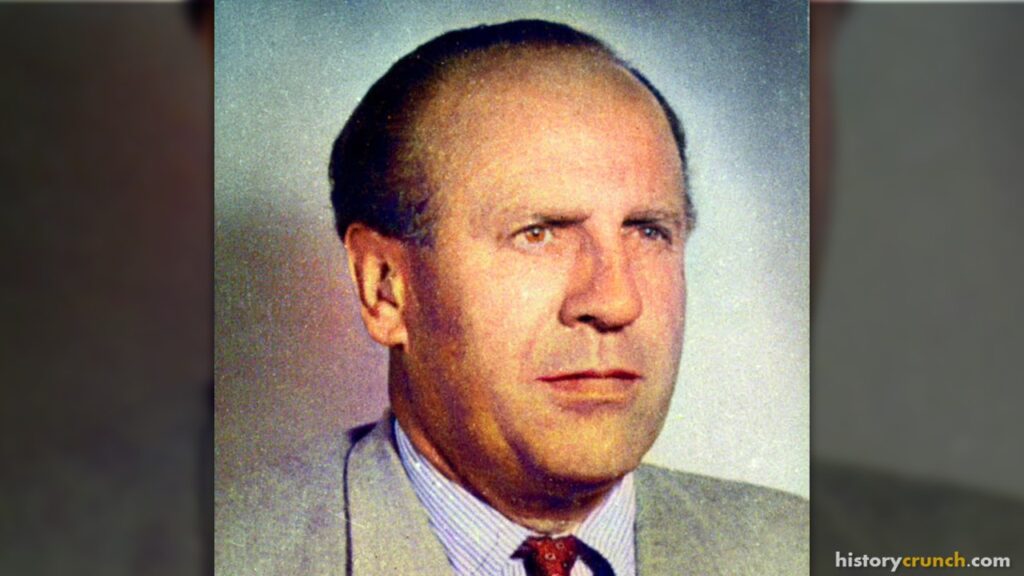
In October 1944, as the Plaszow camp was emptied into Auschwitz, Oskar Schindler won permission to move his workers to a new munitions factory at Brunnlitz in the Sudetenland, the German-annexed border region of Czechoslovakia. A typed list of about 1,100 names was drawn up; those on it went to Brunnlitz, and the women on it were even brought back from Auschwitz. The factory made almost nothing usable, and Schindler bought shells on the black market to cover it. He spent his fortune on bribes and food until May 1945.
LEARN MORESHOW LESSwhy it matters · key numbers · 1 key figureRESISTANCEA Nazi Party member, a war profiteer and a spy saved more Jews than most governments. His workers gave him a gold ring engraved with a line from the Talmud: whoever saves one life saves the world entire.
On November 25th, 1944, with the Red Army about 200 kilometers away, Heinrich Himmler ordered the gassing at the Auschwitz camp stopped and the Birkenau crematoria dismantled to hide the evidence. Prisoners were made to take the buildings apart; the SS burned the records and blew up the shells in January. Himmler, by now trying to negotiate with the Allies, hoped the world could be kept from knowing.
LEARN MORESHOW LESSwhy it matters · 1 key figurePOLITICSThe regime knew it was a crime. Nobody dismantles a building they are proud of.
From January 17th to 21st, 1945, in what prisoners called a death march, the SS marched about 56,000 prisoners out of Auschwitz westward on foot through snow, in thin clothes and clogs, to camps inside Germany. Anyone who fell or stopped was shot; about 15,000 died on the roads in the first days. Across the shrinking Reich, some 250,000 prisoners died on such marches and in open railway wagons in the last four months of the war.
LEARN MORESHOW LESSwhy it matters · key numbersMURDERThe camps were emptied not to save the prisoners but to keep them from being freed. Many who had survived years in Auschwitz died in the last weeks.
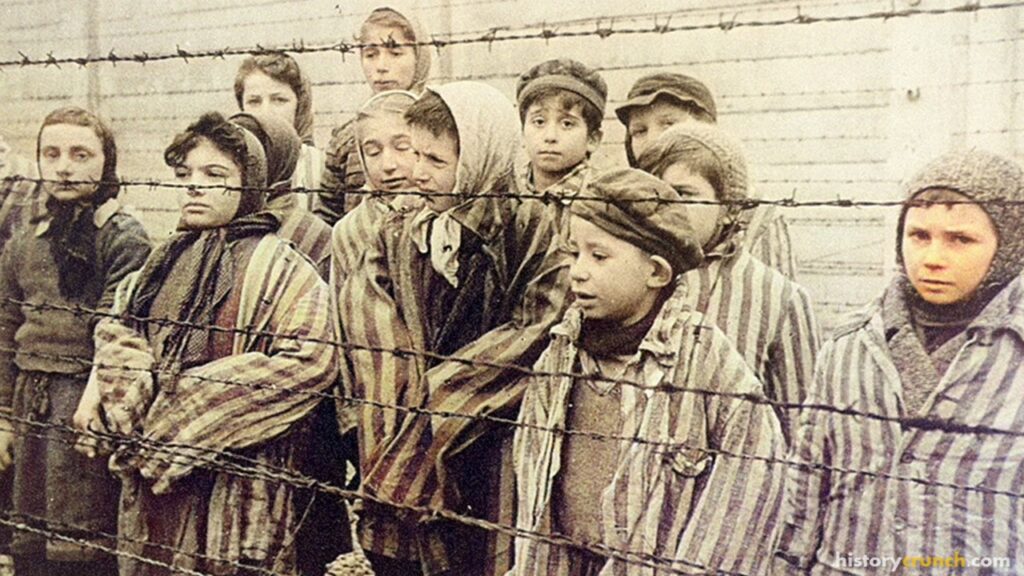
Soldiers of the Soviet 60th Army entered the Auschwitz camp on January 27th, 1945 and found about 7,000 prisoners too sick to have been marched, hundreds of unburied bodies, the blown-up crematoria and the warehouses. Of about 1.3 million people sent to Auschwitz, at least 1.1 million had been murdered there, about a million of them Jews. Since 2005 the date has been International Holocaust Remembrance Day.
LEARN MORESHOW LESSwhy it matters · key numbersLIBERATIONThe site where more people were murdered than anywhere else on earth, 1.1 million, seen for the first time from outside. The number was worked out afterwards from the train records the SS had not managed to burn.
Moved from Auschwitz to Bergen-Belsen in northern Germany in October 1944, the Frank sisters died of typhus in February or March 1945, in a camp with no food, no water and 17,000 typhus deaths that spring. British troops reached it on April 15th and found 13,000 unburied dead and 60,000 dying. Their mother Edith had died at Auschwitz on January 6th. Anne was fifteen.
LEARN MORESHOW LESSwhy it matters · 1 key figureLIFEBergen-Belsen had no gas chambers. It killed by neglect, and it killed the best-known child of the Holocaust weeks before the end.
American troops of the 6th Armored Division reached Buchenwald near Weimar on April 11th, 1945; prisoners had already seized the watchtowers that afternoon. About 21,000 were found alive, among them sixteen-year-old Elie Wiesel, whose father had died in the camp on January 29th. General Eisenhower toured the nearby Ohrdruf camp the next day and ordered every unit in the area to see it, and asked for journalists and members of Congress to be flown in.
LEARN MORESHOW LESSwhy it matters · a source · 1 key figureLIBERATIONEisenhower said he wanted the evidence on record in case anyone ever claimed it was propaganda. The American photographs are why we have the pictures.
IN THEIR OWN WORDS“I made the visit deliberately, in order to be in a position to give first-hand evidence of these things if ever, in the future, there develops a tendency to charge these allegations merely to propaganda.”
General Dwight D. Eisenhower to General George Marshall, April 15th, 1945
Soldiers of the 45th and 42nd US Infantry Divisions reached Dachau on April 29th, 1945 and found about 32,000 prisoners and, on a siding outside the camp, a train of thirty boxcars full of the dead. The first camp was the last major one freed in Germany. Hitler killed himself in Berlin the next day; Joseph Goebbels on May 1st. The American army made the people of Dachau town walk through the camp.
LEARN MORESHOW LESSwhy it matters · key numbersLIBERATIONTwelve years and five weeks after it opened. The men who ran it had fled; the town next door said it had not known.
Captured in disguise, with an eyepatch and false papers, at a British checkpoint on May 21st, 1945, Himmler gave his name two days later and bit a cyanide capsule hidden in his mouth while a doctor examined him. Eichmann, Mengele, Stangl of Treblinka and hundreds of others were already running. About six million Jews, two out of every three in Europe, were dead.
LEARN MORESHOW LESSwhy it matters · key numbers · 1 key figureJUSTICEThe man who ran the Holocaust never answered a question about it. The count of his victims was made by others.
The trials that invented the crime of genocide, the diary and the memoir that put a face on the number, and the long hunt for the men who ran the machine. Twenty-two leaders were tried at Nuremberg in the city of the race laws, and Hermann Goering cheated the hangman. The doctors were tried next. Anne Frank's diary was published in 1947 and Wiesel's Night in 1960; Israel was founded in 1948, the same year the United Nations made genocide a crime. Eichmann was taken in Argentina in 1960 and hanged in Jerusalem. Mengele was never caught. Yad Vashem has found 4.8 million of the six million names, and is still looking.
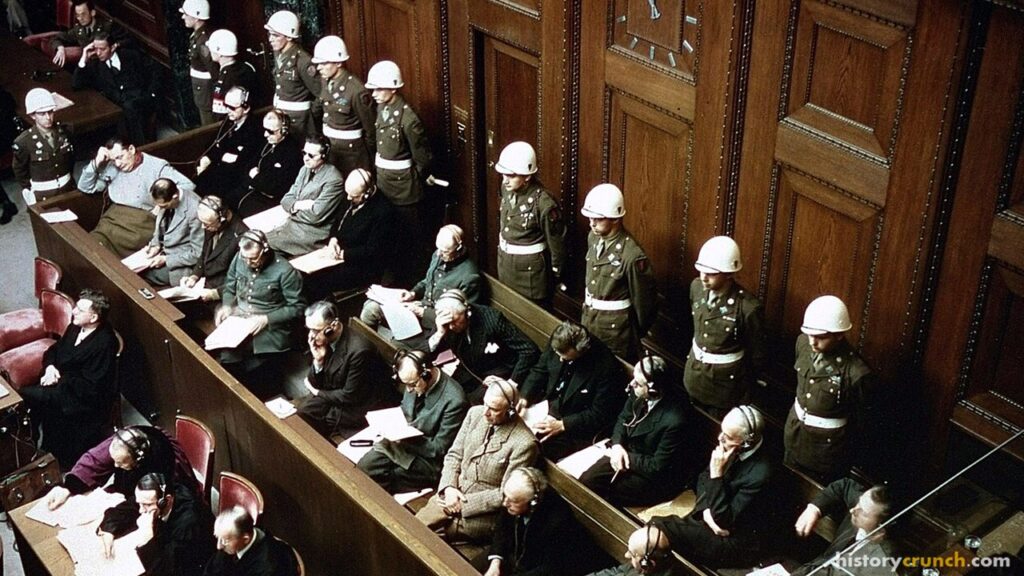
On November 20th, 1945 the United States, Britain, the Soviet Union and France put 22 Nazi leaders on trial before an International Military Tribunal in the city of the party rallies and the race laws, on four charges: conspiracy, crimes against peace, war crimes, and a new one, crimes against humanity. The prosecution relied on the regime's own paperwork and films from the camps. For the first time the leaders of a state answered to an international court.
LEARN MORESHOW LESSwhy it matters · key numbersJUSTICEWinston Churchill and Joseph Stalin had wanted the Nazi leaders simply shot. The Americans insisted on a trial with evidence, so that the record would exist.
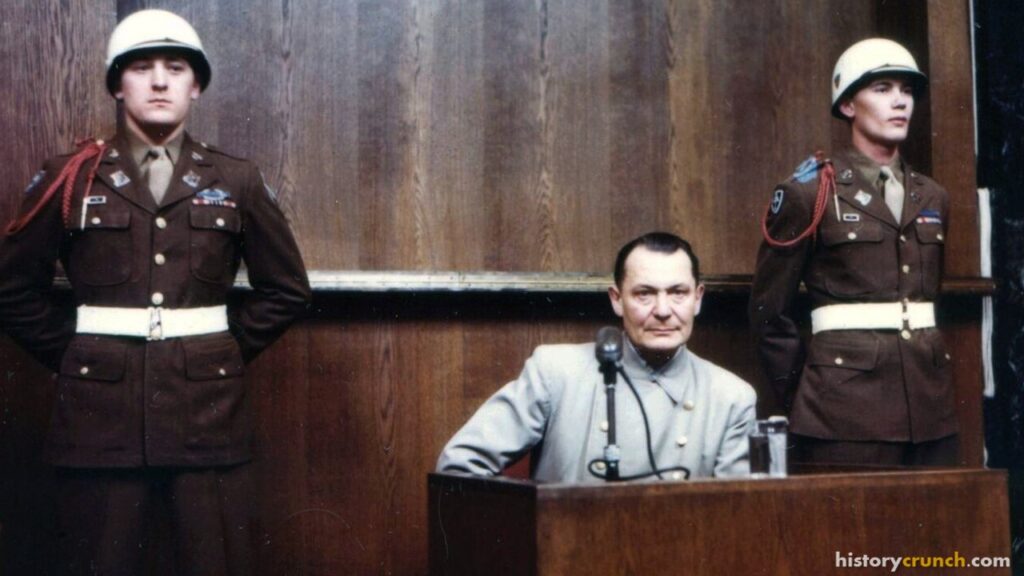
On October 1st, 1946 twelve men were sentenced to death, seven to prison and three acquitted. Hermann Goering, the highest-ranking, found guilty on all four counts, swallowed a smuggled cyanide capsule two hours before his hanging on the night of October 15th. Ten others, including Streicher and Frank, the governor of occupied Poland, were hanged on October 16th and their ashes scattered in a river so there would be no graves.
LEARN MORESHOW LESSwhy it matters · 1 key figureJUSTICEGoering had argued that the victors were simply punishing the losers. The court answered that murder had been a crime before 1933 too.
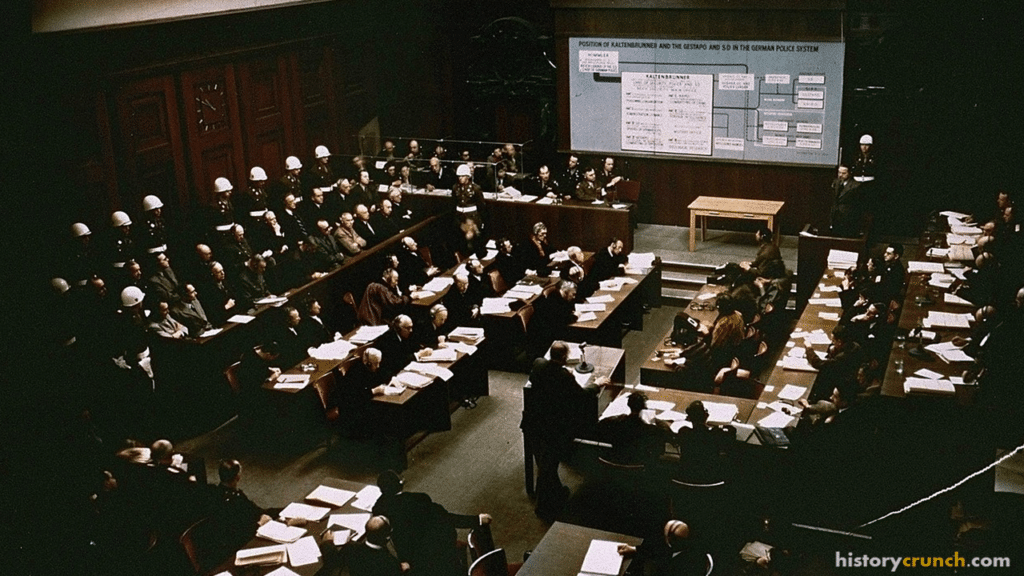
Twelve further American trials followed at Nuremberg between 1946 and 1949. The first, opening on December 9th, 1946, tried 23 doctors and officials for the euthanasia program and the camp experiments; seven were hanged. The Nuremberg Code on consent in medical experiments, still in force, came out of it. Later trials convicted the Einsatzgruppen commanders, 14 to death, and the directors of IG Farben.
LEARN MORESHOW LESSwhy it mattersJUSTICEThe trials established that 'I was following orders' was no defense and that a doctor who experiments on a prisoner is a murderer. Most sentences were later cut short in the Cold War.
Otto Frank, the only one of the eight to survive, returned to Amsterdam in June 1945 and learned in July that his daughters were dead. Miep Gies gave him the diary. He published it on June 25th, 1947 as Het Achterhuis, the Secret Annex, in an edition of 3,000. It has since appeared in more than 70 languages and sold over 30 million copies, and the house is a museum visited by more than a million people a year.
LEARN MORESHOW LESSwhy it matters · key numbers · 1 key figureMEMORYThe numbers of the Holocaust are beyond imagining. One girl's diary is not, which is why it is the book most students read first.
The State of Israel was declared on May 14th, 1948, six months after the United Nations voted to divide Palestine. About 250,000 Jewish survivors were still living in displaced persons camps in Germany, Austria and Italy, most refusing to go back to countries where their families had been murdered; some 140,000 of them went to Israel in its first three years.
LEARN MORESHOW LESSwhy it mattersMEMORYThe argument that won the UN vote was the Holocaust. A people that had nowhere to go in 1938 now had somewhere.
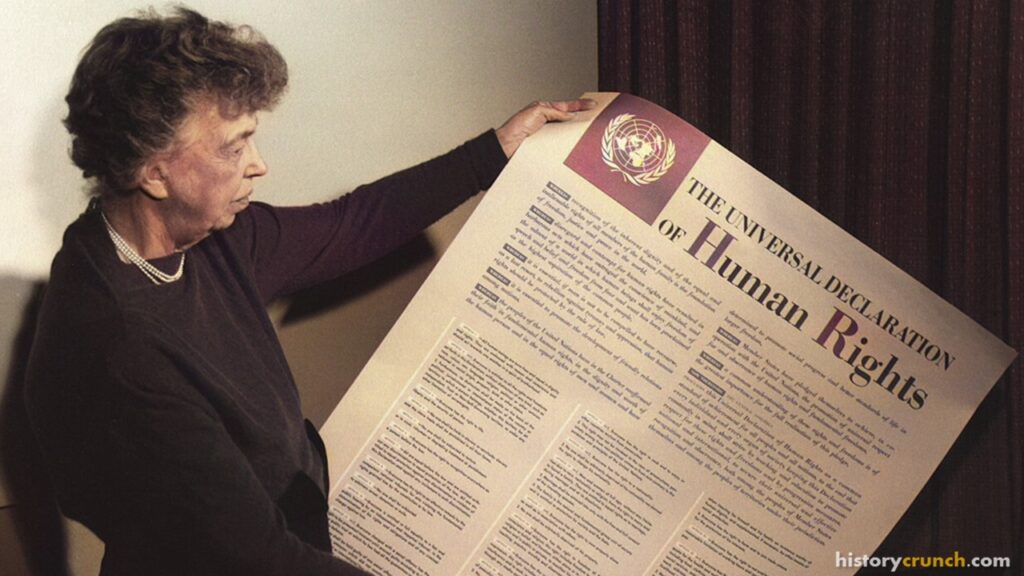
The word genocide was coined in 1944 by Raphael Lemkin, a Polish Jewish lawyer who had lost 49 relatives and spent the war trying to get a name for what was happening. On December 9th, 1948 the United Nations adopted his Genocide Convention, making the destruction of a national, ethnic, racial or religious group a crime in international law. The Universal Declaration of Human Rights followed the next day.
LEARN MORESHOW LESSwhy it mattersJUSTICEBefore 1944 there was no word for it and no law against it. The two documents of December 1948 are the Holocaust's direct legacy.
Israel founded Yad Vashem, the World Holocaust Remembrance Centre, in Jerusalem by a law of August 19th, 1953, to record the name of every victim, since the Nazis had tried to leave none. It has recovered about 4.8 million names so far. It also honors the non-Jews who risked their lives to save Jews as Righteous Among the Nations; more than 28,000 have been named, from 51 countries.
LEARN MORESHOW LESSwhy it matters · key numbersMEMORYTwo thirds of the dead now have their names back. The search for the rest goes on.
Israeli agents seized Adolf Eichmann, who had organized the deportation trains, on a Buenos Aires street on May 11th, 1960 and flew him to Jerusalem. His trial in 1961 was televised and let more than a hundred survivors tell their stories to the world for the first time. He said he had only followed orders. He was hanged on June 1st, 1962, the only civil execution in Israel's history, and his ashes were scattered at sea.
LEARN MORESHOW LESSwhy it mattersJUSTICEFifteen years after the war, the trial put the survivors' testimony on record and made the Holocaust a subject the world could no longer avoid.
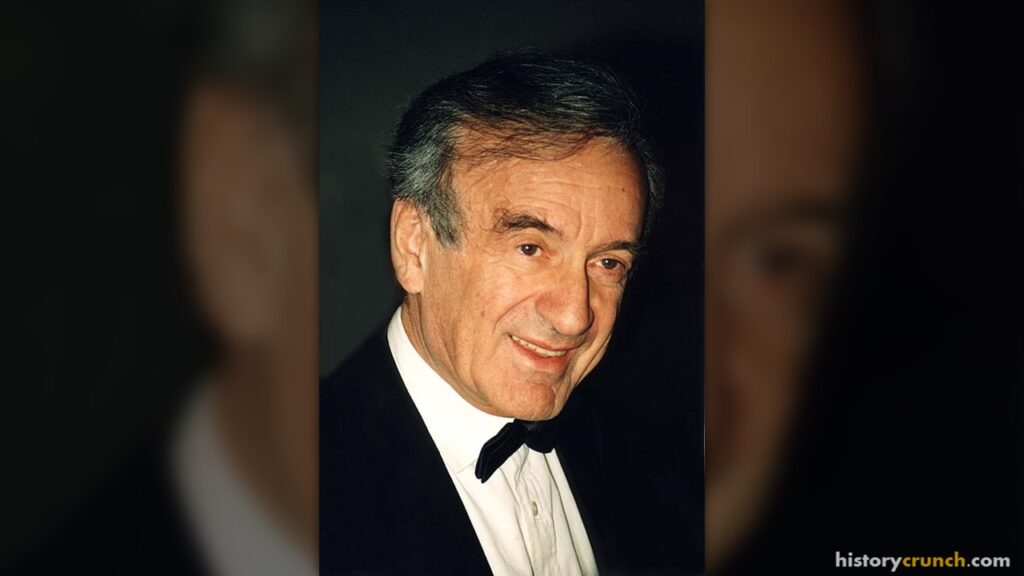
Elie Wiesel's account of the Auschwitz and Buchenwald camps appeared in French in 1958 as La Nuit and in English as Night in September 1960, in an edition of 3,000 that took three years to sell. It has since sold more than ten million copies and is read in schools across the world. Wiesel became the public voice of the survivors, chaired the commission that created the United States Holocaust Memorial Museum, and won the Nobel Peace Prize in 1986.
LEARN MORESHOW LESSwhy it matters · a source · 1 key figureMEMORYOne hundred pages, one teenager, one father. Like Anne Frank's diary, it made the number six million into a person.
IN THEIR OWN WORDS“Neutrality helps the oppressor, never the victim.”
Elie Wiesel, Nobel Peace Prize acceptance speech, December 10th, 1986
Oskar Schindler failed at every business after the war and lived on money from the people he had saved. He died in Germany on October 9th, 1974 and, at his own wish, was buried on Mount Zion in Jerusalem, the only member of the Nazi Party honored with a grave there. Yad Vashem had named him and his wife Emilie Righteous Among the Nations; the film Schindler's List in 1993 made his name known everywhere.
LEARN MORESHOW LESSwhy it matters · 1 key figureMEMORYMore than 8,000 descendants of the people on the list are alive today.
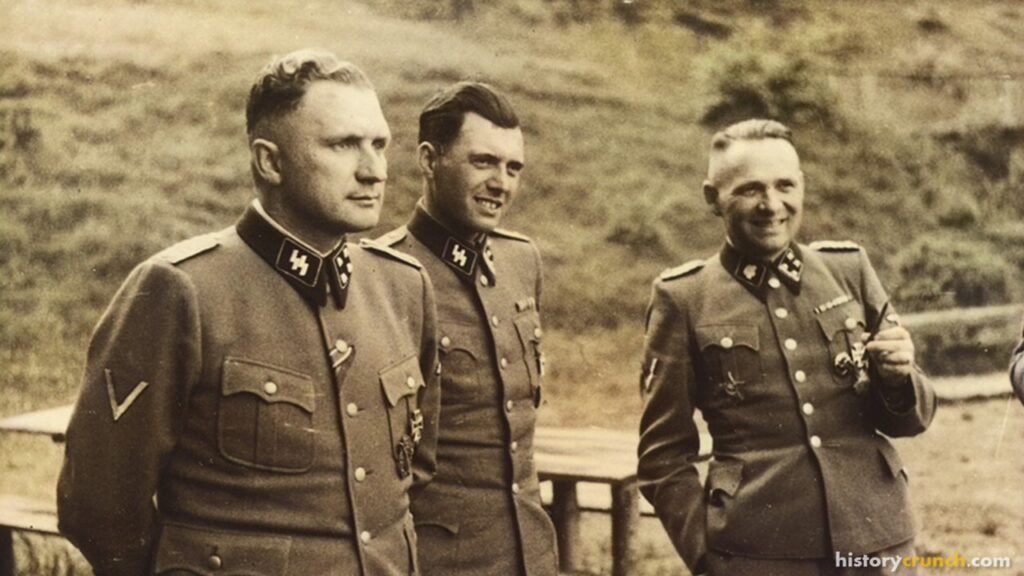
Mengele had drowned after a stroke while swimming off a Brazilian beach on February 7th, 1979, living as Wolfgang Gerhard. In June 1985, after a tip, Brazilian police opened the grave and forensic scientists from three countries identified the skeleton; DNA confirmed it in 1992. He had lived 34 years in Argentina, Paraguay and Brazil, never tried, and his son said he had never regretted anything.
LEARN MORESHOW LESSwhy it matters · key numbers · 1 key figureJUSTICEJustice missed him. Most of the men who ran the camps were never tried at all; of about 6,500 SS who served at Auschwitz, fewer than 800 were ever convicted.
The museum Wiesel had campaigned for since 1978 opened beside the National Mall in Washington on April 22nd, 1993, with a freight car, a pile of shoes from Majdanek, and the names of the villages. Auschwitz had been a state museum since 1947 and Yad Vashem since 1953. In 2005 the United Nations made January 27th, the day Auschwitz was liberated, International Holocaust Remembrance Day.
LEARN MORESHOW LESSwhy it matters · 1 key figureMEMORYThe survivors are almost all gone now. The museums, the diary and the memoir are how the next students will know it happened.

I'm a passionate history and geography teacher with over 15 years of experience working with students in the middle and high school years. I have an Education Degree with a focus in World History. I have been writing articles for History Crunch since 2015 and love the challenge of creating historical content for young learners!
I'm the founder of History Crunch, which I first began in 2015 with a small team of like-minded professionals. I have an Education Degree with a focus in Social Studies education. I spent nearly 15 years teaching history, geography and economics in secondary classrooms to thousands of students. Now I use my time and passion researching, writing and thinking about history education for today's students and teachers.
To cite this timeline as a source, use one of the formats below.
MLA: Beck, E., and B. Millar. “Holocaust Timeline.” HistoryCrunch, 14 September 2026, https://historycrunch.com/holocaust-timeline/.
APA: Beck, E., & Millar, B. (2026). Holocaust Timeline. HistoryCrunch. https://historycrunch.com/holocaust-timeline/
Chicago: Beck, E., and B. Millar. “Holocaust Timeline.” HistoryCrunch. September 14, 2026. https://historycrunch.com/holocaust-timeline/
© History Crunch
The hatred was centuries old. What the Nazis added was a state.
Darwin never said it. Galton and the eugenicists did, and German doctors carried it out.
No written order to murder the Jews has ever been found. He did not need to write one.
Historians disagree about whether the Holocaust was planned from the start or improvised step by step. Intentionalists point to the 1920 party program, Mein Kampf and the 1939 prophecy, and say every step from 1933 led one way. Functionalists point out that the regime pushed emigration until 1941 and turned to murder only when the war put millions of Jews in its hands and no country would take them. Most now hold both: the intention was always there, and the war decided the method.
Fear, propaganda, small steps, and a great many people who benefited.
Not with murder. With laws, one at a time, each one tested first.
To hold the Jews of Poland in one place until the regime decided what to do with them.
Not in a gas chamber. In pits, with rifles, in the summer of 1941.
The murder of every Jew the regime could reach, organized as a state project.
Because the regime, losing the war, put everything it had left into finishing the murder.
The SS ran it, the state served it, and thousands of clerks made it work.
Six places in occupied Poland built for one purpose. Three of them killed 1.7 million people with fewer than 150 SS men.
Railways, a factory, a commandant with a pesticide, and a regime that kept expanding it.
Three million people were moved to their deaths on ordinary timetables, and the SS paid a group fare.
A train, a ramp at the Auschwitz camp, a flick of a doctor's hand, and a shower that was not a shower.
Roll call in the dark, twelve hours of labor, 1,300 calories, and a bunk shared with three others.
Roma, disabled people, Soviet prisoners, Poles, gay men, Jehovah's Witnesses, political prisoners: about five million people besides the Jews.
About 1.5 million Jewish children were murdered. Almost none survived a death camp.
Yes: in Warsaw, in Treblinka, in Sobibor, in Auschwitz, and in the forests. Against an army, without weapons, knowing the end.
A few tens of thousands of people, out of hundreds of millions. Some hid one family; one country rowed its Jews to safety.
Bribes, lies, black-market shells, and a typed list.
One family, one hiding place, one diary, and how the Holocaust reached the Netherlands.
Historians and teachers disagree about whether the diary gives a true picture of the Holocaust. Its defenders say it shows persecution as a family lived it, day by day, and that its ending is the ending millions had. Its critics say it stops at the door of the camps and says nothing of the ghettos, the pits or the gas chambers, so that students who read only the diary know the hiding and not the killing, and that its famous line about people being good at heart was written before Anne saw Auschwitz.
A great deal, early, from many sources. Believing it was the problem.
Refugees before the war; bombing during it. Both are still argued.
Governments, police forces and neighbors across Europe. The Holocaust needed local hands everywhere it reached.
A record, a new crime, and the end of 'following orders' as a defense.
It put the survivors on the stand, and it asked whether a clerk could be a murderer.
Displaced persons camps, closed borders, Israel, and decades of silence before anyone would listen.
A Polish Jewish lawyer invented it in 1944 because there was no word for what was happening to his family.
The Nazis' own paperwork, the camps, the photographs, the trials, the survivors, and the perpetrators' confessions.
Museums, memorial days, the diary, the memoir, the names.
A failed farmer who built the SS and ran the Holocaust, and who died without answering for it.
Radio in every home, a newspaper in every glass case, a film in every cinema, and a bonfire.
No question matches that word.
Research question 1The hatred was centuries old. What the Nazis added was a state.
Research question 2Darwin never said it. Galton and the eugenicists did, and German doctors carried it out.
Research question 3No written order to murder the Jews has ever been found. He did not need to write one.
Research question 4Fear, propaganda, small steps, and a great many people who benefited.
Research question 5Not with murder. With laws, one at a time, each one tested first.
Research question 6To hold the Jews of Poland in one place until the regime decided what to do with them.
Research question 7Not in a gas chamber. In pits, with rifles, in the summer of 1941.
Research question 8The murder of every Jew the regime could reach, organized as a state project.
Research question 9Because the regime, losing the war, put everything it had left into finishing the murder.
Research question 10The SS ran it, the state served it, and thousands of clerks made it work.
Research question 11Six places in occupied Poland built for one purpose. Three of them killed 1.7 million people with fewer than 150 SS men.
Research question 12Railways, a factory, a commandant with a pesticide, and a regime that kept expanding it.
Research question 13Three million people were moved to their deaths on ordinary timetables, and the SS paid a group fare.
Research question 14A train, a ramp at the Auschwitz camp, a flick of a doctor's hand, and a shower that was not a shower.
Research question 15Roll call in the dark, twelve hours of labor, 1,300 calories, and a bunk shared with three others.
Research question 16Roma, disabled people, Soviet prisoners, Poles, gay men, Jehovah's Witnesses, political prisoners: about five million people besides the Jews.
Research question 17About 1.5 million Jewish children were murdered. Almost none survived a death camp.
Research question 18Yes: in Warsaw, in Treblinka, in Sobibor, in Auschwitz, and in the forests. Against an army, without weapons, knowing the end.
Research question 19A few tens of thousands of people, out of hundreds of millions. Some hid one family; one country rowed its Jews to safety.
Research question 20Bribes, lies, black-market shells, and a typed list.
Research question 21One family, one hiding place, one diary, and how the Holocaust reached the Netherlands.
Research question 22A great deal, early, from many sources. Believing it was the problem.
Research question 23Refugees before the war; bombing during it. Both are still argued.
Research question 24Governments, police forces and neighbors across Europe. The Holocaust needed local hands everywhere it reached.
Research question 25A record, a new crime, and the end of 'following orders' as a defense.
Research question 26It put the survivors on the stand, and it asked whether a clerk could be a murderer.
Research question 27Displaced persons camps, closed borders, Israel, and decades of silence before anyone would listen.
Research question 28A Polish Jewish lawyer invented it in 1944 because there was no word for what was happening to his family.
Research question 29The Nazis' own paperwork, the camps, the photographs, the trials, the survivors, and the perpetrators' confessions.
Research question 30Museums, memorial days, the diary, the memoir, the names.
Research question 31A failed farmer who built the SS and ran the Holocaust, and who died without answering for it.
Research question 32Radio in every home, a newspaper in every glass case, a film in every cinema, and a bonfire.