V-E Day, short for Victory in Europe Day, is remembered today as one of the most important moments of World War II because it marked the official end of the fighting in Europe and the defeat of Nazi Germany.
The day is observed on May 8th, 1945, when the surrender of Nazi Germany went into effect and the guns of the European Theater of the war finally fell silent. After nearly six years of destruction across the continent, crowds poured into the streets of cities such as London, Paris, and New York to celebrate the news. Yet even as people rejoiced, the war was not fully over, as heavy fighting continued in the Pacific Theater against Imperial Japan for several more months.
V-E Day was not a single battle but rather a moment of official surrender and celebration. More specifically, it was the day when the Allied Powers formally accepted the unconditional surrender of the German armed forces, bringing the European portion of World War II to a close. The term itself was used by leaders and newspapers of the time as a shorthand for the long-awaited victory over Adolf Hitler and the Nazi regime.
What Was World War II?
World War II was a major global conflict that lasted from 1939 until 1945 and became the largest and deadliest war in all of human history. During those years, the fighting spanned across multiple regions, including Europe, Africa, and the Pacific. The war was fought between two large alliances, known as the Allied Powers and the Axis Powers.
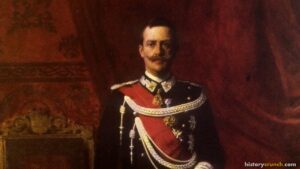
The Axis Powers were led mainly by Nazi Germany, fascist Italy, and Imperial Japan, and these nations worked together to expand their power through military aggression. Opposing them were the Allied Powers, which were led by Britain, the Soviet Union, the United States, and China. The war began on September 1st, 1939, when Nazi Germany, under the leadership of Adolf Hitler, invaded the country of Poland.
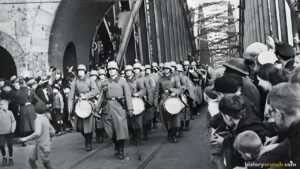
In the early years of the war, from 1939 to 1941, the Nazi German forces moved rapidly across Europe and captured large portions of territory. In fact, Germany experienced a great deal of success with its blitzkrieg, or “lightning war” tactics, which used fast-moving tanks and aircraft to overwhelm enemies. However, the tide of the war slowly turned against the Axis after key Allied victories, such as the Battle of Stalingrad in the Soviet Union and the D-Day landings in France, allowed the Allies to push into Germany from all sides.
What Led to V-E Day?
By the spring of 1945, Allied forces were closing in on Germany from both the east and the west. The British, Canadian, and American armies advanced from the south and the west, while the Soviet Union pushed in from the east. As they crossed into German territory, the advancing soldiers encountered devastated cities, exhausted defenders, and horrific evidence of Nazi crimes in the concentration camps.
The final major fighting in Europe took place during the Battle of Berlin, which lasted from April 16th to May 2nd, 1945. In this battle, Soviet forces surrounded and captured the German capital in fierce street-by-street combat. Seeing that his regime was collapsing, the Nazi dictator Adolf Hitler took his own life in an underground bunker beneath Berlin on April 30th, 1945.
Following Hitler’s death, leadership of Nazi Germany passed to Grand Admiral Karl Dönitz, who understood that Germany could not win the war. As a result, he began arranging for the surrender of the German armed forces. Within days, the last German commanders agreed to lay down their arms.
How Did Germany Surrender?
The surrender of Nazi Germany did not happen all at once, which is part of why the date of V-E Day can seem confusing. On May 7th, 1945, a German general named Alfred Jodl signed an act of military surrender at the Allied headquarters in the French city of Reims. This document called for an unconditional surrender, meaning Germany gave up completely without any conditions of its own.
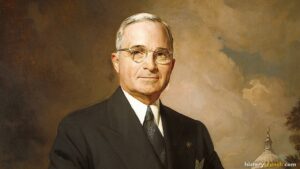
The surrender was set to take effect the following day, May 8th, 1945, which is why the Western Allies chose that date to celebrate V-E Day. In the United States, President Harry S. Truman declared May 8th as V-E Day, and most of the Western Allies followed his lead. A second surrender ceremony was then held near Berlin to satisfy the Soviet Union, which wanted the agreement signed in the German capital itself.
Because of the time difference and the second signing, the Soviet Union marked its Victory Day on May 9th instead of May 8th. This is why Russia and several other countries still celebrate the victory a day later than the Western nations. In reality, the different dates reflect the same event, which was the complete collapse and surrender of Nazi Germany.
How Did People Celebrate V-E Day?
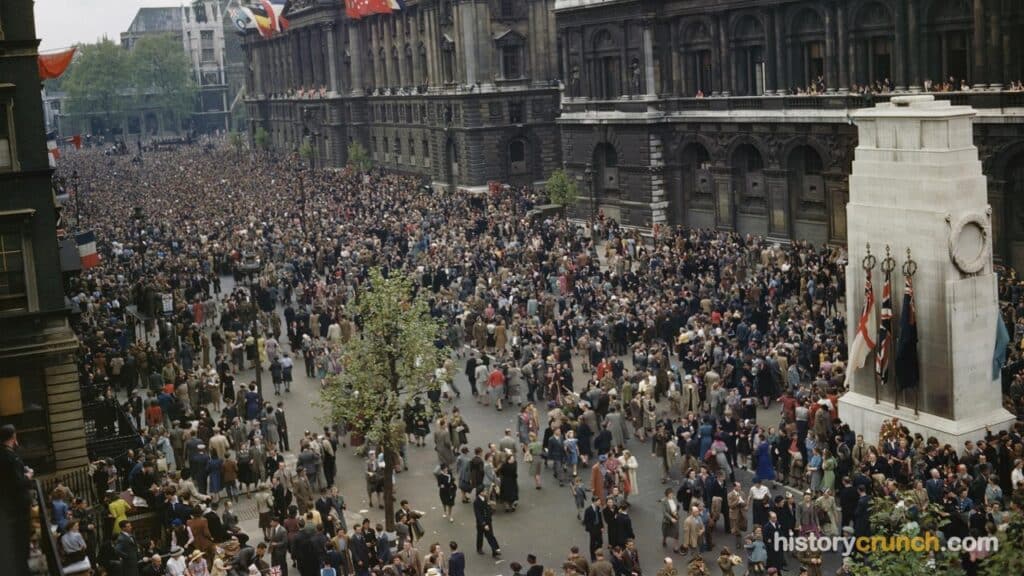
News of the German surrender set off enormous celebrations across the Allied nations. Millions of people who had endured years of bombing, rationing, and loss finally had a reason to rejoice. In cities and towns across Europe and North America, ordinary life stopped as crowds gathered to mark the end of the war in Europe.
In London, huge crowds filled the streets, and the British Prime Minister Winston Churchill and the royal family appeared on the balcony of Buckingham Palace to wave at the cheering people. In the United States, church bells rang and car horns blared as hundreds of thousands of people packed into Times Square in New York City to sing and celebrate. In the United Kingdom, May 8th was declared a national holiday, and people lit bonfires and packed pubs to mark the occasion.
For many people, however, the joy was mixed with quieter feelings of grief and reflection. Millions of soldiers and civilians had died during the war, and families across the world had lost loved ones. As a result, many people also went to houses of worship to give thanks and to pray for those still fighting in the Pacific.
Did V-E Day End World War II?
Although V-E Day was a moment of great relief, it did not mark the end of World War II as a whole. The victory ended the fighting in Europe, but the war against Imperial Japan continued in the Pacific Theater for several more months. Many soldiers who celebrated in May of 1945 knew they might soon be sent to fight in Asia.
The war in the Pacific finally ended after the United States dropped two atomic bombs on the Japanese cities of Hiroshima and Nagasaki in August of 1945. Japan then agreed to surrender, and this event was celebrated as V-J Day, short for Victory over Japan Day. The formal Japanese surrender was signed aboard an American battleship in Tokyo Bay on September 2nd, 1945, which brought World War II to its true conclusion.
Significance of V-E Day
V-E Day is remembered as one of the most important days of the twentieth century because it marked the defeat of Nazi Germany and the end of one of the darkest chapters in European history. The surrender ended years of Nazi aggression, occupation, and mass murder that had spread across the continent. For millions of people who had suffered under Nazi rule, the victory brought freedom and the hope of rebuilding their lives.
The end of the war in Europe also helped shape the world that followed. In the years after 1945, the United States and the Soviet Union emerged as the two most powerful nations, and their rivalry soon grew into the long standoff known as the Cold War. In fact, Germany itself was divided into zones controlled by the Allied nations, a split that would later become the border between East and West for decades.
Today, V-E Day is still commemorated each year in many countries as a time to remember the sacrifices made during World War II. The day honors the soldiers who fought, the civilians who suffered, and the millions who lost their lives. As stated above, it stands as both a celebration of victory and a reminder of the terrible cost of war.
Frequently Asked Questions
What Does V-E Day Stand For?
V-E Day stands for Victory in Europe Day. The letter “V” stands for victory, and the letter “E” stands for Europe. The name was used to describe the day the Allied Powers achieved victory over Nazi Germany in the European part of World War II, and it is written with a hyphen to make it easy to read.
When Is V-E Day Celebrated?
V-E Day is celebrated on May 8th in most Western countries, including the United States, Britain, and France. However, Russia and some other nations observe their Victory Day on May 9th because of the time difference and a second surrender ceremony held near Berlin. Both dates mark the same event, which was the unconditional surrender of Nazi Germany.
Who Surrendered on V-E Day?
Nazi Germany surrendered to the Allied Powers, ending the war in Europe. After Adolf Hitler died, the new German leader Karl Dönitz arranged the surrender, and German General Alfred Jodl signed the act of military surrender in Reims, France. The surrender was unconditional, meaning Germany gave up completely without any terms of its own.
Did World War II End on V-E Day?
No, World War II did not fully end on V-E Day because the fighting in the Pacific continued against Imperial Japan. V-E Day ended only the European part of the war in May of 1945. The entire war did not end until Japan surrendered in the summer of 1945, an event later celebrated as V-J Day.
Why Is V-E Day Still Important Today?
V-E Day is still important because it marked the defeat of Nazi Germany and helped shape the modern world. It ended years of Nazi aggression and set the stage for the rebuilding of Europe and the rise of the United States and the Soviet Union as superpowers. Many countries continue to honor the day each year to remember the sacrifices made during the war.
Cite This Article
To cite this article as a source, use one of the formats below.
MLA: Millar, B. “V-E Day: A Detailed Summary.” HistoryCrunch, 14 August 2026, https://historycrunch.com/v-e-day/.
APA: Millar, B. (2026). V-E Day: A Detailed Summary. HistoryCrunch. https://historycrunch.com/v-e-day/
Chicago: Millar, B. “V-E Day: A Detailed Summary.” HistoryCrunch. August 14, 2026. https://historycrunch.com/v-e-day/
Sources
- J.M. Roberts & Odd Arne Westad, The Penguin History of the World.
- Jerry Bentley & Herbert Ziegler, Traditions & Encounters: A Global Perspective on the Past.