The Industrial Revolution was one of the most important events in human history and dramatically transformed life for people throughout the world. While it first began in Britain, its effects later spread to other parts of Europe, the Americas and now parts of Asia. In general, the Industrial Revolution unfolded in a series of stages which historians refer to as the First Industrial Revolution and the Second Industrial Revolution.
 FactsthatCrunch
The Industrial Revolution unfolded in two distinct phases, each with its own focus, power sources, and key products.
First Industrial Revolution
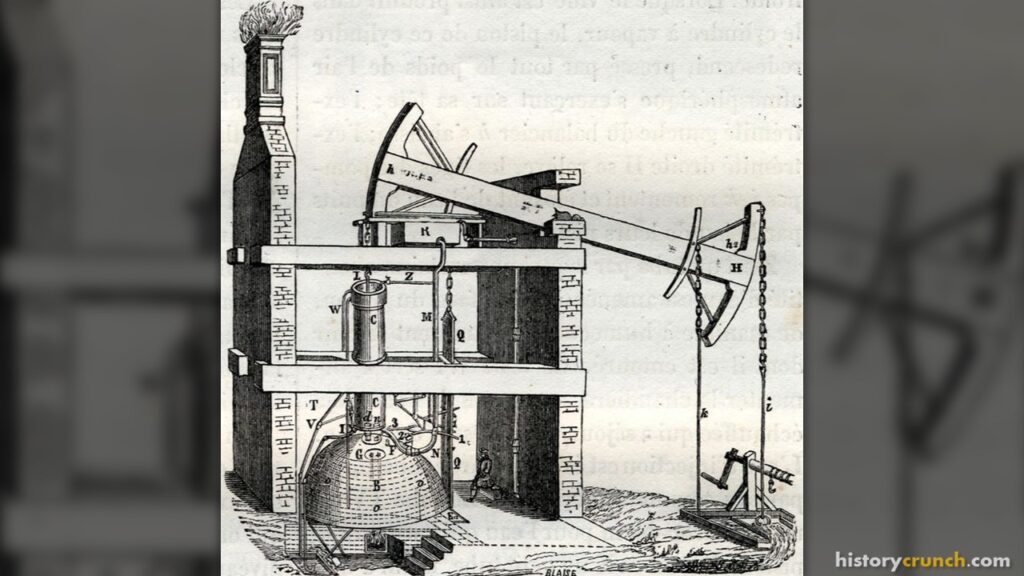
The First Industrial Revolution began in the 18th century and focused primarily on textile manufacturing and steam power. During this time period inventors across Europe and the United States created devices and machines that mechanizedWhen machines take over work that people used to do by hand. production. For example, the steam engine was a vitally important invention to the revolution because it lessened the need for manual labor. The first practical steam engine was created by Thomas Newcomen in 1712. Newcomen produced items for tin mine owners who often complained that they were struggling to deal with flooding in their mines. Traditional methods of removing water from the mines were slow and hard work. Newcomen realized that he could help the tin mine owners. He developed a pump engine that used a pistonA moving part inside a cylinder that transfers force, used in early steam engines. in a cylinder; it was the first of its kind. In the 1760s, James Watt improved on and perfected the design first produced by Thomas Newcomen. In 1764, Watt was given a Newcomen steam engine to repair. He started working on it and soon realized that it was inefficient. As a result, Watt wanted to improve the design. He was successful, and found a way to stop wasting heat and fuel by adding a separate condensing chamber. Watt patented his new steam engine design, and it paved the way for other mechanical design work.
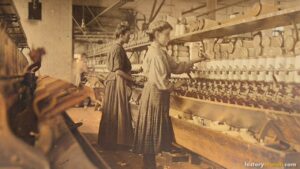
Textile manufacturing benefitted from the effects of the First Industrial Revolution and there were several inventions that streamlined the manufacturing process. In 1733, the clockmaker John Kay invented the flying shuttle, which replaced the handheld shuttle used in weaving. His invention sped up the weaving process and allowed for faster production such that weavers were outpacing spinners. In 1764, James Hargreaves, a carpenter, developed a way to speed up spinning. He did this by attaching several spindles to a single spinning wheel. Using this spinning jenny, as it was called, a person could spin several threads at once. In 1769, Richard Arkwright developed a spinning machine, called the water frame, that could hold up to 100 spindles and was capable of producing strong yarn. The machine replaced the need for manual labor and enabled the production of inexpensive spun cotton by the use of moving water from a creek or river. It was important at the time because cotton was used for clothing and other everyday items. In 1793, the American Eli Whitney invented the cotton gin – a machine that automated and sped up the separation of cottonseed from the short-staple cotton fiber. The invention helped the British cotton industry because it increased the production of cotton and made it cheaper. Samuel Slater is considered to be the “Father of the American Industrial Revolution” when he introduced British industrial techniques into American textile mills in the late 18th century. Slater, who was born in England, arrived in the United States in 1789 and having memorized many of the techniques used in British factories, used his knowledge to develop similar production methods in the United States. For example, he helped a fledgling textile mill in Rhode Island in 1793 with the operation of its spindle frame. Soon, Slater’s designs were spreading across the east coast of the United States in numerous other textile operations.
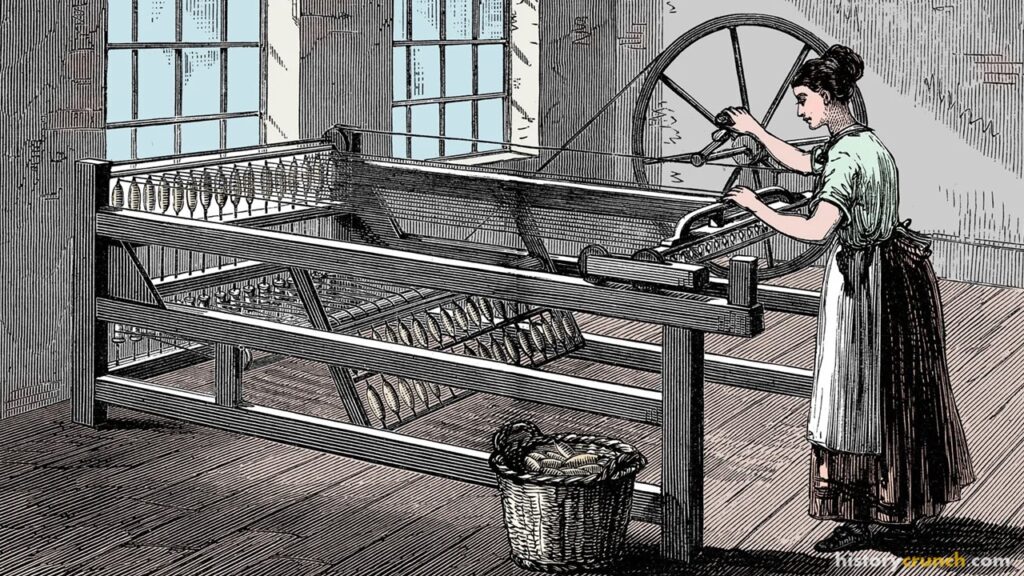
James Watt invented the steam engine during the Industrial Revolution.
Second Industrial Revolution
The Second Industrial Revolution began in the mid-19th century and continued until the start of World War I in 1914. While the First Industrial Revolution centered on textile manufacturing and the innovation of the steam engine, the Second Industrial Revolution focused instead on steel production, the automobile and advances in electricity. Discoveries in the field of electricity improved communication technologies. In 1866, the first underwater telegraph cable across the Atlantic Ocean was successfully installed, and ten years later, Alexander Graham Bell invented the telephone. In the late 1800s American Thomas Edison produced an amazing array of inventions. Among them were the phonograph and the incandescent light bulb. In 1886, German scientist Gottlieb Daimler devised an internal combustion engineAn engine powered by burning gasoline inside it, used to drive early automobiles. that was fueled by gasoline and could power a small vehicle. His invention was one of the biggest advances in transportation technology since the development of the steam engine. Daimler would use his engine to create one of the first automobiles. An improvement in production was the introduction of the assembly line by Henry Ford in 1913. On an assembly lineA system where building a product is split into small tasks, each done by one worker in sequence., the complex job of assembling many parts into a finished product was broken down into a series of small tasks. It sped up production and reduced costs as each worker was only required to install one or two parts at their position on the assembly line. Ford would use the assembly line to speed up the production of automobiles in his factory in Highland Park, Michigan.
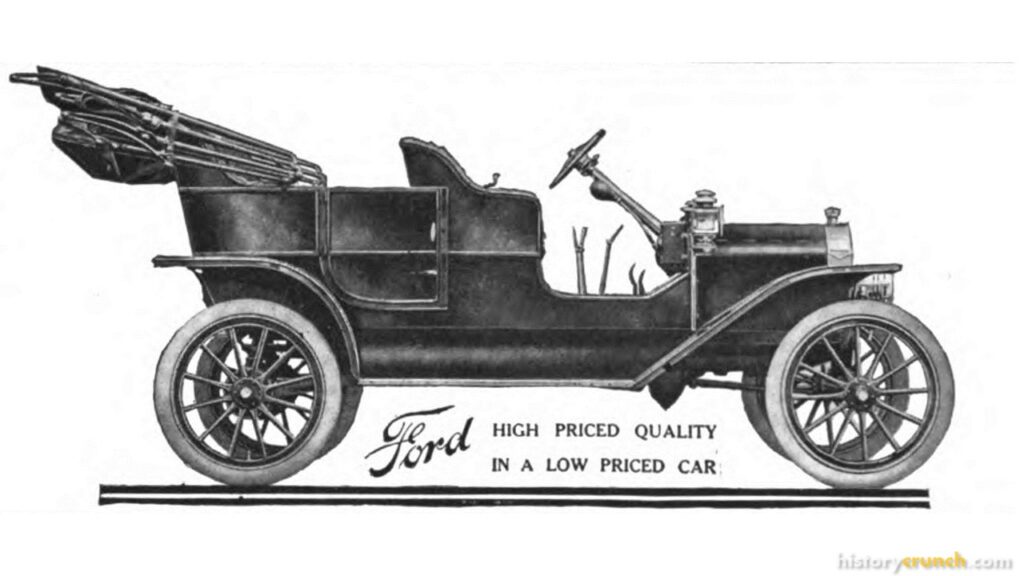
Can you put these four Second Industrial Revolution inventions in the order they appeared?
Key Vocabulary
Mechanized
Piston
Spinning jenny
Water frame
Cotton gin
Internal combustion engine
Assembly line
Frequently Asked Questions
What is the main difference between the First and Second Industrial Revolutions?
The First Industrial Revolution centered on textile manufacturing and steam power. The Second Industrial Revolution instead focused on steel production, automobiles, and electricity. The First began in the 18th century, while the Second started in the mid-19th century and lasted until World War I.
When did each Industrial Revolution take place?
The First Industrial Revolution began in the 18th century, mainly during the 1700s. The Second Industrial Revolution started in the mid-19th century and continued until World War I began in 1914. Both periods overlapped as new inventions kept building on older ones.
Why was the steam engine so important to the First Industrial Revolution?
The steam engine was vital because it reduced the need for manual labor and powered new machines. Thomas Newcomen built the first practical one in 1712 to pump water out of flooded tin mines. James Watt later improved the design in the 1760s by adding a separate condensing chamber.
What inventions came from the Second Industrial Revolution?
The Second Industrial Revolution produced the telephone, the light bulb, and the gasoline-powered engine. Alexander Graham Bell invented the telephone in 1876, and Thomas Edison created the phonograph and incandescent light bulb. Gottlieb Daimler built a gasoline internal combustion engine in 1886 that helped create early automobiles.
Who was the “Father of the American Industrial Revolution”?
Samuel Slater earned that title for bringing British factory methods to the United States. Born in England, he arrived in America in 1789 after memorizing key production techniques. He helped a textile mill in Rhode Island in 1793, and his designs soon spread along the east coast.
What was the assembly line and who introduced it?
The assembly line broke the complex job of building a product into many small tasks. Henry Ford introduced it in 1913 at his factory in Highland Park, Michigan. This sped up production and lowered costs because each worker installed only one or two parts.
Cite This Article
To cite this article as a source, use one of the formats below.
MLA: Beck, Elias. “First Industrial Revolution vs Second Industrial Revolution: A Detailed Comparison.” HistoryCrunch, 27 September 2026, https://historycrunch.com/first-industrial-revolution-vs-second-industrial-revolution/.
APA: Beck, E. (2026). First Industrial Revolution vs Second Industrial Revolution: A Detailed Comparison. HistoryCrunch. https://historycrunch.com/first-industrial-revolution-vs-second-industrial-revolution/
Chicago: Beck, Elias. “First Industrial Revolution vs Second Industrial Revolution: A Detailed Comparison.” HistoryCrunch. September 27, 2026. https://historycrunch.com/first-industrial-revolution-vs-second-industrial-revolution/
Sources
- The Science Museum Group
- Emma Griffin, A Short History of the British Industrial Revolution.
- Robert C. Allen, The Industrial Revolution: A Very Short Introduction.
- Fordham Modern History Sourcebook