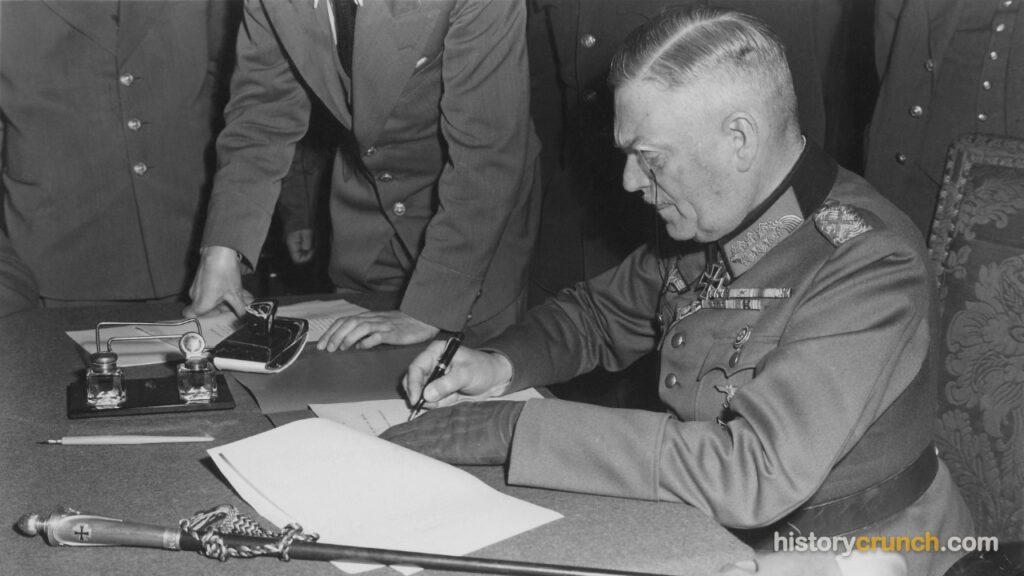
The fall of Nazi Germany was one of the most important events of the twentieth century, and it marked the end of one of the most destructive regimes in all of world history. Nazi Germany, led by Adolf Hitler and the Nazi Party, had plunged the world into the Second World War and carried out the mass murder of millions of people during the Holocaust. By the spring of 1945, the country lay in ruins, its cities bombed, its armies shattered, and its leader dead. The collapse of the regime came after years of fighting on multiple fronts and ended with the unconditional surrender of German forces on May 8th, 1945.
The term “fall of Nazi Germany” refers to the final stages of the Second World War in Europe, roughly from the summer of 1944 until May of 1945, when the combined armies of the Allied Powers closed in on Germany from every direction and destroyed the Nazi state. It includes the major military campaigns of the war’s final year, the death of Adolf Hitler, the surrender of the German military, and the beginning of the punishment and rebuilding that followed.
What Was the Second World War?
The Second World War was a global conflict that lasted from 1939 until 1945 and involved nations from every part of the world. The war in Europe began on September 1st, 1939, when Nazi Germany, under the leadership of Adolf Hitler, invaded Poland using a fast and aggressive style of fighting known as blitzkrieg. In response, Britain and France declared war on Germany on September 3rd, 1939, and the conflict quickly spread across the continent.
The main sides in the war were the Allied Powers and the Axis Powers. The Allied Powers included Britain, France, the Soviet Union, and the United States, while the Axis Powers were led by Nazi Germany, Fascist Italy, and Imperial Japan. The war was the deadliest in human history, resulting in an estimated 70 to 85 million deaths and causing enormous changes to the political, social, and economic landscape of the entire world.
For the first few years of the war, Nazi Germany seemed unstoppable. It conquered Poland, defeated France in the spring of 1940, and controlled much of Europe. In June of 1941, Germany launched a massive invasion of the Soviet Union known as Operation Barbarossa, which was the largest land invasion in history. The turning of the tide against Germany, and its eventual fall, grew out of the failure of this enormous gamble in the east.
Why Did Nazi Germany Begin to Collapse?
The decline of Nazi Germany was caused by a series of major defeats that slowly drained its strength. The most important turning point came at the Battle of Stalingrad, which lasted from the summer of 1942 until February of 1943. There, an entire German army was surrounded and destroyed by the Soviet Union, and Germany’s hope of a lasting offensive in the east collapsed.
By 1943, it was becoming increasingly clear that Germany would eventually be defeated by the pressure of the Allied Powers. In fact, Germany was now forced to fight on several fronts at the same time, which stretched its armies and resources far too thin. In the east, the Soviet Union pushed the Germans back through Eastern Europe, while in the south the Allies invaded Italy and forced Axis forces out of the Mediterranean.
At the same time, Britain and the United States carried out a massive bombing campaign against German cities and factories. These air raids destroyed housing, transportation, and war production and left the German people exhausted. As stated above, the combination of defeats on land and destruction from the air meant that by 1944 the fall of Nazi Germany was only a matter of time.
How Did the Allies Close In on Germany?
A key moment in the fall of Nazi Germany came on June 6th, 1944, a day known as D-Day. On that morning, the United States, Britain, and Canada landed on five beaches along the coast of Normandy in northern France and faced difficult resistance from German soldiers. The landings succeeded, and the Allies were able to open the beaches to more troops and heavy weapons.
The D-Day landings were important because they opened a new front in Western Europe and began the process of liberating France. Over the following months, the Allied armies pushed the Germans back and freed Paris in August of 1944. More specifically, Germany was now squeezed between the Western Allies advancing from the west and the Soviet Union advancing from the east.
In December of 1944, Germany launched a desperate counterattack in the west known as the Battle of the Bulge. German forces inflicted heavy casualties on the Allies, but they ultimately failed to turn the tide of the war. This last major German offensive used up resources that Germany could not replace, and it left the country nearly defenseless. In March of 1945, the Western Allies crossed the Rhine River and pushed deep into Germany, capturing hundreds of thousands of German troops.
What Happened During the Battle of Berlin?
The final major battle of the war in Europe was the Battle of Berlin, which decided the fate of Nazi Germany. As the Western Allies pushed in from the south and west, the Soviet Union advanced from the east and reached the German capital of Berlin. The Soviet army gathered a huge force of over one and a half million soldiers outside the city, which was already heavily damaged by years of bombing.
The Soviets began a massive assault on Berlin in April of 1945, and by April 25th they had completely surrounded the city. That same day, Soviet forces linked up with American troops near the town of Torgau in central Germany. Berlin was defended by a mix of exhausted regular soldiers, local militia known as the Volkssturm, and members of the Hitler Youth, but they had little chance against the overwhelming Soviet firepower.
Fierce street-by-street fighting followed as Soviet troops fought their way toward the center of the city. Many important Nazi leaders killed themselves rather than be captured. In fact, Adolf Hitler himself committed suicide in a bunker underneath Berlin on April 30th, 1945, while Soviet forces were only a short distance away. Within days, organized German resistance in the city collapsed, and Berlin fell to the Soviet Union.
How Did Nazi Germany Surrender?
After the death of Hitler, leadership of what remained of Nazi Germany passed to Grand Admiral Karl Dönitz, who quickly sought to end the war. With the country overrun from every direction and its armies destroyed, there was no way to continue fighting. German commanders began surrendering their forces across Europe in the first days of May of 1945.
Germany signed an unconditional surrender at the town of Reims in France on May 7th, 1945, and a second signing took place in Berlin the following day. An unconditional surrender meant that Germany gave up completely without any conditions or bargaining. This surrender officially ended the Second World War in Europe and brought the Nazi regime to an end.
May 8th, 1945 became known as Victory in Europe Day, or V-E Day, and celebrations broke out in cities across Britain, France, the United States, and beyond. The Soviet Union celebrated its victory a day later, on May 9th, because of the time difference. For many people, the day marked the end of nearly six years of war and suffering in Europe. However, the wider Second World War was not yet over, since the Allies were still fighting Imperial Japan in the Pacific.
What Happened After the Fall of Nazi Germany?
With the fall of Nazi Germany, the Nazi Party was banned, and the country was placed under the control of the victorious Allies. Germany was divided into four zones of occupation, controlled by the United States, Britain, France, and the Soviet Union. The capital city of Berlin, which sat inside the Soviet zone, was itself divided among the four powers.
The Allies also worked to hold Nazi leaders responsible for their crimes. Beginning in late 1945, an International Military Tribunal put senior Nazis on trial in the German city of Nuremberg for crimes against peace, war crimes, and crimes against humanity, including the Holocaust. Many leading Nazis were found guilty, and a number of them were sentenced to death or long prison terms. The Allies chose Nuremberg on purpose, since it had once been a center of Nazi rallies, and they wanted the trials to symbolize the death of Nazi Germany.
The division of Germany also helped set the stage for the next great struggle of the twentieth century. The two most powerful victors, the United States and the Soviet Union, soon became rivals, and their disagreements over the future of Europe grew into the Cold War. In time, the country was split into two separate states, West Germany and East Germany, which remained divided for decades.
Significance of Fall of Nazi Germany
The fall of Nazi Germany is significant because it ended one of the most violent and destructive regimes in world history and brought the war in Europe to a close. The defeat of the Nazi state stopped the machinery of the Holocaust and freed the survivors of the concentration camps, though only after millions had already been murdered. In reality, the collapse of the regime came too late for the many victims of Nazi violence.
The fall of Nazi Germany also reshaped the political map of the world. The war left the United States and the Soviet Union as the two most powerful nations on earth, and their rivalry defined global politics for the rest of the century. In addition, the division and occupation of Germany, along with the trials at Nuremberg, set important examples for how the world would deal with defeated nations and with those responsible for terrible crimes.
Finally, the fall of Nazi Germany served as a warning for future generations about the dangers of extreme nationalism, dictatorship, and hatred. The events of the war and the Holocaust showed how a modern nation could be turned toward mass murder and conquest. For this reason, the collapse of the Nazi regime remains one of the most studied and remembered turning points in all of world history.
Frequently Asked Questions
When Did Nazi Germany Fall?
Nazi Germany officially fell on May 8th, 1945, when German forces surrendered unconditionally to the Allies. The final collapse came after months of defeats in early 1945, including the loss of Berlin to the Soviet Union. The date is remembered as Victory in Europe Day, or V-E Day, and it marked the end of the war in Europe.
What Happened to Adolf Hitler at the End of the War?
Adolf Hitler committed suicide on April 30th, 1945, in a bunker underneath Berlin as Soviet troops closed in on the city. He had spent his final weeks hidden in this fortified shelter, cut off from the collapsing world above. His death removed the leader who had driven Germany into war and made the country’s surrender only a matter of days away.
Who Defeated Nazi Germany?
Nazi Germany was defeated by the combined efforts of the Allied Powers, especially Britain, the United States, and the Soviet Union. The Soviet Union bore the heaviest fighting and the greatest losses on the Eastern Front, while the Western Allies advanced from the west after the D-Day landings. It was the pressure of all these forces at once that finally crushed the German war effort.
What Were the Nuremberg Trials?
The Nuremberg Trials were a series of court cases held after the war in which senior Nazi leaders were put on trial for their crimes. They took place in the German city of Nuremberg and charged the defendants with crimes against peace, war crimes, and crimes against humanity. The trials set lasting legal examples and helped establish the idea that leaders could be held responsible for terrible acts even in wartime.
Did the Fall of Nazi Germany End World War II?
The fall of Nazi Germany ended the war in Europe but not the entire Second World War. After May of 1945, the Allies were still fighting Imperial Japan in the Pacific Theater. The wider war only ended in the late summer of 1945, after the United States dropped atomic bombs on Japan and Japan surrendered.
Cite This Article
To cite this article as a source, use one of the formats below.
MLA: Millar, B. “Fall of Nazi Germany: A Detailed Summary.” HistoryCrunch, 15 August 2026, https://historycrunch.com/fall-of-nazi-germany/.
APA: Millar, B. (2026). Fall of Nazi Germany: A Detailed Summary. HistoryCrunch. https://historycrunch.com/fall-of-nazi-germany/
Chicago: Millar, B. “Fall of Nazi Germany: A Detailed Summary.” HistoryCrunch. August 15, 2026. https://historycrunch.com/fall-of-nazi-germany/
Sources
- USHMM
- Richard J. Evans, The Third Reich Trilogy.
- German History in Documents and Images (GHDI)
- Ian Kershaw, Hitler (biography).