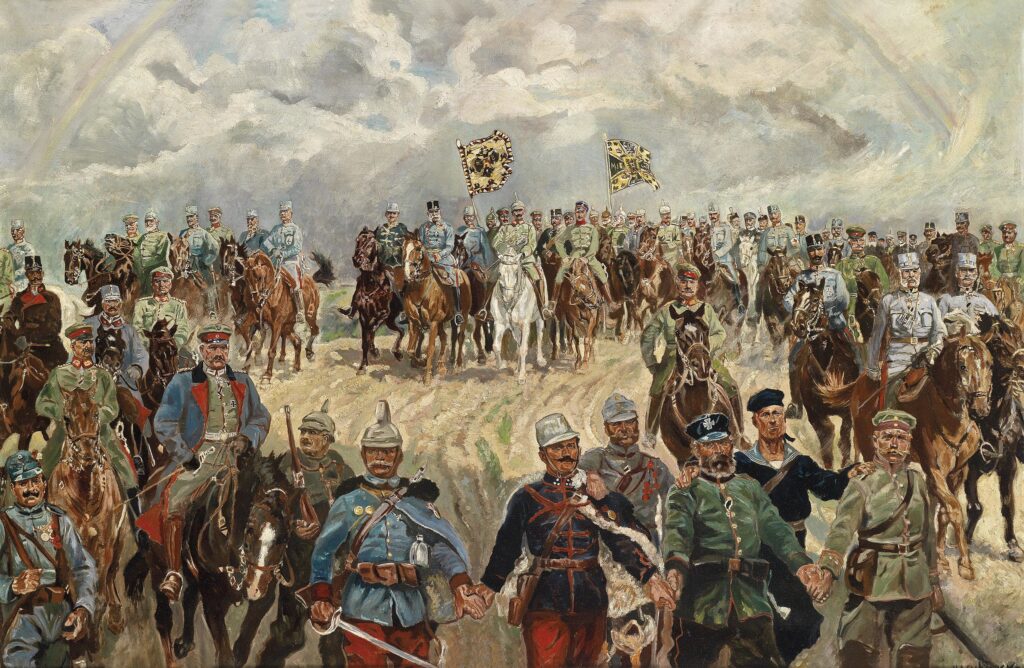
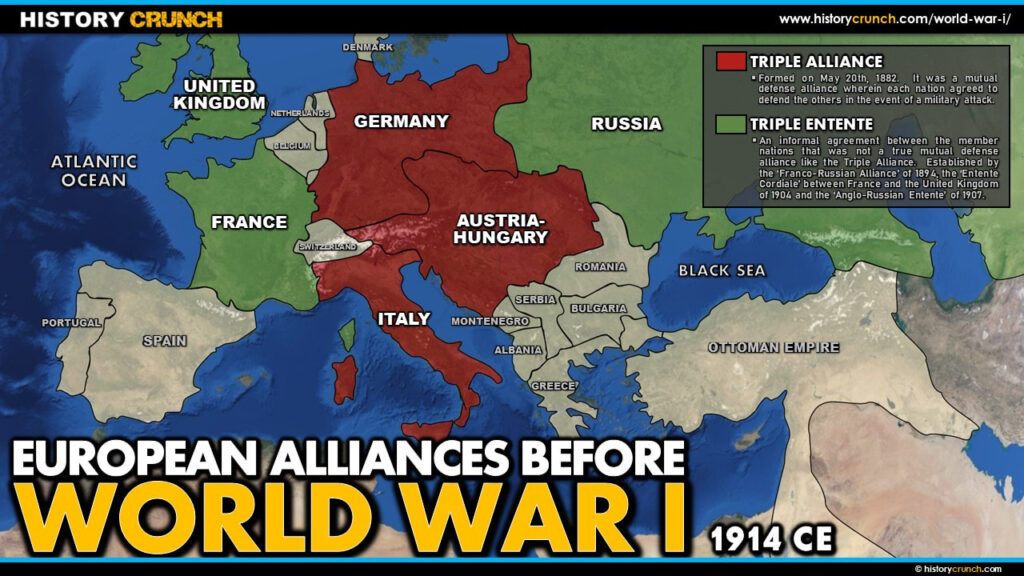
The Triple Alliance of World War I was a mutual defense allianceAn agreement where each member country promises to help protect the others if they are attacked. between the major European nations of Germany, Austria-Hungary and Italy. This means that each member nation agreed to come to the military aid and defense of the other member nations in the event that they were attacked. The Triple Alliance was first formally established by the member nations on May 20th, 1882. In the years leading up to 1914, which was the start of World War I, the main terms of the Triple Alliance were renegotiatedWhen the terms of an existing agreement are discussed and changed by the parties involved. and renewed several times. For instance, each of the member nations had shifting loyalties and issues of national interest in the three decades before World War I, which caused them to seek new terms of the original agreement.
 FactsthatCrunch
Why was the Triple Alliance Created?
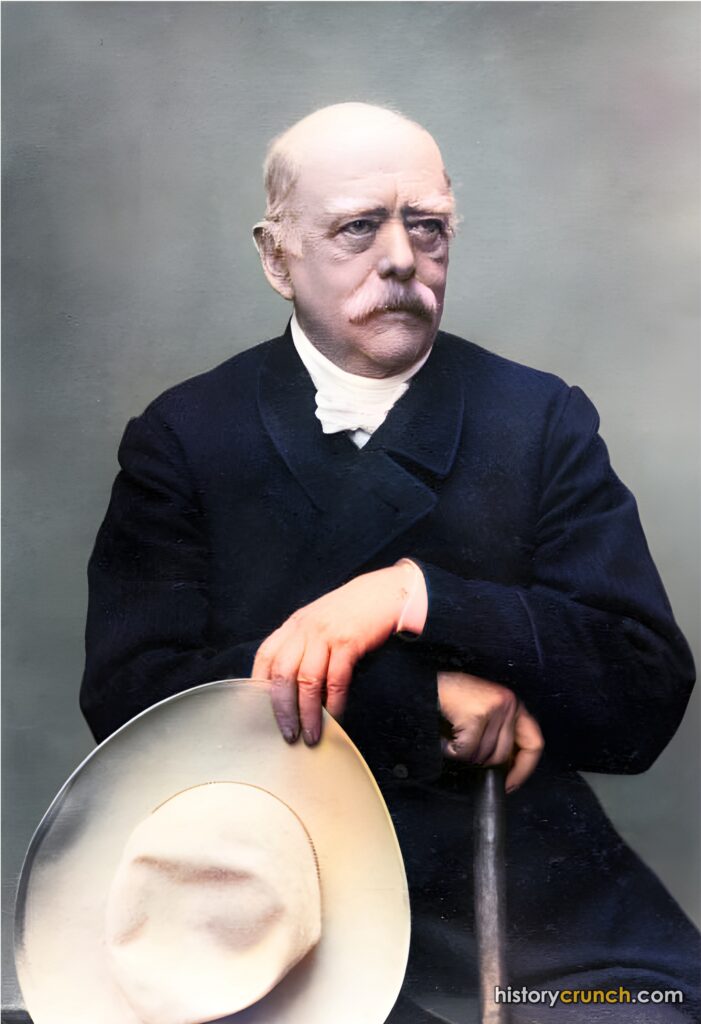
Germany was the main nation that sought to create the Triple Alliance in 1882. At the time, Germany was led by Otto von Bismarck. Bismarck is remembered today for his role in unifying the country of Germany from a series of smaller kingdoms in 1871. He was also the first ChancellorThe head of government in Germany, similar to a prime minister. of Germany and served in the role from 1871 until 1890. Following a series of small wars against other European powers, including France, Bismarck sought to protect German interests in Europe. More specifically, Prussia (the largest Germanic Kingdom before the unification of Germany) defeated France in the Franco-Prussian War, which lasted from 1870 until 1871. As part of its defeat, France gave up a territory of its land called Alsace-LorraineA border territory France was forced to give up to Germany after losing the Franco-Prussian War., which bordered with Germany. Germany’s control over Alsace-Lorraine was a major factor, which led to heightened tensions between Germany and France. As such, Germany approached Austria-Hungary about forming an alliance. The German states and Austria had a long history of cooperation, due to their ethnic, cultural and political similarities. Italy joined the agreement as a means of protecting itself from France, following imperialisticRelated to a powerful country taking control of foreign lands or colonies to expand its power. competition in Africa over colonies.
 FactsthatCrunch
The great questions of the day will not be decided by speeches and majority resolutions, that was the great mistake of 1848 and 1849, but by iron and blood.
Bismarck spoke to the Prussian parliament's budget committee, which was blocking funds for the army. He argued that military power, not debate, would unite Germany, and three wars later it did. As Chancellor, he then used alliances, including the Triple Alliance of 1882, to protect the new German Empire from France.
How did the Triple Alliance Impact World War I?
Therefore, the Triple Alliance was a major factor in dividing Europe between the European powers of the time. In fact, one of the main reasons why historians consider the alliance systems before World War I as a main cause for the outbreak of the war, is because it set the stage for hostilities between nations such as Germany and France. For example, the Triple Alliance eventually led to the informal agreement of the Triple Entente between Britain, France and Russia as a competing alliance system in Europe. Another issue related to the Triple Alliance and the outbreak of World War I was that the main terms of the treaty were kept secret. This helped lead to the start of World War I because it prevented the member nations of the Triple EntenteThe informal competing alliance formed by Britain, France, and Russia in response to the Triple Alliance. from understanding how their actions impacted the military response from Germany. As a result, this caused the tensions between the nations to increase dramatically following the assassination of Austrian Archduke Franz Ferdinand on June 28th, 1914.
As stated above, the terms of the original agreement for the Triple Alliance were renegotiated several times. In fact, the member nations of Germany, Austria-Hungary and Italy did not always agree with each other on certain issues. For instance, Italy and Austria-Hungary had competing interests in the region and islands along the Adriatic Sea and the border they shared. This sense of competition led Italy to make a secret agreement with France in 1902, just months after renewing the Triple Alliance with Germany and Austria-Hungary. In general, the agreements that Italy made centered on its own interests in North Africa and the Balkans, which is a region in southeastern Europe. As such, when tensions between the European nations erupted after the assassination of Franz Ferdinand, Italy was pulled by both the nations of the Triple Alliance and the Triple Entente.
Ultimately, Italy sided with the Triple Entente as it considered Austria-Hungary to be the aggressorA country or side that is seen as starting or escalating a conflict through hostile actions. in the lead up to World War I. This is because, following Ferdinand’s death, Austria-Hungary began taking aggressive actions against Serbia, which was located in the Balkans. As a result, Italy declared war against Austria-Hungary in May of 1915 and joined the Allied Powers alongside France, Britain and Russia. More specifically, Italy officially left the Triple Alliance on May 3rd, 1915. Meanwhile, Austria-Hungary and Germany formed the Central Powers. Regardless, historians consider the history of the Triple Alliance as a significant contributing factor to the start of World War I in 1914.
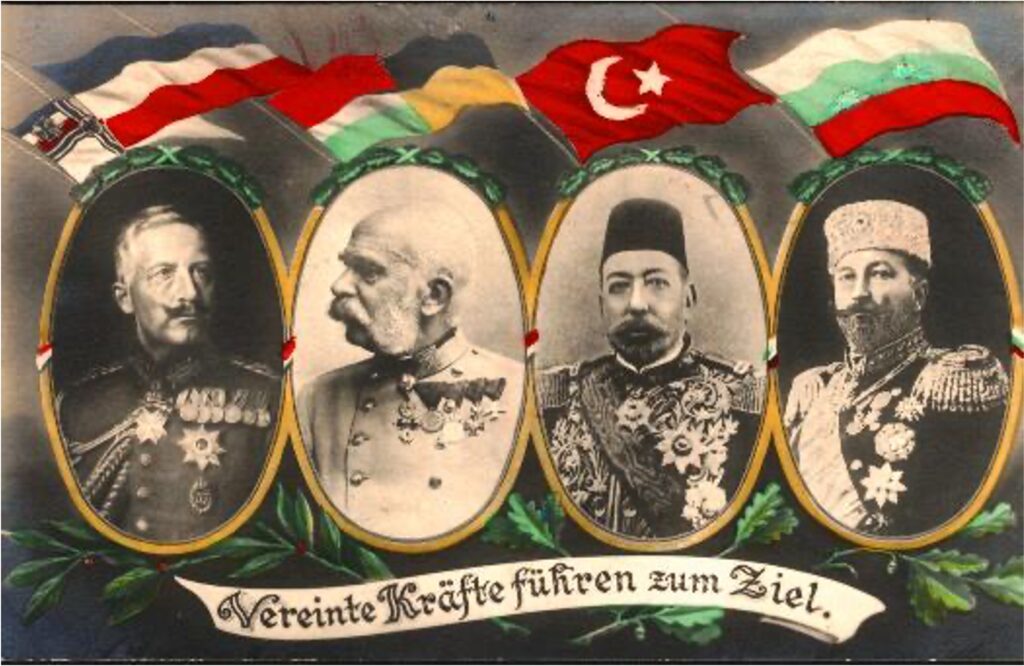
Italy fought on the same side as Germany and Austria-Hungary throughout World War I because of the Triple Alliance.
World War I timeline · 1914 – 1918
Key Vocabulary
Mutual defense alliance
Renegotiated
Chancellor
Alsace-Lorraine
Imperialistic
Triple Entente
Aggressor
Frequently Asked Questions
What was the Triple Alliance in World War I?
The Triple Alliance was a mutual defense agreement between Germany, Austria-Hungary, and Italy. Each member promised to defend the others if they were attacked. It was first formally established on May 20th, 1882. The terms were renewed and changed several times in the decades before the war.
Why was the Triple Alliance created?
Germany created the Triple Alliance in 1882 to protect its interests in Europe. German Chancellor Otto von Bismarck feared tension with France after the Franco-Prussian War of 1870 to 1871. Germany took the border territory of Alsace-Lorraine from France, which angered the French. Italy joined mainly to protect itself from France after colonial rivalry in Africa.
How did the Triple Alliance help cause World War I?
The Triple Alliance helped divide Europe into rival camps before the war. It led Britain, France, and Russia to form the Triple Entente as a competing alliance. The terms of the Triple Alliance were also kept secret, which raised suspicion between nations. These tensions grew sharply after Archduke Franz Ferdinand was killed on June 28th, 1914.
Why did Italy leave the Triple Alliance?
Italy left because it saw Austria-Hungary as the aggressor as World War I began. Italy and Austria-Hungary had long competed over land and islands along the Adriatic Sea. Italy had even made a secret deal with France in 1902. Italy officially left the alliance on May 3rd, 1915, and joined the Allied Powers.
What was the difference between the Triple Alliance and the Central Powers?
The Triple Alliance was the prewar agreement between Germany, Austria-Hungary, and Italy. When the war began, Italy stayed neutral, and in 1915 it left the alliance and joined the Allied side. Germany and Austria-Hungary then formed the Central Powers. They were later joined by the Ottoman Empire and Bulgaria.
Cite This Article
To cite this article as a source, use one of the formats below.
MLA: Beck, Elias. “The Triple Alliance and World War I: A Detailed Summary.” HistoryCrunch, 28 September 2026, https://historycrunch.com/triple-alliance-and-world-war-i/.
APA: Beck, E. (2026). The Triple Alliance and World War I: A Detailed Summary. HistoryCrunch. https://historycrunch.com/triple-alliance-and-world-war-i/
Chicago: Beck, Elias. “The Triple Alliance and World War I: A Detailed Summary.” HistoryCrunch. September 28, 2026. https://historycrunch.com/triple-alliance-and-world-war-i/
Sources
- Fordham Modern History Sourcebook
- Margaret MacMillan, The War That Ended Peace.