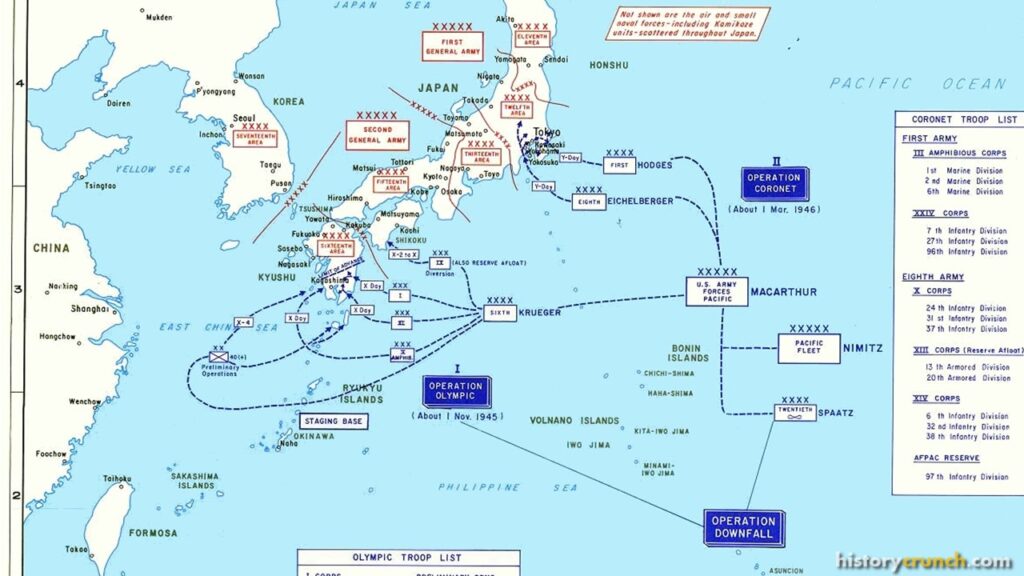
Operation Downfall was the codenameA secret word or phrase used to refer to a military plan without revealing its true purpose. assigned to the proposed Allied invasion of Japan near the end of World War II. The operation was planned in two stages, known as ‘Operation Olympic’ and ‘Operation Coronet’, and would have been the largest amphibiousInvolving military forces attacking from the sea onto land, using both ships and ground troops. military operation in history. However, Operation Downfall was never carried out. Japan surrendered in August of 1945 following the atomic bombings of Hiroshima and Nagasaki and the Soviet Union’s declaration of war against Japan. The planning for Operation Downfall, and the reasons it was ultimately not needed, are an important part of the history of World War II.
 FactsthatCrunch
Operation Downfall, the Allied invasion of Japan, began in 1945 but was stopped partway by the atomic bombs.
Operation Downfall was never carried out. Its first stage, Operation Olympic, was scheduled to begin on November 1st, 1945, but Japan announced its surrender on August 15th, 1945, before a single invasion landing took place.
Operation Downfall – Background
By the middle of 1945, the Allied Powers had made significant progress in the Pacific Theater of World War II. American forces had captured a series of islands across the Pacific, including Iwo Jima and Okinawa, and were drawing closer to the Japanese home islands. Germany had surrendered in May of 1945, which meant that the Allied Powers could now direct their full attention and resources toward defeating Japan. However, despite these advances, Japan showed no signs of surrendering. Japanese forces had fought with extraordinary determination on every island the Allied Powers had attacked, and Allied commanders expected that an invasion of Japan itself would be far more costly than any previous campaign in the Pacific.
The battles of Iwo Jima and Okinawa in early 1945 provided Allied planners with a clear indication of what an invasion of Japan might look like. At Iwo Jima, American forces suffered approximately 26,000 casualties over five weeks of fighting against a Japanese garrison of approximately 22,000 soldiers, of whom nearly all were killed rather than captured. At Okinawa, the fighting lasted almost three months and resulted in approximately 49,000 American casualties. The Japanese defense of Okinawa also involved large-scale kamikaze attacks against the Allied naval fleet, which sank 36 ships and damaged hundreds more. These battles convinced many Allied planners that the Japanese military would defend the home islands to the last soldier, and that the cost of an invasion would be enormous.
FactsthatCrunchGermany surrendered, letting the Allies turn their full attention and resources toward defeating Japan.
Operation Downfall – The Plan
Operation Downfall was planned in two stages. The first stage was ‘Operation Olympic’, which called for the invasion of Kyushu, the southernmost of Japan’s four main islands. Operation Olympic was scheduled to begin on November 1st, 1945. The plan called for approximately 767,000 Allied troops to land on the beaches of southern Kyushu and fight their way inland. The captured island of Okinawa was to serve as the main staging areaA location where troops and supplies are gathered and organized before a military operation begins. for the invasion force. Once Kyushu was secured, airbases would be established there to provide air support for the second stage of the operation.
The second stage was ‘Operation Coronet’, which called for the invasion of the Kanto Plain near Tokyo on the main Japanese island of Honshu. Operation Coronet was scheduled to begin in the spring of 1946. This stage of the operation was planned to be even larger than Operation Olympic, with an estimated force of over one million Allied troops taking part. The goal of Operation Coronet was to capture Tokyo and force the unconditional surrenderA complete surrender with no negotiations or conditions, requiring the losing side to accept all terms of the winner. of Japan. Together, the two stages of Operation Downfall were expected to last up to 18 months and bring the war in the Pacific to a final end.
Responsibility for planning Operation Downfall fell to a group of senior American commanders, including General Douglas MacArthur, Fleet Admiral Chester Nimitz, and the Joint Chiefs of Staff. There was significant disagreement among these commanders about whether an invasion was the best approach. The United States Navy argued that Japan could be defeated without an invasion, through a combination of naval blockadeA military strategy that cuts off an enemy’s access to food, supplies, and resources by surrounding them. and continued aerial bombing, which would cut off Japan’s supply of food and resources. The United States Army, led by General George Marshall, argued that a blockade approach could prolong the war for several more years, and that a direct invasion was necessary to force a quick and decisive surrender. In the end, the Army’s position was accepted and planning for Operation Downfall moved forward.
FactsthatCrunchOperation Downfall – Japanese Defenses
Japan was aware that an Allied invasion of its home islands was likely and began preparing its defenses well in advance. The Japanese defense plan was known as ‘KetsugoJapan’s home-island defense plan, named with a Japanese word meaning ‘decisive,’ designed to inflict massive Allied casualties.‘, which means ‘decisive’. The plan was built around the idea that Japan could not prevent Allied forces from landing, but could inflict such devastating casualties during the landings that the American public would lose the will to continue the war and accept a negotiated peace rather than unconditional surrender.
Japan’s geography limited the number of suitable invasion beaches, and both sides knew it. The beaches of southern Kyushu and the beaches near Tokyo were the only locations that could support the landing of a large invasion force. This means that Japan was able to predict with considerable accuracy exactly where the Allied landings would take place and concentrate its defenses accordingly.
A central part of the Japanese defensive strategy was the use of kamikazeA Japanese suicide attack in which pilots deliberately crashed their planes into enemy ships. attacks on a far larger scale than had been seen at Okinawa. By the summer of 1945, Japan had assembled thousands of airplanes for use in suicide attacks against the Allied invasion fleet. Japanese planners estimated that these attacks could destroy between 30 and 50 percent of the Allied invasion force before it even reached the beaches. Japan also prepared large numbers of suicide boats, manned torpedoes, and other weapons designed to attack Allied ships at close range. Furthermore, Japan began training and arming its civilian population to resist the invaders, including women and older men who were issued weapons and instructed to fight. Historians estimate that Japan had mobilized approximately 2.3 million soldiers and as many as 28 million civilian militia members to defend the home islands.
Operation Downfall – Casualty Estimates
One of the most debated aspects of Operation Downfall was the question of how many casualties an invasion of Japan would have produced. American military planners produced a range of estimates, and the figures varied considerably depending on the assumptions used.
The Joint War Plans Committee estimated that Operation Olympic alone would result in approximately 456,000 American casualties, including around 109,000 killed. Former United States President Herbert Hoover, in a memo submitted to President Harry Truman, estimated that a full invasion of Japan could result in between 500,000 and 1,000,000 American deaths. Some estimates were even higher. In anticipation of the casualties expected from an invasion of Japan, the United States government manufactured approximately 500,000 Purple Heart medals. It should also be noted that casualty estimates for Japanese soldiers and civilians were far higher than those for American forces. Historians have estimated that a full invasion could have resulted in millions of Japanese military and civilian deaths.
These casualty estimates weighed heavily on President Truman and American military leadership as they considered how to bring the war to an end. The scale of the losses expected from Operation Downfall was one of the key factors that contributed to Truman’s decision to authorize the use of atomic weapons against Japan.
FactsthatCrunchIn anticipation of the casualties expected from an invasion of Japan, the United States government manufactured approximately 500,000 Purple Heart medals before the war ended in August 1945. The medals were produced to award soldiers, sailors, and airmen wounded or killed during what planners expected to be a massive, bloody campaign across the Japanese home islands. Japan's surrender made the invasion unnecessary, and the stockpile was never distributed for its intended purpose.
The stockpile was so large that the United States military kept awarding Purple Heart medals from it for decades, through the Korean War, the Vietnam War and beyond. Medals made for a battle that never happened ended up honoring Americans wounded in later wars.
The United States government manufactured approximately 500,000 Purple Heart medals for an invasion that never happened, and the supply lasted for decades of later wars.
Operation Downfall – Cancellation
Operation Downfall was never carried out. In August of 1945, two events brought Japan to the point of surrender and made the invasion unnecessary. On August 6th, 1945, the United States dropped an atomic bomb on the Japanese city of Hiroshima, killing an estimated 70,000 to 80,000 people immediately and destroying the city. Three days later, on August 9th, 1945, a second atomic bomb was dropped on the city of Nagasaki, killing an estimated 40,000 people immediately. On the same day, August 9th, the Soviet Union declared war on Japan and launched a large-scale invasion of Japanese-held Manchuria in northern China. The combination of these events broke Japan’s remaining will to continue the war. Japan announced its surrender on August 15th, 1945, and formally signed the surrender documents on September 2nd, 1945, aboard the American battleship USS Missouri in Tokyo Bay.
With Japan’s surrender, Operation Downfall was cancelled and never executed. The Allied occupation of Japan, rather than an armed invasion, became the means by which Japan transitioned to peace.
FactsthatCrunchFollow the chain from top to bottom. Tap any step to read what happened.
Operation Downfall – Significance
Operation Downfall was significant for several reasons. First, Operation Downfall was significant because it demonstrated the extraordinary scale of preparation that the Allied Powers had undertaken to bring the war in the Pacific to an end. The planning for Operation Downfall involved hundreds of thousands of troops, thousands of ships and airplanes, and detailed coordination between multiple branches of the American military. The operation would have been the largest amphibious invasion in history, surpassing even the D-Day landings in Normandy in June of 1944. The fact that such a massive operation was planned and prepared in detail reflects the seriousness with which Allied commanders approached the challenge of defeating Japan.
Operation Downfall was significant because the casualty estimates associated with it played a direct role in the decision to use atomic weapons against Japan. President Truman and American military planners faced the prospect of enormous losses on both sides if a conventional invasion of Japan was carried out. The atomic bombings of Hiroshima and Nagasaki were authorized in part as a means of ending the war quickly and avoiding the catastrophic casualties that Operation Downfall was expected to produce. As such, Operation Downfall shaped one of the most important and debated decisions in the history of World War II.
Operation Downfall was also significant because its cancellation, and Japan’s subsequent surrender, determined the way in which the post-war occupation of Japan unfolded. Rather than a prolonged and devastating invasion of the Japanese home islands, Japan surrendered relatively intact as a nation and society. The United States led the occupation of Japan under General Douglas MacArthur, which allowed for the rebuilding of Japan as a democratic nation in the years following the war. This process had lasting consequences for the political and economic development of Japan and for the broader relationship between Japan and the United States during the Cold War that followed.
FactsthatCrunchOperation Downfall never happened, but the plan to invade Japan shaped how World War II ended and what came after it.
It would have been the largest amphibious invasion in history, bigger even than the D-Day landings in Normandy in June of 1944.
Its enormous casualty estimates were one of the key reasons President Harry Truman authorized the atomic bombings of Hiroshima and Nagasaki.
Because Japan surrendered before any invasion, it came out of the war largely intact as a nation and society.
The American occupation that followed under General Douglas MacArthur rebuilt Japan as a democracy and a close ally of the United States during the Cold War.
Explore World War II · 1939 – 1945
Keep exploring World War II with these History Crunch resources.
Key Vocabulary
Codename
Amphibious
Kamikaze
Staging area
Blockade
Ketsugo
Unconditional surrender
Frequently Asked Questions
What was Operation Downfall?
Operation Downfall was the codename for the planned Allied invasion of Japan near the end of World War II. It was designed in two stages, Operation Olympic and Operation Coronet. It would have been the largest amphibious military operation in history, but it was never carried out.
Why was Operation Downfall never carried out?
Operation Downfall was cancelled because Japan surrendered in August of 1945 before any invasion began. The atomic bombings of Hiroshima and Nagasaki, along with the Soviet declaration of war, broke Japan’s will to fight. Japan announced its surrender on August 15th, 1945, which made the invasion unnecessary.
What were Operation Olympic and Operation Coronet?
Operation Olympic and Operation Coronet were the two stages of Operation Downfall. Olympic was set for November 1st, 1945, and aimed to invade Kyushu with about 767,000 troops. Coronet, planned for the spring of 1946, would have invaded the Kanto Plain near Tokyo with over one million troops.
How many casualties were expected from an invasion of Japan?
Casualty estimates for an invasion of Japan were extremely high and varied widely. One committee estimated Operation Olympic alone could cause about 456,000 American casualties, including roughly 109,000 killed. Some estimates reached one million American deaths, and Japanese military and civilian losses were expected to climb into the millions.
How did Operation Downfall affect the decision to drop the atomic bombs?
The huge casualty estimates for Operation Downfall were a key factor in the decision to use atomic weapons. President Truman and his military leaders feared enormous losses on both sides from a conventional invasion. The bombings of Hiroshima and Nagasaki were authorized partly to end the war quickly and avoid those losses.
How did Japan plan to defend its home islands?
Japan’s defense plan was called Ketsugo, which means “decisive.” The goal was to inflict such heavy casualties during the landings that the American public would accept a negotiated peace. Japan prepared thousands of kamikaze planes, suicide boats, and armed civilians, including women and older men, to resist the invaders.
Cite This Article
To cite this article as a source, use one of the formats below.
MLA: Millar, B. “Operation Downfall: A Detailed Summary.” HistoryCrunch, 2 October 2026, https://historycrunch.com/operation-downfall/.
APA: Millar, B. (2026). Operation Downfall: A Detailed Summary. HistoryCrunch. https://historycrunch.com/operation-downfall/
Chicago: Millar, B. “Operation Downfall: A Detailed Summary.” HistoryCrunch. October 2, 2026. https://historycrunch.com/operation-downfall/
Sources
- Antony Beevor, The Second World War.
- The National WWII Museum