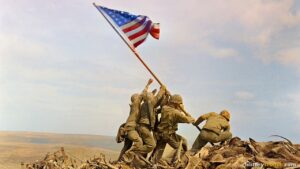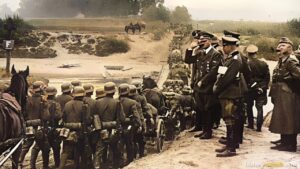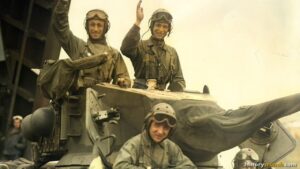
The American home front of World War II was one of the most important aspects of the overall American war effort. When the United States entered World War II following the Japanese attack on Pearl Harbor on December 7th, 1941, it was not only American soldiers who were called upon to contribute to the war effort. American civilians on the home front played a crucial role as well, through industrial production, rationingGovernment-controlled limits on how much of an essential good each person could buy, so enough reached the military., and a wide range of other contributions that supported the fighting forces overseas. In general, World War II is considered by historians to be an example of ‘total warA conflict in which all parts of society—not just armies—are organized and used to support the fighting effort.’, which means that all aspects of society were mobilized toward the war effort. As such, the main developments on the American home front during World War II included: the dramatic expansion of industrial production, the entry of women into the workforce in large numbers, the rationing of essential goods, the introduction of war bondsLoans ordinary citizens made to the government to help fund the war, repaid with interest after a set time., and the deeply controversial internmentThe forced confinement of a group of people in camps, used here against Japanese-Americans during World War II. of Japanese-Americans.

What Was World War II?
World War II lasted from 1939 to 1945 and became the largest and deadliest war in all of human history. The war began on September 1st, 1939, when Nazi Germany, under the leadership of Adolf Hitler, invaded the country of Poland. The war unfolded across two main theaters of conflict: the European Theater and the Pacific Theater. The United States remained out of the direct fighting in the war until December of 1941, when Japan launched a surprise attack on the American naval base at Pearl Harbor, Hawaii. The attack on Pearl Harbor brought the United States formally into World War II on the side of the Allied Powers, and from that point forward both American soldiers overseas and American civilians on the home front played a major role in the overall war effort.
American Home Front – Industrial Production
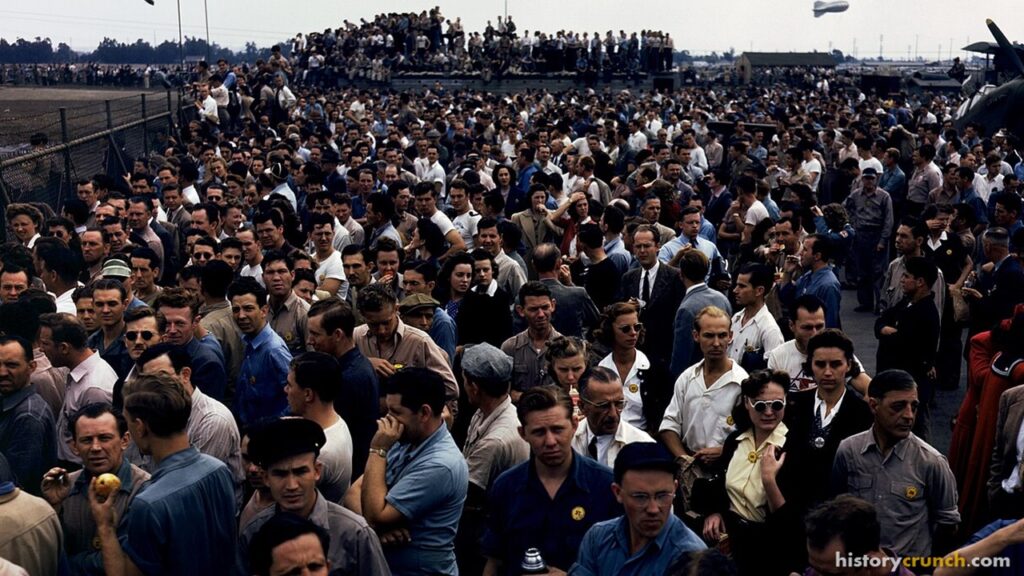
One of the most important developments on the American home front during World War II was the dramatic expansion of industrial production. When the United States entered the war, its factories were quickly converted from producing consumer goods to producing the weapons, vehicles, aircraft, and supplies needed by Allied forces on the battlefield. For instance, automobile factories were converted to produce tanks, jeeps and military trucks, while aircraft manufacturers dramatically expanded their output to supply American and Allied air forces. The scale of American industrial production during World War II was remarkable and played a direct role in the eventual Allied victory.
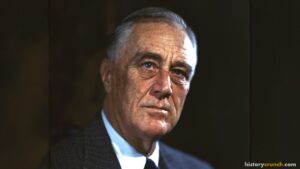
The Lend-Lease Act, which was passed by Congress in March of 1941 before the United States formally entered the war, also played an important role in supporting the Allied war effort through American industrial production. The Lend-Lease ActA 1941 law giving the president power to send weapons, food, and supplies to Allied nations considered vital to U.S. defense. gave President Franklin D. Roosevelt the ability to provide military aid to any nation whose defense was considered vital to the United States. As a result, Britain, the Soviet Union, China and other Allied nations received enormous quantities of weapons, vehicles, food, and other supplies produced by American industry. In general, the Lend-Lease Act allowed the United States to support the Allied war effort before its direct military involvement and to extend that support significantly after Pearl Harbor.
The United States sent no military aid to the Allies until after Japan attacked Pearl Harbor.
American Home Front – Women in the Workforce
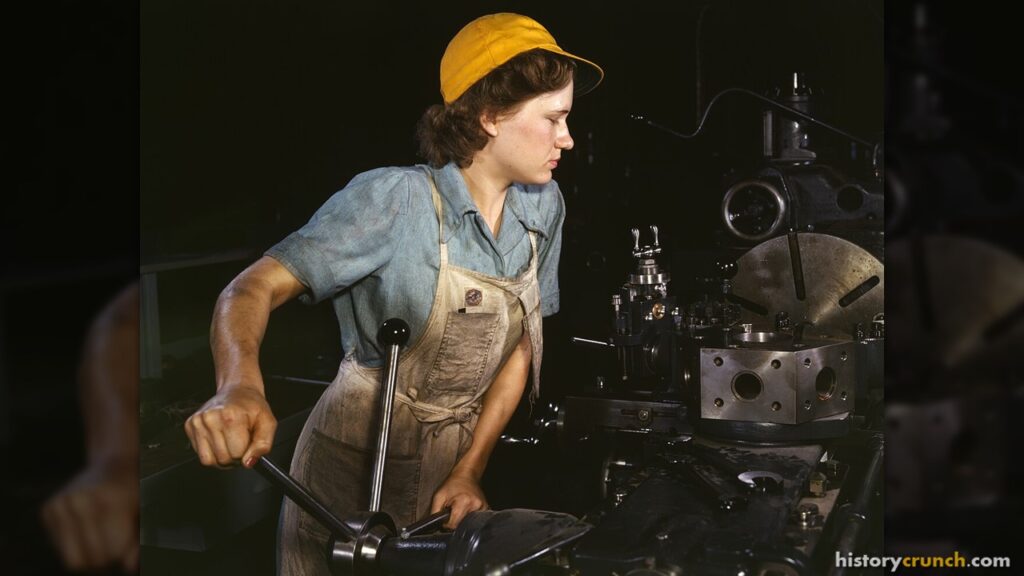
One of the most significant social changes produced by the American home front of World War II was the large-scale entry of women into the workforce. Before the war, very few women held jobs in industrial or manufacturing sectors of the economy. Women who did work were usually limited to roles such as: teachers, secretaries, and nurses. However, when American men began enlisting and being drafted into the armed forces in large numbers, the factories and industrial facilities that were essential to the war effort needed workers to fill the positions left behind.
As a result, American women entered the workforce in large numbers for the first time, taking on jobs in factories, shipyards, and other industrial facilities that had previously been exclusively male. The most famous symbol of this development was the cultural icon known as ‘Rosie the RiveterA fictional character used in government posters to persuade women to take industrial jobs during the war.’, a fictional character used in government posters and advertising campaigns to encourage women to take up industrial work in support of the war effort. For instance, by 1944, women made up approximately one third of the total American civilian workforce, a dramatic increase from the pre-war period.
It should also be noted that the entry of women into the workforce during World War II had lasting consequences for American society. Although many women were encouraged to return to their pre-war domestic roles after the war ended, the experience of wartime employment helped lay the foundation for the wider movement toward women’s equality in the workplace that developed in the decades that followed. As such, the American home front of World War II played an important role in shaping the long-term social history of the United States.
FactsthatCrunch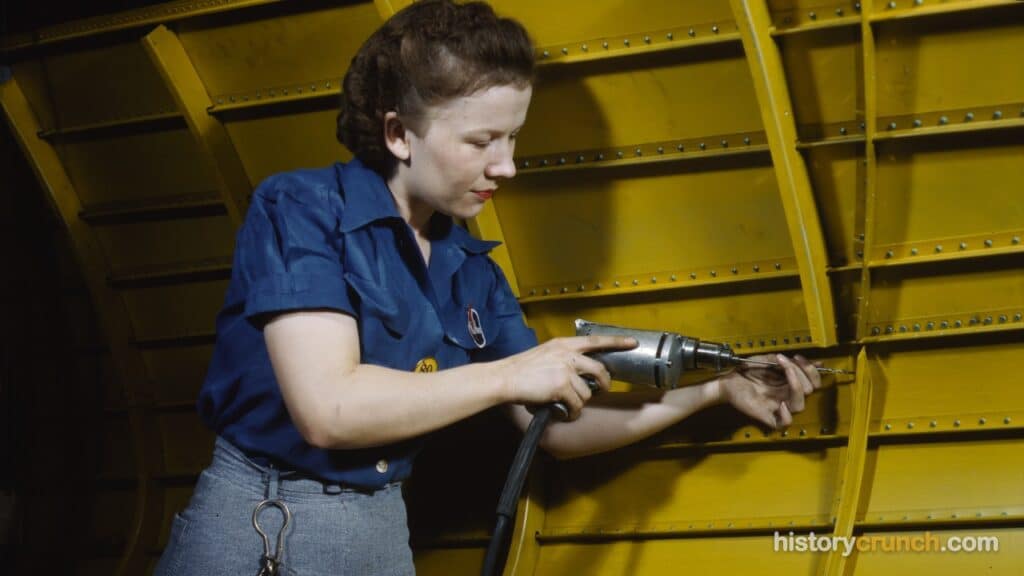 Black & whiteColour
American Home Front – Rationing
Another important aspect of the American home front during World War II was the introduction of rationing. Rationing refers to the government-controlled distribution of essential goods in limited quantities in order to ensure that sufficient supplies were available for the war effort. For instance, the United States government introduced rationing programs for a wide range of goods, including: food items such as meat, butter, sugar, and canned goods, as well as non-food items such as rubber, gasoline, and nylon. Rationing was administered through a system of ration books and stamps, which were distributed to American households and had to be used when purchasing rationed goods.
The rationing system required American civilians to make meaningful adjustments to their daily lives. For example, families were encouraged to grow their own vegetables in what became known as ‘Victory GardensHome and community vegetable gardens civilians grew to reduce demand on commercial food supplies for the war effort.’, in order to reduce the demand for commercially produced food and free up more of the commercial food supply for use by American and Allied forces overseas. It is estimated that by 1944, approximately 20 million Victory Gardens had been planted across the United States, producing a significant portion of the country’s vegetables. As such, rationing and initiatives like Victory Gardens represented one of the most direct ways in which ordinary American civilians contributed to the overall war effort on the home front.
FactsthatCrunchThe American ration book and stamp system gave every household a set of stamps each month that limited how much of certain goods one family could buy during World War II.
American Home Front – War Bonds
The United States government also relied on the purchase of war bonds by American civilians as an important means of financing the enormous cost of the war effort. War bonds were essentially loans made by ordinary citizens to the government, which the government promised to repay with interest after a set period of time. The sale of war bonds was promoted heavily through advertising campaigns, public events, and celebrity endorsements. For instance, famous actors, musicians, and athletes participated in war bond drives across the country to encourage the public to contribute financially to the war effort.
In general, the war bond program was highly successful. American civilians purchased billions of dollars worth of war bonds throughout the course of World War II, providing the government with an important source of funding for military operations. As well, the war bond drives helped maintain public engagement with and support for the war effort on the home front by giving ordinary citizens a direct and tangible way to contribute to the conflict.
FactsthatCrunchHow did war bonds help pay for World War II?
War bonds were loans that ordinary Americans made to the U.S. government by buying certificates that the government promised to repay later with interest. The United States Treasury ran eight major war bond drives between 1942 and 1945, and those drives raised about 185 billion dollars to help cover the enormous cost of weapons, ships, and supplies. Buying bonds also pulled money out of everyday spending, which helped keep prices from rising too fast while factories ran at full production.
American Home Front – Japanese-American Internment
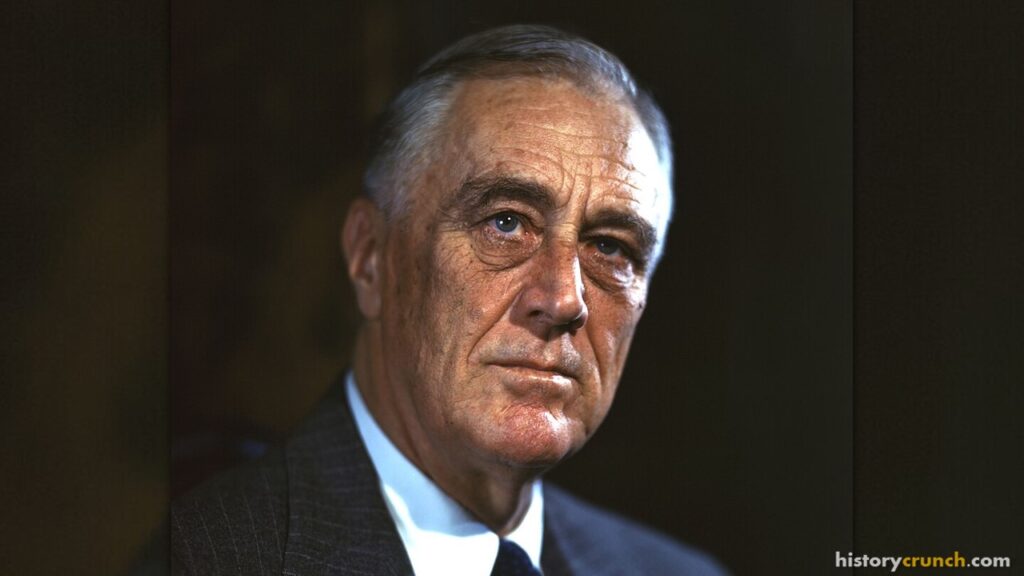
It should also be noted that the American home front of World War II included one of the most controversial and troubling episodes in American history, which was the forced internment of Japanese-Americans. Following the attack on Pearl Harbor on December 7th, 1941, widespread fear and anti-Japanese sentiment spread rapidly across the United States. Due to concerns among the American public and within the government that Americans of Japanese ancestry might remain loyal to Japan, President Franklin D. Roosevelt signed Executive Order 9066A presidential directive signed in 1942 that authorized forcing Japanese-Americans into remote internment camps. on February 19th, 1942. This order authorized the forced relocation of over 120,000 Japanese-Americans, including many who were American citizens, into internment camps located in remote areas of the country.
Families were given very little time to arrange their affairs and were forced to sell or abandon their homes, businesses, and possessions. Life in the internment camps was difficult, with families housed in poorly constructed barracks with little privacy and limited access to food and medical care. The internment of Japanese-Americans continued until late 1944, when the exclusion orders were ended. However, many returned home to find their property stolen or their businesses ruined.
The internment of Japanese-Americans is widely regarded today as a serious violation of the democratic rights and freedoms that the United States was fighting to defend during World War II. In 1988, President Ronald Reagan signed the Civil Liberties Act, which offered a formal government apology and provided financial compensation of $20,000 to each surviving internee. The act formally acknowledged that the internment had been based on what it described as “race prejudice, war hysteria, and a failure of political leadership.” As such, the Japanese-American internment remains one of the most important and sobering lessons of the American home front during World War II.
FactsthatCrunchRoosevelt Signs Executive Order 9066, Starting the Forced Removal of Japanese Americans
On the 19th of February, 1942, President Franklin D. Roosevelt signed Executive Order 9066, which gave the Secretary of War the power to designate military areas on the West Coast and remove people from them. The order did not name Japanese Americans by name, but it was applied to virtually the entire Japanese American population living on the West Coast. About 110,000 people were forced from their homes and sent to inland internment camps, and roughly two-thirds of them were American-born citizens.
American Home Front – Significance
The American home front of World War II was significant because it demonstrated the enormous capacity of American society to mobilize in support of a major war effort. The dramatic expansion of industrial production, the entry of women into the workforce, the rationing of essential goods, the sale of war bonds, and the contributions of millions of ordinary American civilians all played important roles in sustaining the Allied war effort and contributing to the eventual Allied victory in 1945. At the same time, the home front experience also revealed serious tensions and contradictions within American society, most clearly in the forced internment of Japanese-Americans, which stood in stark contrast to the democratic values the United States claimed to be defending. As such, the American home front of World War II remains an important and complex chapter in both the history of the war and the overall history of the United States.
FactsthatCrunchMobilizing the American home front during World War II brought real industrial power and civic unity, but it also produced serious injustices that contradicted the freedoms the United States said it was fighting to protect.
Key Vocabulary
Total war
Lend-Lease Act
Rosie the Riveter
Rationing
Victory Gardens
War bonds
Executive Order 9066
Internment
Frequently Asked Questions
What was the American home front during World War II?
The American home front was the effort by civilians inside the United States to support the war from 1941 to 1945. It included industrial production, rationing, war bonds, and millions of workers filling new jobs. This support was just as important to victory as the fighting done by soldiers overseas.
Why did women join the workforce during World War II?
Women joined the workforce because so many men left their jobs to serve in the armed forces. Factories and shipyards still needed workers, so women took positions that had once been held only by men. By 1944, women made up about one third of the civilian workforce.
What was rationing and why was it used?
Rationing was the government’s limited distribution of key goods so enough supplies reached the war effort. Families used ration books and stamps to buy items like meat, sugar, gasoline, and rubber. Many people also grew food in Victory Gardens, which numbered about 20 million by 1944.
What were war bonds?
War bonds were loans that ordinary citizens made to the government to help pay for the war. The government promised to repay the money with interest after a set number of years. Celebrities joined bond drives, and Americans bought billions of dollars worth of bonds during the war.
What happened during Japanese-American internment?
Japanese-American internment was the forced relocation of over 120,000 people of Japanese ancestry into remote camps. President Franklin D. Roosevelt authorized it by signing Executive Order 9066 on February 19th, 1942. Many internees were U.S. citizens, and in 1988 the government formally apologized and paid $20,000 to each survivor.
Cite This Article
To cite this article as a source, use one of the formats below.
MLA: Millar, B. “American Home Front of World War II: A Detailed Summary.” HistoryCrunch, 4 October 2026, https://historycrunch.com/american-home-front-of-world-war-ii/.
APA: Millar, B. (2026). American Home Front of World War II: A Detailed Summary. HistoryCrunch. https://historycrunch.com/american-home-front-of-world-war-ii/
Chicago: Millar, B. “American Home Front of World War II: A Detailed Summary.” HistoryCrunch. October 4, 2026. https://historycrunch.com/american-home-front-of-world-war-ii/
Sources
- Imperial War Museum
- Antony Beevor, The Second World War.