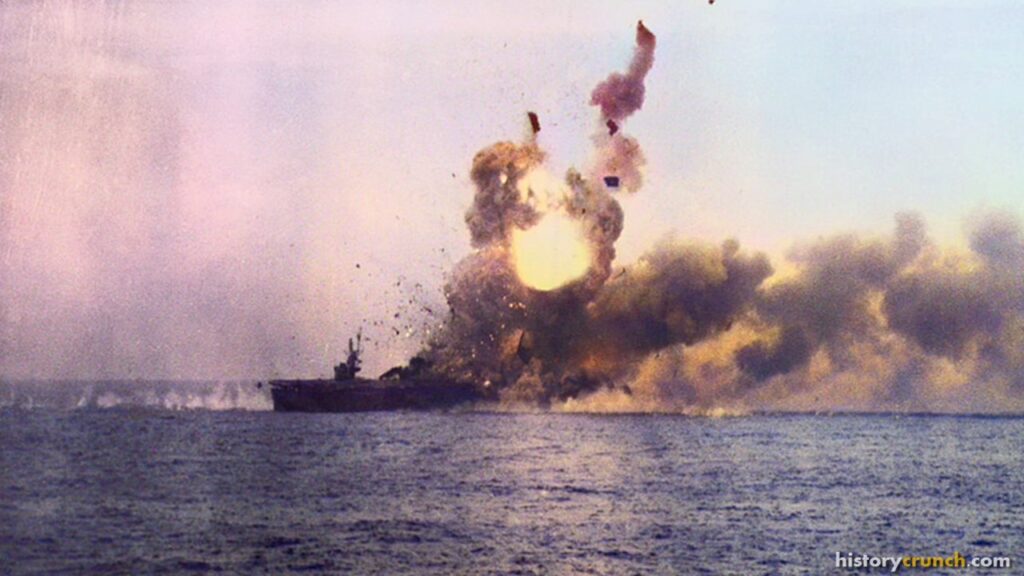
KamikazeUsually translated as ‘divine wind,’ referring originally to typhoons that destroyed Mongol invasion fleets in the 13th century. pilots refer to Japanese military pilots who carried out suicide attacks against Allied ships in the final stages of World War II in the Pacific Theater. In fact, these pilots became especially significant from late 1944 to 1945, when Japan faced growing defeat in the Pacific and turned to special attack tactics in hopes of slowing the United States’ advance toward the Japanese home islands.
 FactsthatCrunch
What were the main origins of the word kamikaze in Japanese history before World War II?
Kamikaze Pilots – Background
Kamikaze pilots appeared during a desperate phase of the Pacific War for Imperial Japan. By 1944, Japan had lost most of its experienced pilots, large numbers of aircraft and much of its offensive naval strength. In fact, the Battle of the Philippine Sea in June of 1944 was especially damaging because Japan lost so many experienced pilots that it became much harder to defend its positions in the Pacific. At the same time, American forces were moving steadily closer to Japan through the Central and Southwest Pacific, using a strategy called ‘island-hoppingAn American military strategy of capturing select islands across the Pacific to move steadily closer to Japan.‘.
The term ‘kamikaze’ is usually translated as ‘divine wind.’ It referred to the typhoons that had helped destroy Mongol invasion fleets in the 13th century. During World War II, the formal Japanese term was closer to ‘special attack unitsThe formal Japanese military term used during World War II for the suicide mission pilots known outside Japan as kamikaze.,’ but ‘kamikaze’ became the term most widely used outside Japan for these suicide missions.
FactsthatCrunchTap each impact to read what it led to.
Kamikaze Pilots – Beginnings
The first organized kamikaze attacks took place on October 25th, 1944, during the Battle of Leyte Gulf in the Philippines. Japanese leaders had concluded that ordinary air attacks were no longer producing enough results against heavily defended Allied fleets. They hoped that pilots deliberately crashing airplanes loaded with explosives into ships could inflict more damage than conventional bombing or torpedo attacks.
In fact, the Battle of Leyte Gulf was a turning point in the war because the United States had just returned to the Philippines, which threatened Japan’s sea routes to vital resources in Southeast Asia. Japanese commanders believed they needed extraordinary measures to overcome this challenge. As a result, historians usually point to this as fact that Japan no longer had the strength to wage the kind of naval and air war it had earlier in World War II.
FactsthatCrunchOn October 25th, 1944, Japan launched its first organized kamikaze attacks during the Battle of Leyte Gulf. Japanese commanders had decided that conventional air attacks could no longer inflict enough damage on heavily defended Allied fleets, so pilots were ordered to crash bomb-loaded planes directly into enemy ships.
Japan relied on standard bombing and torpedo runs, though losses of experienced pilots at the Battle of the Philippine Sea in June 1944 had already weakened its air power sharply.
Suicide attacks became Japan's main air tactic for the rest of the Pacific War, reaching their largest scale at Okinawa in 1945, where Japan sent massive waves of kamikaze pilots against the Allied fleet.
Kamikaze Pilots – Who They Were
Some of the kamikaze pilots were actually trained pilots with real combat experience. However, many others were very young men whose training had been shortened due to Japan’s lack of men, resources and time. At the beginning of World War II, Japanese pilots often received hundreds of flight hours before combat. However, by 1944, training levels had fallen dramatically. This meant that many later kamikaze pilots were much less prepared than the pilots who had fought at the start of the war.
There has long been a debate over how voluntary these missions really were. Japanese wartime accounts stressed the ideas of volunteering and self-sacrificeGiving up one’s own life willingly for a cause, the idea Japanese wartime accounts used to describe kamikaze missions.. However, later evidence showed that many young pilots faced intense pressure from the military culture of the time and the Japanese code of honor. As a result, it is generally believed that while some of the pilots were willing participants, many others were also likely pressured into carrying out the missions due to a sense of national duty.
Many kamikaze pilots in World War II volunteered freely and eagerly for their missions.
Kamikaze Pilots – Methods
The goal of the kamikaze pilots was to fly their planes, which were loaded with bombs or other explosives, and try to crash directly into American ships. These attacks were especially dangerous against aircraft carriers, destroyers, radar ships, and other vessels operating close to combat zones. The tactic aimed not only to sink ships but also to destroy flight decksThe flat top surfaces of aircraft carriers from which planes take off and land, targeted by kamikaze pilots to disable the ships., start fires, kill sailors, and weaken Allied naval operations through shock and repeated losses. Essentially, the Japanese were attempting to destroy the moraleThe confidence and fighting spirit of a group of soldiers or sailors, which Japan hoped to destroy in American forces through kamikaze attacks. of American sailors by showing the lengths to which they would fight.
The kamikaze threat reached its height during the Battle of Okinawa in 1945. There, Japan launched very large waves of suicide pilots against the Allied fleet supporting the invasion. The attacks were especially intense because thousands of ships were gathered near the island and could not easily avoid danger. As a result, the kamikaze pilots inflicted serious losses during this campaign, and Okinawa became the clearest example of how destructive the tactic could be when used on a large scale.
Regardless, this did not stop the Allied advance. In fact, it is believed that only a small number of kamikaze missions actually achieved a direct hit. Even when the attacks were deadly, they did not slow the American advances in the Pacific TheaterThe region of the Pacific Ocean and surrounding lands where World War II fighting between Japan and the Allied powers took place. of World War II.
Why were ships at the Battle of Okinawa especially vulnerable to kamikaze attacks?
Kamikaze Pilots – Impact and Significance
Kamikaze pilots caused real destruction and had a significant impact on the war. In fact, by the end of the war, it is estimated that more than 3,800 kamikaze pilots had died, and their attacks had killed more than 7,000 Allied sailors. Furthermore, they sank several dozen ships and damaged many more.
Also, kamikaze pilots were significant because they displayed the reality of the Japanese war effort in the later stages of World War II. More specifically, Japan had reached the point where it was sacrificing planes and pilots in one-way attacks because it could no longer compete on equal terms in training, fuel, production or naval strength. In that sense, the kamikaze missions represented an Imperial Japan that was weakened and struggling to maintain its defenses.
Regardless, the kamikaze pilots of World War II became a symbol of the brutality and desperation of the Pacific Theater of World War II.
Explore World War II · 1939 – 1945
Keep exploring World War II with these History Crunch resources.
Key Vocabulary
Pacific Theater
Island-hopping
Kamikaze
Special attack units
Flight decks
Self-sacrifice
Morale
Frequently Asked Questions
What does the word kamikaze mean?
Kamikaze is usually translated as “divine wind.” The name came from typhoons that helped destroy Mongol invasion fleets in the 13th century. During World War II, the formal Japanese term was closer to “special attack units,” but kamikaze became the word used most widely outside Japan.
When did kamikaze attacks begin?
The first organized kamikaze attacks took place on October 25th, 1944, during the Battle of Leyte Gulf. By then Japan had lost many experienced pilots and much of its naval strength. Japanese leaders believed that ordinary air attacks were no longer causing enough damage to Allied fleets.
Were kamikaze pilots true volunteers?
The answer is debated, and the truth likely falls in the middle. Japanese wartime accounts stressed volunteering and self-sacrifice. Later evidence showed that many young pilots faced heavy pressure from military culture and the code of honor. Some were willing, but many others were probably pushed into the missions by a sense of national duty.
How many people died from kamikaze attacks?
By the end of the war, more than 3,800 kamikaze pilots had died. Their attacks killed more than 7,000 Allied sailors. The planes also sank several dozen ships and damaged many more, though most missions never scored a direct hit.
Where were kamikaze attacks the worst?
The kamikaze threat reached its height during the Battle of Okinawa in 1945. Japan launched very large waves of suicide pilots against the Allied fleet supporting the invasion. Thousands of ships were gathered near the island and could not easily avoid danger, which made the attacks especially deadly.
Did kamikaze attacks stop the American advance?
No, the attacks did not slow the American advance across the Pacific. Only a small number of missions actually struck their targets directly. The tactic showed how weak and desperate Imperial Japan had become in the final stages of the war.
Cite This Article
To cite this article as a source, use one of the formats below.
MLA: Millar, B. “Kamikaze Pilots: A Detailed Summary.” HistoryCrunch, 1 October 2026, https://historycrunch.com/kamikaze-pilots/.
APA: Millar, B. (2026). Kamikaze Pilots: A Detailed Summary. HistoryCrunch. https://historycrunch.com/kamikaze-pilots/
Chicago: Millar, B. “Kamikaze Pilots: A Detailed Summary.” HistoryCrunch. October 1, 2026. https://historycrunch.com/kamikaze-pilots/
Sources
- The National WWII Museum
- Imperial War Museum
- Max Hastings, Inferno / All Hell Let Loose.