The impacts of the Korean War were enormous for Korea, the Cold War, and East Asia. Fought from June 25th, 1950, to July 27th, 1953, the Korean War ended with an armisticeAn agreement to stop fighting, but not a full peace treaty that ends a war permanently., but it left Korea divided, heavily damaged, and locked into a conflict that has never been fully resolved. As such, historians consider the Korean War to be an important event in Asian history, American history and the overall Cold War.
 FactsthatCrunch
What were the biggest impacts of the Korean War?
The Korean War left the Korean Peninsula permanently divided, with a demilitarized zone near the 38th parallel separating two hostile governments that never signed a full peace treaty. The war left approximately 4 million people killed, wounded, or missing, destroyed much of Korea's housing and industry, and forced massive reconstruction efforts in the south with heavy support from the United Nations Korean Reconstruction Agency. The conflict also hardened American Cold War strategy worldwide, pushing the United States to build lasting military alliances with South Korea and Japan and to commit to higher peacetime defense spending through the rest of the Cold War.
A Divided Korea
One of the most important impacts of the Korean War was that it hardened the division of the Korean Peninsula. Before the war, North Korea and South Korea had already been created as rival states in 1948, but the fighting made that split far more permanent. When the armistice was signed on July 27th, 1953, the battle line became the boundary between the two sides, and a demilitarized zoneA buffer strip of land between two hostile sides where military forces are not allowed., or DMZ, was created between them. No final peace treaty followed, which meant the war effectively ended in a cease-fire rather than a full settlement.
This was significant because the Korean War did not solve the question of who would rule Korea. Instead, it left two hostile governments facing each other across one of the most heavily armed borders in the world. In this way, the impacts of the Korean War can still be seen today in the continued division between North Korea and South Korea.
FactsthatCrunchHuman Cost and Destruction
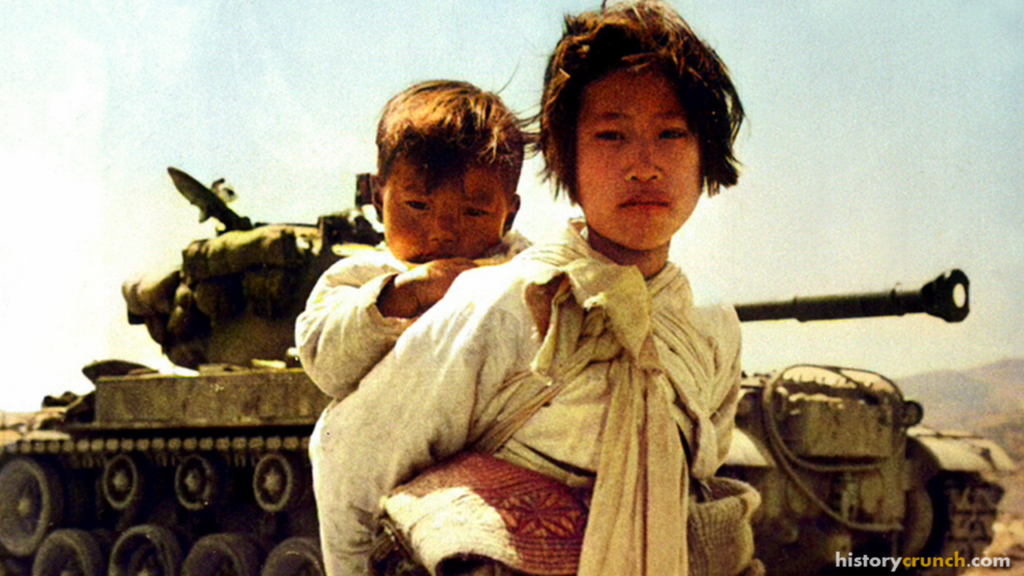
Another major impact of the Korean War was the terrible human cost. The war caused millions of casualtiesPeople killed, wounded, or missing as a result of war., including very large numbers of civilians. In fact, historians estimate that the war resulted in roughly 4,000,000 casualties, including civilians, and that at least 2.5 million people lost their lives overall. The fighting also devastated towns, cities, homes, roads, and industry across the peninsula.
The physical destruction inside Korea was severe. In fact, during the war, two-fifths of Korea’s industrial facilities were destroyed and one-third of its homes were devastated. This meant that the impacts of the Korean War were not limited to the battlefield. The war also created homelessness, poverty, refugee movement, and long-term suffering for civilians across both North Korea and South Korea.
The war also shattered countless families. Because the peninsula remained divided after 1953, many people were cut off from relatives on the other side of the border for decades. This became one of the deepest social and emotional legacies of the conflict and shows that the impacts of the Korean War were personal as well as political.
The Cold War Grows More Dangerous
The impacts of the Korean War were also global because the conflict made the Cold War more intense. The war brought the United States, communist China, and the Soviet-backed North Korean state into direct military confrontation on the Korean Peninsula. This transformed Korea from a regional crisis into one of the first major hot wars of the Cold War.
The war also helped shape American foreign policy in a lasting way. The U.S. Department of State explains that after fighting broke out in Korea, NSC-68A U.S. government document that called for a much stronger military buildup against the Soviet Union. was accepted throughout the United States government as the foundation of American foreign policy. NSC-68 called for a much stronger policy of containment against the Soviet Union. Therefore, one of the major impacts of the Korean War was that it encouraged greater military spending and a more heavily armed Cold War strategy.
At the same time, the war showed that Cold War rivalry could erupt into full-scale fighting without turning into World War III. That lesson shaped later Cold War crises, because both sides continued competing aggressively while also trying to avoid direct nuclear war between the superpowers.
FactsthatCrunchWhat were the main effects of NSC-68 on American Cold War policy?
The United States, Japan, and East Asia
The impacts of the Korean War were especially important in East Asia. The war pushed the United States to build a more permanent security system in the region. In fact, the Department of State notes that after the conflict, the United States extended security commitments to both South Korea and Japan and built alliances that lasted far beyond the war itself. In 1953, the United States and South Korea signed a mutual security treaty, and Japan also became a central part of the American Cold War position in Asia.
The war also helped Japan recover economically and strategically. During the conflict, Japan became an important supply and support base for United States and United Nations forces. As American policy shifted, Japan moved from defeated enemy to major ally. This was important because the impacts of the Korean War were not limited to Korea itself. The war also helped reshape the balance of power across Northeast Asia.
FactsthatCrunchDesiring to declare publicly and formally their common determination to defend themselves against external armed attack so that no potential aggressor could be under the illusion that either of them stands alone in the Pacific area
What does the treaty's stated goal of ensuring no aggressor believes either party stands alone in the Pacific area reveal about the direction of American policy in East Asia after the Korean War?
North Korea and South Korea After 1953
After the war, North Korea and South Korea developed in very different directions. Both states became highly militarizedBuilt up with large armed forces and weapons as a central part of how a country operates., and both justified strong state control by pointing to the danger posed by the other side. In North Korea, the war strengthened the regime’s emphasis on military power, dictatorship, and hostility toward outside enemies. In South Korea, the war increased dependence on United States support and tied the country closely to the anti-communist side of the Cold War.
Reconstruction also became a major issue, especially in the south. After the war, international aid and South Korean rebuilding efforts were necessary because the country had been so badly damaged. In fact, the United Nations Korean Reconstruction Agency was established to carry out economic aid to South Korea, with most of the contributions provided by the United States. As such, one of the major impacts of the Korean War was that it left South Korea needing large-scale outside support in the years after the fighting stopped.
FactsthatCrunchTap each impact to read what it led to.
Significance
The impacts of the Korean War were significant because they lasted far beyond 1953. The war left Korea divided, caused immense destruction, intensified the Cold War, strengthened the American alliance system in East Asia, and helped make the Korean Peninsula a permanent flashpointA place or situation likely to erupt into serious conflict at any moment. in world politics.
The impacts of the Korean War are still visible in the modern world. The DMZ remains in place, North Korea and South Korea remain separate states, and the conflict continues to shape diplomacy, military planning, and political tensions in East Asia. For that reason, the impacts of the Korean War were not only immediate. They became part of the long-term structure of the Cold War and of modern Korean history.
FactsthatCrunchWhen the Korean Demilitarized Zone was established by the 1953 Armistice Agreement, it was drawn about 2.5 miles (4 kilometers) wide and stretched approximately 155 miles (250 kilometers) across the peninsula. Each side pulled its military forces back 1.2 miles (2 kilometers) from the ceasefire line, creating a buffer strip that neither army could enter. The zone was supervised by a Military Armistice Commission made up of representatives from both sides, with a Joint Security Area at Panmunjom as the only place where representatives could meet face to face.
Today the DMZ remains one of the most heavily fortified borders in the world, lined with minefields, electric fences, guard posts, and tens of thousands of troops on both sides. South Korean and American forces conduct regular exercises along the southern edge, while North Korea maintains artillery positions and tunnels near the northern side. Because the area has been off-limits to human activity for more than seven decades, it has become an unplanned nature preserve, sheltering rare birds and wildlife that have returned to the empty land between the two armies.
The DMZ began as a temporary military buffer in 1953 and has lasted so long that it now shapes both the security and the ecology of the Korean Peninsula.
Korean War timeline · 1950 – 1953
Key Vocabulary
Armistice
Demilitarized zone
Casualties
NSC-68
Containment
Militarized
Flashpoint
Frequently Asked Questions
How did the Korean War end?
The Korean War ended with an armistice signed on July 27th, 1953, not a peace treaty. This meant the fighting stopped in a cease-fire rather than a full settlement. Because no peace treaty was ever signed, the two Koreas technically remain at war today.
What is the DMZ?
The DMZ, or demilitarized zone, is the buffer area created between North Korea and South Korea in 1953. It runs along the battle line where the fighting stopped when the armistice was signed. The DMZ is still one of the most heavily armed borders in the world.
How many people died in the Korean War?
Historians estimate the Korean War caused roughly 4,000,000 casualties, with at least 2.5 million people losing their lives. Many of those killed were civilians caught in the fighting. In South Korea alone, the war destroyed about two-fifths of industry and one-third of homes.
How did the Korean War affect the Cold War?
The Korean War made the Cold War more intense by turning it into an actual shooting war. It brought the United States, communist China, and North Korea into direct combat. The war also led the United States to adopt NSC-68, which called for stronger containment and much higher military spending.
How did the Korean War change Japan?
The Korean War helped Japan shift from defeated enemy to important American ally. During the fighting, Japan became a key supply and support base for United States and United Nations forces. This boosted Japan’s economy and made it central to the American Cold War position in East Asia.
Cite This Article
To cite this article as a source, use one of the formats below.
MLA: Millar, B. “Impacts of the Korean War: A Detailed Summary.” HistoryCrunch, 18 September 2026, https://historycrunch.com/impacts-of-the-korean-war/.
APA: Millar, B. (2026). Impacts of the Korean War: A Detailed Summary. HistoryCrunch. https://historycrunch.com/impacts-of-the-korean-war/
Chicago: Millar, B. “Impacts of the Korean War: A Detailed Summary.” HistoryCrunch. September 18, 2026. https://historycrunch.com/impacts-of-the-korean-war/
Sources
- Max Hastings, The Korean War.
- Truman Presidential Library