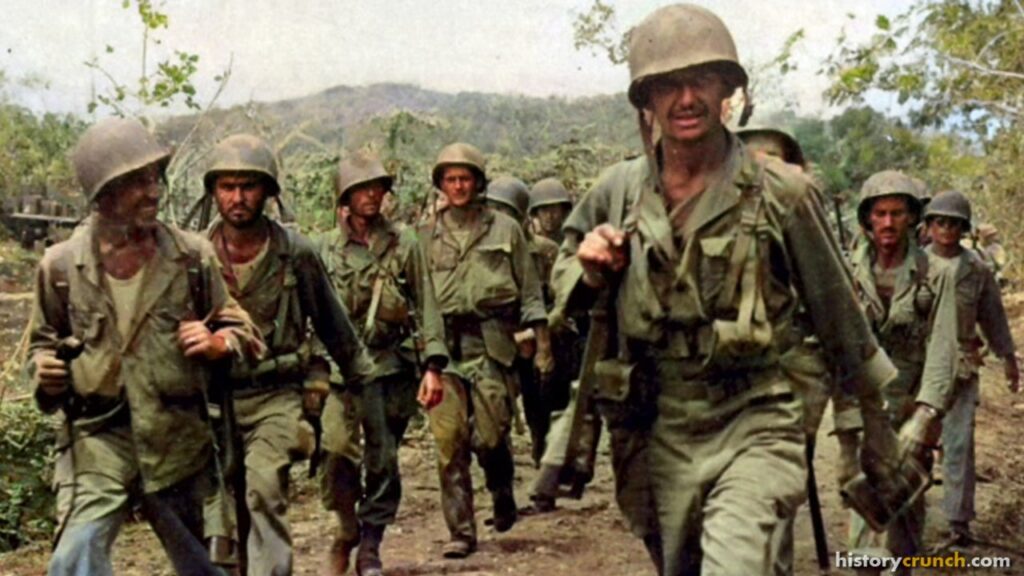
The Battle of Saipan was one of the most important Pacific battles of World War II and helped bring the war much closer to the Japanese mainland islands. The Battle of Saipan was fought from June 15th, 1944, to July 9th, 1944, in the Mariana Islands, and it gave the United States a base from which long-range B-29 bombers could strike the Japanese home islands more directly.

Battle of Saipan – Background
The Battle of Saipan took place during the larger Mariana and Palau Islands campaign. By mid-1944, the United States had already pushed across much of the Central Pacific, and Saipan, Mariana Islands, became a major target because it sat inside Imperial Japan’s inner defensive line. Saipan also mattered because airfields there would place much of Japan within range of strategic bombingAir attacks aimed at destroying an enemy’s industry, cities, and war-making ability rather than just battlefield targets..
The island was much more difficult to capture than some earlier Pacific targets. Saipan was larger, more rugged, and better suited for defense than the flatter coral islands attacked earlier in the war. Japanese forces had prepared strong positions, including artillery, beach defenses, caves, and fortified ground around central highlands such as Mount Tapotchau, Saipan, Mariana Islands.
Japanese planners also treated Saipan as extremely important. The island had a garrisonA body of troops stationed in a place to defend it. of about 30,000 to 32,000 troops, along with a large civilian population that included Japanese settlers, Okinawans, Koreans, and Chamorro people. Because of this, the Battle of Saipan became not only a hard military struggle but also a disaster for many civilians trapped in the fighting.
FactsthatCrunchHow did the terrain and defenses of Pacific Island targets in World War II affect how hard they were to capture?
Tap a point to read its detail.
Battle of Saipan – The Landings
Before the landings, American naval and air forces bombarded the island. Carrier aircraft struck Japanese airfields beginning on June 11th, 1944, and naval bombardment followed on June 13th and 14th. These attacks damaged defenses and weakened Japanese air strength, but they did not fully destroy the island’s prepared positions.
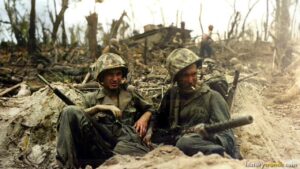
As mentioned above, the Battle of Saipan began on June 15th, 1944, when Marines came ashore on the island’s southwestern coast. The landing was extremely difficult. Japanese artillery, mortars, machine guns, and anti-boat weapons hit the assault waves heavily, and the first day brought severe American casualties. Regardless, American forces established a beachheadA small area of enemy shore captured and held by attacking forces as a starting point for further advance. and kept pushing inland.
The fighting then became a brutal battle of attritionA strategy of wearing down the enemy through continuous losses in troops, supplies, and strength over time.. Japanese defenders withdrew from the beaches into the interior and used hills, caves, and fortified positions to slow the advance. Some of the hardest combat took place around Mount Tapotchau and in areas nicknamed Death Valley and Purple Heart Ridge. The Battle of Saipan therefore turned into a hard, close-range campaign rather than a quick amphibiousInvolving military forces attacking from sea onto land, combining naval and ground operations together. victory.
FactsthatCrunchThe American landing on Saipan in June 1944 came in stages, starting days before the first Marines reached the beach.
Battle of Saipan – The Battle Turns
While the ground fighting continued, a major naval battle took place nearby. On June 19th and 20th, 1944, the Battle of the Philippine Sea was fought as Japan tried to send naval air power to defend the Marianas. The result was a major Japanese defeat, which meant Saipan’s defenders could no longer expect meaningful reinforcement, resupply, or air support.
As the Battle of Saipan continued, American troops steadily pushed the Japanese northward. The Japanese defense remained fierce, but it could not reverse the growing pressure. By early July, organized resistance had been compressed into the northern part of the island, and the defenders were running out of space, supplies, and hope of rescue.
One of the most dramatic moments came on the night of July 6th to 7th, 1944, when thousands of Japanese troops launched a massive banzai chargeA desperate mass infantry attack launched by Japanese troops when defeat seemed certain.. A banzai charge was a desperate mass infantry attack, usually carried out when defeat seemed certain. The attack killed many Americans, but it failed and cost the Japanese defenders even more heavily. Organized resistance ended on July 9th, 1944.
The Battle of the Philippine Sea, fought on June 19th and 20th, 1944, meant that Saipan's Japanese defenders could no longer expect meaningful reinforcement, resupply, or air support.
Battle of Saipan – Civilian Suffering
The Battle of Saipan was also one of the most tragic Pacific battles for civilians. Thousands of civilians died during the fighting, and many were caught between bombardment, ground combat, fear, and Japanese propaganda that warned them Americans would torture or kill them. These fears contributed to mass suicides in the final stage of the battle.
Some of the most famous deaths took place at northern cliff areas later known as Suicide Cliff and Banzai Cliff, Saipan, Mariana Islands. There, many civilians and soldiers jumped to their deaths rather than surrender. This became one of the most haunting parts of the Battle of Saipan and showed how deeply fear and indoctrinationThe process of teaching people to accept certain beliefs so completely that they do not question them. shaped the battle’s final days.
FactsthatCrunchWhy Did Civilians Jump to Their Deaths at Suicide Cliff and Banzai Cliff on Saipan?
Civilians at Saipan's northern cliffs jumped to their deaths because Japanese propaganda had told them that American troops would torture and kill anyone who surrendered. That warning, combined with the shock of the battle closing in around them, led many civilians and soldiers to choose death over capture. The fear had been so deeply taught that large numbers jumped from the cliffs rather than trust that surrender was safe.
Battle of Saipan – Significance
The Battle of Saipan was important because it changed the strategic map of the Pacific War. Once the island was captured, the United States could build airfields there and use them for long-range bombing missions against Japan. In the months that followed, Saipan became one of the bases from which B-29 bombers attacked Tokyo and other Japanese cities.
The Battle of Saipan also had major political effects inside Imperial Japan. The loss of the island showed that the Japanese home islands were now directly vulnerable, and the defeat helped bring down Prime Minister Hideki Tojo’s government in July of 1944. As such, the Battle of Saipan was not just a battlefield defeat for Japan. It was also a major shock to Japanese leadership and public confidence.
Finally, the Battle of Saipan was significant because it showed the scale and brutality of the Pacific War in 1944. It involved amphibious assault, cave fighting, massive casualties, civilian deaths, and psychological warfare, all in one campaign. For these reasons, the Battle of Saipan stands as one of the most important turning-point battles in the war against Japan.
FactsthatCrunchWhen Saipan fell to American forces in early July 1944, Japan's military leaders recognized that the home islands were now directly open to air attack, and Prime Minister Hideki Tojo resigned on July 18th, 1944, less than two weeks after organized resistance on the island had collapsed.
Tojo held power; Japan's inner defensive line was intact
Tojo's government fell; Japan faced direct bombing from Saipan's airfields
Explore World War II · 1939 – 1945
Keep exploring World War II with these History Crunch resources.
Key Vocabulary
Beachhead
Attrition
Amphibious
Banzai charge
Indoctrination
Strategic bombing
Garrison
Frequently Asked Questions
When was the Battle of Saipan fought?
The Battle of Saipan was fought from June 15th, 1944, to July 9th, 1944. It took place on the island of Saipan in the Mariana Islands. The fighting lasted about three and a half weeks and was part of the larger Mariana and Palau Islands campaign.
Why was Saipan so important to the United States?
Saipan mattered because its airfields placed much of Japan within range of American bombers. Once the island was captured, long-range B-29 bombers could fly from Saipan to strike Tokyo and other cities. The island also sat inside Japan’s inner defensive line, which made it a major target.
What was a banzai charge?
A banzai charge was a desperate mass infantry attack, usually made when defeat seemed certain. On the night of July 6th to 7th, 1944, thousands of Japanese troops launched one of the largest such attacks of the war. It killed many Americans but failed and cost the Japanese defenders even more heavily.
Why did so many civilians die during the battle?
Thousands of civilians died because they were trapped between bombardment and close ground combat. Japanese propaganda also warned them that American troops would torture or kill them. These fears led to mass suicides at northern cliffs later known as Suicide Cliff and Banzai Cliff.
How did the Battle of Saipan affect Japan’s government?
The loss of Saipan helped bring down Prime Minister Hideki Tojo’s government in July of 1944. The defeat showed that the Japanese home islands were now directly open to attack. It shocked both Japanese leaders and the public, making it more than just a battlefield loss.
Cite This Article
To cite this article as a source, use one of the formats below.
MLA: Millar, B. “Battle of Saipan: A Detailed Summary.” HistoryCrunch, 2 October 2026, https://historycrunch.com/battle-of-saipan/.
APA: Millar, B. (2026). Battle of Saipan: A Detailed Summary. HistoryCrunch. https://historycrunch.com/battle-of-saipan/
Chicago: Millar, B. “Battle of Saipan: A Detailed Summary.” HistoryCrunch. October 2, 2026. https://historycrunch.com/battle-of-saipan/
Sources
- Max Hastings, Inferno / All Hell Let Loose.
- Antony Beevor, The Second World War.
- Gerhard L. Weinberg, A World at Arms.
- Imperial War Museum