The Battle of Kiev was one of the largest and most devastating battles of World War II. Fought from July 7th, 1941 to September 26th, 1941, during the overall events of Operation Barbarossa, it ended with a major Nazi German victory around Kiev, Ukraine, then part of the Soviet Union, and destroyed much of the Soviet Southwestern FrontThe Soviet military command responsible for defending the Kiev area, largely destroyed in the battle..

Battle of Kiev – Background
The Battle of Kiev took place during the first months of Nazi Germany’s invasion of the Soviet Union. On June 22nd, 1941, Nazi Germany launched Operation BarbarossaThe massive Nazi German invasion of the Soviet Union launched on June 22nd, 1941, across a huge front., a massive attack across a huge front. Ukraine was especially important to Hitler because it contained major cities, farmland, industry, and access routes farther east and south. As German armies advanced, Kiev, Ukraine, became one of the main Soviet defensive positions in the south.
The battle also grew out of a major argument inside the German command. Some German leaders wanted to drive straight toward Moscow, Russia, after the early victories of the summer. Hitler, however, insisted that Ukraine had to be secured first. As a result, German armored forces were redirected southward to help trap the Soviet armies defending Kiev, Ukraine. This decision mattered because it shaped not only the battle itself, but also the larger course of the war in 1941.
On the Soviet side, the problem was made worse by Stalin’s refusal to allow a full withdrawal from the Kiev area. Several Soviet commanders recognized that the armies around Kiev, Ukraine, were in danger of being surrounded, but Stalin still wanted the city held. Therefore, the Soviet defense remained in place even as the danger of encirclementA military tactic where enemy forces are completely surrounded, cutting off escape and supply. grew much more serious.
 FactsthatCrunch
It is September 1941, early in World War II on the Eastern Front. You are Joseph Stalin, leader of the Soviet Union, and German Army Group South is closing in on your forces near Kiev. More than 600,000 Soviet soldiers are in danger of being completely surrounded if they stay in place.
Battle of Kiev – Nazi German Encirclement
The Battle of Kiev was not simply one direct fight inside the city. Instead, it was a much larger operation fought across a wide area of eastern Ukraine. German forces under Army Group South pushed from the west and south, while Heinz Guderian’s panzerGerman armored fighting units, especially tank forces, used for fast, powerful advances. forces turned south from Army Group Center. Their goal was to close a giant pocket around the Soviet armies defending Kiev, Ukraine.
By mid-September, the German pincer movementAn attack where two forces push in from opposite sides to trap an enemy in the middle. succeeded. On September 16th, 1941, the encirclement was effectively closed east of Kiev, Ukraine. Three days later, on September 19th, 1941, German forces entered the city itself. Even so, the battle continued for several more days as trapped Soviet formations tried to break out and German forces tightened the pocket.
The result was catastrophic for the Soviet Union. German and later historical estimates vary, but all major accounts agree that several hundred thousand Soviet soldiers were killed, wounded, or captured and that the Soviet Southwestern Front was largely destroyed. Mikhail Kirponos, one of the main Soviet commanders, was killed while trying to escape the encirclement. As such, the Battle of Kiev became one of the greatest Soviet defeats of the entire war.
FactsthatCrunch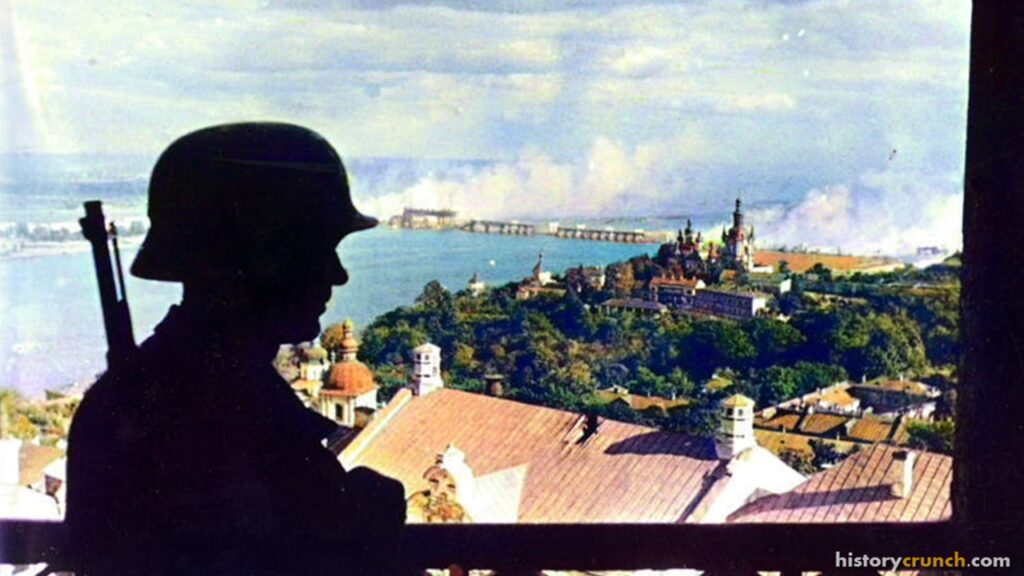 Black & whiteColour
Battle of Kiev – Aftermath
The German victory at Kiev, Ukraine, opened the way for further Axis advances in Ukraine and removed a major Soviet force from the southern front. In the short term, it looked like one of Germany’s greatest triumphs of 1941. In fact, the battle was so large that it is often described as one of the biggest encirclement victories in military history.
However, the victory had a more complicated meaning in the larger war. By turning powerful German forces south toward Kiev, Ukraine, Hitler won a huge battle, but he also lost valuable time before the final push on Moscow, Russia. Much of August was lost in argument over strategy, and the renewed German advance on Moscow did not begin until October. Therefore, the Battle of Kiev was both a major German success and part of the larger delay that helped keep the Soviet Union in the war.
The occupation of Kiev, Ukraine, also had terrible consequences for civilians. Nazi German forces entered the city on September 19th, 1941. Then, on September 29th and 30th, 1941, SS and police units, with auxiliariesNon-German helpers who assisted SS and police units in carrying out killings during the occupation., carried out the massacre at Babyn Yar, just outside Kiev, Ukraine, murdering 33,771 Jews in two days according to German reports. This is important because it shows that the Battle of Kiev was connected not only to military defeat, but also to the beginning of one of the worst atrocitiesExtremely cruel and violent acts, especially mass killings of civilians. of the Holocaust in eastern Europe.
FactsthatCrunchBattle of Kiev – Significance
The Battle of Kiev was important because it showed both the strength and the limits of the German invasion of the Soviet Union in 1941. Germany was able to carry out a huge encirclement and inflict a devastating defeat on the Red Army. At the same time, the battle did not end the war in the east. The Soviet Union survived, rebuilt its armies, and kept fighting.
The Battle of Kiev also helps students understand the wider nature of World War II on the Eastern Front. It was a war of enormous armies, huge movements across vast spaces, and terrible losses for both soldiers and civilians. The battle destroyed Soviet forces around Kiev, Ukraine, but it also delayed Germany’s drive on Moscow, Russia, and was followed by brutal occupation and mass murder. For all of these reasons, the Battle of Kiev stands as one of the most important battles of the war in 1941.
FactsthatCrunchThe whole situation makes it increasingly plain that we have underestimated the Russian colossus, which consistently prepared for war with that utterly ruthless determination so characteristic of totalitarian states.
The passage shows Halder growing alarmed about Soviet strength. Based on the article, what does his alarm help explain about why the drive on Moscow stalled in 1941?
Explore World War II · 1939 – 1945
Keep exploring World War II with these History Crunch resources.
Key Vocabulary
Operation Barbarossa
Encirclement
Panzer
Pincer movement
Southwestern Front
Auxiliaries
Atrocities
Frequently Asked Questions
When was the Battle of Kiev fought?
The Battle of Kiev was fought from July 7th, 1941 to September 26th, 1941. It took place during Operation Barbarossa, Nazi Germany’s invasion of the Soviet Union. The fight ended with a major German victory in and around Kiev, Ukraine.
Why did Hitler send his forces toward Kiev instead of Moscow?
Hitler insisted that Ukraine had to be secured before any push on Moscow. Ukraine held major cities, farmland, industry, and routes farther east and south. So German armored forces turned south to help trap the Soviet armies defending Kiev.
How many Soviet soldiers were lost at Kiev?
Several hundred thousand Soviet soldiers were killed, wounded, or captured at Kiev. The exact numbers vary between accounts, but the losses were enormous. The Soviet Southwestern Front was largely destroyed, making this one of the Soviet Union’s greatest defeats of the war.
What happened at Babyn Yar after the battle?
On September 29th and 30th, 1941, SS and police units carried out a massacre at Babyn Yar, just outside Kiev. German reports state that 33,771 Jews were murdered in two days. This mass killing was one of the worst atrocities of the Holocaust in eastern Europe.
Why was the Battle of Kiev important even though Germany won?
The battle showed both the strength and the limits of the German invasion in 1941. Germany won a huge encirclement, but it lost valuable time before attacking Moscow. The renewed drive on Moscow did not begin until October, which helped keep the Soviet Union in the war.
Cite This Article
To cite this article as a source, use one of the formats below.
MLA: Millar, B. “Battle of Kiev: A Detailed Summary.” HistoryCrunch, 4 October 2026, https://historycrunch.com/battle-of-kiev/.
APA: Millar, B. (2026). Battle of Kiev: A Detailed Summary. HistoryCrunch. https://historycrunch.com/battle-of-kiev/
Chicago: Millar, B. “Battle of Kiev: A Detailed Summary.” HistoryCrunch. October 4, 2026. https://historycrunch.com/battle-of-kiev/
Sources
- Max Hastings, Inferno / All Hell Let Loose.
- Imperial War Museum
- Antony Beevor, The Second World War.
- Gerhard L. Weinberg, A World at Arms.