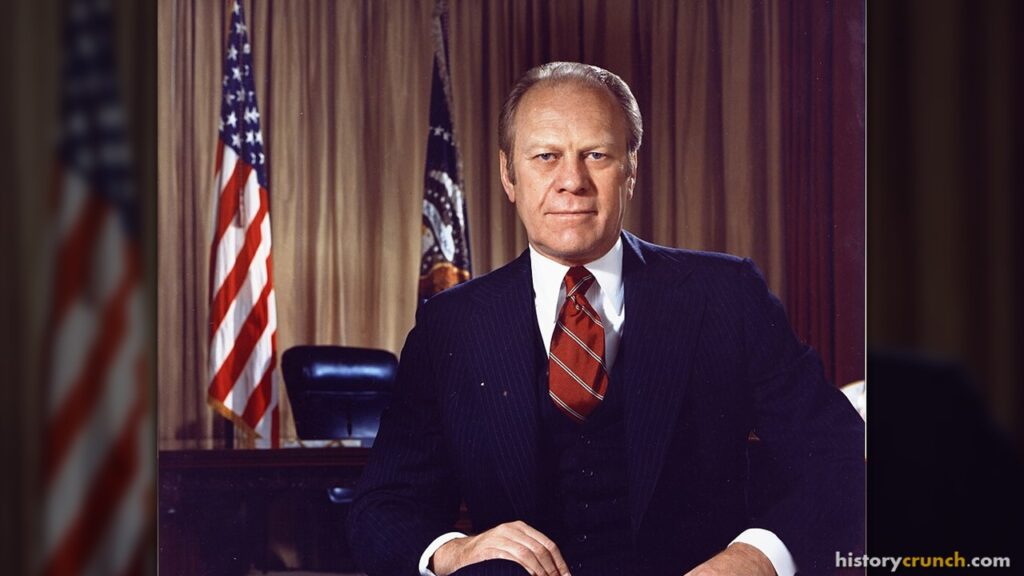
Gerald Ford was the 38th president of the United States, serving from August 9th, 1974, to January 20th, 1977, after earlier serving for many years in Congress and then briefly as vice president. He famously took office during the Watergate Scandal after Richard Nixon resigned. He is remembered for trying to restore stability and trust in government during a difficult period in American history. Due to the timeframe of his presidency he also played a role in the overall events of the Cold War.
 FactsthatCrunch
Gerald Ford was born Leslie Lynch King Jr. and grew up in Grand Rapids, Michigan, after his mother remarried and gave him the name he would carry through life. Before entering politics, he built a background in academics, college athletics at the University of Michigan, law at Yale Law School, and naval service during World War II.
Gerald Ford – Early Life
Gerald Ford was born Leslie Lynch King Jr. on July 14th, 1913, in Omaha, Nebraska. His parents separatedWhen two married people stop living together but are not yet officially divorced. soon after his birth, and he later moved with his mother to Grand Rapids, Michigan. After his mother married Gerald R. Ford Sr. on February 1st, 1916, he began being called Gerald R. Ford, although the name was not legally changed until later.
Ford grew up in Grand Rapids and became a strong student and athlete. He attended the University of Michigan, where he played football, and then went on to Yale Law School. Afterward, he served in the United States Navy during World War II from 1942 to 1946. Therefore, before he entered national politics, Ford had already built a background in education, athletics, military service, and law.
FactsthatCrunchGerald Ford was born with the name Leslie Lynch King Jr.
Gerald Ford – Rise in Politics
After World War II, Ford returned to Michigan and entered politics. He was elected to the House of Representatives in 1948 from Michigan’s 5th congressional district and served from January 3rd, 1949, until December 6th, 1973. Over time, he earned a reputation for honesty, openness, and cooperation, and in 1965 his fellow Republicans chose him as House Minority LeaderThe elected head of the political party in the House of Representatives that holds fewer seats.. This was important because it made him one of the best-known Republican leaders in Congress.
Ford’s rise took an unexpected turn in 1973. After Vice President Spiro Agnew resigned, President Richard Nixon selected Ford to replace him under the 25th AmendmentA change to the U.S. Constitution that sets rules for replacing a president or vice president who cannot serve.. Ford was confirmed by Congress and sworn in as vice president on December 6th, 1973. As such, his long reputation in Congress helped make him the man Nixon believed could win public trust during a national crisis.
FactsthatCrunchHow did Gerald Ford's path to the vice presidency unfold between 1965 and 1973?
Gerald Ford – President of the United States
Ford became president on August 9th, 1974, after Nixon resigned because of the Watergate scandal. This made Ford the only person in United States history to become both vice president and president without being elected to either office by the national voters. When he took office, he told Americans that the country’s “long national nightmare” was over, which showed that one of his first goals was to calm the political crisis that Watergate had created.
One of the most controversial decisions of Ford’s presidency came on September 8th, 1974, when he gave Richard Nixon a full pardonAn official government action that forgives a person for a crime and removes their legal punishment.. Ford believed that a long legal fight over Watergate would keep the country divided and distracted from other major problems. However, many Americans reacted angrily, and some believed there had been a secret deal between Ford and Nixon. Therefore, the pardon damaged Ford politically even though he believed it was necessary for national healing.
Ford also faced major economic problems. InflationA general rise in prices that makes money buy less than it did before. was high, the economy was weak, and energy shortages remained serious. He tried to respond with spending cuts, tax proposals, and his “Whip Inflation Now” campaign, often shortened to “WIN.” Even so, these efforts did not fully solve the country’s problems, and many Americans continued to feel economic frustration during his presidency.
Foreign policy was also a major part of Ford’s presidency. In 1975, he oversaw the final stage of the Vietnam War as North Vietnamese forces captured Saigon on April 30th. During Operation Frequent Wind, the United States evacuated thousands of Americans and South Vietnamese, and Ford also pushed for humanitarian aid for refugees. This was significant because Ford had to manage the final end of a war that had shaped American politics for years.
Ford also took part in détente, which was the effort to reduce Cold War tensions between the United States and the Soviet Union. In the summer of 1975, 35 nations signed the Helsinki Final Act, also called the Helsinki Accords. The agreement addressed European security, trade, and human rights, and Ford later saw it as one of the most important foreign-policy achievements of his presidency.
In 1976, Ford had to fight hard just to win the Republican nomination because Ronald Reagan challenged him in the primaries. Ford survived that challenge, but he then lost the general election to Jimmy Carter. As such, his presidency lasted only a little more than two years, and it remained closely tied to the unusual circumstances that had brought him into office in the first place.
FactsthatCrunchThe Helsinki Final Act of 1975 was a diplomatic agreement signed by 35 nations that tried to reduce Cold War tensions by setting shared rules on security, trade, and human rights in Europe.
Gerald Ford – Later Years and Death
After leaving office, Ford remained active in public life and was often seen as an experienced elder statesman. Over time, some people came to view his Nixon pardon more favorably than they had in 1974. In 2001, he received the John F. Kennedy Profiles in Courage Award for that decision, which showed that many later observers saw the pardon as a politically costly act that Ford believed was right for the country.
Gerald Ford died on December 26th, 2006, at his home in Rancho Mirage, California, at the age of 93. He received a state funeral and was buried at the Gerald R. Ford Presidential Museum in Grand Rapids, Michigan.
Gerald Ford – Significance
Gerald Ford was significant because he helped lead the United States through the aftermath of Watergate and tried to restore trust in the presidency. His calm style, long congressional experience, and focus on stability made him an important transitional leader during a very unsettled time in American history.
At the same time, Ford remains a debated historical figure. Some people remember him mainly for pardoning Nixon, while others emphasize that he helped lower political tensions, managed serious economic and foreign-policy problems, and brought a sense of decency back to the White House after scandal. Regardless, Gerald Ford stands out as one of the most unusual presidents in United States history because no other president entered the office in quite the same way.
FactsthatCrunchKey Vocabulary
Separated
House Minority Leader
25th Amendment
Pardon
Inflation
Détente
Helsinki Accords
Frequently Asked Questions
How did Gerald Ford become president without being elected?
Gerald Ford became president on August 9th, 1974, after Richard Nixon resigned over the Watergate scandal. He had earlier become vice president in December 1973 when Spiro Agnew resigned and Nixon picked him under the 25th Amendment. This made Ford the only person to hold both offices without being elected to either by national voters.
Why did Gerald Ford pardon Richard Nixon?
Ford pardoned Nixon on September 8th, 1974, because he believed a long legal fight would keep the country divided. He wanted the nation to move past Watergate and focus on other serious problems. Many Americans reacted with anger, and some suspected a secret deal, which hurt Ford politically.
What was the “Whip Inflation Now” program?
“Whip Inflation Now,” often shortened to “WIN,” was Ford’s campaign to fight the high inflation of the 1970s. He also tried spending cuts and tax proposals to strengthen the weak economy. These efforts did not fully solve the problems, and many Americans stayed frustrated during his presidency.
What happened during Ford’s presidency in the Vietnam War?
Ford oversaw the final stage of the Vietnam War when North Vietnamese forces captured Saigon on April 30th, 1975. During Operation Frequent Wind, the United States evacuated thousands of Americans and South Vietnamese. Ford also pushed for humanitarian aid to help refugees fleeing the conflict.
Who defeated Gerald Ford in the 1976 election?
Ford lost the 1976 general election to Democrat Jimmy Carter. First he had to survive a tough primary challenge from Ronald Reagan to win the Republican nomination. His short presidency of just over two years remained tied to the unusual way he entered office.
Cite This Article
To cite this article as a source, use one of the formats below.
MLA: Millar, B. “Gerald Ford: A Detailed Biography.” HistoryCrunch, 10 October 2026, https://historycrunch.com/gerald-ford/.
APA: Millar, B. (2026). Gerald Ford: A Detailed Biography. HistoryCrunch. https://historycrunch.com/gerald-ford/
Chicago: Millar, B. “Gerald Ford: A Detailed Biography.” HistoryCrunch. October 10, 2026. https://historycrunch.com/gerald-ford/
Sources
- State Department — Office of the Historian
- John Lewis Gaddis, The Cold War: A New History.