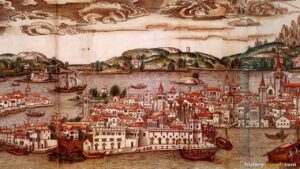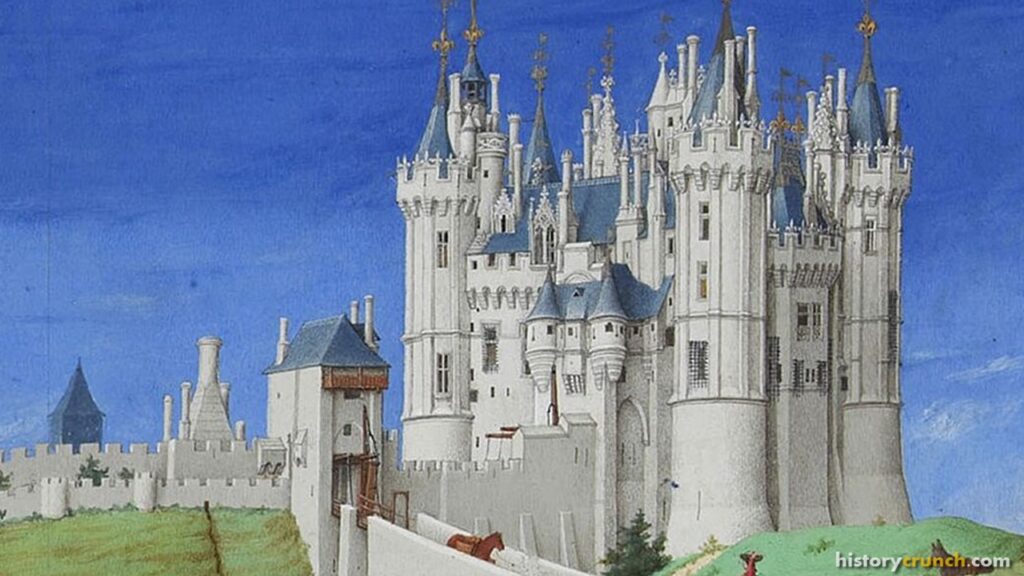
Medieval Castles were some of the most significant structures of the Middle Ages. A Medieval Castle was a fortifiedBuilt with strong walls and defenses to protect against enemy attack. structure (usually out of stone) that was mainly for the nobility or royalty in European societies. While fortified structures existed for centuries, the classic Medieval Castle is considered to have first emerged in the 9th or 10th century. This is a highly debated topic among historians. However, by the 11th century there were many castles being built across Europe. At the time, Europe was divided among many different kingdoms which were often in conflict. As such, castles allowed for protection from attack. The history of Medieval Castles stretches from their origins in the early Middle Ages to their decline in the Renaissance.
 FactsthatCrunch
Why did castle building spread across Europe by the 11th century?
What Was the Middle Ages?
The Middle Ages (or Medieval Period) lasted for approximately 1000 years from the 5th century to the 15th century. Due to its timeframe, the Middle Ages in Europe is divided into three smaller periods referred to as the Early, High and Late Middle Ages. Throughout this time period castles played an important political, social and military role in European society.
The Early Middle Ages began in the 5th century during the decline of the Roman Empire. Europe at the time was ruled by many different kingdoms and did not have large unified countries such as those in modern times. The Byzantine Empire (or Eastern Roman Empire) remained in the eastern sections of Europe and parts of the Middle East and was formed in the early 4th century, when Constantine founded Constantinople in 330 CE; the Western Roman Empire later collapsed in the 5th century.
The High Middle Ages began at the start of the 11th century and included some of the most prominent events and elements of the whole Middle Ages. For example, life in the High Middle Ages was characterized by religious faith in the Catholic Church and the social structure of feudalismA medieval system where kings gave land to nobles in exchange for loyalty and military service.. Feudalism was a form of government common during medieval Europe that involved society being structured in a very rigid and hierarchical way. It was popular in European society from the 9th century until the 15th century and was a decentralized form of government in which local lords exercised administrative and judicial power, rather than power being held by a single absolute monarch.
The final period of the Middle Ages is called the Late Middle Ages and is considered to have occurred from the start of the 14th century to the end of the 15th century. The Late Middle Ages was a difficult time for most people in Europe and the surrounding areas. This is due to the spread of the bubonic plague that led to the events of the Black Death. The Black Death is one of the most important events in Western history and is the most famous pandemic in all of human history.
Purpose and Function
Generally, historians believe that Medieval Castles were built as a defensive measure to protect noble lords and their families. They allowed a place for wealth and people to be held when under siege and as a means of creating a defensive line against an attack. However, castles also served many more roles in European society. For example, historians have also argued that castles served an important offensive role in European conflicts. For instance, castles were often the site of weapons storage and made excellent centers for organizing and assembling armies. As such, they were often used as staging grounds for a future assault. Finally, castles also served as important symbols of power. Noble lords used them as residences and to symbolize their authority to local peasants or other nobility. Furthermore, larger castles helped noble lords gain favor and respect from the local peasants as they could seek refuge and safety in the castle during a conflict. This further helped the lord as it allowed him access to a loyal supply of people for his army. As a result, castles were important in feudalistic societies and helped to maintain the rigid hierarchy present in many societies of the time.
As well, Medieval Castles were important features of the Manor System (Manorialism) in Europe during the timeframe of the Middle Ages. For example, they served as the manor for the noble lord and functioned as the political and economic center of the manor in medieval society. Furthermore, Medieval Castles were symbols of feudal power. They represented the authority of kings, nobles, and knights over their land and people. In times of peace, they acted as centers of medieval culture. For instance, castles were known to be where knights trained for battle, local artisans worked, and entertainers performed.
History
As mentioned previously, the history of Medieval Castles began after the fall of the Roman Empire around the 5th century CE. This was a difficult time for the people of Europe and gave rise to the Middle Ages. In fact, the Early Middle Ages was a time of constant wars, invasions, and local conflicts that ultimately created a need for security.
The first true Medieval Castles appeared approximately in the timeframe of the 9th and 10th centuries in France, and they came to England with the Normans after 1066. This was during the time of the feudal system, when kings granted land to nobles in exchange for loyalty and military service. These nobles then built castles to protect their territories and to keep control over the surrounding lands. The earliest castles were known as ‘motte-and-baileyAn early castle design with a wooden tower on a raised earth mound next to an enclosed courtyard.‘ castles. These early castles were made of a wooden tower (the keep) built on a raised mound of earth called a motte, surrounded by a courtyard (bailey) that was enclosed by a wooden fence or palisadeA defensive wall made from large wooden tree trunks lined up tightly together. wall. While these early castles were relatively easy and quick to build, they were also vulnerable to fire and decay.
By the 11th century, Medieval Castle design had dramatically changed. For instance, after the Norman Conquest of England in 1066, William the Conqueror and his followers built hundreds of motte-and-bailey castles across the country to establish their control of the region. With that said, over time, the wooden structures were replaced with stone castles, which were stronger, more durable, and more resistant to attack. These stone keep castles, such as the Tower of London, featured thick stone walls, narrow windows for archers (arrow loopholes), and high towers that provided both defense and visibility. The keep was often the center of life in the castle, containing the great hall, living quarters, and storerooms.
During the High Middle Ages, castle architecture became even more advanced and impressive. In fact, builders began constructing castles with multiple layers of walls. For instance, they would construct an outer wall for the first line of defense and an inner wall to protect the keep. This design made it much harder for enemies to attack the castle and get inside the fortified walls. A famous example of these types of Medieval Castles can be seen in the Caerphilly Castle in Wales.
The decline of Medieval Castles began in the Late Middle Ages, around the 15th century. Advances in military technology, especially the development of gunpowder and cannons, made castle walls less effective against powerful artillery. Instead of relying on castles for defense, rulers began building more comfortable palaces and manor houses, focusing on luxury rather than military strength. Further to this idea, centralized governments and stronger monarchies reduced the need for fortified homes, as large standing armies replaced the private knights and lords of the feudal era. In fact, many castles were abandoned, destroyed in wars, or repurposed as administrative buildings, prisons, or ruins that have since become historical landmarks.
FactsthatCrunchHow did castle design evolve from simple wooden mounds to massive stone fortresses during the Middle Ages?
Main Features
Early castles (or other fortified structures) were usually made out of wood. Constructing out of wood was cheaper than constructing out of stone but it had a few main problems. The main issue with wood construction was that fire posed a severe risk. As a result, people sought new ways to construct castles to make them stronger and better fortified. For instance, by the High Middle Ages, castles were generally constructed out of stone blocks. While wood was still used in some of the construction of the castle, the outer walls and central residence of the lord were usually made out of stone.
The location of the Medieval Castle was also incredibly important. Since castles were protecting both wealth and people they were often the site of warfare. As a result, constructing the castle in a location that was easier to defend was one of the first priorities of the builders. To do this, Medieval Castles were often built on hills, rocky outcrops and next to water. Building on higher land such as a hill or rocky outcrop allowed the castle the advantage of higher walls. This made it more difficult for an assaulting army to breach the walls of the castle but also allowed the lookouts in the castle the ability to see advancing armies from a greater distance. Building next to or near water allowed a natural protection. For example, if built on the side of a river or lake, the defenders of the castle could count on that side being more difficult for the assaulting army. As well, being built near a body of water allowed for easier transport to and from the castle. This is also why many European castles were constructed on already established roads.
FactsthatCrunchIt is the spring of 1090 CE, during the Middle Ages in medieval Europe, and you are a Norman lord who has been granted land in northern England by the king under the feudal system. You must build a castle to protect your territory, your wealth, and the people loyal to you. The site you choose will decide whether your castle can survive a siege or fall quickly to an enemy army.
Main Features
Besides location, Medieval Castles were constructed with many different features. The following is a list and explanation of the main features found in most of the European castles at the time. Not all castles had every feature but, in general, they were important features that made up many castles.
- Arrow Loophole – (also sometimes called arrow slits) were narrow cut-outs in the castle walls which allowed archers to shoot arrows at assaulting armies. While they varied in shape and size through the Medieval period they were often in the shape of a cross, which allowed a defending archer the ability to better aim at his target.
- Bailey – Also called a ‘ward’, a bailey was the inside courtyard that was protected by the outer walls. It was usually attached to the main castle and the walls of the bailey were connected to the outer walls of the castle. A single castle could have several baileys. In general, the bailey was where homes of knights and other soldiers were located. As well, it sometimes contained the stables for the horses, workshops, and different types of storage.
- Bastion – A bastion (which can also be known as a bulwark) was a part of the curtain wall that protruded outward. It allowed the defending forces in the castle the ability to shoot projectiles at advancing armies that tried to climb or smash the curtain walls of the castle.
- Battlements – Battlements are the structures at the top of a castle wall. The tooth-like structures that stick up on the battlements are called merlons. The battlements on the castle walls helped protect lookouts and archers at the top while they defended the castle against advancing armies.
- Curtain Wall – The curtain walls were the defensive walls that surrounded a bailey. These are the classic walls that people think of when they envision Medieval castles. They were the main type of defense for castles and as a result were often built very high and thick. For example, a curtain wall of a typical Medieval castle could be as high as 39 feet (12 meters) and as thick as 10 feet (3 meters). This helped prevent an assaulting army from using ladders to scale the wall and from siege weapons such as trebuchets or cannons from breaching the wall. The tops of curtain walls often contained battlements and walkways for the defending army.
- Drawbridge – The drawbridge was a wooden bridge that could be lowered or stretched out from the main castle entrance. It usually spanned over a moat or other type of defensive barrier. Because it could be lowered and lifted when needed it allowed better defenses for the castle as it helped prevent a direct path to the castle walls and entrance.
- Gatehouse – The gatehouse was the main entrance of a castle. It generally included a small gate opening in-between two high towers that were connected to the curtain walls. This allowed the defending forces of the castle the ability to control who could enter and leave the castle. However, the gatehouse also usually included several different defensive features. For instance, the main gate of the gatehouse was a portcullis, which was a metal or wooden gate that could be lowered from above. As well, above the gatehouse were the ‘murder holes’. These were holes in the ceiling of the main gate passage which allowed the defending forces the ability to drop rocks or burning oil onto people trapped in the passage of the gatehouse.
- Great Hall – The great hall was the main room of a Medieval Castle. It was generally a meeting place that could hold many people at once and was the main dining quarters for the noble lord of the castle. It usually contained a large fireplace and was used for gatherings and special occasions.
- Keep – The keep was usually the largest and most well defended tower in the castle. During the Medieval period the keep was almost always referred to as the ‘donjon’. In general, it served as the residence of the noble lord who lived at the castle.
- Merlon – A merlon is the upright section common on the outer curtain walls of a castle. They are the tooth-like structures that go along the top of a wall’s exterior. The gaps between them, called crenels, allowed archers on the upper walkway to shoot arrows through while the merlons gave them cover. Merlons were a major part of castle battlements.
- Moat – A moat was a defensive ditch that surrounded a castle. While usually depicted as being filled with water, moats were also sometimes dry ditches or had the ability to be dried and later filled with water. When filled with water, moats offered the castle protection in that the assaulting forces could not easily use ladders to scale the walls. As well, it prevented the use of siege weapons to directly smash or undermine the curtain walls of the castle. When dry, the moat offered protection in that it made the walls of the castle even higher and more difficult for the assaulting forces to overcome.
- Motte – A motte was a small hill that had a flat top. Mottes were generally man-made and were excellent sites for building castles as they elevated the castle above the surrounding terrain.
- Palisade – A palisade is the term given to a defensive wall of a castle or other fortification. It is generally made out of wood in the form of large tree trunks that are lined up beside one another to form a high and strong wall. Palisades were used in fortified cities throughout history but were an easy and cheap form of defense used in Medieval castles. They were usually constructed outside of the main curtain walls of the castle.
- Portcullis – A portcullis was a metal or wooden gate that could be lowered from above. It was an important feature of the gatehouse which was the entrance of the castle.
- Postern – A postern was a secondary or ‘back door’ of a castle. It was usually in a hidden location and allowed the residents of the castle to come and go without being noticed. As it was an entrance to the castle it was generally protected by a strong wooden or metal gate.
- Rampart – The ramparts of a castle were the walkway sections on the top of the outer walls. They allowed defenders to stand at the top of the wall and to move soldiers and supplies along the length of the wall as they defended against a siege.
Explore Middle Ages · 476 – 1500 CE
Keep exploring Middle Ages with these History Crunch resources.
Key Vocabulary
Fortified
Feudalism
Motte-and-bailey
Curtain wall
Portcullis
Trebuchet
Rampart
Frequently Asked Questions
When were the first medieval castles built?
The first true medieval castles appeared around the 9th and 10th centuries in France, and they came to England with the Normans after 1066. They grew common under feudalism, when kings gave nobles land in return for loyalty and service. Those nobles then built castles to guard their territory and control the people who lived on it.
What is a motte-and-bailey castle?
A motte-and-bailey castle had a wooden tower built on a raised mound of earth called a motte. Around it sat a courtyard, or bailey, ringed by a wooden fence known as a palisade. These castles went up quickly and cheaply, but fire and rot made them easy to lose.
Why were later castles made of stone instead of wood?
Stone replaced wood because it was stronger, lasted longer, and did not burn like a wooden tower. Fire was the biggest danger to early wooden castles, so builders switched to stone blocks. By the High Middle Ages, the outer walls and the lord’s home were usually stone.
How thick were medieval castle walls?
A typical curtain wall could stand about 39 feet (12 m) high and reach 10 feet (3 m) thick. Walls this size stopped attackers from using ladders to climb over them. They also helped block siege weapons like trebuchets and cannons from smashing through.
Why did castles stop being built?
Castles declined in the 15th century mainly because gunpowder and cannons made stone walls easier to break. Stronger kings with large standing armies also no longer needed private lords in fortified homes. Many rulers then chose comfortable palaces, and old castles were abandoned or turned into other buildings.
What were murder holes used for?
Murder holes were openings in the ceiling of the gatehouse passage above the main gate. Defenders used them to drop rocks or pour burning oil onto enemies caught below. The gatehouse also held a portcullis, a heavy gate that could be lowered to seal the entrance.
Cite This Article
To cite this article as a source, use one of the formats below.
MLA: Beck, Elias. “Medieval Castles: A Detailed Summary.” HistoryCrunch, 15 September 2026, https://historycrunch.com/medieval-castles/.
APA: Beck, E. (2026). Medieval Castles: A Detailed Summary. HistoryCrunch. https://historycrunch.com/medieval-castles/
Chicago: Beck, Elias. “Medieval Castles: A Detailed Summary.” HistoryCrunch. September 15, 2026. https://historycrunch.com/medieval-castles/
Sources
- Chris Wickham, Medieval Europe.
- Fordham Medieval Sourcebook
- The Met (Heilbrunn Timeline) — medieval art