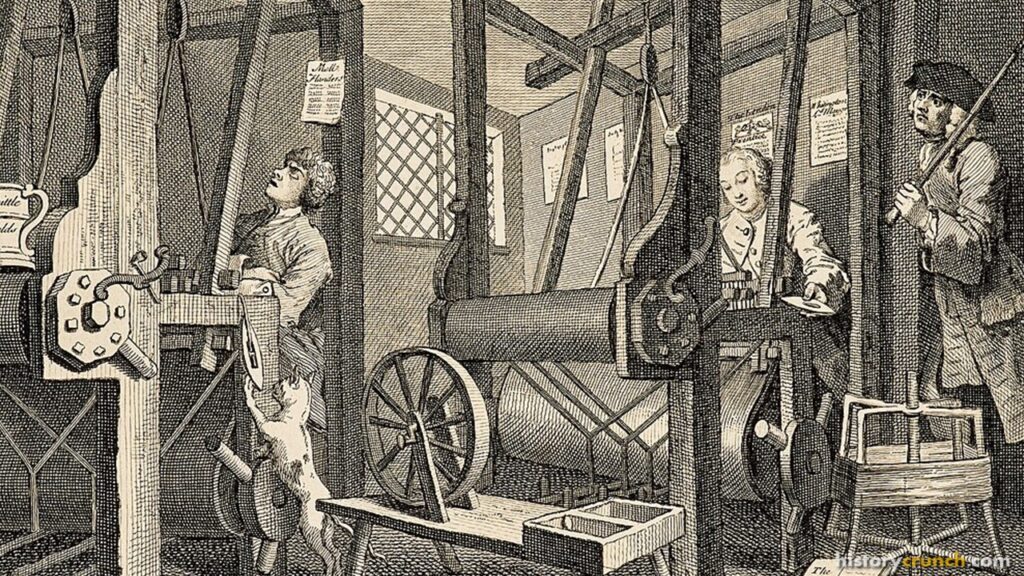
A free market economy is an economy in which individual people and businesses make the majority of the economic decisions and usually control most or all of the means of productionThe resources, tools, and facilities used to make goods and services in an economy. through private ownership and competition. It is viewed as a contrasting system to mixed or command economies. While a free market system promises the highest level of consumer choice, it often suffers from wide income gaps between the rich and the poor and the highs and lows of the boom and bust cycleThe pattern of economic highs followed by sharp downturns that free market economies often experience.. Free market economies have occurred throughout history, but are best known in Britain during the Industrial Revolution.
Economics is the study of how societies handle the distribution of money (wealth) and the production of goods and services. There are several different types of economic systems that historians and economists have identified throughout history, including: command economyA system where the central government sets wages and decides what and how much gets produced., mixed economy and free market economy.
 FactsthatCrunch
What Is a Free Market Economy?
A free market economy is considered to be on the right side of the economic spectrum and is based on the principles of individualism, such as: economic freedom, self-interest, competition and private property. This means that a free market economy contains a low degree of government intervention in the economy and focuses on the maximum freedom of choice for the individuals and businesses of the country. For example, in a free market economy the economic decisions of a country are generally determined by the individual needs or wants of the people and businesses. Therefore, the market forces of supply and demand are responsible for determining the needs of the citizens of the country, deciding what should be produced and who should get them. The individual wants or desires of the people of the country are the most important factor in a free market economy and the leadership of the government is usually focused on maintaining this freedom and staying out of the way of supply and demandThe market forces that determine what gets made, how much it costs, and who receives it.. Furthermore, in a free market economy, the means of production are controlled by individuals and businesses through the use and promotion of private property. As a result, the production output of the economy and the wages of the workers are determined by the market forces of supply and demand. This contrasts with a command economy, where the central government sets wages and quotas for production.
FactsthatCrunchAdam Smith used the famous phrase invisible hand only once in The Wealth of Nations.
In his 1776 book, Scottish economist Adam Smith described how people seeking their own gain can end up helping society, as if led by an invisible hand. The phrase later became a common way to describe how supply and demand guide a free market economy.
Examples of a Free Market Economy
Because of the nature of free market economies, they are often associated with democratic societies based upon the principles of laissez-faire capitalism. A democracy is a form of government in which most or all authority of the country is in the hands of the people who elect representatives to run the government. Often, laissez-faireA French phrase meaning the government should stay out of the economy and let people handle their own affairs. capitalism is also referred to as free market capitalism or market capitalism. Simply put, laissez-faire translates to “leave us alone” meaning that the government should remain out of the economy and instead allow individuals to freely carry out their own economic affairs. Historically, laissez-faire capitalism was most common in Britain during the 18th and 19th centuries in the timeframe of the Industrial Revolution. At the time, it was a revolutionary idea, because in the previous centuries, mercantilism had been the dominant economic system. In general, mercantilismAn older economic system that favored heavy government control and regulation of trade and production. is viewed as an economic system that favored heavy government control and regulation. At the time, absolute monarchs ruled over vast empires and controlled almost all aspects of the economy. However, prominent thinkers, including Adam Smith, began to argue against mercantilism in favor of an economic system with more freedom for individuals. The development of capitalism as an economic system sought to reject the idea of government control of the economy and instead put the focus on individuals. On the economic spectrum, laissez-faire capitalism is a right-wing ideology that is fundamentally based on: private ownership, competition, free trade, self-reliance, self-interest, and the principles of supply and demand. These principles are central to understanding a free market economy. Some modern examples of countries that embrace the principles of free market economies are: Hong Kong, Singapore, Australia and the United States. While no current country is considered to be a true free market economy, these four contain high levels of economic freedom for their citizens by ensuring many of the principles above. In reality, most countries contain a mix of right and left wing economic values.
FactsthatCrunchPositives of a Free Market Economy
On the positive side, a free market economy benefits society because it focuses on competition and economic freedom as its main principles. Competition is important because it allows privately owned businesses to compete for the money of consumers. This leads to several different things including: lower prices for goods and services, increased innovation and a wider selection of products. Consumers benefit from this system because they receive low prices for high quality goods and services. Next, while a command economy may sometimes lead to waste if the leader is not producing the exact goods and services desired by the people, a free market economy is excellent at avoiding waste. In general, the concept of competition pushes individuals and businesses to use resources in an efficient manner in order to maximize profits. Therefore, free market economies are generally less wasteful. The next positive aspect of a free market economy is that they lead to high levels of economic output. The competition present in a free market economy is not just limited to businesses but also drives individuals to work as hard as possible to earn money. This incentive for profit and wealth benefits the overall economy because it causes a high level of economic output that means the economic system is producing many goods and services in an efficient manner.
FactsthatCrunchCompetition shaped how free markets worked during the Industrial Revolution, bringing real gains for consumers alongside serious risks.
Negatives of a Free Market Economy
Although there are several positive aspects of a free market economy, there are also several negative aspects as well. First, a free market economy is based on little or no government intervention in the economy. While this may be beneficial in promoting economic freedom and choice, it also has the ability to cause large income gaps in society. For example, during the Industrial Revolution in Britain, which had a free market economy, the business owners were able to amass large fortunes while the working class people struggled. Because the government did not intervene in the economy, working class people suffered with low wages, a lack of worker rights and horrible working conditions. The lack of a government to protect the working class people meant that wealthy entrepreneurs could take advantage of the poor. The next problem associated with free market economies is that they often lead to higher levels of unemployment. A key feature of a command economy is that the government provides full employment for all people in society. However, the nature of a free market economy is such that individuals cannot count on the government to protect or help them in a time of need. As such, most countries based on a free market economy have some level of unemployment. This means, that at some points a certain percentage of the population will be struggling with poverty and be unable to support themselves. Further to this idea, because the government does not intervene in a free market economy, monopolies may also form. A monopolyWhen one corporation dominates and controls an entire industry, removing consumer choice. is when one corporation dominates and controls an entire industry. This is bad for consumers, because without the benefit of choice, the corporation would increase prices to whatever they wanted. Finally, free market economies are usually reliant on the forces of supply and demand. While this provides a framework for economic freedom to exist it also creates a system of ‘boom and bust’ in the overall economy. As such, free market economies are often susceptible to changing economic conditions, which could be difficult to endure for many average consumers.
FactsthatCrunchFree market economies guarantee everyone a job.
Key Vocabulary
Means of production
Laissez-faire
Mercantilism
Supply and demand
Monopoly
Boom and bust cycle
Command economy
Frequently Asked Questions
What is a free market economy in simple terms?
A free market economy is a system where people and businesses make most economic decisions with little government control. Private owners control the means of production, and prices come from supply and demand. It sits on the right side of the economic spectrum and rewards competition and individual choice.
How does a free market economy differ from a command economy?
In a free market economy, supply and demand set prices, wages, and what gets produced. In a command economy, the central government sets wages and production quotas instead. A command economy also aims to provide jobs for everyone, while a free market usually has some unemployment.
What does laissez-faire capitalism mean?
Laissez-faire is a French phrase that roughly means “leave us alone.” It describes the idea that the government should stay out of the economy and let people run their own business affairs. This idea grew popular in Britain during the 18th and 19th centuries, replacing the older system of mercantilism.
What are the main advantages of a free market economy?
The main advantage is competition, which pushes businesses to lower prices and improve their products. Consumers get high quality goods and a wide selection of choices. Free markets also avoid waste and produce high levels of output because profit drives people to work hard.
What are the disadvantages of a free market economy?
The biggest drawback is wide income gaps between rich and poor, since the government does not protect workers. During Britain’s Industrial Revolution, owners grew rich while workers faced low wages and poor conditions. Free markets can also cause unemployment, allow monopolies to form, and swing through boom and bust cycles.
Which countries have free market economies today?
Hong Kong, Singapore, Australia, and the United States are often named as strong examples of free market economies. None of them is a pure free market, though, since all have some government involvement. Most countries today mix right-wing and left-wing economic ideas.
Cite This Article
To cite this article as a source, use one of the formats below.
MLA: Beck, Elias. “Free Market Economy: A Detailed Summary.” HistoryCrunch, 27 September 2026, https://historycrunch.com/free-market-economy/.
APA: Beck, E. (2026). Free Market Economy: A Detailed Summary. HistoryCrunch. https://historycrunch.com/free-market-economy/
Chicago: Beck, Elias. “Free Market Economy: A Detailed Summary.” HistoryCrunch. September 27, 2026. https://historycrunch.com/free-market-economy/
Sources
- Robert C. Allen, The Industrial Revolution: A Very Short Introduction.
- The Science Museum Group
- Fordham Modern History Sourcebook