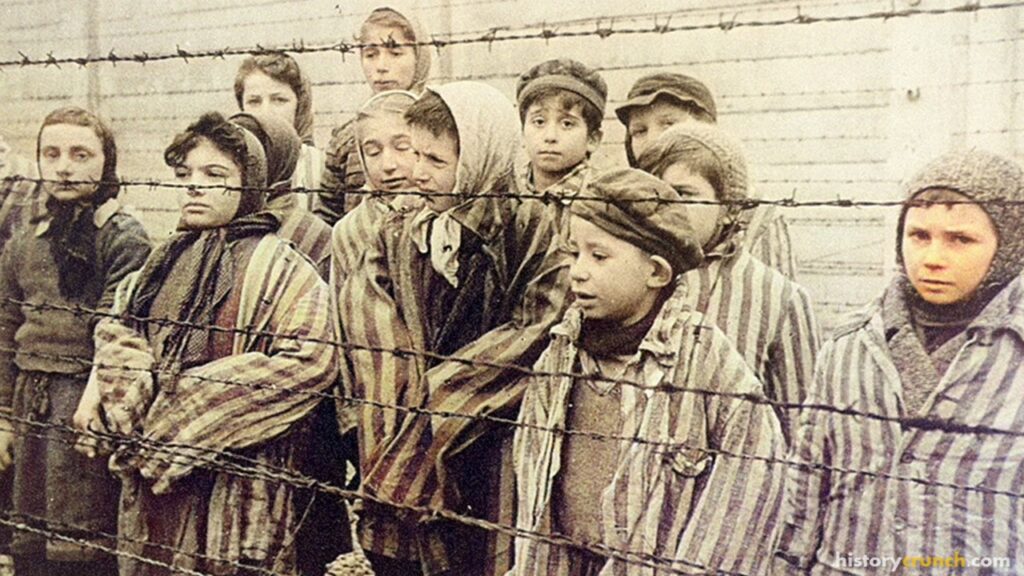
Photo of Jewish children taken by Soviet soldiers during the liberation of Auschwitz in 1945. (Colorized by historycrunch.com)
Table of Contents
When the Allied forces of World War II liberated Europe from Nazi control, they also made terrible discoveries of the atrocities of the Holocaust and the system of concentration and death camps. This article details the history and significance of the liberation of these camps at the end of World War II.
The liberation of the Nazi concentration and death camps occurred in the final months of World War II, as Allied forces advanced into Nazi-occupied Europe in 1944 and 1945. These liberations revealed the full horror of the Holocaust and exposed the world to the scale of the genocideA mass killing of a group of people targeted for ethnic, religious, or racial reasons. carried out by Nazi Germany. The liberations of the camps were generally carried out by American, British, Soviet, and other Allied troops. In short, the soldiers of these nations were unprepared for the horrible atrocitiesActs of extreme cruelty and violence committed against people. they encountered when they found and liberatedFreed from enemy control by advancing military forces. the camps.
What Was the Holocaust?
The Holocaust is one of the most important events of the 20th century and is perhaps the most significant genocide in human history. A genocide is a mass killing of a group of people for ethnic, religious or racial reasons. The term ‘holocaustA term referring to death by fire, used to name the Nazi mass murder of millions of people.’ refers to death by fire in reference to the way that people were executed during the event. It unfolded during the reign of Adolf Hitler in Germany and the major events of World War II. During the Holocaust, which occurred from 1933 to 1945, over 11 million people were executed. In total, 6 million were Jewish people, while the other 5 million included several other groups, including: disabled people, homosexuals, communists, Soviet and Polish prisoners of war, Roma, and other religious and ethnic minorities.
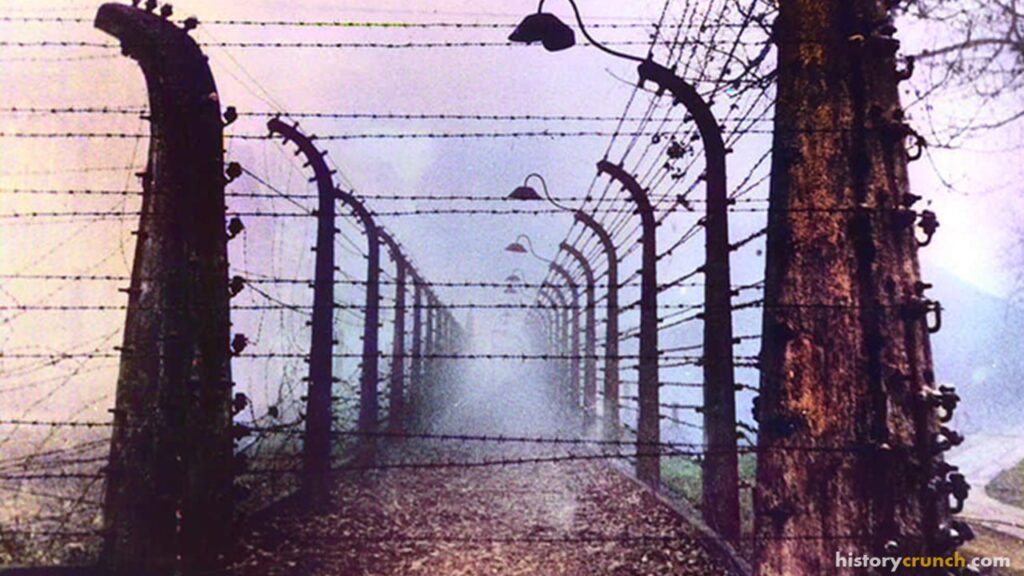
Barbed wire double fences at Auschwitz. (Colorized by historycrunch.com)
How were concentration camps and death camps different during the Holocaust, and what did they have in common?
Tap an item to read its detail.
Forced Labor Prisoners were put to work under brutal conditions for German industries and the Nazi war effort. Camps like Dachau, opened in 1933, used inmates as a source of unpaid forced labor.
Long-Term Detention Concentration camps held prisoners for months or years. They housed a wide range of groups including political opponents, Roma, disabled people, and Soviet prisoners of war.
Dachau as a Model Dachau, established on March 22nd, 1933, near Munich, became the model on which the SS organized later camps. It trained camp guards and set the administrative structure used across the system.
Starvation and Disease Prisoners in concentration camps died in large numbers from starvation, disease, and physical abuse, though systematic mass killing was not always the camp's primary purpose.
Part of the Holocaust System Both types of camps were built and run by the Nazi SS. Both held Jewish people and other persecuted groups, and both were sites of extreme suffering and death.
Liberated by Allied Forces Allied armies liberated both types of camps in 1944 and 1945. Soviet forces reached Majdanek on July 23rd, 1944, and Auschwitz on January 27th, 1945. American forces freed Buchenwald and Dachau in April of 1945.
Evidence of Nazi Crimes Documents, crematoria, and physical remains found at both types of camps served as key evidence at the Nuremberg Trials, which began on November 20th, 1945.
Guards Fled Before Liberation At many camps of both types, Nazi guards tried to kill remaining prisoners before fleeing. Some forced prisoners on brutal marches when Allied troops approached.
Designed to Kill on Arrival Death camps were built specifically to murder people immediately upon arrival. Most victims never lived in the camp; they were killed in gas chambers within hours of reaching the site.
Operation Reinhard Sites The three Operation Reinhard death camps, Belzec, Sobibor, and Treblinka, were built in occupied Poland in 1942 solely to kill Jewish people. Treblinka alone killed approximately 700,000 to 900,000 people.
Auschwitz-Birkenau Auschwitz-Birkenau functioned as both a concentration camp and a death camp. Its gas chambers and crematoria killed approximately 1.1 million people, the majority of them Jewish.
No Long-Term Population Unlike concentration camps, death camps had very few long-term survivors among those selected for immediate killing. A small number were kept alive temporarily to help operate the killing process.
Forced LaborPrisoners were put to work under brutal conditions for German industries and the Nazi war effort. Camps like Dachau, opened in 1933, used inmates as a source of unpaid forced labor.
Long-Term DetentionConcentration camps held prisoners for months or years. They housed a wide range of groups including political opponents, Roma, disabled people, and Soviet prisoners of war.
Dachau as a ModelDachau, established on March 22nd, 1933, near Munich, became the model on which the SS organized later camps. It trained camp guards and set the administrative structure used across the system.
Starvation and DiseasePrisoners in concentration camps died in large numbers from starvation, disease, and physical abuse, though systematic mass killing was not always the camp's primary purpose.
Part of the Holocaust SystemBoth types of camps were built and run by the Nazi SS. Both held Jewish people and other persecuted groups, and both were sites of extreme suffering and death.
Liberated by Allied ForcesAllied armies liberated both types of camps in 1944 and 1945. Soviet forces reached Majdanek on July 23rd, 1944, and Auschwitz on January 27th, 1945. American forces freed Buchenwald and Dachau in April of 1945.
Evidence of Nazi CrimesDocuments, crematoria, and physical remains found at both types of camps served as key evidence at the Nuremberg Trials, which began on November 20th, 1945.
Guards Fled Before LiberationAt many camps of both types, Nazi guards tried to kill remaining prisoners before fleeing. Some forced prisoners on brutal marches when Allied troops approached.
Designed to Kill on ArrivalDeath camps were built specifically to murder people immediately upon arrival. Most victims never lived in the camp; they were killed in gas chambers within hours of reaching the site.
Operation Reinhard SitesThe three Operation Reinhard death camps, Belzec, Sobibor, and Treblinka, were built in occupied Poland in 1942 solely to kill Jewish people. Treblinka alone killed approximately 700,000 to 900,000 people.
Auschwitz-BirkenauAuschwitz-Birkenau functioned as both a concentration camp and a death camp. Its gas chambers and crematoria killed approximately 1.1 million people, the majority of them Jewish.
No Long-Term PopulationUnlike concentration camps, death camps had very few long-term survivors among those selected for immediate killing. A small number were kept alive temporarily to help operate the killing process.
As World War II came to an end and the Allied armies pushed their way through Poland, they came across the systems of concentration and death camps that were part of the Holocaust. What they found were piles of corpses, gas chambers, crematoriaFurnaces used to burn the bodies of people who had been killed in the camps., and thousands of survivors suffering from starvation, disease, and abuse.
While high command officers of the Allied forces were aware that the camps existed during the course of World War II, the average Allied soldier (American, British, Canadian, French, Soviet) was unaware and was surprised by the horrors they discovered. Often, the Nazi guards left in a rush and abandoned the camps fearing the arrival of the Allied troops. As such, they tried to execute as many prisoners as possible before abandoning their post and the Allied soldiers found camps with bodies scattered throughout. Since many were not killed before the Nazi guards fled the camps, the Allies also discovered thousands of sick and dying people. Other times, the Nazi guards took the prisoners with them and forced them to march until they died. Regardless, the Allied soldiers discovered horrible atrocities and began the process of recording their discovery for history. Many of the images that exist today, from the camps, come from the records of Allied soldiers who liberated the camps. As well, the United States Army forced local townspeople to go through the camps after their liberation to see the piles of dead. The intent was to force the people to witness the atrocities that they had supported by not acting out against the Nazi regimeA government or system of rule, especially one that holds power through force.. The photographs and films of the atrocities in the camps also proved to be important as evidence for war crimes trials, including the Nuremberg Trials. The liberation of the camps not only saved the lives of remaining prisoners but also made the world confront the unimaginable scale and brutality of the Holocaust.
The Majdanek Camp in Poland was the first to be liberated when Soviet forces arrived on July 23rd, 1944. The Soviets later liberated Auschwitz on January 27th, 1945. American forces liberated Buchenwald and Dachau in April of 1945. While the liberation of the camps was a relatively bright point in the atrocities of the Holocaust, it still highlighted the devastation of the overall event. For example, many of the freed prisoners died shortly after being liberated due to their bodies being too weak. As well, survivors were now faced with the reality of the fate of their family and friends.
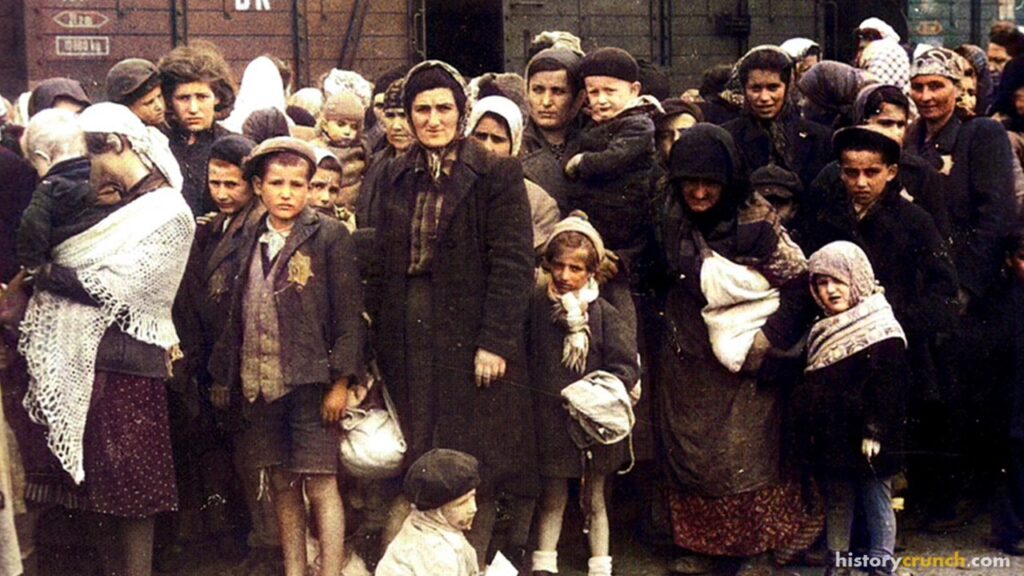
Arrival of Hungarian Jewish women and children at Auschwitz, the Nazi death camp in 1944. (Colorized by historycrunch.com)
Soviet and Allied forces began finding Nazi concentration and death camps in mid-1944 as they advanced through German-controlled territory.
The first liberations happened in the east, months before the war in Europe ended.
Soldiers were often unprepared for what they found inside the camps.
July 23rd, 1944
Majdanek LiberatedSoviet forces entered Majdanek near Lublin, Poland, making it the first major Nazi camp to be liberated.
January 17th, 1945
Auschwitz EvacuatedNazi guards forced most prisoners on death marches west before Soviet troops arrived; about 60,000 prisoners left the Auschwitz complex on foot.
January 27th, 1945
Auschwitz ReachedSoviet soldiers entered the abandoned Auschwitz-Birkenau camp and found roughly 7,000 survivors too sick to march.
April 4th, 1945
Ohrdruf EnteredAmerican troops from the 4th Armored Division reached Ohrdruf in Germany, the first Nazi camp encountered by U.S. forces.
April 11th, 1945
Buchenwald FreedAmerican forces liberated Buchenwald near Weimar, Germany, finding more than 21,000 surviving prisoners.
7,000
Survivors found at Auschwitz-Birkenau by Soviet troops on January 27th, 1945
21,000+
Prisoners alive at Buchenwald when American forces arrived on April 11th, 1945
60,000
Prisoners forced onto death marches from the Auschwitz complex in January 1945
A mass killing of a group of people targeted for ethnic, religious, or racial reasons.
Holocaust
A term referring to death by fire, used to name the Nazi mass murder of millions of people.
Crematoria
Furnaces used to burn the bodies of people who had been killed in the camps.
Atrocities
Acts of extreme cruelty and violence committed against people.
Liberated
Freed from enemy control by advancing military forces.
Regime
A government or system of rule, especially one that holds power through force.
Nuremberg Trials
Legal proceedings held after World War II to prosecute Nazi leaders for war crimes.
Frequently Asked Questions
Which concentration camp was liberated first?
The Majdanek camp in Poland was the first camp liberated, when Soviet forces arrived on July 23, 1944. Its early capture gave the Allies some of the first direct proof of the Holocaust. The Soviets later reached Auschwitz on January 27, 1945.
Which Allied countries liberated the camps?
American, British, and Soviet forces carried out most of the liberations, along with other Allied troops. Soviet soldiers reached camps in the east, such as Majdanek and Auschwitz. American forces freed Buchenwald and Dachau in April of 1945.
Why were Allied soldiers so shocked by what they found?
Most ordinary soldiers had no warning about the camps and were stunned by the scale of death. They found piles of corpses, gas chambers, crematoria, and thousands of starving, sick survivors. Though top commanders knew the camps existed, the average soldier did not.
What did the Nazi guards do before the Allies arrived?
Many guards fled in a rush and tried to kill as many prisoners as possible before leaving. Others forced prisoners on brutal marches that lasted until many died. Because guards often ran out of time, the Allies found thousands of survivors still alive.
Why were photographs of the camps so important?
The photos and films served as key evidence in war crimes trials, including the Nuremberg Trials. Allied soldiers recorded what they found so the world could not deny it. Many famous images of the Holocaust come from these liberation records.
Did liberation save the survivors?
Liberation saved many lives, but a large number of freed prisoners died soon after because their bodies were too weak. Others survived only to learn that their families and friends had been killed. The event was a bright point that still showed the Holocaust’s terrible cost.
Cite This Article
To cite this article as a source, use one of the formats below.
MLA: Beck, Elias. “Liberation of the Camps: A Detailed Summary.” HistoryCrunch, 16 September 2026, https://historycrunch.com/liberation-of-the-camps/.
APA: Beck, E. (2026). Liberation of the Camps: A Detailed Summary. HistoryCrunch. https://historycrunch.com/liberation-of-the-camps/
Chicago: Beck, Elias. “Liberation of the Camps: A Detailed Summary.” HistoryCrunch. September 16, 2026. https://historycrunch.com/liberation-of-the-camps/
Sources
J.M. Roberts & Odd Arne Westad, The Penguin History of the World.
Jerry Bentley & Herbert Ziegler, Traditions & Encounters: A Global Perspective on the Past.
Facebook
X
Reddit
Pinterest
LinkedIn
We strive to produce educational content that is accurate, engaging and appropriate for all learners. If you notice any issues with our content, please contact us and let us know!
AUTHOR INFORMATION
Elias Beck
I'm a passionate history and geography teacher with over 15 years of experience working with students in the middle and high school years. I have an Education Degree with a focus in World History. I have been writing articles for History Crunch since 2015 and love the challenge of creating historical content for young learners!
The Battle of Midway in World War II was a decisive victory for the United States and had far-reaching consequences for the rest of the war. This article details the history and significance of the Battle of Midway in World War II.
Australia in World War II played an important role in the overall Allied war effort, across multiple regions. This article details the history and significance of Australia in World War II.
The Ruhr Crisis was a major political and economic crisis in Weimar Germany that began in 1923 when French and Belgian troops occupied the Ruhr after Germany fell behind on reparations. The crisis led to passive resistance, hyperinflation, and greater instability in Germany after World War I. This article details the history and significance of the Ruhr Crisis.
Albert Einstein is one of the most important scientists in history, and his theory of relativity changed how people understand space, time, and energy. This biography follows his life from a curious German student to a world-famous physicist in the United States.
Victor Emmanuel III was the King of Italy from 1900 to 1946 whose hesitant leadership brought Italy into World War I and whose fateful decision to appoint Mussolini as Prime Minister in 1922 enabled the rise of Italian fascism. This article details the life and significance of Victor Emmanuel III.
The Allied Powers of World War II formed one of the most important alliances in history, and their victory helped shape the modern world that emerged after the end of the Second World War.

 FactsthatCrunch