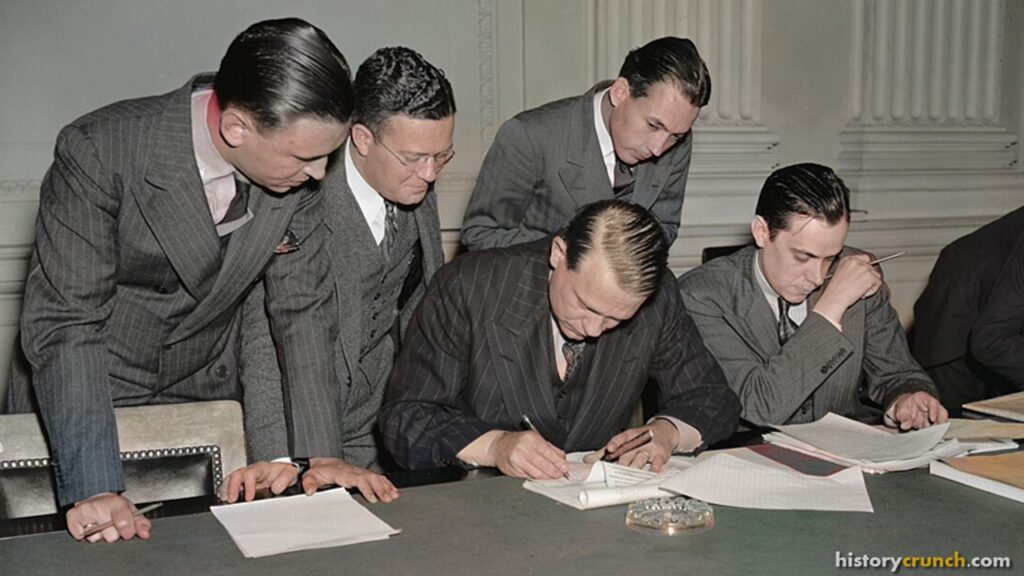
The House Un-American Activities Committee (HUAC) was a committee of the United States House of Representatives that conducted investigations against American citizens accused of carrying out anti-American actions. In particular, the HUAC carried out a number hearings against people accused of having communist connections during the 1950s. As such, historians associate the HUAC with the events of the Cold War, the Second Red Scare and McCarthyism.
HOUSE UN-AMERICAN ACTIVITIES COMMITTEE – CAUSES
The House Un-American Activities Committee (HUAC) was established in 1938 by the United States House of Representatives to investigate alleged disloyalty and subversive activities, especially communist influence in America. It gained prominence during the Cold War, particularly in the late 1940s and 1950s, as fears of Soviet espionage and domestic communism grew. HUAC conducted high-profile investigations into Hollywood, labor unions, and government agencies, leading to blacklists, ruined careers, and heightened public paranoia.
The HUAC is most often associated with the Second Red Scare of the 1950s and McCarthyism under Joseph McCarthy. McCarthyism was a period in the 1950s, during the Cold War, when a fear of the spread of communism in the United States. During this time thousands of American citizens were accused of and investigated for possible connections to communism. Since the United States was locked in an ideological conflict with the Soviet Union, many Americans associated communism with the enemy and sought to remove any communist elements in their own country.
HOUSE UN-AMERICAN ACTIVITIES COMMITTEE – SUMMARY
Famously, the House Un-American Activities Committee (HUAC) carried out a series of hearings against Americans for their suspected ties to communism.
Early Hearings (1938–1940s): The House Un-American Activities Committee initially targeted Nazi sympathizers and fascist groups, but soon shifted its focus to communism, especially as tensions with the Soviet Union grew during and after the end of World War II.
Hollywood Hearings (1947): One of House Un-American Activities Committee’s most famous investigations involved the American film industry. For instance, the HUAC questioned writers, directors, and actors suspected of communist ties. The ‘Hollywood Ten’, a group of screenwriters and directors who refused to testify, were held in contempt of Congress and jailed. This led to the blacklisting of many in the entertainment industry. The best example of this at the time was the ‘Hollywood Blacklist’. The Hollywood Blacklist refers to a time in the 1950s when many who worked in the entertainment industry were blacklisted as being either communist or communist sympathizers. Being blacklisted meant these people were unable to find work in the industry and several were forced to face hearings in front of the HUAC.
Alger Hiss Case (1948): The House Un-American Activities Committee investigated Alger Hiss, a former United States State Department official, who was accused of being a Soviet spy. Although Hiss denied the charges, he was convicted of perjury, which ultimately boosted the HUAC’s credibility in American society and boosted public support.
1950s Hearings: During the height of the Cold War and McCarthyism, House Un-American Activities Committee expanded its investigations to include government agencies, educators, labor unions, and civil rights organizations. Many individuals were forced to testify about their political beliefs and associations, often under the threat of losing their jobs.
Decline (1960s–1975): The House Un-American Activities Committee eventually went into a period of decline, following the fall from grace and death of Joseph McCarthy. Although McCarthy had no actual role in the HUAC many Americans associated his accusations against Americans with the investigations and hearings of the HUAC. In fact, in 1959, former United States President Harry S. Truman referred to the HUAC as “the most un-American thing in the country.” Eventually, following a period of decline and a negative reputation with the American public the committee was renamed as the Internal Security Committee in 1969. It was only 6 years later, and in 1975 the committee was altogether terminated.
HOUSE UN-AMERICAN ACTIVITIES COMMITTEE – SIGNIFICANCE
The House Un-American Activities Committee (HUAC) was significant because it played a central role in fueling Cold War fears of communist infiltration in American society. Its investigations led to widespread blacklisting, especially in Hollywood, and encouraged a culture of fear, censorship, and suspicion in American society. In fact, the HUAC’s actions contributed to violations of civil liberties and due process, as individuals were often accused without solid evidence. As a result, historians have argued that the HUAC symbolizes the dangers of political overreach and the suppression of dissent in a democratic society. As such, it sontinues to be studied and debate.