Henry Ford is one of the most significant figures in the history of the United States, especially in relation to the history and significance of the late Industrial Revolution. In fact, he is considered to be one of the most significant captains of industry of the early 20th century in the United States. Today, he is best remembered as one of the greatest inventors and entrepreneurs in United States history. For example, he is known for starting the Ford Motor Company and developing the first mass-produced automobile. As well, his company is credited with utilizing the assembly line method of production, which revolutionized mass productionMaking large quantities of a product quickly and cheaply using methods like the assembly line..
 FactsthatCrunch
Henry Ford built the Ford Motor Company into one of the largest manufacturers in American history, pioneering the moving assembly line and making cars affordable for ordinary workers. His Willow Run factory near Detroit built 8,685 B-24 bombers during World War II, nearly half of all B-24s made in the United States.
Henry Ford – Early Life
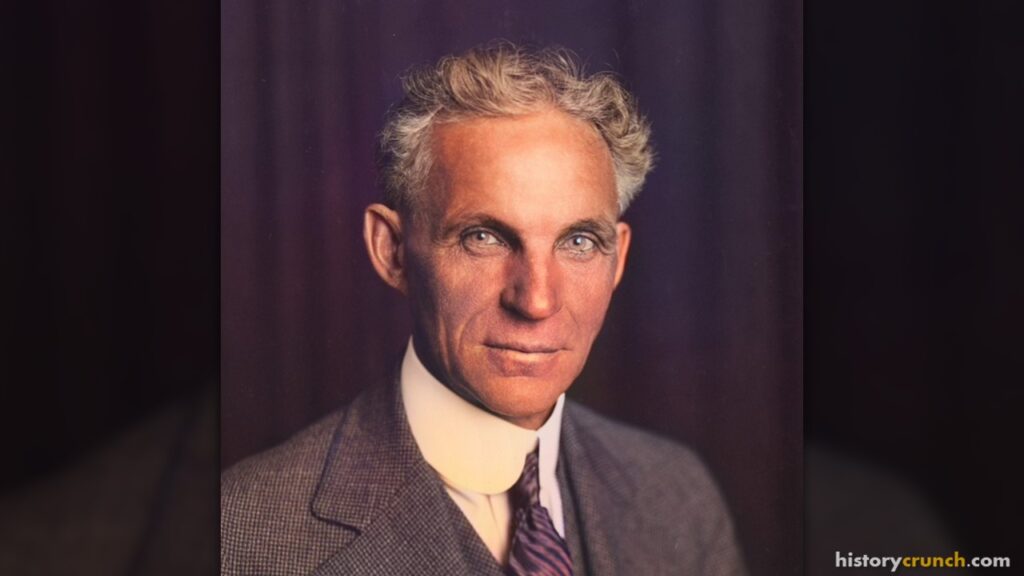
Henry Ford was born in the state of Michigan in the United States on July 30th, 1863. His father was Irish, and his mother was American. Henry Ford was naturally interested in basic machines and inventions from an early age. For instance, as a young man, Henry’s father gave him a pocket watch. Henry supposedly took the watch apart to better understand its workings. This led to an interest in clocks and watches as a teenager, which resulted in him repairing the timepieces of friends and family. Henry Ford’s mother died unexpectedly in 1876, and his father expected Henry to take over the family farm. However, Henry Ford did not enjoy the farm work and was instead drawn to working with different machines and parts.
In 1879, Henry Ford left his family’s farm and travelled to Detroit, Michigan where he started work as an apprentice machinistSomeone learning the skills of working with machines under the guidance of an experienced worker.. When he did return to the family farm, he focused more on improving the machinery than actually working on the farm itself. For instance, he reportedly worked on a steam engine on the farm. Ford also studied bookkeeping around this time. Unhappy with life on the farm, Henry Ford left in 1891 and started working as an engineer with the Edison Illuminating Company of Detroit. He was quickly promoted to chief engineer, which allowed him the income to save up enough money to work on his own experiments, including gasoline engines. For example, in 1896 Ford developed a self-propelled vehicle which he called the Ford QuadricycleThe first vehicle Henry Ford built, with four bicycle wheels and a small gasoline engine.. This was the first vehicle developed by Henry Ford. It was built with a simple frame, had four bicycle wheels and a small gasoline engine. Ford sold the Quadricycle to fund better cars, and in 1901 he won a famous race in Grosse Pointe, Michigan, with a new racer.
FactsthatCrunchHow did Henry Ford's Quadricycle lead to the founding of the Ford Motor Company?
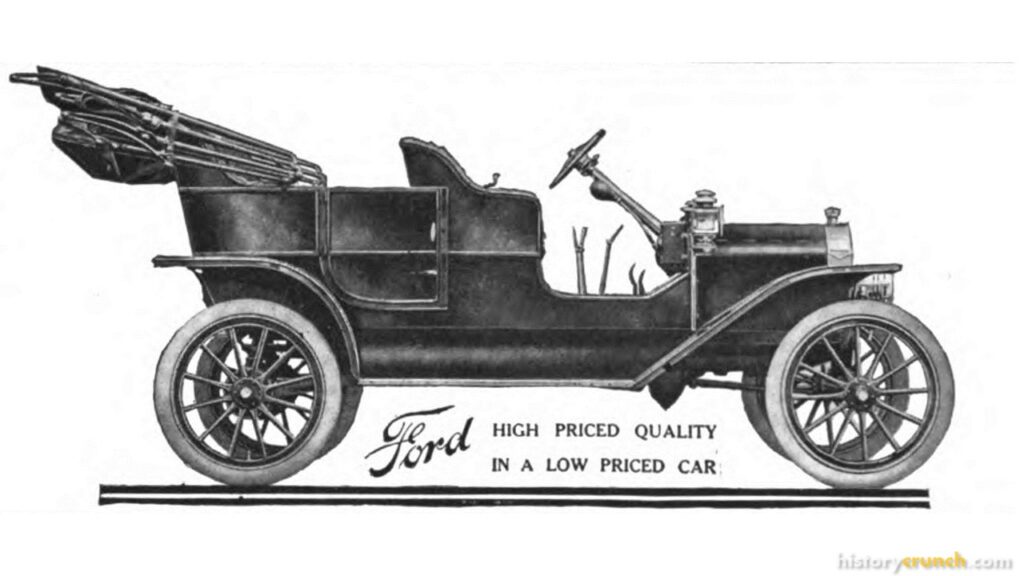
Henry Ford – Ford Motor Company
In 1903, Henry Ford completed an important event in his own life and the history of technological innovation in the United States: he developed the Ford Motor Company with other investors. The company developed a number of automobiles, and he became a very successful man. For example, his Model T was one of the first significant automobiles in American history and was produced on a mass scale. The Model T was first introduced in 1908 and had several features that are still common in today’s vehicles. It proved to be a wildly popular automobile and is credited with transforming the way that people travel. Its popularity was due in part to a few main factors. First, the Model T was relatively inexpensive and could be afforded by many people at the time. For instance, when it was first released it cost approximately $825, which relates to about $23,000 in today’s currency. Furthermore, with improvements to production Ford was able to lower the cost of the vehicle, which led to increased sales. The second reason for the popularity of Henry Ford’s Model T is that it was easy to drive. It had a sensible steering, drive and brake system, which allowed it to be easily learned and operated by most people. Third, the Model T was developed with parts that were easily and cheaply replaceable. As such, it was affordable for most people to fix and repair the vehicle themselves. In fact, the Model T was so popular that by 1914, more than 250,000 of them had been sold in the United States. The sales increased to over 472,000 by 1916 after Ford cut the price of the Model T to just $360. In fact, by 1918, half of all the cars in the United States were Model T’s. The Model T maintained its popularity with the American public well into the mid-1920 when it was eventually replaced by the new Model A.
Another innovation pioneered by Henry Ford and the Ford Motor Company was the development of the assembly line in industrial production. Under this model of production, a part would travel along a belt and workers would install individual pieces. This meant that each worker generally performed the same installation over and over again. Previous to this method, workers would often perform several tasks, but the development of the assembly lineA production method where a part moves along a belt and each worker installs one specific piece repeatedly. simplified production and led to dramatic increases in the output of the factories. This is important because it allowed Henry Ford to develop his automobiles faster, which allowed him to increase sales while also lowering the overall price of the automobile. The development of the assembly line as a method of production is a significant step forward in the mass production of goods. As such, it became an important production technique throughout the later years of the Industrial Revolution and remains an important innovation still today.
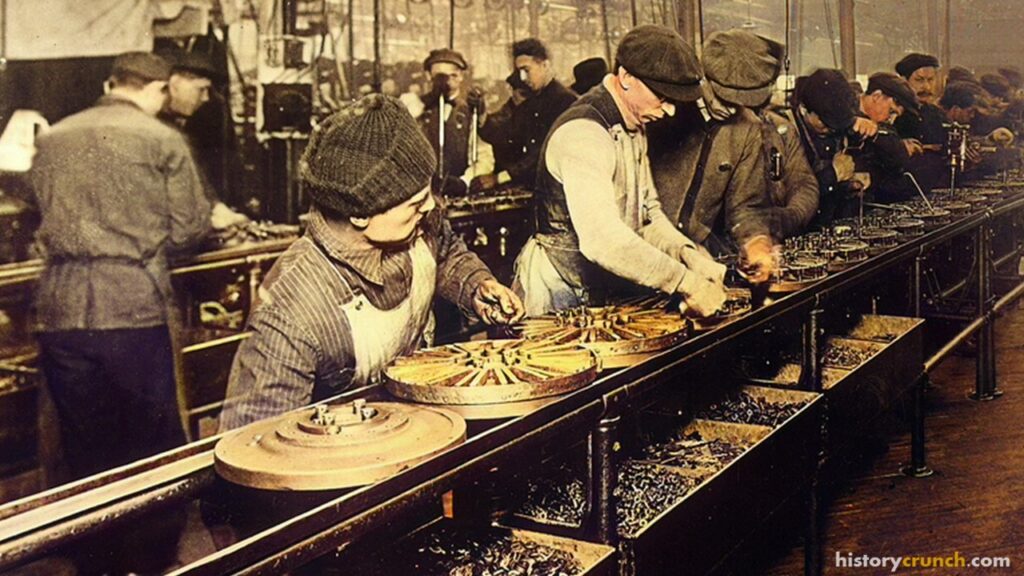 FactsthatCrunch
Ford's assembly line drove the Model T's price lower and lower, putting a car within reach of ordinary American workers by 1916.
Henry Ford – Labor Policies
Not only did Ford’s development of the automobile help transform society, but his labor policies also improved working conditions for ordinary people. For example, Henry Ford is considered to be a pioneer of the idea of welfare capitalismA form of capitalism that includes basic social programs designed to benefit poor or working-class people. in the United States. Welfare capitalism is a form of capitalism that includes basic social programs that generally benefit the poor or working-class. For instance, Ford spearheaded two main ideas with the workers in his factories. First, he introduced the ideas of a five-dollar wage in 1914. At the time, this was more than double what other industrial workers were being paid. Second, Ford introduced the five-day working week. He instituted a plan which lowered the number of hours employees worked each week. For instance, by 1926, workers in his factories worked a maximum of five days a week and eight hours a day for a total of forty hours a week.
 FactsthatCrunch
Welfare capitalism is an economic system where private businesses operate for profit but also provide basic social programs to support poor or working-class people. These programs can include higher wages, shorter work hours, or other benefits that improve workers' daily lives. The goal is to improve conditions for workers within a free-market system rather than replacing that system.
"Henry Ford practiced welfare capitalism when he introduced a five-dollar daily wage in 1914 and later a five-day, forty-hour workweek for his factory workers."
Henry Ford – Later Years and Death
Ford opposed American involvement in World War I and World War II. With that said, during both world wars, the Ford Motor Company assisted the United States by producing aircraft and aircraft engines. For example, during World War II, Henry Ford ordered the construction of a massive factory (Willow Run) near Detroit, Michigan. In fact, the factory had the largest assembly line in the world at the time. At its height, the factory had a B-24 bomber coming off the assembly line every 58 minutes. Furthermore, the Willow Run factory produced about 8,700 B-24s during the war, which was nearly half of all of the B-24 bombers used by the United States in World War II.
World War II was also significant for Henry Ford for a negative reason. Earlier in his life, Ford had overseen the publishing of articles that were anti-Semitic in nature (prejudice towards Jewish people). As such, with the context of Nazi Germany and the Holocaust, Ford had developed some controversy associated with his name. In fact, in July of 1938, which was just before the outbreak of World War II, Nazi Germany gave Ford the award of the Grand Cross of the German EagleThe highest award Nazi Germany could give to a person who was not a German citizen.. This is significant because it was the highest medal Nazi Germany could bestow on a foreigner.
With that said, Henry Ford suffered a series of strokes in the 1930s, which limited his ability to control the company. In fact, at this time the company was essentially run by a team of senior executives who oversaw the day-to-day operations of the factory in Ford’s name.
With his health failing from several strokes, Ford died on April 7th, 1947.
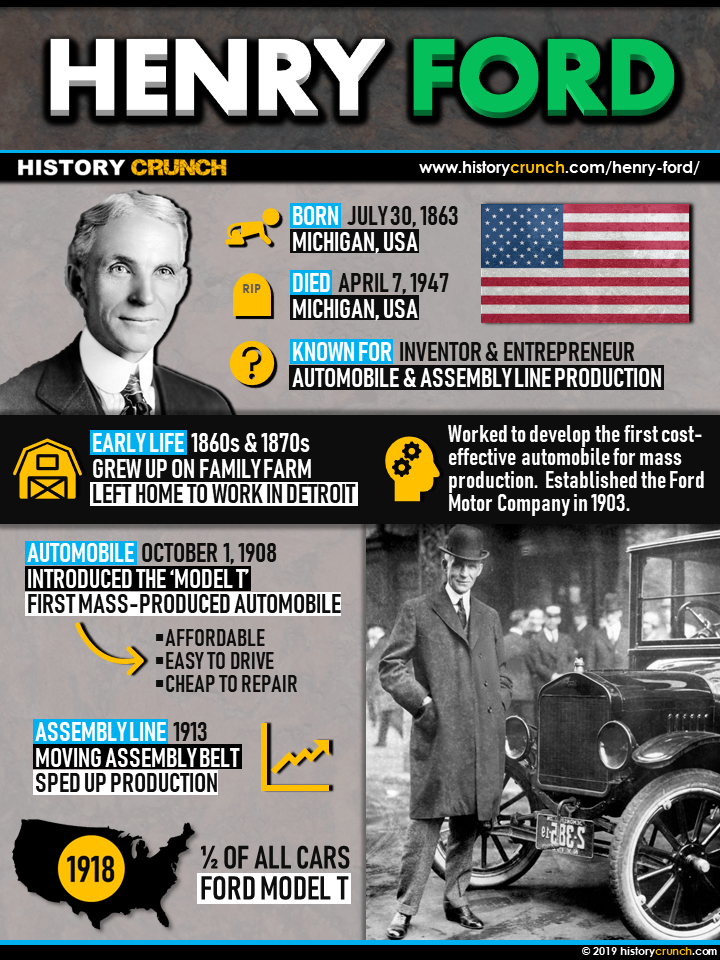
Henry Ford – Infographic
Industrial Revolution timeline · 1760 – 1840
Key Vocabulary
Apprentice machinist
Ford Quadricycle
Assembly line
Mass production
Welfare capitalism
Anti-Semitic
Grand Cross of the German Eagle
Frequently Asked Questions
What is Henry Ford best known for?
Henry Ford is best known for founding the Ford Motor Company and mass-producing cars on a moving assembly line. He created the popular Model T and made cars affordable for ordinary people. His use of the assembly line also changed the way goods were made around the world.
Did Henry Ford invent the automobile?
No, Henry Ford did not invent the automobile, but he changed how cars were built and sold. His first vehicle, the Ford Quadricycle, appeared in 1896 and ran on a small gasoline engine. His true achievement was making cars cheap enough for millions of people to own.
Why was the assembly line so important?
The assembly line was important because it let factories produce goods much faster and cheaper. Each worker installed one part as the product moved along a belt. This method lowered the price of the Model T and became a key part of modern manufacturing.
What were Henry Ford’s labor policies?
Henry Ford introduced a five-dollar daily wage in 1914, which was more than double the usual pay. He also brought in the five-day, forty-hour workweek by 1926. These ideas made him a pioneer of welfare capitalism, which aimed to help working-class people.
Why is Henry Ford a controversial figure?
Henry Ford is controversial because he oversaw the publishing of anti-Semitic articles that spread prejudice against Jewish people. In July of 1938, Nazi Germany gave him its highest award for a foreigner, the Grand Cross of the German Eagle. This tie to Nazi Germany remains a dark mark on his legacy.
When did Henry Ford die?
Henry Ford died on April 7th, 1947, after suffering several strokes in the 1930s. His failing health had already reduced his control of the company. By then, a team of senior executives ran the daily operations in his name.
Cite This Article
To cite this article as a source, use one of the formats below.
MLA: Beck, Elias. “Henry Ford: A Detailed Biography.” HistoryCrunch, 26 September 2026, https://historycrunch.com/henry-ford/.
APA: Beck, E. (2026). Henry Ford: A Detailed Biography. HistoryCrunch. https://historycrunch.com/henry-ford/
Chicago: Beck, Elias. “Henry Ford: A Detailed Biography.” HistoryCrunch. September 26, 2026. https://historycrunch.com/henry-ford/
Sources
- Fordham Modern History Sourcebook
- Joel Mokyr, The Enlightened Economy.
- The Science Museum Group