
The Aztec Empire rose in less than a hundred years and fell in two. A people who called themselves the Mexica arrived in the Valley of Mexico as the last and poorest of the migrants from the north, founded a city on an island nobody wanted in 1325, served stronger cities for a century, and then, in 1428, joined two neighbors to destroy their masters. By 1502 the Triple Alliance took tribute from about 400 towns and five million people, and its capital, Tenochtitlan, was larger than any city in Europe. In 1519 about 500 Spaniards walked into it. This timeline runs from the Olmec of 1500 BCE, whose ideas the Aztecs inherited, to the museum that stands over the Templo Mayor today, and every card on it sits on a real date.
From an eagle on a cactus to a temple under a city street.
The Aztec Empire rose in less than a hundred years and fell in two. A people who called themselves the Mexica arrived in the Valley of Mexico as the last and poorest of the migrants from the north, founded a city on an island nobody wanted in 1325, served stronger cities for a century, and then, in 1428, joined two neighbors to destroy their masters. By 1502 the Triple Alliance took tribute from about 400 towns and five million people, and its capital, Tenochtitlan, was larger than any city in Europe. In 1519 about 500 Spaniards walked into it. This timeline runs from the Olmec of 1500 BCE, whose ideas the Aztecs inherited, to the museum that stands over the Templo Mayor today, and every card on it sits on a real date.
The Aztecs were the last of a line two thousand years long, and they knew it.
The Olmec, Teotihuacan, the Toltecs, and what each one left.
From an island in the north that has never been found, following a god who spoke.
Aztlan, Chapultepec, Culhuacan, the flayed princess, the island.
No stone, no wood, no fields. Two hundred years later, 200,000 people.
The founding, the twin city, the chinampas, the dike, the aqueducts.
By borrowing one with Toltec blood and serving a stronger city for fifty years.
Acamapichtli, Huitzilihuitl, the Tepanec marriage, Chimalpopoca's murder.
Three cities, one army, and tribute split two-two-one.
Itzcoatl's choice, the siege of Azcapotzalco, the pact, the burning of the books.
Leave the local king in place, take the tribute, and come back if it stops.
The southern lakes, Coixtlahuaca, the Tarascan defeat, Ahuitzotl's garrisons.
Eleven rulers in 145 years, chosen by a council, and none of them safe.
Itzcoatl, Moctezuma I, Tizoc, Ahuitzotl, Moctezuma II.
For captives, not kills, with obsidian and cotton armor, and the ranks to prove it.
Schools, the flower wars, eagle and jaguar warriors, Otumba.
Cleaner, better fed and better schooled than Seville, and ruled by the calendar.
Chinampas, the market, schools, the laws of dress, the ballgame.
Nobles, commoners, merchants, priests, and slaves whose children were born free.
The founding bargain, the laws of dress, the merchants, the tlacotin, the encomienda.
Two calendars turning together, a fire lit every 52 years, and a world that had ended four times already.
The tonalpohualli, the xiuhpohualli, the New Fire, the Sun Stone.
From a handful of painted books that survived the fire, and from friars who asked.
The burning of 1430, the burning of 1524, Sahagun, Mendoza, Duran.
Weavers, healers, market traders, priestesses and, in death, warriors.
The flayed princess, the laws, the schools, Malintzin, the Florentine Codex.
No money but cacao, no wheels, no animals, and a market of 60,000 people a day.
Chinampas, the market, tribute, the merchants, the Codex Mendoza.
Pyramids on a swamp, causeways across a lake, and a city the Spanish said was a dream.
The founding, the temple, the dike, the aqueduct, the palace, the ruins.
That the sun had to be fed, the world had ended four times, and Huitzilopochtli had chosen them.
Teotihuacan's gods, the flayed princess, Huitzilopochtli's rise, the temple, the New Fire.
Because the gods had died to make the world, and the debt was paid in the only coin that counted.
The famine, the flower wars, the dedication of 1487, the Toxcatl massacre, the causeway sacrifices.
Seven pyramids one inside another, two shrines, and the center of the Aztec world.
The founding, the dedication, the destruction, the discovery, the museum.
Battles by appointment, fought to take prisoners for the gods, against an enemy left alive on purpose.
The famine, Tlacaelel's idea, the first wars, Tlaxcala's hatred, the alliance of 1519.
By finding, in six months, that the empire's subjects hated it more than they feared him.
Cuba, Malintzin, Veracruz, the ships, Tlaxcala, Cholula, the causeway.
Hostage, massacre, flight, plague, siege: fifteen months from welcome to ruin.
Moctezuma seized, Toxcatl, the Sad Night, smallpox, the brigantines, the fall.
A slave girl of nineteen who became the conquest's voice, and Mexico's word for betrayal.
Her gift to the Spanish, Cholula, the causeway, the son, the name.
Three rulers in twenty months, one a hostage, one dead of smallpox, one hanged in the jungle.
Moctezuma's hesitation, Cuitlahuac's eighty days, Cuauhtemoc's siege and death.
Five to six million people, the strongest army in the Americas, and it lasted two years against 500 men.
Allies, disease, weapons, the ruler, the gods.
The most famous explanation of the conquest, and the one historians now doubt most.
Tula's legend, the omens, the sightings, the speech on the causeway, the hostage.
One slave with smallpox, and an empire without immunity.
Smallpox in 1520, Cuitlahuac's death, the siege, cocoliztli, the empty valley.
A Spanish city on the Aztec grid, Spanish masters on the Aztec tribute, and a new god on the old temple.
Mexico City, the friars, the encomienda, the codices, Cuauhtemoc's death.
From under a square, under a cathedral, and under an electricity cable.
The Sun Stone in 1790, the flag in 1821, Coyolxauhqui in 1978, the museum in 1987.
A language, a flag, a diet, a city, and an argument about what to call 1521.
The founding sign, the codices, the chinampas, Nahuatl, the museum.
A marquisate, a lawsuit, a jungle march, and a death in Spain out of favor.
The rebel captain, the new city, Cuauhtemoc's hanging, the encomiendas, the king's book.
The Aztecs were the last people to rule the Valley of Mexico and the newest. Two thousand years before them the Olmec of the Gulf coast had built the first pyramids, ball courts and calendars; a thousand years before them Teotihuacan, in the same valley, had been one of the largest cities on earth, with the gods the Aztecs would later worship; and three hundred years before them the Toltecs of Tula had made the golden age every Aztec ruler claimed to descend from. The Aztecs found all three in ruins, gave Teotihuacan its name, buried Olmec masks under their own temple, and called the best of what they made 'Toltec'.
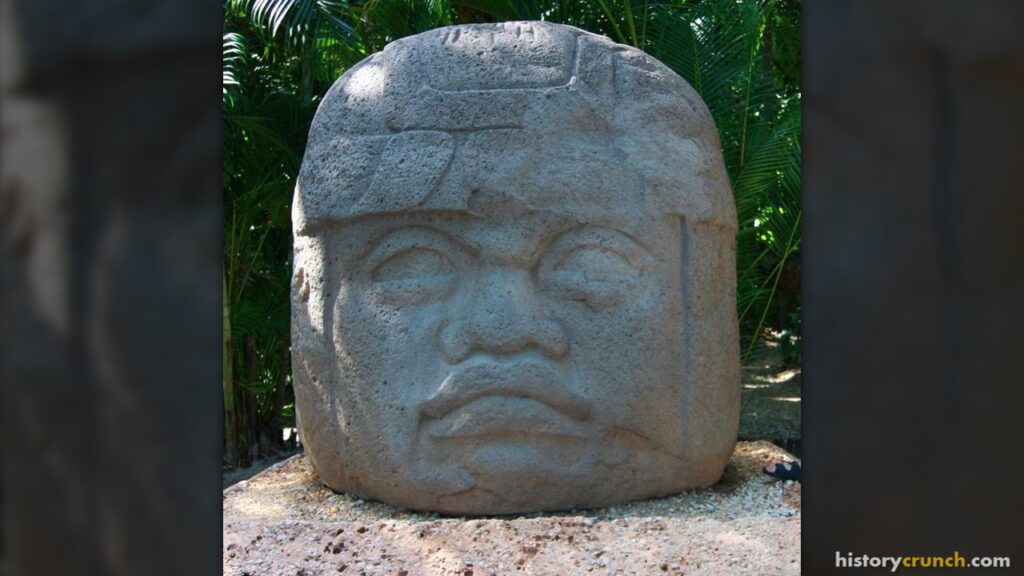
From about 1500 BCE the Olmec people of the Gulf coast of Mexico, in the wet lowlands of what are now Veracruz and Tabasco, built the first planned centers in Mesoamerica. The first was San Lorenzo, a platform of earth raised by hand with drains of carved stone, where they carved the colossal stone heads, up to 10 feet (3 m) tall and 20 tons, that are their signature. The Olmec had no metal, no wheel for work and no animals to pull a load.
LEARN MORESHOW LESSwhy it matters · key numbersPEOPLESAlmost everything the Aztecs later did, the Olmec did first: pyramids, ball courts, calendars, blood offerings and gods that were part animal. Historians call them the mother culture of Mesoamerica, and the Aztecs were their heirs at a distance of two thousand years.
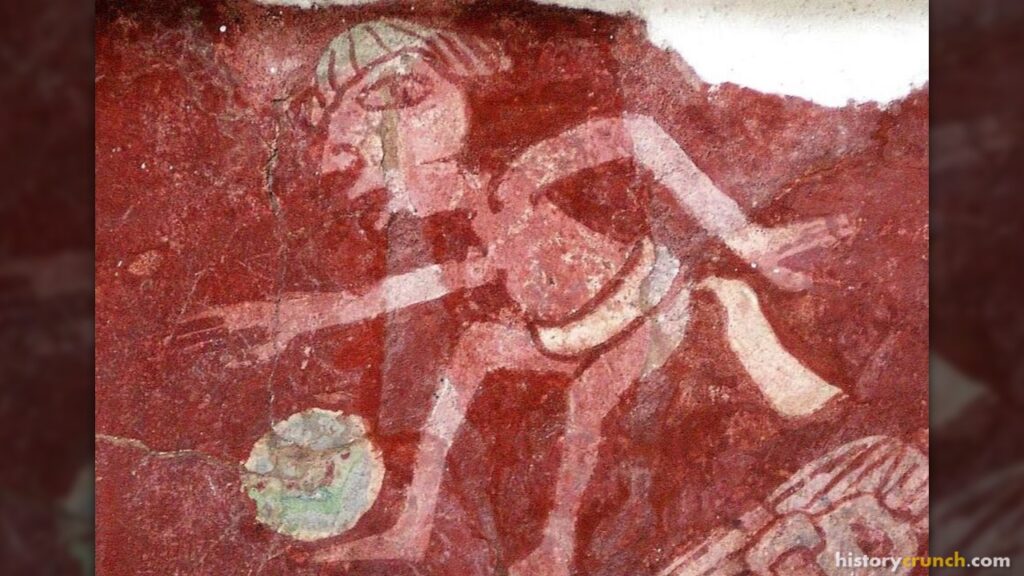
The oldest known ball court in the Americas, at Paso de la Amada on the Pacific coast of Mexico, dates from about 1400 BCE, and rubber balls of about the same age have been found in Olmec country. The game, played with the hips and a solid rubber ball on a sunken court, was passed from people to people for three thousand years. The Aztecs called it ullamaliztli and Tenochtitlan had courts beside its main temple.
LEARN MORESHOW LESSwhy it mattersCULTUREThe ballgame is the longest-running sport in human history and the clearest single thread from the Olmec to the Aztec. For both it was religion and politics as well as play, and it could end in sacrifice.
About 900 BCE San Lorenzo was abandoned, its monuments smashed and buried, for reasons nobody has settled. The Olmec center moved to La Venta, an island in a river swamp, where over the next five centuries they built a clay pyramid 100 feet (30 m) high, laid out plazas on a north-south line, and buried offerings of jade and serpentine in careful patterns under the ground.
LEARN MORESHOW LESSwhy it mattersPEOPLESLa Venta's pyramid and its aligned plazas are the plan every later Mesoamerican city followed, Tenochtitlan included. The buried offerings under the Templo Mayor, found in the 1970s, are the same idea two thousand years on.
By about 400 BCE La Venta was abandoned and the Olmec, as a distinct civilization, were gone. Their ideas were not. The peoples who followed them, the Maya to the east and the builders of Teotihuacan to the west, kept the calendar, the pyramid, the ball court, the jaguar god and the feathered serpent.
LEARN MORESHOW LESSwhy it mattersPEOPLESNo Mesoamerican civilization ever wholly disappeared; each was absorbed by the next. The Aztecs, arriving 1,700 years later, would collect Olmec objects and bury them under their own temple as sacred antiques.
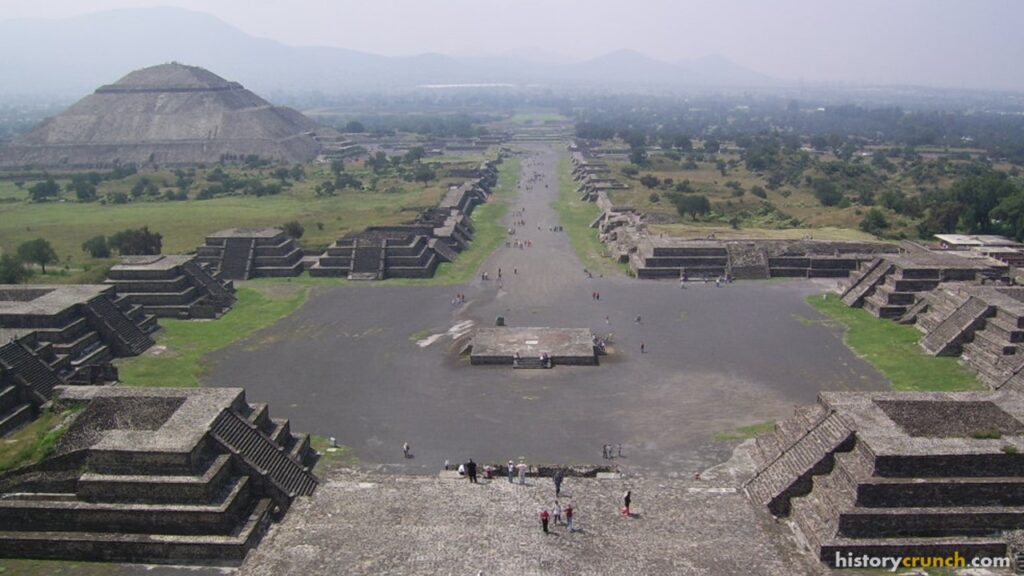
About 100 BCE a city began to grow in a side valley northeast of the lakes of central Mexico, the same valley the Aztecs would settle 1,400 years later. Its builders are unknown; they left no writing that can be read. Over the next three centuries they laid it out on a grid around a two-mile (3 km) avenue, the Avenue of the Dead, larger and more ordered than any city in Europe at the time.
LEARN MORESHOW LESSwhy it mattersCITIESTeotihuacan was the first great city of the Valley of Mexico and the model for every city that followed there. The Aztecs found it in ruins, gave it the name it has now, which means 'the place where the gods were made', and believed the present world had been created there.
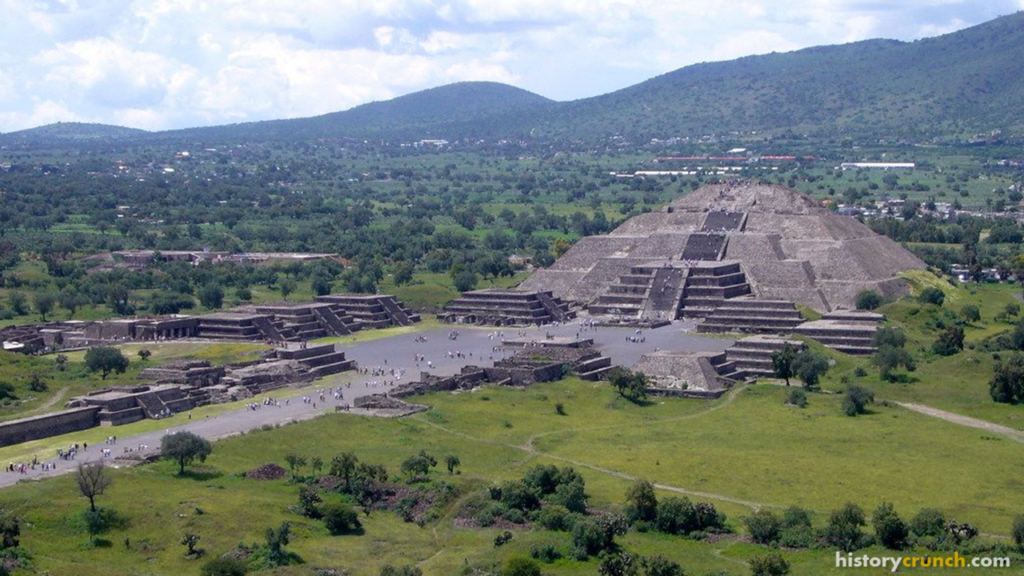
About 200 CE the people of Teotihuacan finished the Pyramid of the Sun, 215 feet (65 m) high and about 730 feet (220 m) on each side, the largest building in the Americas for a thousand years. It was built of rubble and earth faced with stone, over a cave that was probably a shrine, by people working without metal tools, wheels or draft animals. The Pyramid of the Moon at the north end of the avenue followed over the next fifty years.
LEARN MORESHOW LESSwhy it matters · key numbersCITIESThese pyramids were standing when the Aztecs arrived and are standing now. The Aztec rulers made pilgrimages to them, and the Templo Mayor in Tenochtitlan was a smaller version of the same idea.
Around 450 CE Teotihuacan had perhaps 150,000 people, making it one of the six largest cities in the world, in a league with Rome and Constantinople. Its apartment compounds housed craftsmen who made obsidian blades for all of Mesoamerica, its merchants reached the Maya cities 600 miles (1,000 km) away, and its gods, the Feathered Serpent and the Storm God, are the ancestors of the Aztec Quetzalcoatl and Tlaloc.
LEARN MORESHOW LESSwhy it matters · key numbersCITIESThe Aztec gods, the Aztec obsidian trade and the Aztec idea of a city all came from here. When the Aztecs called themselves the successors of the Toltecs, it was Teotihuacan's world they were claiming.
About 750 CE the center of Teotihuacan was burned, its temples and palaces deliberately and selectively, and its statues broken. Whether by invaders or by its own people rising against their rulers is not known; drought and famine may have come first. The city was never rebuilt. People went on living in its outer districts for centuries among the ruins.
LEARN MORESHOW LESSwhy it mattersCITIESThe fall of Teotihuacan left the Valley of Mexico without a master for six hundred years and set the pattern the Aztecs feared: a great city, made by the gods, that could end in a day.
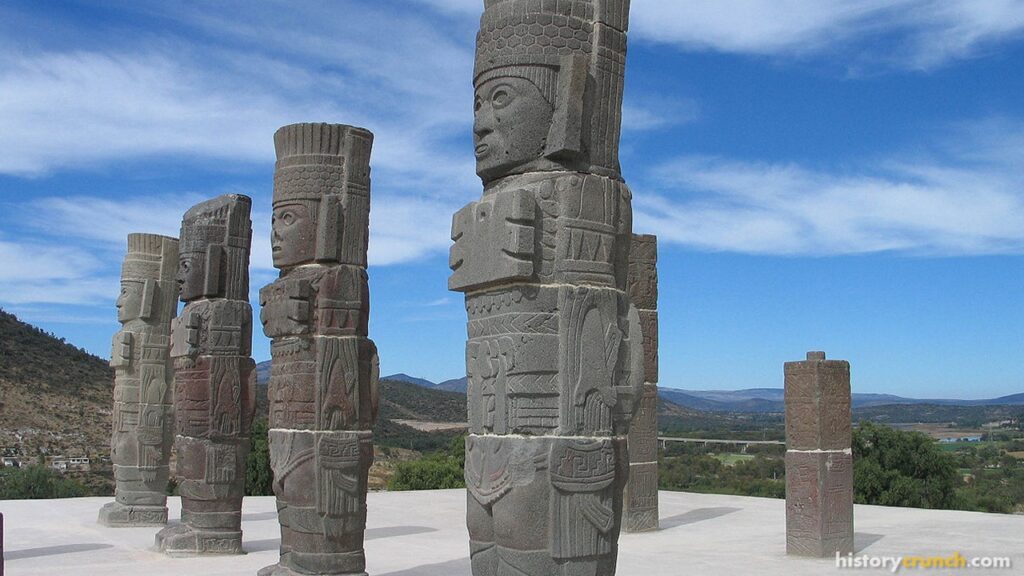
About 900 CE the Toltecs, a people from the north who settled in the Valley of Mexico after Teotihuacan's fall, built their capital at Tula, 40 miles (65 km) north of the lakes. Its pyramid was topped by four warrior statues 15 feet (4.6 m) tall, its walls carved with jaguars and eagles eating hearts. Toltec legend told of a priest-king, Ce Acatl Topiltzin Quetzalcoatl, who was driven out by a rival god and sailed east promising to return.
LEARN MORESHOW LESSwhy it mattersPEOPLESTo the Aztecs the Toltecs were the golden age: the word toltecatl meant artist. Every Aztec ruler claimed Toltec blood, and the legend of the returning Quetzalcoatl was in Moctezuma's mind when the Spanish came from the east in 1519.
About 1168 Tula was sacked and burned, probably by peoples moving south from the deserts as drought spread there. The Toltec state broke into small city-states around the lakes, each ruled by a family claiming Toltec descent. Behind the last Toltecs came wave after wave of northern migrants, whom the settled peoples called Chichimeca, 'dog people'. Among them, the last and least welcome, were the Mexica.
LEARN MORESHOW LESSwhy it mattersPEOPLESThe Aztecs arrived in a valley of quarreling Toltec heirs. That is why they could find a place there at all, and why, once strong, they could claim to be the Toltecs' true successors.
The Mexica's own story begins on an island in the north called Aztlan, which has never been found, and with a god, Huitzilopochtli, who spoke from a bundle and led them south for a century and a half. They reached the valley last, poorest and least wanted, were driven from one shore and hired as soldiers on another, and were thrown into the lake for flaying a princess. On an island nobody wanted they saw the sign the god had promised, an eagle on a cactus, and in 1325 they founded Tenochtitlan on a swamp with no stone, no wood and no fields. Fifty years later they borrowed a king with Toltec blood.
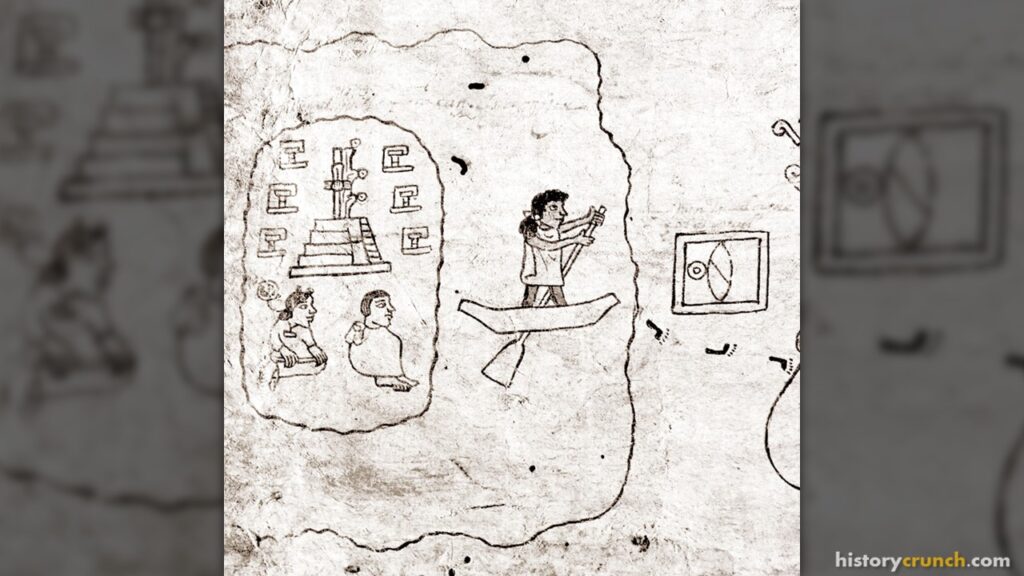
The Mexica told their own story in pictures: in a year they called One Flint, which most historians place at 1168, the year Tula fell, they left Aztlan, an island home somewhere in the north whose location has never been found, carrying the bundle of their god Huitzilopochtli, who spoke to them and told them where to go. The Codex Boturini, painted on a strip of bark paper, shows the whole journey as footprints. The name Aztec comes from Aztlan; the people called themselves Mexica.
LEARN MORESHOW LESSwhy it matters · a debatePEOPLESWhether Aztlan was a real place or a founding legend is still argued, but the journey shaped everything: the Mexica understood themselves as a chosen people led by their god to a promised land, and that belief drove the empire.
Was Aztlan a real place?
Yes: the migration stories agree on a lake, an island and a northern direction, and the Mexica language belongs to a family from northwest Mexico.
Partly: the story was rewritten under Itzcoatl in the 1430s to make the Mexica look destined, and Aztlan, 'place of whiteness', reads like a mirror of the island city they ended up in.
About 1250, after more than a century of wandering that the codices count in stops of a few years each, the Mexica entered the Valley of Mexico, a high basin 7,000 feet (2,200 m) up with five connected lakes at its center and city-states on every shore. They settled at Chapultepec, 'grasshopper hill', on the western shore. The established peoples treated them as barbarians: late, poor, and known for a god who demanded hearts.
LEARN MORESHOW LESSwhy it mattersPEOPLESThere was no free land left in the valley. For the next 75 years the Mexica would be tenants, mercenaries and refugees, and the memory of that humiliation is in everything they built afterward.
About 1299 the neighboring city-states combined to drive the Mexica off Chapultepec and their leader was sacrificed. The survivors were taken in by Culhuacan, an old Toltec city on the southern shore, which settled them on a stretch of volcanic rock full of snakes and used them as soldiers. The Mexica, the story goes, ate the snakes and asked for more, and fought so well that Culhuacan grew afraid of them.
LEARN MORESHOW LESSwhy it mattersPEOPLESCulhuacan gave the Mexica the one thing they lacked: a claim to Toltec ancestry, through marriage into its royal line. The first Mexica king would be a Culhua prince.
The Mexica asked the ruler of Culhuacan for his daughter, to be honored, they said, as a goddess. He sent her. At the festival he was invited to, he found a priest dancing in her skin: Huitzilopochtli had ordered her sacrificed and flayed so that she would become the goddess Toci. The Culhua fell on the Mexica and drove them into the marshes of the lake. It was about 1323.
LEARN MORESHOW LESSwhy it mattersRELIGIONThe story is the Mexica's own, told without apology, and it explains why in 1325 they were on an island nobody else wanted. It also shows what their religion asked of them and of everyone around them.
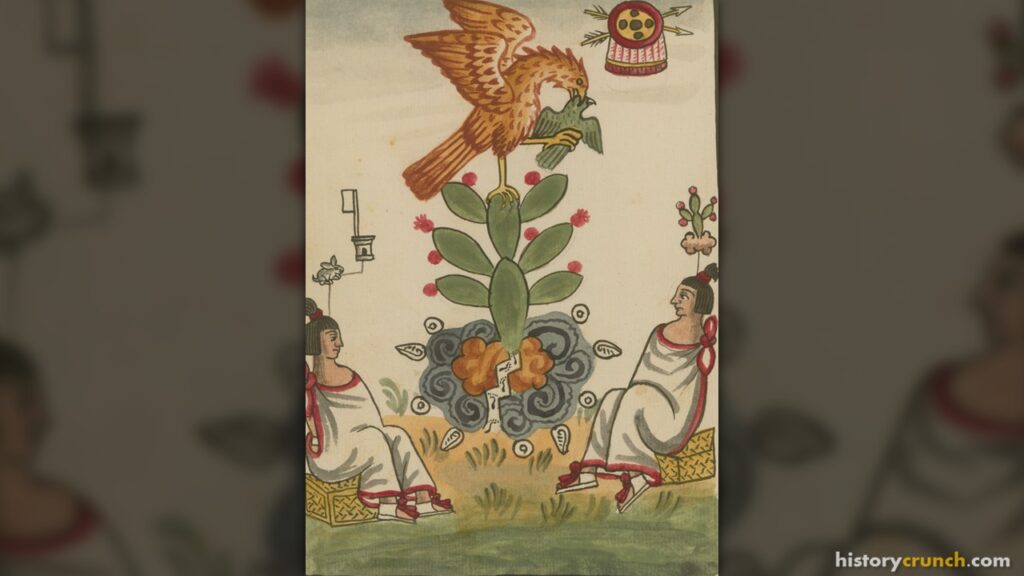
On a small marshy island in the western part of Lake Texcoco, on land no altepetl, no city-state, had claimed, the Mexica saw what their god had promised: an eagle perched on a prickly-pear cactus growing from a rock, with a snake in its beak in most tellings. There, on a date traditionally given as July 20th, 1325, they founded Tenochtitlan, 'the place of the prickly pear on the rock', and named it for their leader Tenoch. The island had no stone, no timber and no farmland. It had fish, birds, reeds, and water on every side that no enemy could easily cross.
LEARN MORESHOW LESSwhy it matters · key numbersCITIESThe eagle on the cactus is on the flag of Mexico today. Everything on this timeline for the next two centuries happens on or around this island, which grew from a reed village into a city of 200,000 in under two hundred years.
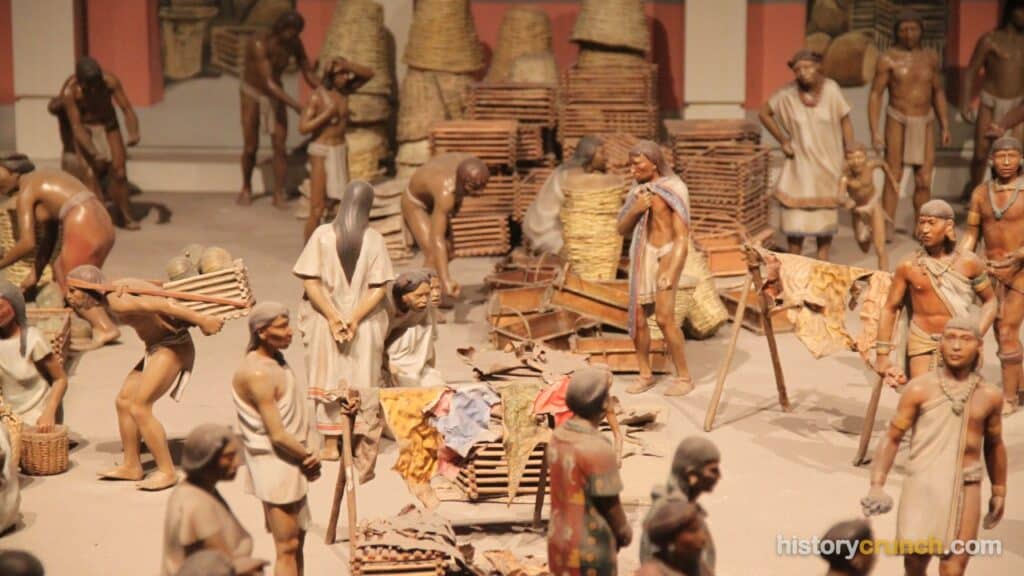
About 1337 a group of Mexica broke away and founded a second city, Tlatelolco, on an island just north of Tenochtitlan, under a ruler of their own from the Tepanec royal house. Over time the two islands were joined by fill until they were one city with two centers. Tlatelolco became the merchants' city, and its market the largest in the Americas.
LEARN MORESHOW LESSwhy it mattersCITIESThe great market that amazed the Spanish in 1519, with 60,000 people trading in a day by their estimate, was Tlatelolco's, not Tenochtitlan's. The two cities' rivalry ended in 1473 when Tenochtitlan conquered its twin.
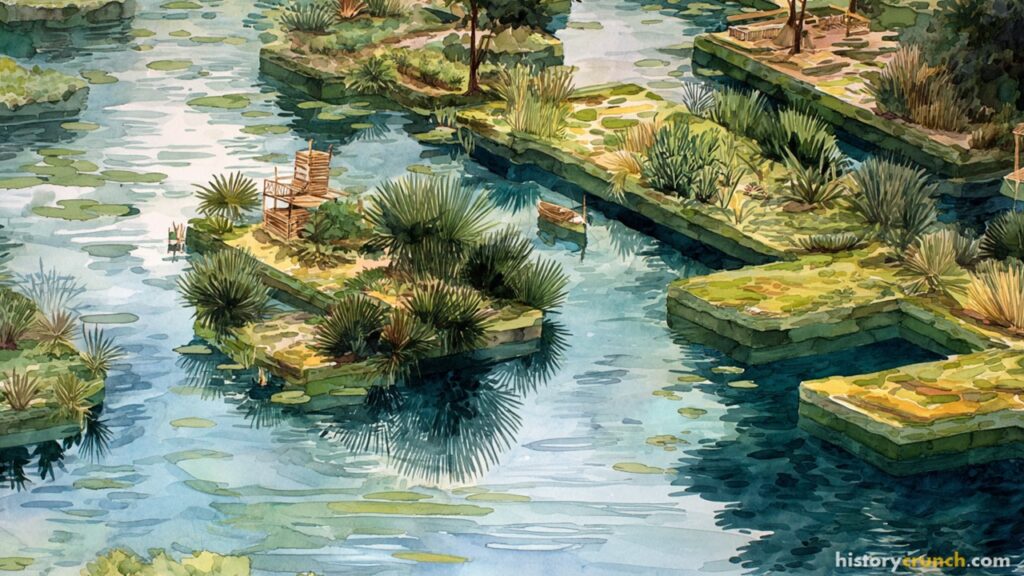
Within twenty years of the founding, about 1345, the Mexica had begun building chinampas, the raised fields that turned the shallow lake into farmland. A plot was staked out with posts and woven fences, filled with layers of mud and rotting plants dredged from the lake bottom, and anchored with willows planted along its edges. A chinampa about 30 feet (9 m) wide and 300 feet (90 m) long could give up to seven harvests of maize, beans, squash, chilies and flowers a year.
LEARN MORESHOW LESSwhy it matters · key numbersECONOMYThe chinampas are the reason a city could exist on an island with no farmland. By 1519 they covered about 23,000 acres (9,000 hectares) of the southern lakes and fed a population larger than London's. Some are still farmed at Xochimilco today.
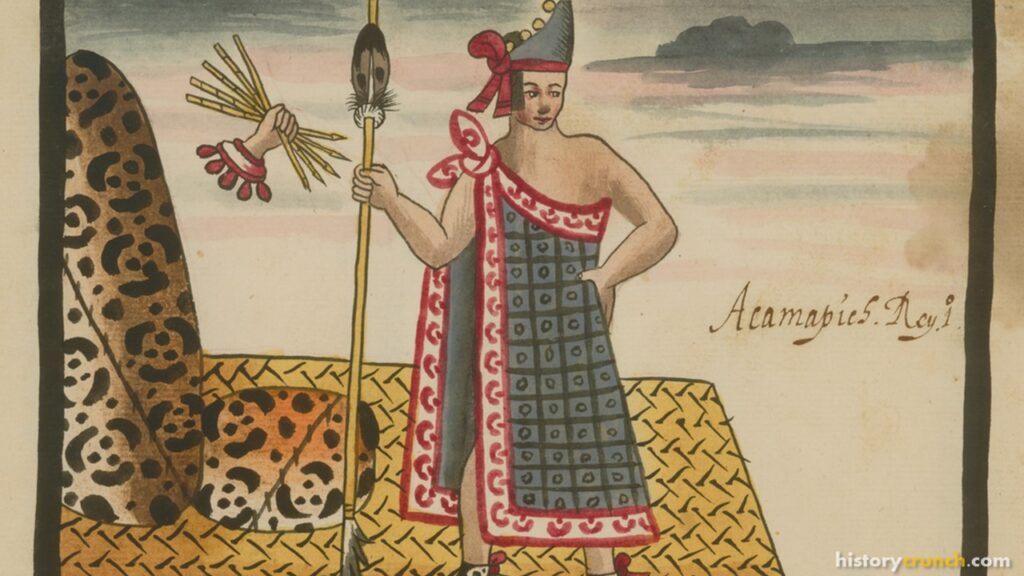
In 1376 the Mexica chose their first tlatoani, 'he who speaks', a king, later styled huey tlatoani, 'great speaker': Acamapichtli, 'handful of reeds', a prince of Culhuacan's Toltec line through his mother and so a ruler with a pedigree. Tenochtitlan was still a vassal paying tribute to the Tepanec city of Azcapotzalco across the water, and he ruled by its permission. He reigned about nineteen years, married a wife from each of the Mexica clans, and fathered the royal house that ruled until 1521.
LEARN MORESHOW LESSwhy it matters · 1 key figureRULERSA king with Toltec blood made the Mexica a people with a right to exist among the old cities of the valley. Every later emperor descended from Acamapichtli, and the Spanish would deal with his great-great-grandsons.
For fifty years the Mexica rose by serving the Tepanecs of Azcapotzalco, fighting their wars and marrying their daughters. When the old Tepanec ruler died in 1426 and his son murdered the Mexica king, the people wanted to surrender and the nobles made them a bargain: fight, and serve us forever if we win. Itzcoatl won. With Texcoco and Tlacopan he took Azcapotzalco in 1428 and made the Triple Alliance, which is the Aztec Empire. Then he burned the old histories and had new ones painted in which the Mexica had always been chosen, and his nephew Tlacaelel built the religion, the tribute and the wars that fed it.
Acamapichtli's son Huitzilihuitl, 'hummingbird feather', became tlatoani about 1391 and married a daughter of Tezozomoc, the aged and formidable ruler of Azcapotzalco, to whom the Mexica paid tribute. The marriage cut Tenochtitlan's tribute to a token and made the Mexica the Tepanecs' favorite soldiers. Under Huitzilihuitl the Mexica began wearing cotton instead of maguey fiber, which meant they were no longer poor.
LEARN MORESHOW LESSwhy it mattersRULERSFor thirty years the Mexica rose by serving a stronger master, fighting Azcapotzalco's wars and taking a share of its conquests. They learned empire by working for one.
In 1418 Tezozomoc of Azcapotzalco conquered Texcoco, the leading city of the eastern shore, with Mexica help, and had its king killed. The king's sixteen-year-old son, Nezahualcoyotl, 'fasting coyote', watched from a tree and escaped into years of exile. Tezozomoc gave Texcoco's lands to his allies, Tenochtitlan among them, and the Mexica received their first tributary towns.
LEARN MORESHOW LESSwhy it mattersWARNezahualcoyotl would return to build the Triple Alliance with the Mexica and become the most admired ruler in Aztec history, a poet, lawgiver and engineer. The alliance was born from this defeat.
Tezozomoc died in 1426 after ruling Azcapotzalco for about sixty years, and his son Maxtla seized the Tepanec throne from the heir. Maxtla distrusted the Mexica, whose ruler Chimalpopoca, Tezozomoc's own grandson, had backed the rightful heir, Tayauh. Within months Chimalpopoca was dead in Maxtla's custody, by strangling or by suicide in his cage, and Maxtla cut off Tenochtitlan's food and demanded its submission.
LEARN MORESHOW LESSwhy it mattersRULERSSixty years of rising by obedience ended in a night. The Mexica now had to fight their masters or be destroyed, and they chose to fight.
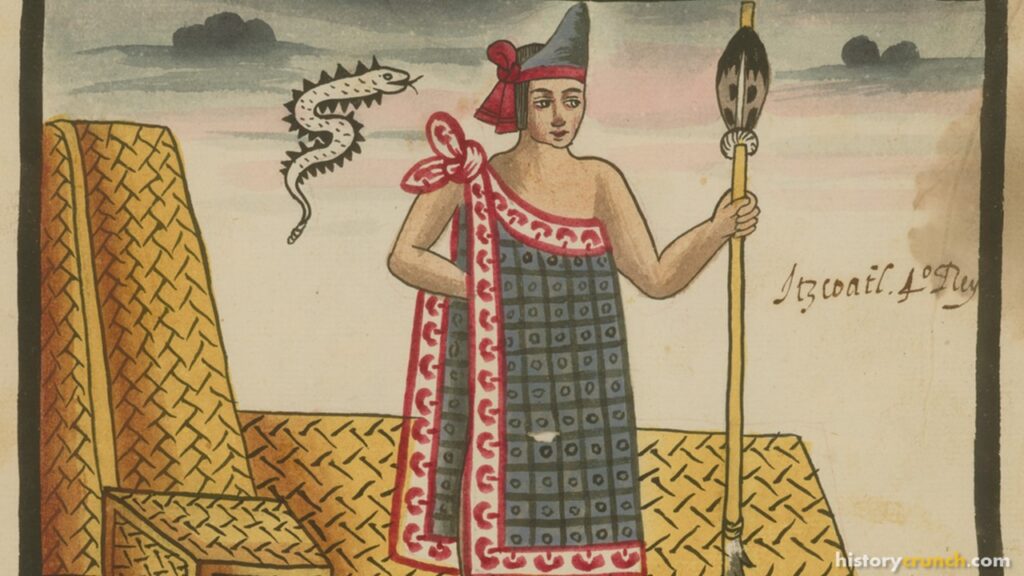
In 1427 the Mexica nobles chose Itzcoatl, 'obsidian serpent', a son of Acamapichtli by a slave woman, as their fourth tlatoani. The common people wanted to surrender to Maxtla; Itzcoatl and his nephew Tlacaelel made them a bargain, recorded in the chronicles: if the nobles lost, the people could eat them, and if they won, the people would serve the nobles forever. Then Itzcoatl sent Tlacaelel to Azcapotzalco to declare war.
LEARN MORESHOW LESSwhy it matters · 1 key figureRULERSItzcoatl made the decision from which the empire came, and the bargain with the people is the founding contract of Aztec society: the nobles took the risk and afterward took the rewards.
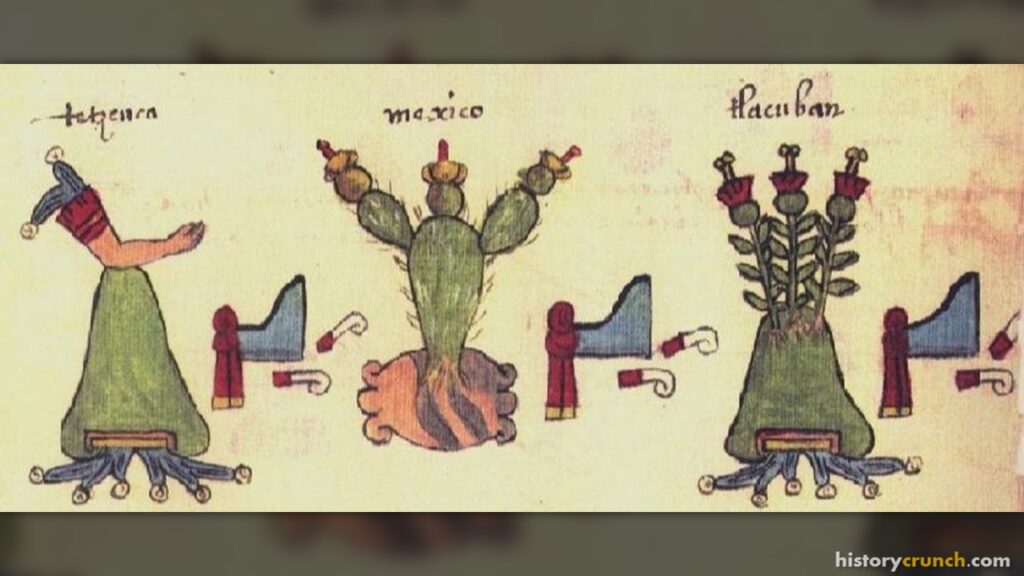
In 1428 Itzcoatl of Tenochtitlan, the exiled Nezahualcoyotl of Texcoco and the ruler of Tlacopan, a small Tepanec city that changed sides, joined their armies and after a siege of more than a hundred days took and burned Azcapotzalco. Maxtla fled and was killed. The three cities then made a pact: they would fight together, and tribute from conquered lands would be split two parts to Tenochtitlan, two to Texcoco and one to Tlacopan.
LEARN MORESHOW LESSwhy it matters · key numbers · 1 key figurePOLITICSThe Aztec Empire is this alliance. It was never one state but three cities sharing conquests, with Tenochtitlan the strongest and, within fifty years, the master. Everything the Spanish found in 1519 was built by it in ninety years.
After the victory Itzcoatl ordered the painted histories of the Mexica and their neighbors collected and burned, because, as the Florentine Codex records, 'it is not wise that all the people should know the paintings' and the old books held 'many lies'. New histories were painted in which Huitzilopochtli had led the Mexica from Aztlan to greatness and the Mexica were the heirs of the Toltecs.
LEARN MORESHOW LESSwhy it matters · a source · 1 key figureIDEASMost of what is known about early Mexica history is the version written after this burning. Historians read the migration story knowing it was edited by the winners.
IN THEIR OWN WORDS“It is not wise that all the people should know the paintings. The common people would be driven to ruin and there would be trouble, because these paintings contain many lies.”
The Florentine Codex, Book 10, on Itzcoatl's orderWHAT TO NOTICEThe reason the chronicles give for the burning of the old books.
Itzcoatl's nephew Tlacaelel, 'manly heart', held the office of cihuacoatl, 'woman snake', the second post in the state, from about 1433 under four rulers until his death about 1487. He refused the throne several times. The chronicles credit him with the new histories, the raising of Huitzilopochtli to chief god, the doctrine that the sun needed human blood to keep moving, the flower wars that supplied it, and the tribute system that fed the city.
LEARN MORESHOW LESSwhy it mattersIDEASIf any one person built the Aztec Empire as the Spanish found it, it was Tlacaelel. He is the reason the Mexica religion became a religion of war and the reason their neighbors hated them enough to join Cortes.
Between 1430 and 1440 the Triple Alliance conquered the cities of the southern lakes, Xochimilco, Cuitlahuac, Mixquic and Chalco's neighbors, whose chinampas were the richest farmland in the valley. Conquered cities kept their rulers and their gods but paid tribute, in maize, cloth, warriors and labor, to Tenochtitlan. The Mexica built a causeway to Coyoacan and put the southern towns to work on it.
LEARN MORESHOW LESSwhy it mattersWARControl of the chinampa towns fed Tenochtitlan's growth. The pattern of conquest, leave the local ruler in place and take tribute, was the whole method of Aztec empire and its weakness: nobody conquered was ever loyal.
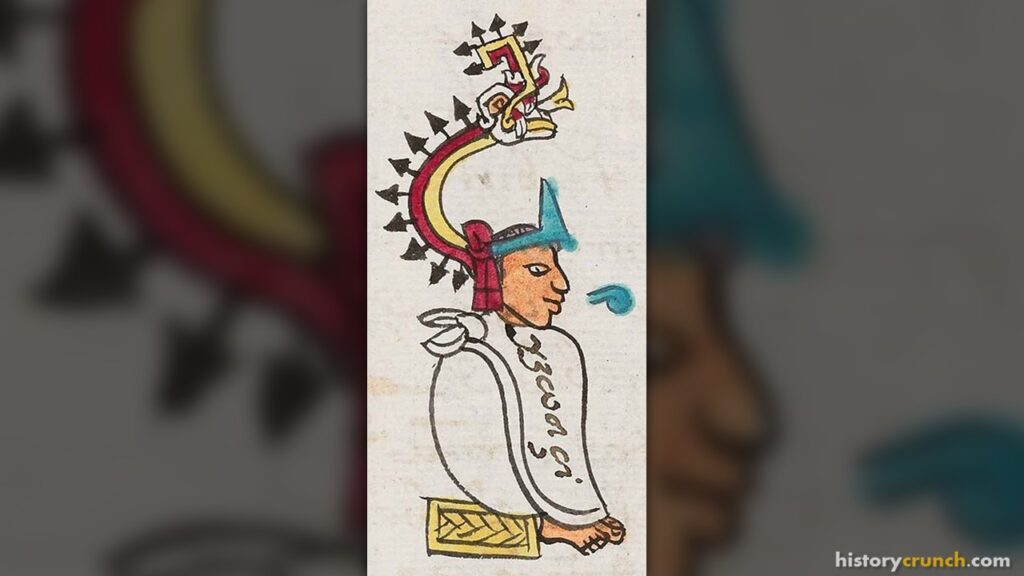
Itzcoatl died in 1440 after thirteen years in which the Mexica had gone from vassals under siege to masters of the western and southern valley. He had rebuilt Tenochtitlan in stone, begun the causeways to the mainland, and created the offices, ranks and rewards that made war the road to wealth for every Mexica man. His nephew Moctezuma Ilhuicamina, 'the elder', was chosen to succeed him.
LEARN MORESHOW LESSwhy it matters · 2 key figuresRULERSThirteen years is all it took. The Mexica in 1440 were no longer one city-state among many but the center of a growing system of tribute, and the next ruler would carry it beyond the valley.
Moctezuma I took the empire over the mountains, made laws that fixed rank in cloth and stone, sent every boy to school, and lived through the famine of One Rabbit, after which the priests said the gods were hungry and the flower wars began. His grandsons and great-nephews conquered to both oceans and lost one army to the Tarascans; one was poisoned for losing, and Ahuitzotl, who never lost, dedicated the seventh Templo Mayor in 1487 with thousands of captives in front of invited enemies. By his death in 1502 the empire took tribute from about 400 towns and five to six million people, and every one of those towns had a reason to hate it.
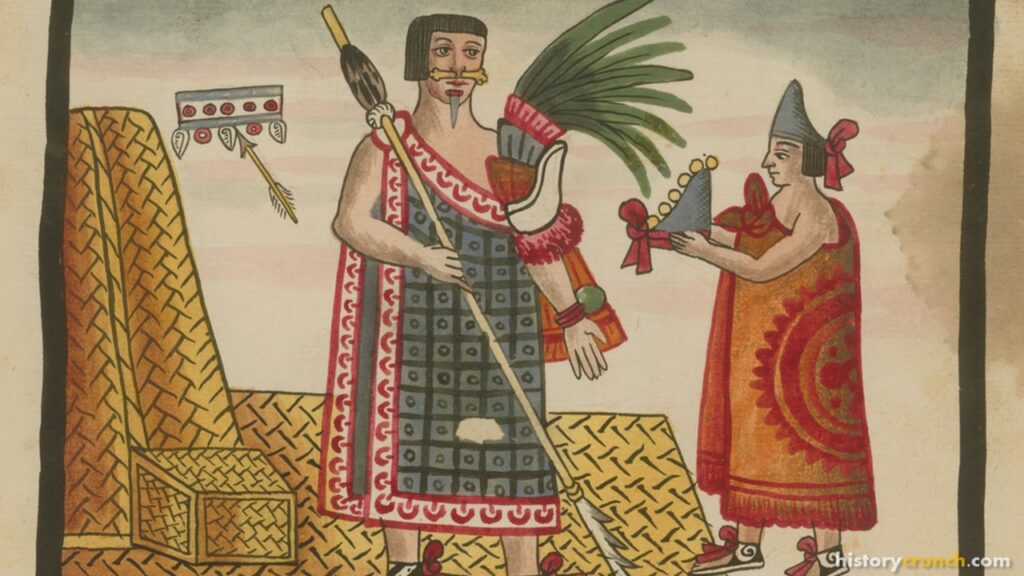
Moctezuma Ilhuicamina, 'he who frowns like a lord, archer of the sky', became the fifth tlatoani in 1440 at about forty years old, a veteran of the Tepanec war. He ruled for 29 years, the longest reign in Mexica history, and in it the empire crossed the mountains for the first time. He was also a lawgiver: his codes set what each class could wear, build and own, and made drunkenness for commoners a capital crime.
LEARN MORESHOW LESSwhy it matters · key numbers · 1 key figureRULERSMoctezuma I turned a valley power into an empire and a rough soldiers' society into a ranked state where a cotton cloak or a stone house told you exactly who a person was.
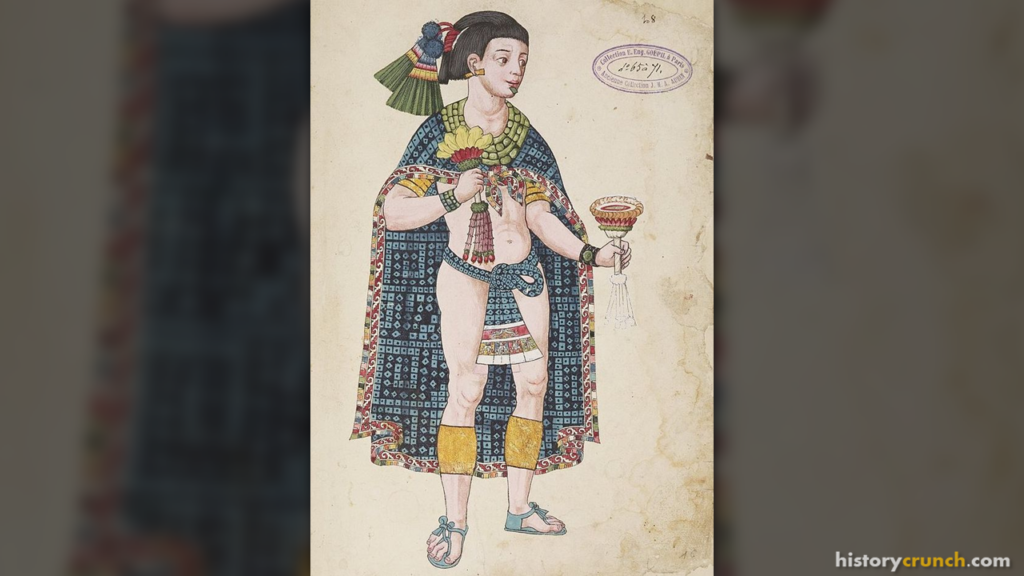
Around 1445 Moctezuma I issued laws fixing the outward signs of rank. Only nobles, the pipiltin, could wear cotton, sandals in the palace, or cloaks below the knee; commoners, the macehualtin, wore maguey fiber and went barefoot before the ruler. Only the tlatoani wore turquoise. A commoner who wore a noble's cloak could be killed for it, and a house with a second story was a noble's house or a crime.
LEARN MORESHOW LESSwhy it matters · 1 key figureSOCIETYAztec society was made visible on the body. A student who understands the cloak law understands the whole system: a warrior who took captives could rise, but the line between noble and commoner was drawn in cloth.
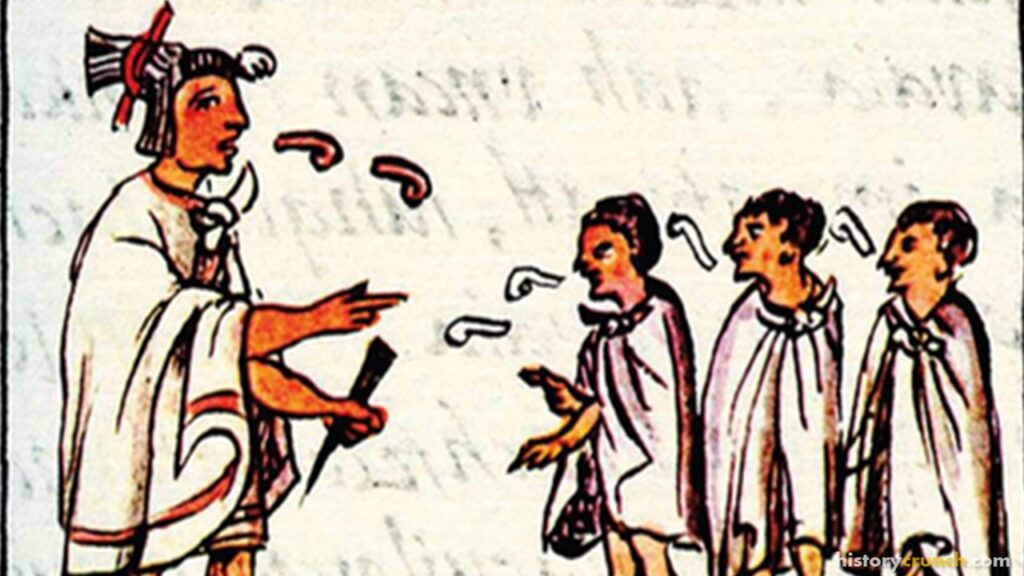
Moctezuma I's laws of the 1440s made schooling a duty. Noble boys went to the calmecac, the priests' school attached to a temple, to learn the calendar, the songs, the histories in the painted books, and to fast and bleed themselves before the gods; commoners' boys went at about fifteen to the telpochcalli, the 'house of youth' of their district, to learn to fight and to work on public labor. Girls learned weaving and the household at home or in the temple. Sahagun's informants said no Aztec child was left untaught.
LEARN MORESHOW LESSwhy it matters · 1 key figureSOCIETYThe Aztecs are the only society of their time known to have required schooling for every boy, noble or common. It is also how the state got its priests, its officials and, above all, its warriors.
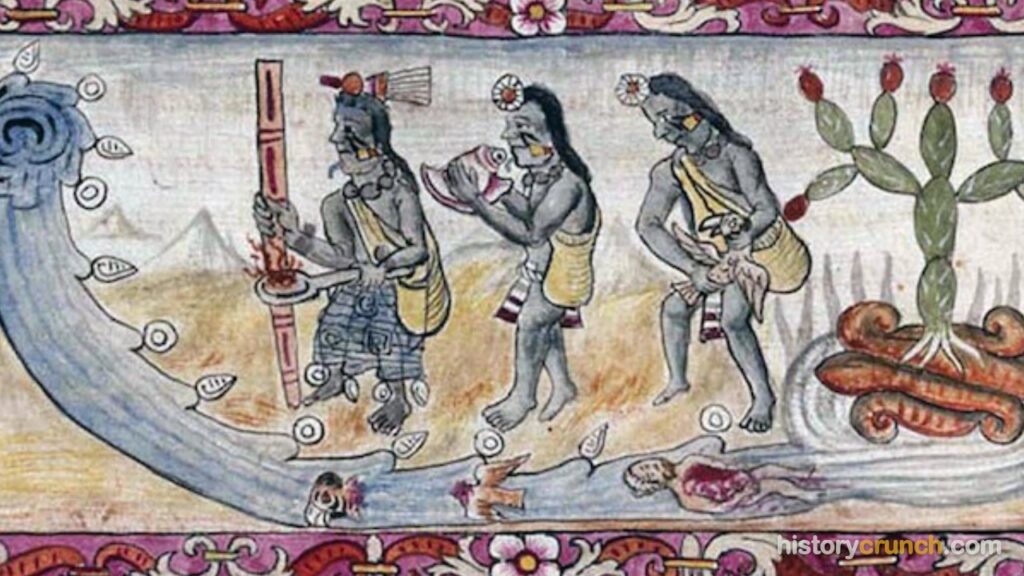
In 1449 heavy rains raised Lake Texcoco and flooded Tenochtitlan. Moctezuma I asked Nezahualcoyotl of Texcoco, the alliance's engineer, for a remedy, and he designed a dike about 10 miles (16 km) long, of stone and earth between rows of stakes, running north to south across the lake. It held back the salty eastern water and kept the fresh western water around the city. Tens of thousands of laborers from the tributary towns built it.
LEARN MORESHOW LESSwhy it matters · key numbersCITIESThe dike made the lake around Tenochtitlan fresh enough for chinampas and kept the city dry for seventy years. Cortes broke it in 1521, and the flooded, salt-poisoned city that the Spanish inherited was the result.
Four years of frost, drought and failed harvests, from 1450 to 1454, brought the Valley of Mexico to starvation. In the year One Rabbit, 1454, the chronicles say, people sold themselves and their children into slavery to the Totonacs of the coast for a few measures of maize, and the dead were left unburied. Moctezuma I opened the royal granaries and then closed them, and the priests read the disaster as the gods' hunger.
LEARN MORESHOW LESSwhy it matters · 1 key figureSOCIETYThe famine is the usual explanation for what came next: the flower wars to feed the gods, the drive to conquer the fertile lowlands so that the valley would never starve again, and the belief that the empire's survival depended on blood.
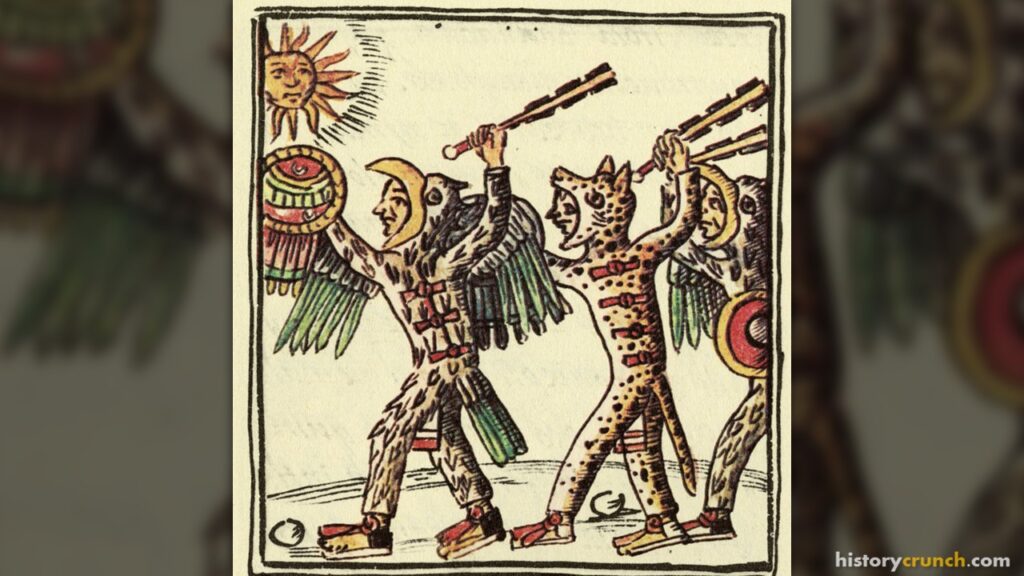
From about 1455 the Triple Alliance and the cities of the Puebla valley, Tlaxcala, Huexotzinco and Cholula, fought wars by agreement: a fixed day, a fixed field, equal numbers, and the object not to kill but to capture, so that the captives could be sacrificed. Tlacaelel is credited with the idea. The chronicles call them xochiyaoyotl, flower wars, because the warriors fell like flowers.
LEARN MORESHOW LESSwhy it mattersWARThe flower wars kept the temples supplied and the young warriors trained, and they left Tlaxcala unconquered and full of hatred sixty years later, when the Spanish came looking for allies.
In 1458 Moctezuma I sent the alliance army over the mountains into the Mixtec country of Oaxaca to punish Coixtlahuaca, a trading city that had killed Mexica merchants. The city was taken, its ruler strangled, and it was made to send tribute: gold dust, jade, cochineal dye and quetzal feathers, the luxuries the valley could not make. Over the next decade the armies reached the Gulf coast and the Huastec country.
LEARN MORESHOW LESSwhy it matters · 1 key figureWARThis is where the empire became an empire, taking tribute from peoples 200 miles (320 km) away who spoke other languages. The Aztec merchants who went ahead of the armies were spies as much as traders.
Moctezuma I died in 1469 without a son fit to rule, and the council of nobles, guided by Tlacaelel, chose his grandson Axayacatl, 'water face', aged about nineteen. The empire he inherited paid tribute from the Pacific to the Gulf. Nezahualcoyotl of Texcoco died three years later, in 1472, after a reign of forty years in which he had written poems, built gardens and forbidden human sacrifice in his own temple.
LEARN MORESHOW LESSwhy it matters · 1 key figureRULERSThe choice of a teenage grandson shows how the succession worked: the nobles chose, and they chose warriors. Nezahualcoyotl's death took away the alliance's one voice against the growing sacrifices.
In 1473 a quarrel between the two Mexica cities, over a marriage and over the market, turned to war. Axayacatl's army stormed Tlatelolco; its ruler Moquihuix was thrown from the top of his temple, and the city lost its independence and became a district of Tenochtitlan under a military governor. Its market went on as before, now paying its takings to Tenochtitlan.
LEARN MORESHOW LESSwhy it mattersWARThe great market that the Spanish described belonged to Tenochtitlan from this year. The last stand of the Aztecs in 1521 was made in Tlatelolco's ruins.
In 1478 Axayacatl marched west against the Tarascans, or Purepecha, of Michoacan, the one neighbor as strong as the alliance and the only one with copper and bronze weapons. Near Taximaroa his army of about 24,000 met about 40,000 Tarascans and was cut to pieces; the chronicles say fewer than 5,000 came home. The Aztecs never attacked Michoacan again and built a line of forts along the border instead.
LEARN MORESHOW LESSwhy it matters · key numbersWARThe Aztec Empire had a western limit fixed by defeat. The Tarascans were still unconquered and hostile in 1519, and the Spanish would find them as useful as they found Tlaxcala.
Axayacatl died in 1481 and his brother Tizoc, 'chalk leg', took the throne. His coronation war, the campaign every new ruler fought to win captives for his own installation, was a failure that lost more men than it took. He commissioned the Stone of Tizoc, a great round carving of himself conquering fifteen cities, most of which he had not conquered. In 1486, after five years, he died suddenly; the chronicles say his own nobles poisoned him.
LEARN MORESHOW LESSwhy it mattersRULERSThe empire needed a ruler who won. Tizoc's fate shows that the tlatoani was chosen by the nobles and could be removed by them, and his stone shows that carving a victory was almost as good as winning one.
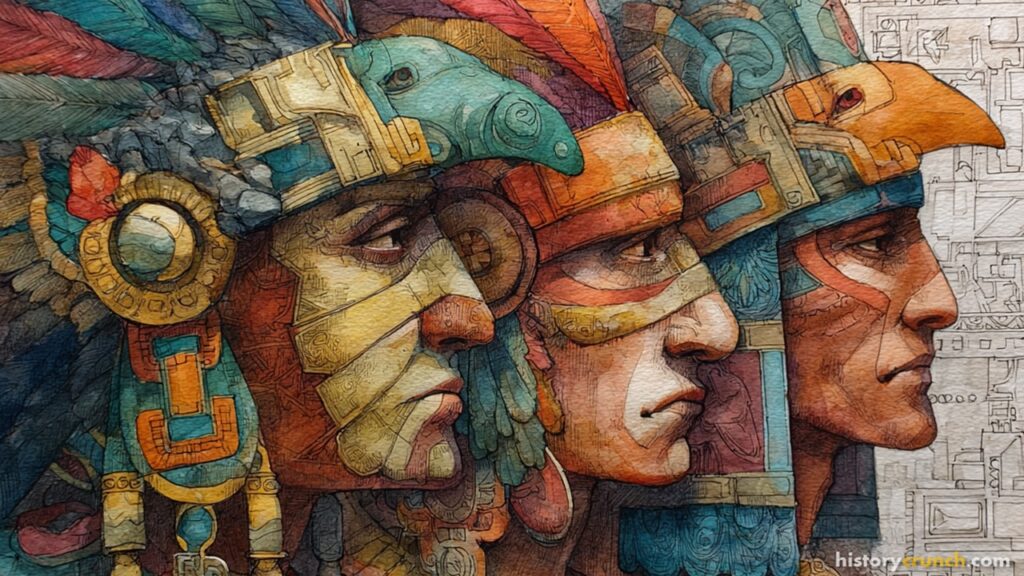
Ahuitzotl, 'water dog', the third brother, became tlatoani in 1486 and ruled sixteen years of almost continuous war. He took the empire south to the Pacific coast of Guatemala and east into Oaxaca, put garrisons in conquered towns for the first time, and doubled the tribute coming into the city. He was said to sleep among his soldiers and to give away everything he took.
LEARN MORESHOW LESSwhy it matters · key numbersRULERSAt Ahuitzotl's death the Aztec Empire reached its largest extent: about 80,000 square miles (200,000 sq km), some 400 tributary towns and five to six million people. This is the empire Moctezuma II inherited and lost.
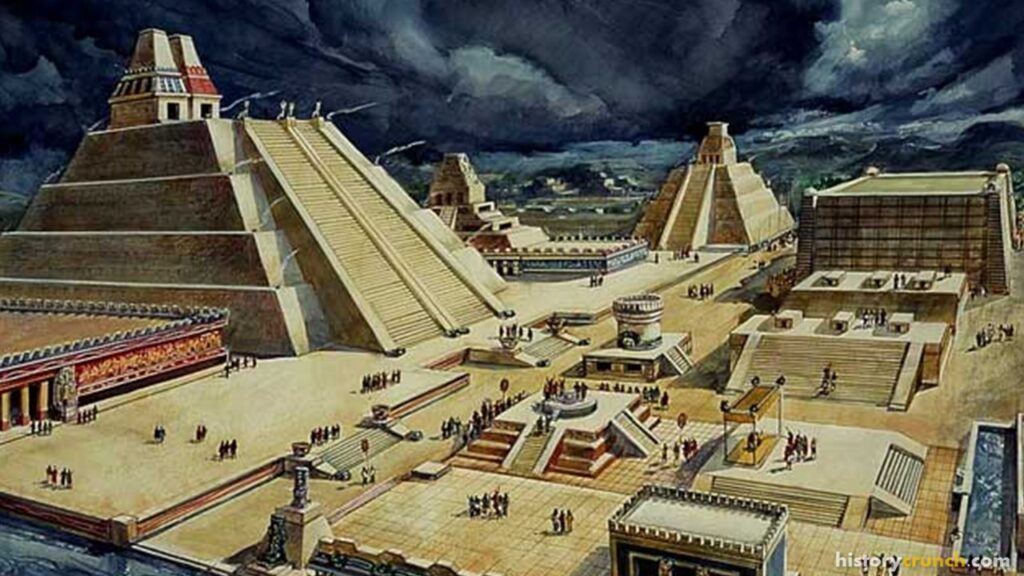
In 1487 Ahuitzotl dedicated the sixth rebuilding of the Templo Mayor, the twin-shrined pyramid at the center of Tenochtitlan, about 180 feet (60 m) high, with Huitzilopochtli's shrine on the south and Tlaloc's on the north. Rulers and nobles from every subject and enemy city were invited to watch. The chronicles say that over four days captives from the recent wars were sacrificed in lines stretching the length of the causeways; the numbers given run from 4,000 to 80,400, and historians believe the lower figures.
LEARN MORESHOW LESSwhy it matters · key numbers · a debateRELIGIONThe dedication was a display of terror meant for the guests. The temple the Spanish saw in 1519 and destroyed in 1521 was this one, and its ruins, found under Mexico City in 1978, are the timeline's last card.
How many were sacrificed at the dedication?
The chronicles say 80,400 in four days, and the empire had just fought wars that yielded thousands of captives.
That number is physically impossible in the time; most historians put it in the low thousands, still the largest sacrifice on record, and read the higher figure as propaganda that served both the Aztecs and the Spanish.
By the 1490s the pochteca, the hereditary long-distance merchants of Tlatelolco and Tenochtitlan, traveled in armed caravans as far as the Maya lowlands, trading obsidian, cloth and dyed rabbit fur for jade, cacao, feathers and gold. They lived in their own districts under their own courts and god, and reported to the tlatoani on every city they visited. An insult to a pochteca was a cause of war.
LEARN MORESHOW LESSwhy it mattersECONOMYThe empire ran on tribute but it grew on information, and the merchants supplied it. The cacao beans they carried were the Aztec currency; a turkey cost about 100 beans.
In 1499 Ahuitzotl, wanting more fresh water for the growing city, built a second aqueduct from the springs of Acuecuexatl at Coyoacan, over the objections of Coyoacan's ruler, whom he had killed for objecting. The spring was stronger than anyone had measured; the aqueduct flooded Tenochtitlan for forty days, ruining the chinampas and the houses of the poor. Ahuitzotl was said to have struck his head on a lintel escaping the water, an injury that killed him three years later.
LEARN MORESHOW LESSwhy it mattersCITIESThe city lived by managing water, and its greatest conqueror was undone by it. The older aqueduct from Chapultepec, two channels of stone so that one could be cleaned while the other ran, was the one still working in 1521.
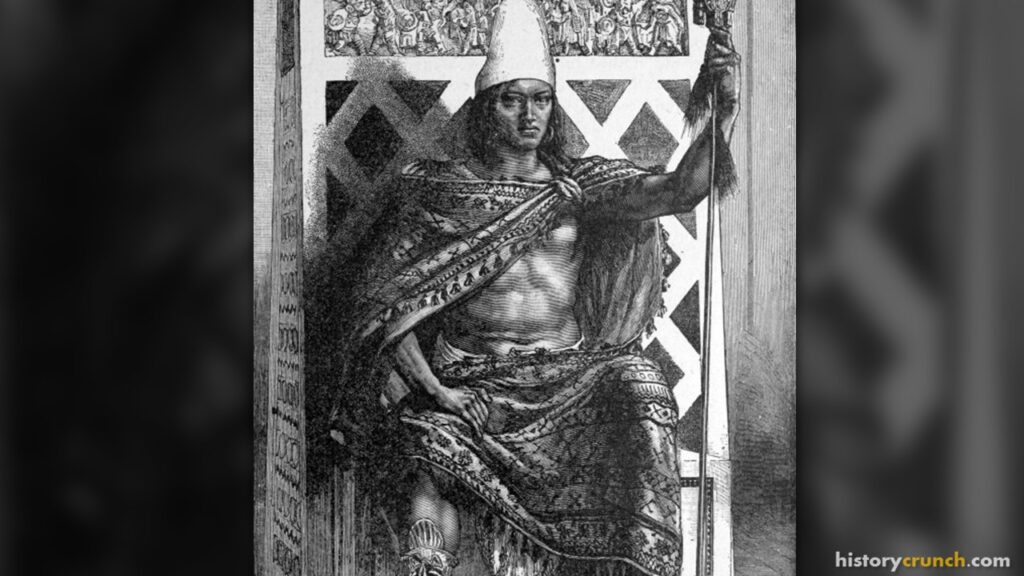
Ahuitzotl died in 1502 and the council chose his nephew Moctezuma Xocoyotzin, 'the younger', a son of Axayacatl, aged about 36, a priest and a general, found, the story says, sweeping the temple steps. He was crowned with a war against Nopallan and Icpatepec that brought 5,100 captives for the ceremony. He ruled the empire at its height for seventeen years.
LEARN MORESHOW LESSwhy it matters · 1 key figureRULERSMoctezuma II is the Aztec ruler everyone knows, because the Spanish met him. He inherited the largest state in the Americas and an army that had never lost a war except to the Tarascans.
Moctezuma II remade the court into a place of silence and ceremony, lit the last New Fire in 1507, and from 1517 had reports of ships on the coast. In 1519 Hernan Cortes landed with about 500 men, a rebel from Cuba who could only be saved by success, found a slave girl who could speak to everyone, sank his ships, fought Tlaxcala and made it his army, killed Cholula as a warning, and walked down the causeway into a city of 200,000 on November 8th, where the ruler no one could look at came out in a litter to meet him. Whether Moctezuma thought he was a god, or a problem to be managed, is still argued.
In his first year Moctezuma II dismissed the commoners Ahuitzotl had raised to office and replaced them with nobles, and had many of the old servants killed so that they could not compare him with his uncle. He made the palace a place of ceremony: no one might look at his face, nobles entered barefoot in plain cloaks, and he ate alone behind a screen from three hundred dishes. His palace, with its zoo, aviary and gardens, covered about six acres (2.4 hectares).
LEARN MORESHOW LESSwhy it matters · 1 key figureRULERSThe Spanish descriptions of Moctezuma as a god-king surrounded by silence describe a court he had built himself over seventeen years. His remoteness was policy, and in 1519 it became a weakness.
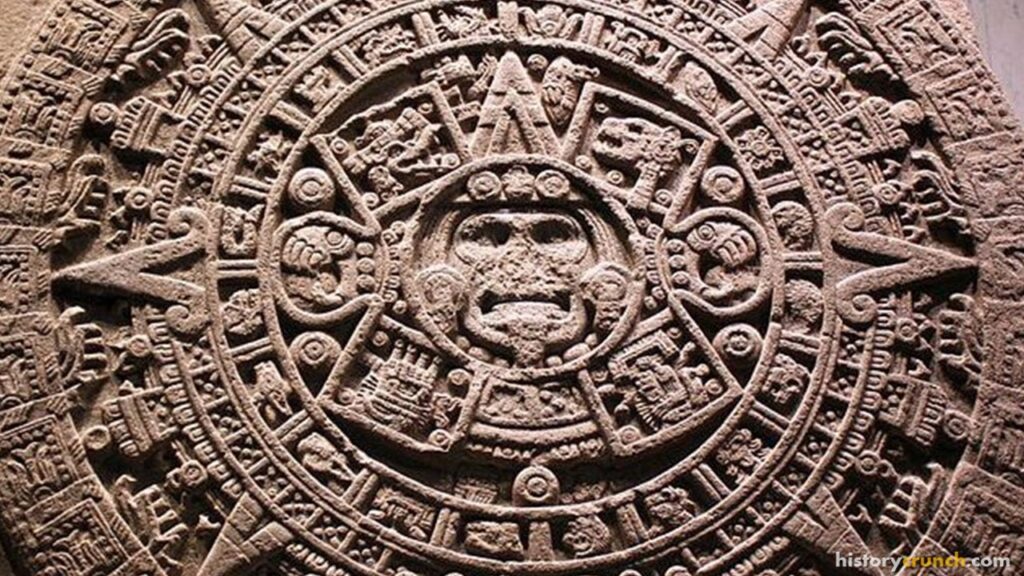
In 1507, at the end of a 52-year cycle, the point at which the 365-day and 260-day calendars returned to the same day together, every fire in the empire was put out. The people broke their pots, fasted and climbed to their roofs. At midnight on the Hill of the Star the priests lit a new fire on the chest of a sacrificed captive; if it had failed to catch, the world would end and the stars would descend as monsters. It caught, and runners carried it to every hearth. Moctezuma moved the ceremony from the year One Rabbit to Two Reed to escape the memory of the famine.
LEARN MORESHOW LESSwhy it matters · key numbers · 1 key figureRELIGIONThis was the last New Fire ever lit. The next was due in 1559, and by then there was no empire. The ceremony shows how the Aztecs understood time: as a cycle that could stop.
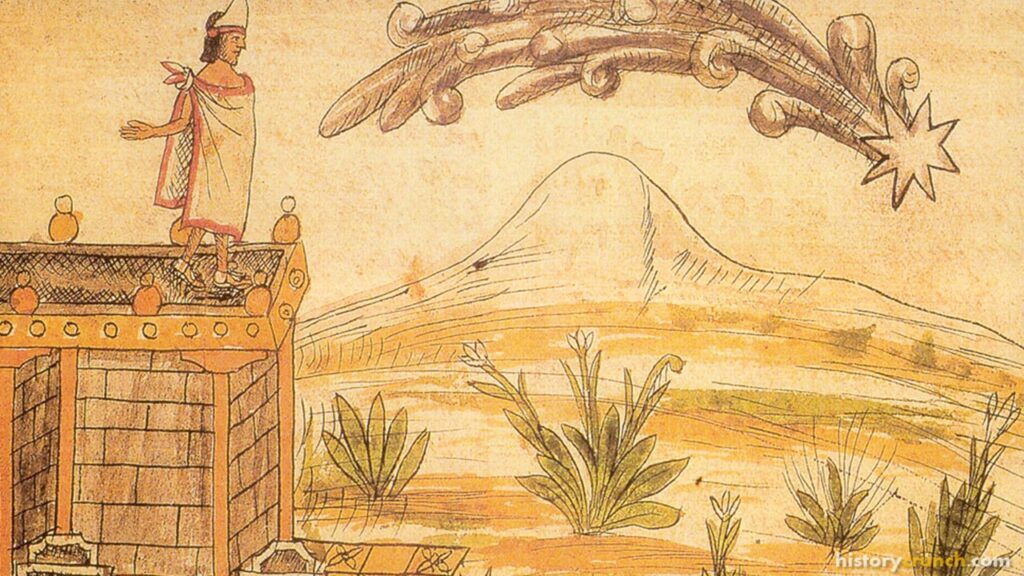
From about 1509, the chronicles written after the conquest say, Tenochtitlan saw ten years of signs. A tongue of fire stood in the eastern sky for a year; Huitzilopochtli's temple burned with no cause; the lake boiled and flooded; a woman wailed at night for her children; and fishermen brought Moctezuma a crane with a mirror in its head, in which he saw armed men riding deer. The Spanish were already in the Caribbean, and rumors of them had been reaching the coast since 1502.
LEARN MORESHOW LESSwhy it matters · a debate · 1 key figureRELIGIONWhether the omens were seen at the time or remembered afterward, they are how the Aztecs explained their own defeat: the gods had warned them and the ruler had been afraid. Historians treat them as history written backward.
Were the omens real?
Some were: a comet was recorded in 1517 and the temple fire and flood have natural explanations, and the Mexica took such signs seriously.
The list of ten omens appears only in accounts written decades after 1521 by survivors trying to make sense of the catastrophe, and it matches lists of omens in European histories the friars knew.
Sometime in Moctezuma II's reign, probably about 1512, sculptors finished the Sun Stone, a disc of basalt 12 feet (3.6 m) across and 24 tons in weight, with the face of the sun god at its center inside the signs of the four previous worlds, the twenty day-signs, and two fire serpents. It was probably set flat in the temple precinct as a platform for gladiatorial sacrifice. It is not a working calendar; it is a picture of how time is made of ages, each ending in disaster.
LEARN MORESHOW LESSwhy it matters · key numbers · 1 key figureCULTUREThe Sun Stone is the most famous object the Aztecs made and the emblem of Mexico. It was buried after the conquest and found by accident in 1790.
In 1517 an expedition from Cuba under Francisco Hernandez de Cordoba reached Yucatan and was beaten off by the Maya with half its men lost; in 1518 Juan de Grijalva sailed along the Gulf coast to Aztec territory and traded with Moctezuma's coastal governors, who painted the ships and sent the pictures to Tenochtitlan. Moctezuma's messengers brought gold to the shore and asked when the strangers would come back.
LEARN MORESHOW LESSwhy it matters · 1 key figureCONTACTMoctezuma had two years' warning and detailed reports. What he did not have was any category for what he was looking at, and the question of whether he took Cortes for the returning god Quetzalcoatl starts here.
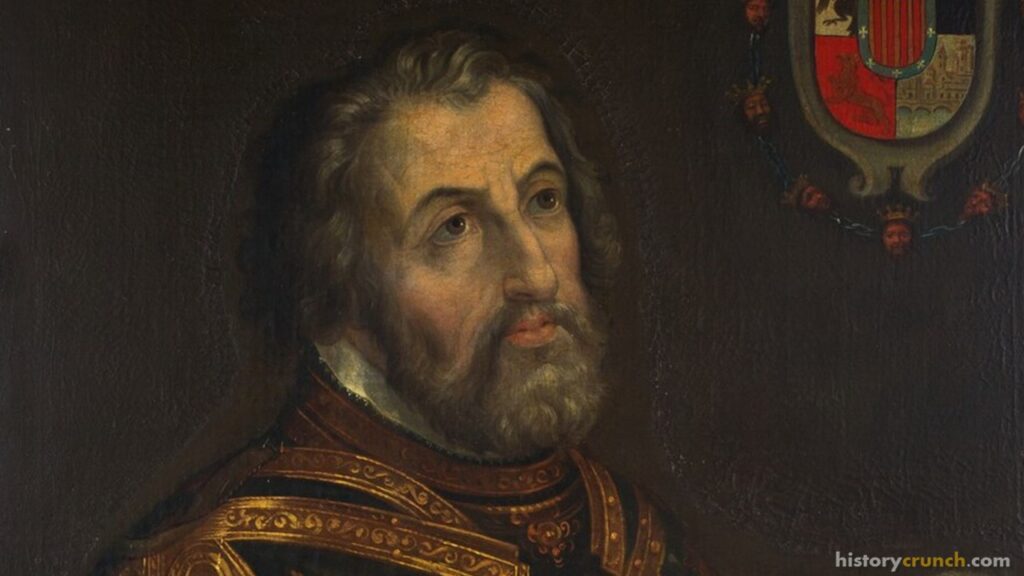
On February 10th, 1519 Hernan Cortes, a 33-year-old Spanish landowner in Cuba who had never commanded anything, sailed for Mexico with eleven ships, about 500 soldiers, 16 horses, 14 cannon and a few hundred Cuban and African servants. The governor of Cuba, Diego Velazquez, had appointed him captain and then, suspecting him, revoked the appointment; Cortes left before the order could be enforced. He was, from that day, a rebel who could only be saved by success.
LEARN MORESHOW LESSwhy it matters · key numbers · 1 key figureCONTACTEverything Cortes did in Mexico he did as a man who would be hanged if he came home with nothing. That is part of why he burned his ships and marched inland with 500 men against an empire of millions.
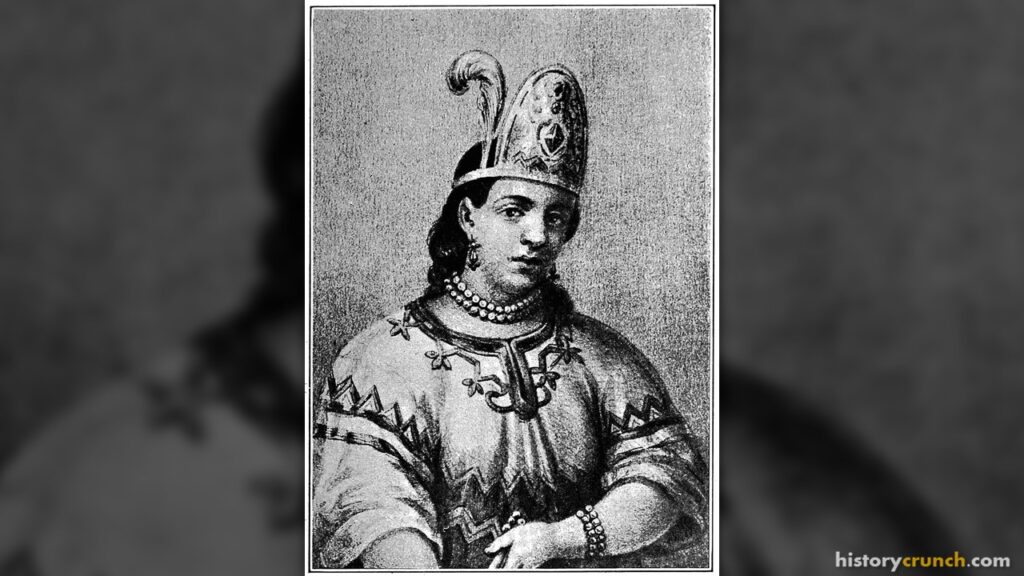
After a battle at the mouth of the Tabasco River in March 1519, the local ruler gave the Spanish twenty women, among them a young Nahua noblewoman, sold into slavery as a child, who spoke both Nahuatl and the Maya of the coast. The Spanish called her Marina; the Mexica called her Malintzin, and Cortes, by extension, Malinche. Within weeks she was translating from Nahuatl to Maya for a Spanish castaway who translated to Spanish, and within months she spoke Spanish herself.
LEARN MORESHOW LESSwhy it matters · a debate · 2 key figuresPEOPLECortes could not have negotiated, spied, made alliances or understood a single warning without her. In Mexico her name became a word for betrayal, and historians have argued for a century about whether that is fair to an enslaved woman of nineteen.
Was Malintzin a traitor?
She chose the Spanish side, and her intelligence, above all her warning of the Cholula plot, made the conquest possible.
She was a slave given away twice by her own people, with no Aztec loyalty to betray; she served the only masters who valued her, and the word malinchista says more about later Mexico than about her.
On Good Friday, April 21st, 1519 the Spanish landed on the Gulf coast near the site of Veracruz. Moctezuma's governor met them with gifts, and the messengers who followed brought a sun of gold and a moon of silver the size of cartwheels, feather cloaks and jewels, and a request that the strangers go home. Cortes founded a town, had its council elect him captain-general under the king of Spain, and so cut his legal tie to the governor of Cuba.
LEARN MORESHOW LESSwhy it matters · 2 key figuresCONTACTThe gold was meant to satisfy the strangers and it did the opposite. And the founding of a town was a lawyer's trick that turned a rebel into a royal officer, at least on paper.
In July 1519, after hanging two men who had plotted to sail back to Cuba, Cortes had his ships stripped and run aground, keeping one to carry his letters and a share of the gold to the king. There was now no way home for 500 men except through Tenochtitlan. He had also found allies: the Totonacs of Cempoala, who paid tribute to Moctezuma and hated it, and who gave him porters and warriors and a first lesson in how many enemies the empire had.
LEARN MORESHOW LESSwhy it matters · 1 key figureCONTACTThe scuttled ships are the most famous decision of the conquest, and the Totonac alliance the most important one. The empire would be brought down by its own subjects, with the Spanish as the spark.
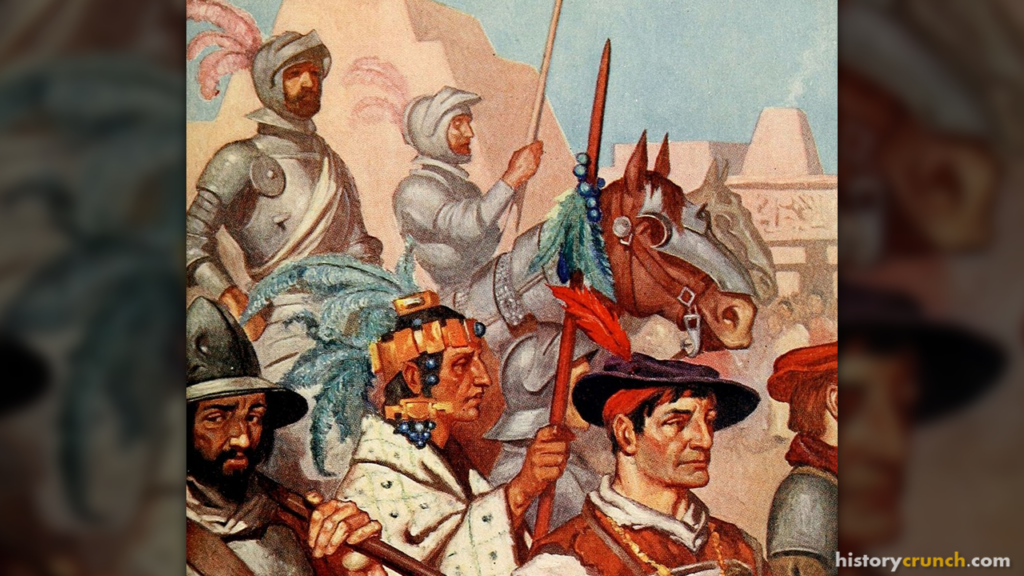
Marching inland in September 1519, the Spanish entered the territory of Tlaxcala, the alliance's enemy in the flower wars, and were attacked for two weeks by armies of tens of thousands under the commander Xicotencatl the younger. Steel, horses and crossbows held against the obsidian-edged macuahuitl, barely. On September 18th the Tlaxcalan council made peace and then alliance: they would give the Spanish an army if the Spanish would help them destroy Tenochtitlan.
LEARN MORESHOW LESSwhy it matters · 1 key figureWARTlaxcala was the conquest. Its warriors, tens of thousands strong, fought every battle to the end, and without them 500 Spaniards would have died in the mountains. Tlaxcala kept privileges under Spanish rule for three centuries as the price.
In October 1519 the Spanish and their Tlaxcalan allies entered Cholula, the holy city of Quetzalcoatl with its great pyramid, larger in volume than any in Egypt, and an ally of Moctezuma. Malintzin was told by a local woman that an ambush was planned. On October 18th Cortes gathered the city's nobles and warriors in the temple courtyard and had them killed; the Spanish said 3,000 died, the Tlaxcalans looted the city, and the news reached Tenochtitlan within days.
LEARN MORESHOW LESSwhy it matters · 2 key figuresWARCholula was a warning to every city on the road and to Moctezuma above all. After it, no city resisted the Spanish march, and the ruler in Tenochtitlan stopped trying to keep them away and began trying to manage them.
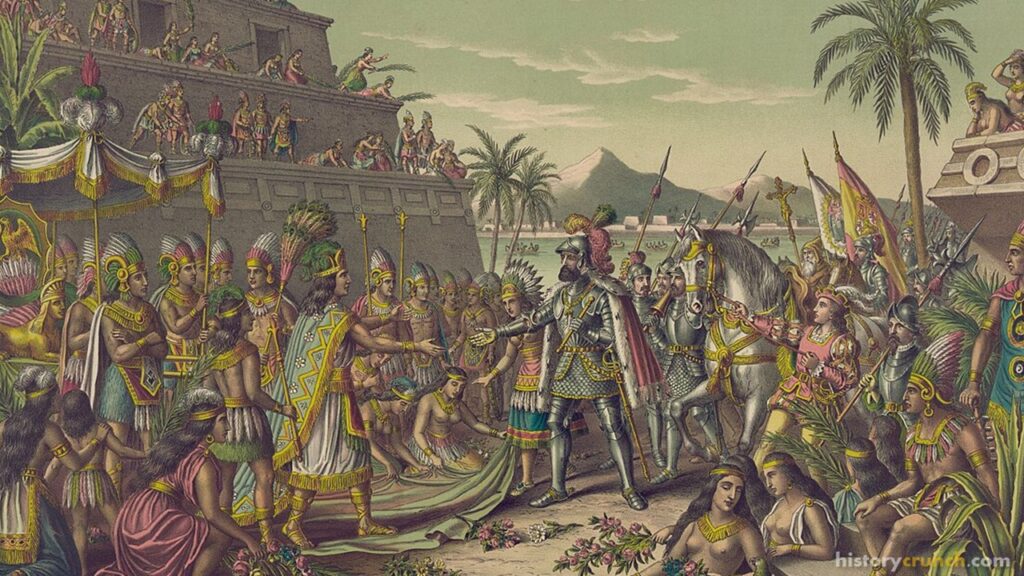
On November 8th, 1519 the Spanish, about 400 of them with several thousand Tlaxcalans, walked down the southern causeway into Tenochtitlan between crowds of tens of thousands, and Moctezuma II came out to meet them carried in a litter under a canopy of green feathers, his nobles sweeping the ground before him. Through Malintzin the two men exchanged speeches; Cortes tried to embrace the ruler and was held back. Moctezuma lodged the Spanish in his father's palace and gave them everything they asked for.
LEARN MORESHOW LESSwhy it matters · a source · a debateCONTACTTwo worlds that had not known of each other met in one afternoon, and the meeting has been argued over since: whether Moctezuma's speech of welcome was a surrender, a courtesy, or a trap.
IN THEIR OWN WORDS“You have come to your city, Mexico. You have come here to sit on your throne, to sit under its canopy.”
Moctezuma II to Hernan Cortes, November 8th, 1519, as recorded in the Florentine CodexWHAT TO NOTICEPart of the speech of welcome, in Nahuatl, as Sahagun's Mexica informants remembered it thirty years later.
Did Moctezuma surrender his empire in this speech?
Cortes said so in his letter to the king, and the speech as recorded gives the city to the visitor.
Nahua courtesy required a host to belittle himself and offer everything; the words were a polite formula, and Cortes, who needed a legal claim, chose to hear them as a deed of gift.
Six days after the welcome Cortes made Moctezuma a hostage, and for seven months ruled through him while his men melted the treasury into bars. Then Alvarado massacred the nobles at their festival, the city rose, Moctezuma died, and on the Sad Night of June 30th, 1520 the Spanish lost half their men on the causeway. They should have died at Otumba a week later, and did not. Smallpox reached the city in October and killed a third of it and its new ruler. Cortes came back in 1521 with 900 Spaniards, 100,000 allies and thirteen ships carried over the mountains, cut the water, and took the city house by house in 75 days. On August 13th, 1521 it was rubble.
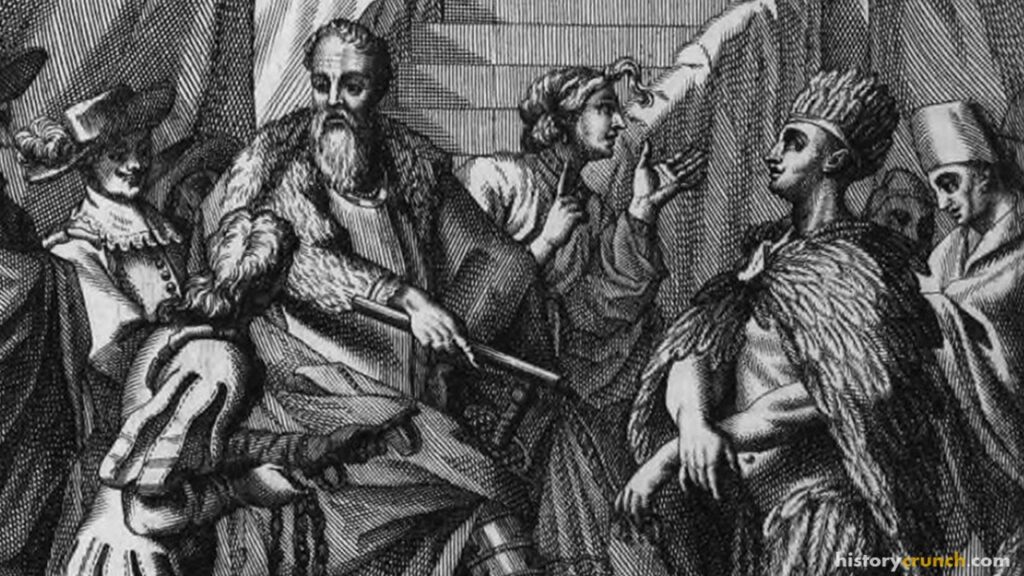
On November 14th, 1519, six days after the welcome, Cortes walked into Moctezuma's palace with thirty armed men and, using the killing of some Spaniards on the coast as his excuse, told the ruler he must come and live in the Spanish quarters or die. Moctezuma went. For the next seven months he ruled as a prisoner, holding court, receiving tribute and giving orders, while the Spanish melted down his treasury into bars.
LEARN MORESHOW LESSwhy it matters · 2 key figuresCONTACTA ruler who could not be looked at was now a hostage in a Spanish guardroom, still obeyed because the Mexica had no way to think of him otherwise. His authority held the city still for half a year, which was all the Spanish needed and the last thing the Mexica needed.
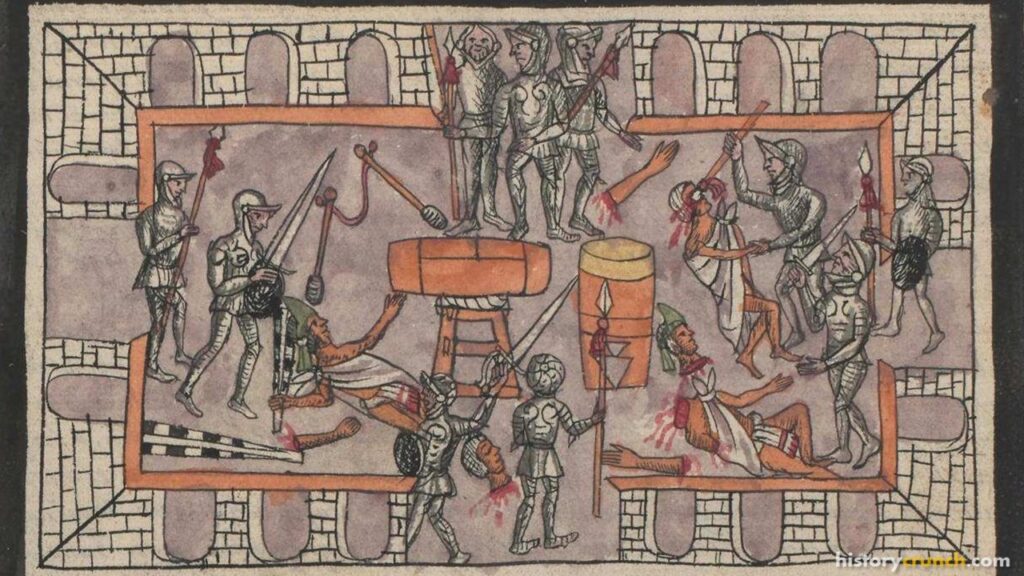
On May 22nd, 1520, with Cortes away, the Mexica nobles held the festival of Toxcatl in the temple precinct with Alvarado's permission, unarmed, several hundred of the city's leading warriors dancing in feathers and gold. Alvarado, claiming he had learned of a plot, blocked the exits and his men killed them all. The Florentine Codex says the blood ran like water. The city rose that night, and the Spanish were besieged in the palace.
LEARN MORESHOW LESSwhy it matters · a sourceWARWhatever Alvarado feared, the massacre ended the strange peace of seven months. From this day the Mexica fought, and the war that followed lasted fifteen months and destroyed the city.
IN THEIR OWN WORDS“The blood of the chieftains ran like water and gathered into pools. The Spaniards went everywhere, searching the communal houses to kill those who were hiding.”
The Florentine Codex, Book 12, on the massacre at ToxcatlWHAT TO NOTICEFrom the Mexica account gathered by Bernardino de Sahagun from survivors.
In May 1520 the governor of Cuba sent about 900 men under Panfilo de Narvaez to arrest Cortes. Cortes left Pedro de Alvarado in Tenochtitlan with about 120 men and marched to the coast with the rest. On the night of May 28th he attacked Narvaez's camp at Cempoala in the rain, took him prisoner, and recruited his soldiers with promises of gold. He now had more than 1,000 Spaniards.
LEARN MORESHOW LESSwhy it matters · 1 key figureWARThe Spanish were divided among themselves, and Cortes won because the men he beat wanted gold more than they wanted their orders. The horses, guns and men he took from Narvaez were the army that came back to besiege the city.
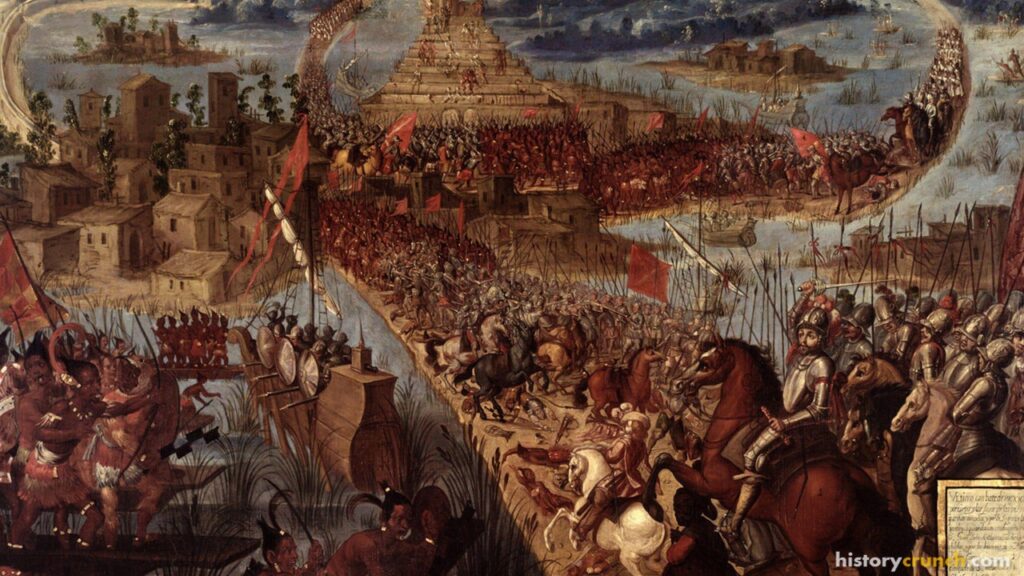
Cortes returned on June 24th, 1520 and found the Spanish besieged. He sent Moctezuma to the palace roof to calm the crowd; the Mexica, who had already chosen his brother Cuitlahuac to lead them, answered with stones and arrows, and Moctezuma was hit. He died on or about June 29th. The Spanish said the stones killed him; the Mexica accounts say the Spanish strangled him before they fled. His body was carried out and burned by his own people without ceremony.
LEARN MORESHOW LESSwhy it matters · a debate · 3 key figuresRULERSThe ruler who had let the strangers in died despised by both sides. How he died is one of the conquest's open questions, and each answer says who is telling the story.
Who killed Moctezuma?
His own people: the Spanish accounts, including Cortes's letter and Bernal Diaz's memoir, say a stone thrown from the crowd struck him and he refused treatment.
The Spanish: the Mexica accounts in the Florentine Codex and the chronicles of Duran say he was found dead with the other captive lords, killed before the Spanish broke out, because a hostage of no further use was a danger.
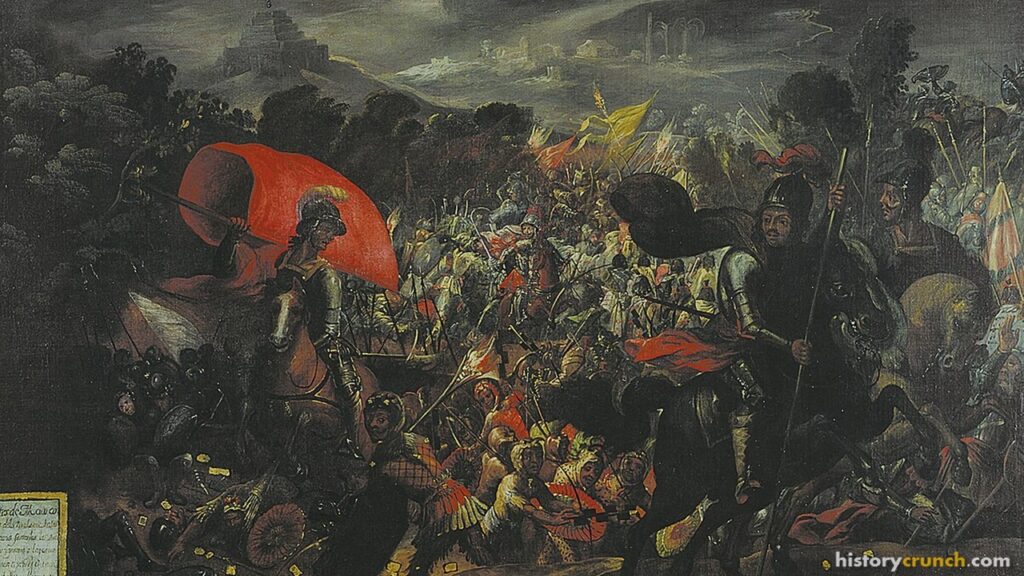
On the rainy night of June 30th, 1520 the Spanish and their Tlaxcalan allies tried to slip out of the city along the western causeway to Tacuba with a portable bridge and as much gold as they could carry. They were seen. Mexica canoes attacked from both sides and the gaps in the causeway filled with the dead, the drowned and the gold. Spanish losses were between 450 and 860 killed or captured, with more than a thousand Tlaxcalans and almost all the horses and guns; captured Spaniards were sacrificed on the Templo Mayor. Cortes is said to have wept under a tree at Tacuba.
LEARN MORESHOW LESSwhy it matters · key numbers · 2 key figuresWARThe Sad Night is the Mexica's great victory over the Spanish and the moment the conquest almost ended. It also cost the Mexica the chance to finish it: the survivors were let go.
A week later, on July 7th, 1520, the starving remnant of the Spanish army, most of them wounded, was caught on the plain of Otumba by a Mexica army sent to finish it. With no guns and about twenty horses, the Spanish cavalry charged straight at the commander's standard, killed him and took it; the Mexica army, which fought by its banners, broke. The Spanish reached Tlaxcala on July 11th, and Tlaxcala, against the advice of some of its lords, took them in.
LEARN MORESHOW LESSwhy it matters · 1 key figureWARTlaxcala's decision to keep faith with a beaten ally is the decision on which the conquest turned. Had the four lords voted the other way, the Spanish would have died on the road.
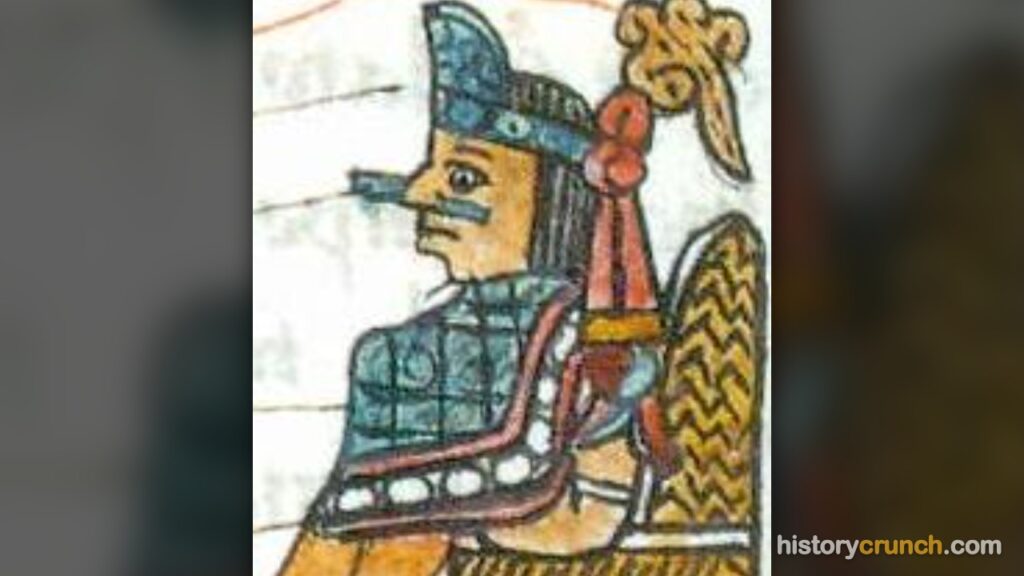
In September 1520 Cuitlahuac, the brother who had warned against admitting the Spanish and had led the fighting on the Sad Night, was formally installed as tenth tlatoani. He cleaned the city, rebuilt the causeway gaps, sent envoys to Tlaxcala offering an end to the flower wars if it changed sides, which it refused, and armed the city. He reigned about eighty days.
LEARN MORESHOW LESSwhy it matters · 1 key figureRULERSCuitlahuac was the war leader the empire had needed in November 1519. He had one season, and smallpox took it from him.
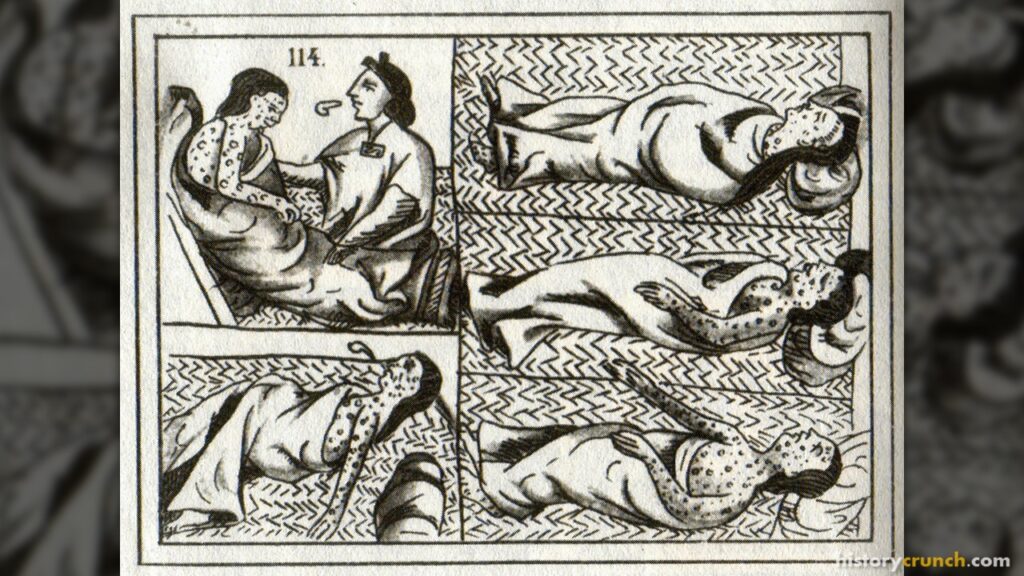
Smallpox came to Mexico with an African slave in Narvaez's army and reached Tenochtitlan by October 1520. No one in the Americas had ever had it and no one had any resistance. For sixty days, the Florentine Codex says, people lay so covered in sores they could not move, and many died of hunger because everyone in a house was sick at once. Perhaps a quarter to a half of the city's people died, and the disease spread through the empire and beyond it, as far as the Inca.
LEARN MORESHOW LESSwhy it matters · key numbers · a sourceSOCIETYSmallpox killed more Mexica than the Spanish did and killed their new ruler. The city the Spanish besieged in 1521 had already lost a large share of its warriors, and the epidemic went on killing for a century.
IN THEIR OWN WORDS“Many died of it. They could no longer walk, they could only lie in their beds. Many starved to death, because no one was left to care for anyone else.”
The Florentine Codex, Book 12, on the smallpox of 1520WHAT TO NOTICEA Mexica survivor's memory, set down about thirty years later.
Cuitlahuac died of smallpox about December 4th, 1520, eighty days after his coronation. In February 1521 the nobles chose Cuauhtemoc, 'descending eagle', a nephew of Moctezuma about 25 years old, ruler of Tlatelolco and a proven warrior, as eleventh tlatoani. He executed those who spoke of surrender, including Moctezuma's sons, and sent to every subject city for help. Few answered.
LEARN MORESHOW LESSwhy it matters · 2 key figuresRULERSThe last ruler of the Aztecs was a young man chosen to fight to the end, and he did. That the subject cities did not come is the measure of what the empire had been to them.
Through the winter of 1520 the Spanish had thirteen brigantines, flat-bottomed sailing ships with a cannon each, built in Tlaxcala and then taken apart and carried 50 miles (80 km) over the mountains by 8,000 Tlaxcalan porters to Texcoco, which had changed sides. They were launched on Lake Texcoco on April 28th, 1521. Cortes now had about 900 Spaniards, 90 horses, 15 cannon and perhaps 100,000 native allies from Tlaxcala, Texcoco, Huexotzinco, Chalco and other cities that had paid tribute to the Mexica.
LEARN MORESHOW LESSwhy it matters · key numbers · 1 key figureWARTenochtitlan's defense was the lake; the Mexica had thousands of war canoes. Thirteen ships with cannon took the lake away from them in a day, and the siege became possible.
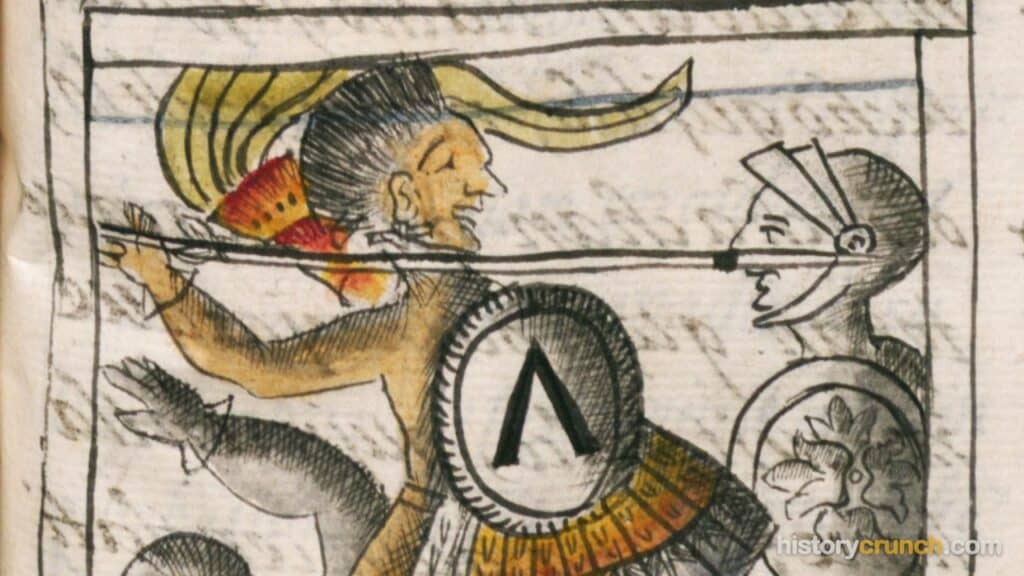
On May 26th, 1521 the Spanish cut the Chapultepec aqueduct, Tenochtitlan's only fresh water, and took the ends of the three causeways; the brigantines swept the canoes from the lake. For 75 days the attackers fought up the causeways by day and were driven back by night, filling the gaps the Mexica opened, while the city starved and drank the salt water of the lake. Sixty captured Spaniards were sacrificed in sight of their comrades on June 30th, the anniversary of the Sad Night.
LEARN MORESHOW LESSwhy it matters · key numbers · 2 key figuresWARTenochtitlan was not stormed; it was starved, cut off from water and pulled down house by house. The Spanish decided to destroy the city rather than take it, because every building was a fort.
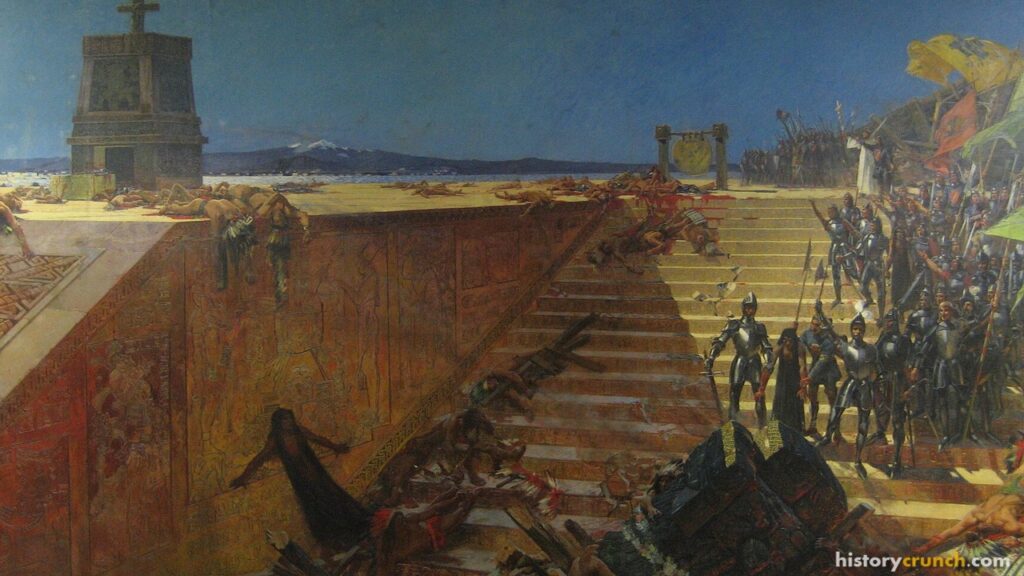
On August 13th, 1521, with the defenders driven into a corner of Tlatelolco, Cuauhtemoc tried to escape across the lake by canoe and was taken by a brigantine. Brought to Cortes, he asked to be killed with the dagger at Cortes's belt, and was refused. The survivors, starving and sick, were let out along the causeways over three days; the Spanish chroniclers said the Tlaxcalans killed many of them. The Mexica dead of the siege are estimated at 100,000 to 240,000. The city of 200,000 was rubble.
LEARN MORESHOW LESSwhy it matters · key numbers · a sourceWARThe Aztec Empire ended on this day, 196 years after the founding of the city, and Spanish America began. The date is on the plaque in Tlatelolco's square today: 'It was neither a triumph nor a defeat. It was the painful birth of the mestizo nation that is Mexico today.'
IN THEIR OWN WORDS“Broken spears lie in the roads; we have torn our hair in our grief. The houses are roofless now, and their walls are red with blood.”
A Nahuatl lament on the fall of Tenochtitlan, recorded about 1528WHAT TO NOTICEFrom the songs collected in the Cantares Mexicanos, in the translation known to most students.
Cortes built Mexico City on the ruins, on the same grid, with the same stone. Twelve friars in patched robes converted the survivors and burned their books, and then, needing to preach in Nahuatl, wrote down almost everything now known about the Aztecs from the survivors' own mouths. The conquistadors took the tribute the emperors had taken; epidemics took most of the people. The Sun Stone came out from under the main square in 1790, the eagle and the cactus went on the flag in 1821, and in 1978 workers laying a cable found the Templo Mayor under a city block. About 1.5 million people still speak Nahuatl, and Mexico still argues about what to call 1521.
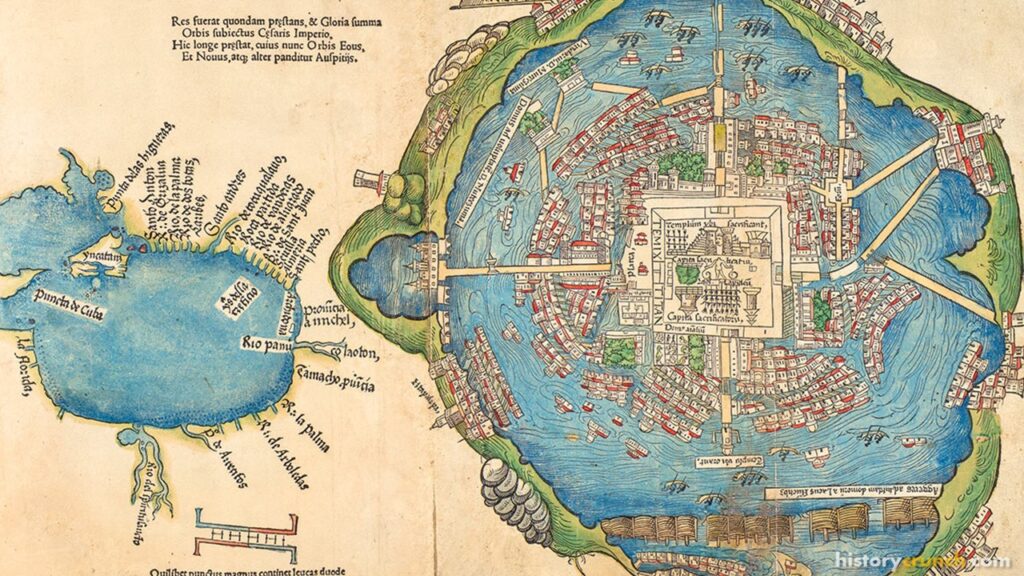
In 1522 Cortes decided, against advice, to build the Spanish capital on the site of Tenochtitlan rather than on the mainland. Native laborers pulled down the Templo Mayor and the palaces and used the stone for a cathedral, a governor's palace and Spanish houses laid out on the old grid; the lake was left to silt. Cortes's letters to the king describing the conquest were printed in Seville in 1522 and 1523 and read across Europe.
LEARN MORESHOW LESSwhy it matters · 1 key figureCITIESMexico City stands on Tenochtitlan, and its cathedral stands beside the Templo Mayor, which is why the temple was lost for 450 years and found by accident. Cortes's letters are the reason the Spanish version of the story reached the world first.
On June 18th, 1524 twelve Franciscan friars reached Mexico City on foot from the coast, and Cortes knelt in the road to kiss their robes in front of the Mexica lords, to show what the new power respected. The friars learned Nahuatl, opened schools for noble boys, burned codices and idols, and baptized by the thousand. Within twenty years most of central Mexico was nominally Christian.
LEARN MORESHOW LESSwhy it matters · 1 key figureRELIGIONThe conquest of the Aztec gods was done by twelve men in patched robes rather than by soldiers. The friars destroyed most of the Aztec books, and the friars, learning the language to preach, wrote down almost everything now known about the Aztecs.
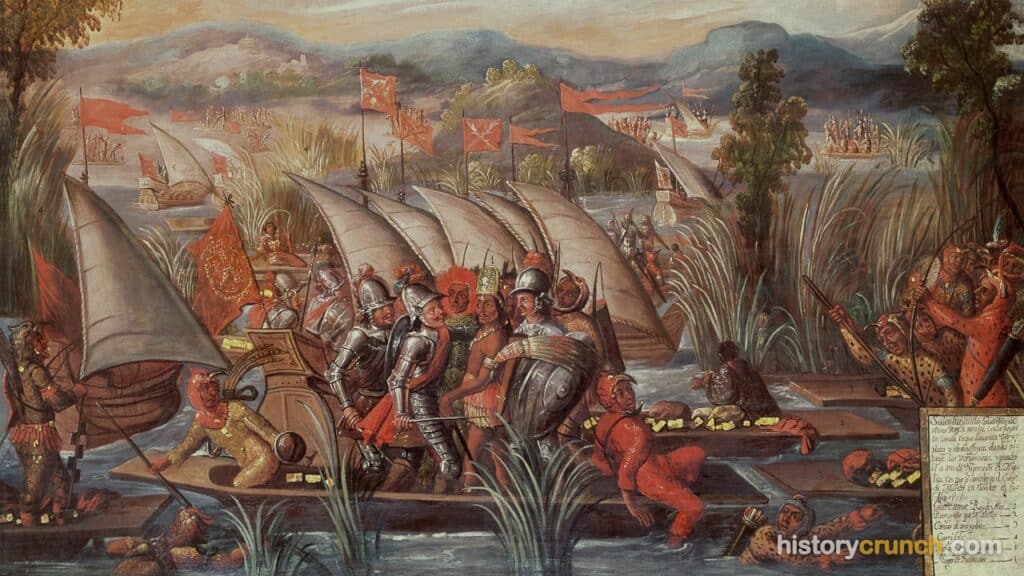
Cortes kept Cuauhtemoc alive as a prisoner for three and a half years, had his feet burned in 1521 to make him reveal the lost gold of the Sad Night, and took him along on an expedition to Honduras in 1524 rather than leave him in Mexico. On February 28th, 1525, in the Maya country of what is now Campeche, Cortes accused him of plotting a rising and had him hanged from a ceiba tree. Bernal Diaz, who was there, wrote that the execution was unjust and that everyone thought so.
LEARN MORESHOW LESSwhy it matters · a source · 2 key figuresRULERSThe last tlatoani died a prisoner far from his city. Mexico made him its first national hero: his statue stands on the Paseo de la Reforma, and his name, not Cortes's, is on the streets.
IN THEIR OWN WORDS“It was unjust, and everyone thought so.”
Bernal Diaz del Castillo, a soldier on the Honduras march, on the hanging of CuauhtemocWHAT TO NOTICEFrom his True History of the Conquest of New Spain, written in old age.
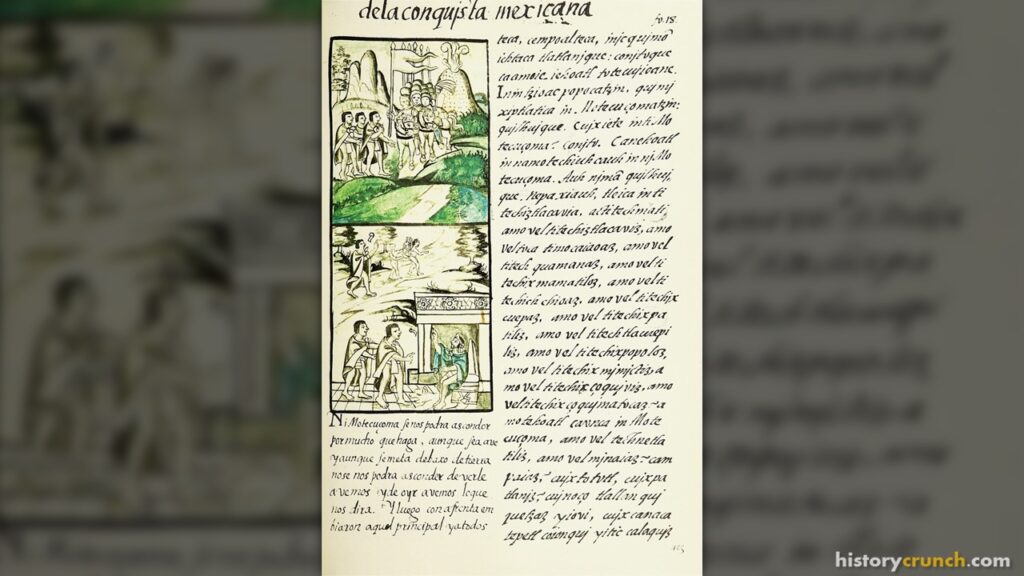
In 1529 a young Franciscan, Bernardino de Sahagun, landed in Mexico. He learned Nahuatl and, from the 1540s, spent forty years questioning Mexica elders and nobles about their gods, calendar, trades, plants, animals, laws, medicine and history, having their answers written in Nahuatl by native scribes and illustrated by native painters. The result, twelve books now called the Florentine Codex, was finished about 1577 and confiscated by the king, who feared it kept the old religion alive.
LEARN MORESHOW LESSwhy it mattersIDEASMost of what this timeline says about how the Aztecs lived and what they believed comes from Sahagun's informants, in their own words. He is called the first anthropologist, and his book is the reason the Mexica did not lose their history along with their city.
Under Spanish rule the Aztec tribute system was kept and turned over to Spaniards. By 1530 the conquistadors held encomiendas, grants of the labor and tribute of native towns, which fed and enriched them as the same tribute had fed Tenochtitlan. Native nobles who cooperated kept their lands and titles; commoners worked as before, now also for the church and the mines. Native slavery of the Aztec kind was abolished by the crown in 1542, in law.
LEARN MORESHOW LESSwhy it mattersSOCIETYThe conquest changed who received the tribute more than it changed who paid it. For the macehualtin the difference was a new master, a new god and, every few years, a new epidemic.
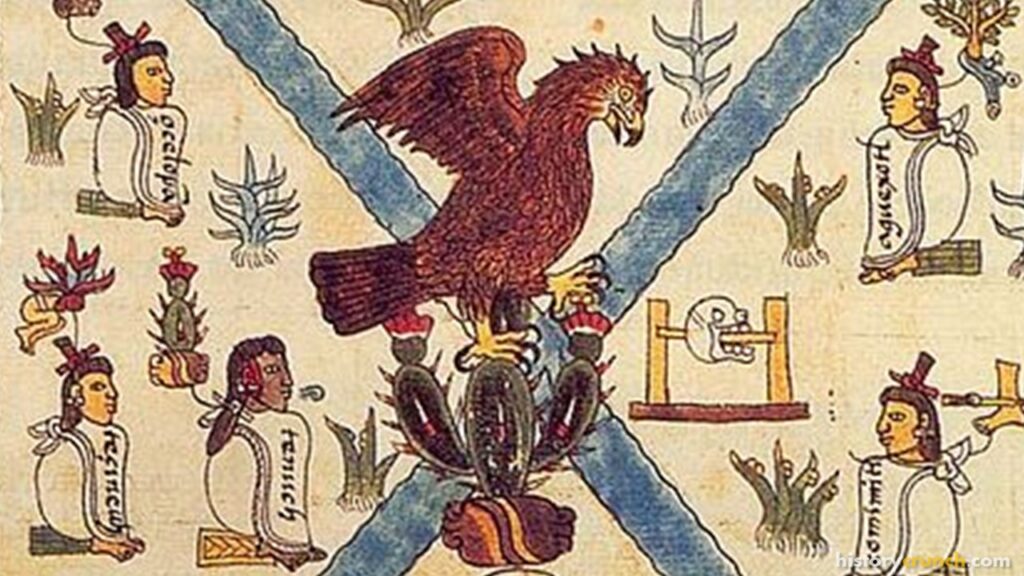
About 1541 the first viceroy of New Spain, Antonio de Mendoza, had Mexica painters make a book for the king: the history of the tlatoani, page after page of the tribute each province had paid, in maize, cloaks, feathers, jaguar skins and warriors' costumes, and a picture-life of a Mexica from cradle to old age, with Spanish notes explaining every glyph. The ship carrying it was taken by French pirates, and the book reached Oxford in 1659, where it still is.
LEARN MORESHOW LESSwhy it mattersIDEASThe Codex Mendoza is the Aztec Empire's own account book, and the best evidence there is of what the empire took from whom. The founding-of-Tenochtitlan page at its front is on this timeline's first Mexica card.
In 1545 a disease the Nahua called cocoliztli, 'pestilence', with fever and bleeding, swept central Mexico and killed, by most estimates, five to fifteen million people in three years, most of the remaining native population. It returned in 1576. What it was is still argued; recent work on skeletons points to a form of salmonella. From perhaps 20 million people in 1519, central Mexico had about one million by 1620.
LEARN MORESHOW LESSwhy it matters · key numbersSOCIETYThe greatest killer of the Aztec world was neither Cortes nor smallpox but the diseases that came after, and the population did not recover for three centuries. The empty land is why New Spain looked as it did.
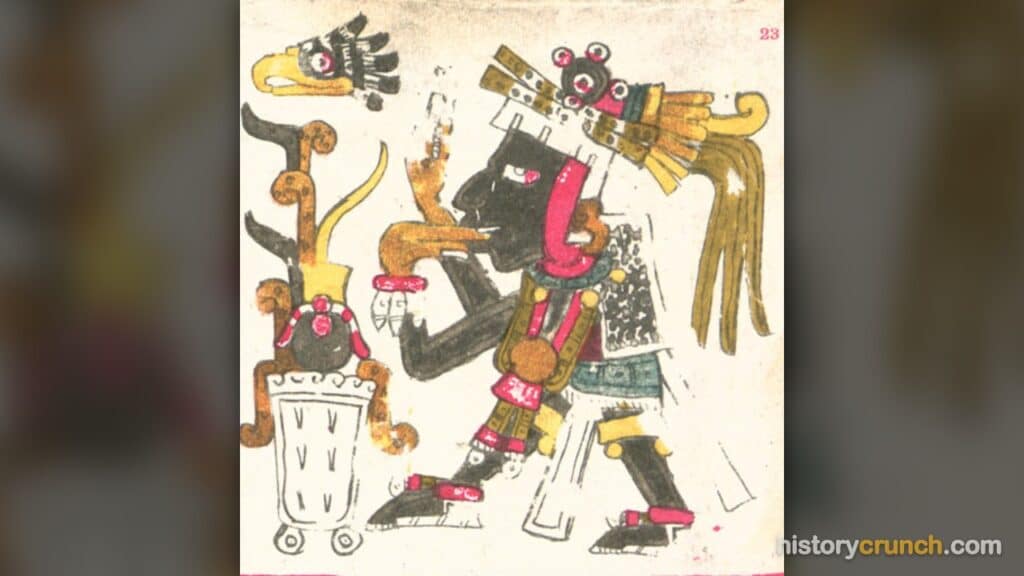
In 1552 a Mexica healer, Martin de la Cruz, teaching at the Franciscan college of Tlatelolco, set down 185 native plants and the illnesses they treated, from headache to 'the fatigue of those who hold public office', with a painting of each; a Nahua scholar, Juan Badiano, translated it into Latin. It was sent to Spain as a gift and lost in the Vatican library until 1929. Aztec doctors set bones, stitched wounds with hair, and used a salve of the pepper plant that later analysis found to work.
LEARN MORESHOW LESSwhy it mattersIDEASAztec medicine was as good as Europe's in 1520 and in some ways better, and this is the earliest medical book written in the Americas. Many of its plants are in the Mexican pharmacy today.
In 1581 the Dominican friar Diego Duran, raised in Texcoco and a Nahuatl speaker from childhood, finished his History of the Indies of New Spain, written from Mexica chronicles now lost and from old men who remembered the conquest. It tells the story from the Mexica side, from Aztlan to the siege, with the omens, the famine, the dedication of the temple and Moctezuma's fear, and it is illustrated with the paintings on this timeline. It was not published until 1867.
LEARN MORESHOW LESSwhy it mattersIDEASDuran and Sahagun between them preserved the Aztec voice, and where this timeline gives the Mexica's own view of an event, it is usually one of them speaking.
On December 17th, 1790 workmen repaving the main square of Mexico City, the Zocalo, uncovered the Sun Stone, buried face down where the Spanish had put it 270 years before. A few months earlier the same works had turned up the statue of Coatlicue, the earth goddess with a skirt of snakes. The stone was set into the wall of the cathedral, where it stayed for 95 years; the goddess was reburied as too frightening to display.
LEARN MORESHOW LESSwhy it mattersCULTUREThis is the day modern Mexico began to recover its Aztec past from under its streets. The stone is now the centerpiece of the National Museum of Anthropology, and its face is on the Mexican coin.
On November 2nd, 1821, weeks after Mexico won its independence from Spain, the new government decreed a flag of green, white and red with the eagle on the prickly-pear cactus at its center, the sign the Mexica had seen on the island in 1325. The country took its name from the Mexica. The snake in the eagle's beak was added later.
LEARN MORESHOW LESSwhy it mattersPOLITICSIndependent Mexico chose to descend from Tenochtitlan rather than from Cortes. The founding of the Aztec capital is on every Mexican flag and coin, which is why the empire's story is national history there.
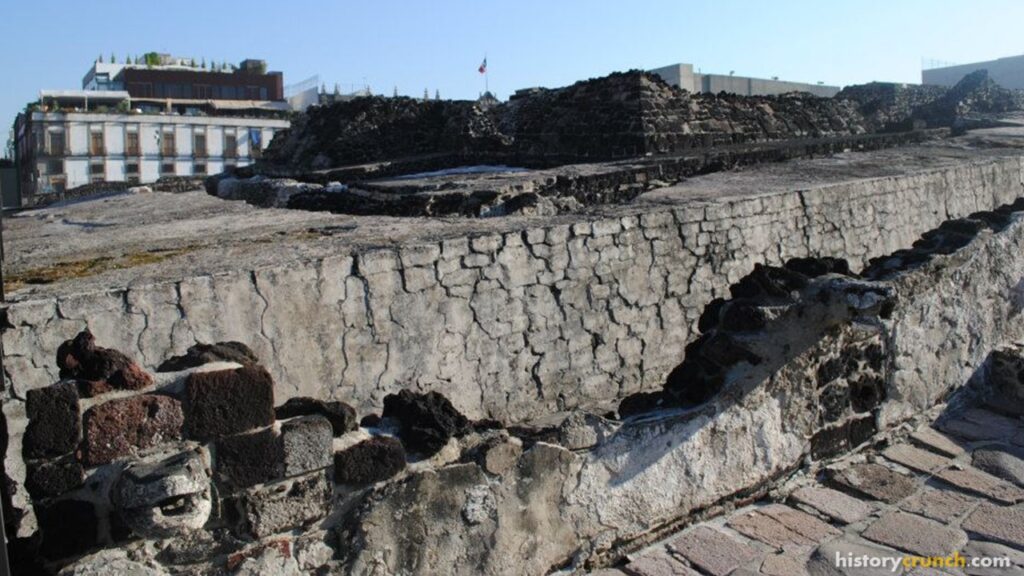
On February 21st, 1978 workers laying electrical cable a block from the cathedral struck a carved stone disc 10 feet (3.2 m) across: the goddess Coyolxauhqui, sister of Huitzilopochtli, cut to pieces, as she lay at the foot of his temple in the myth. It marked the base of the Templo Mayor. The Mexican government cleared a city block and over the next five years archaeologists uncovered the temple's seven layers, one inside the other, and more than a hundred buried offerings: jaguars, jade, Olmec masks, and the skulls of the sacrificed.
LEARN MORESHOW LESSwhy it mattersCULTUREThe temple the Spanish destroyed in 1521 was found under a street, and its offerings are the best evidence of Aztec religion that does not come through a friar's pen. The stone is where Ahuitzotl's dedication of 1487 happened.
On October 12th, 1987 the Museo del Templo Mayor opened beside the excavated temple in the heart of Mexico City, with the Coyolxauhqui stone at its center and 7,000 objects from the offerings. The same year the historic center of the city, Aztec and Spanish together, was listed as a World Heritage site. Excavation has continued since; in 2015 archaeologists found the tzompantli, the rack of skulls the conquistadors described, with hundreds of skulls still in it.
LEARN MORESHOW LESSwhy it matters · key numbersCULTURETenochtitlan is still being dug out from under Mexico City, and every year adds to what this timeline can say. About 1.5 million people in Mexico still speak Nahuatl, the language of every card on it.

I'm a passionate history and geography teacher with over 15 years of experience working with students in the middle and high school years. I have an Education Degree with a focus in World History. I have been writing articles for History Crunch since 2015 and love the challenge of creating historical content for young learners!

I'm the founder of History Crunch, which I first began in 2015 with a small team of like-minded professionals. I have an Education Degree with a focus in Social Studies education. I spent nearly 15 years teaching history, geography and economics in secondary classrooms to thousands of students. Now I use my time and passion researching, writing and thinking about history education for today's students and teachers.
To cite this timeline as a source, use one of the formats below.
MLA: Beck, E., and B. Millar. “Aztec Empire Timeline.” HistoryCrunch, 15 September 2026, https://historycrunch.com/aztec-empire-timeline/.
APA: Beck, E., & Millar, B. (2026). Aztec Empire Timeline. HistoryCrunch. https://historycrunch.com/aztec-empire-timeline/
Chicago: Beck, E., and B. Millar. “Aztec Empire Timeline.” HistoryCrunch. September 15, 2026. https://historycrunch.com/aztec-empire-timeline/
© History Crunch
The Aztecs were the last of a line two thousand years long, and they knew it.
From an island in the north that has never been found, following a god who spoke.
No stone, no wood, no fields. Two hundred years later, 200,000 people.
By borrowing one with Toltec blood and serving a stronger city for fifty years.
Three cities, one army, and tribute split two-two-one.
Leave the local king in place, take the tribute, and come back if it stops.
Eleven rulers in 145 years, chosen by a council, and none of them safe.
For captives, not kills, with obsidian and cotton armor, and the ranks to prove it.
Cleaner, better fed and better schooled than Seville, and ruled by the calendar.
Nobles, commoners, merchants, priests, and slaves whose children were born free.
Two calendars turning together, a fire lit every 52 years, and a world that had ended four times already.
From a handful of painted books that survived the fire, and from friars who asked.
Weavers, healers, market traders, priestesses and, in death, warriors.
No money but cacao, no wheels, no animals, and a market of 60,000 people a day.
Pyramids on a swamp, causeways across a lake, and a city the Spanish said was a dream.
That the sun had to be fed, the world had ended four times, and Huitzilopochtli had chosen them.
Because the gods had died to make the world, and the debt was paid in the only coin that counted.
Historians disagree about how much sacrifice there was. Some accept the chronicles' thousands a year and the 1487 total in the tens of thousands; others argue the numbers were inflated both by Aztec rulers who wanted to frighten and by Spaniards who wanted to justify, and that the archaeology so far supports hundreds a year rather than thousands.
Seven pyramids one inside another, two shrines, and the center of the Aztec world.
Battles by appointment, fought to take prisoners for the gods, against an enemy left alive on purpose.
Historians disagree about what the flower wars were for. The traditional view is religious: captives for sacrifice. Others argue they were a slow siege of Tlaxcala by other means, or a way to train warriors cheaply, and that the religious explanation was what the Mexica told themselves.
By finding, in six months, that the empire's subjects hated it more than they feared him.
Hostage, massacre, flight, plague, siege: fifteen months from welcome to ruin.
A slave girl of nineteen who became the conquest's voice, and Mexico's word for betrayal.
Three rulers in twenty months, one a hostage, one dead of smallpox, one hanged in the jungle.
Five to six million people, the strongest army in the Americas, and it lasted two years against 500 men.
Historians disagree about which cause mattered most. The older view, from the Spanish sources, puts steel, horses and Cortes's genius first. The newer view puts the native allies first, since they did most of the fighting, and smallpox second, and treats the Spanish as the spark rather than the fire. Most agree the empire's own tribute system, which made every subject a potential enemy, was the deepest cause.
The most famous explanation of the conquest, and the one historians now doubt most.
Historians disagree about the returning-god story. Some argue the Mexica did read the Spanish through their prophecies, as their own later accounts say. Others argue the story was built after the conquest, by friars who wanted the Aztecs' religion to have foretold its own end and by Mexica nobles who needed an explanation for a defeat, and that Moctezuma's actions look like a ruler managing a dangerous embassy, not a man awaiting a god.
One slave with smallpox, and an empire without immunity.
A Spanish city on the Aztec grid, Spanish masters on the Aztec tribute, and a new god on the old temple.
From under a square, under a cathedral, and under an electricity cable.
A language, a flag, a diet, a city, and an argument about what to call 1521.
A marquisate, a lawsuit, a jungle march, and a death in Spain out of favor.
No question matches that word.
Research question 1The Aztecs were the last of a line two thousand years long, and they knew it.
Research question 2From an island in the north that has never been found, following a god who spoke.
Research question 3No stone, no wood, no fields. Two hundred years later, 200,000 people.
Research question 4By borrowing one with Toltec blood and serving a stronger city for fifty years.
Research question 5Three cities, one army, and tribute split two-two-one.
Research question 6Leave the local king in place, take the tribute, and come back if it stops.
Research question 7Eleven rulers in 145 years, chosen by a council, and none of them safe.
Research question 8For captives, not kills, with obsidian and cotton armor, and the ranks to prove it.
Research question 9Cleaner, better fed and better schooled than Seville, and ruled by the calendar.
Research question 10Nobles, commoners, merchants, priests, and slaves whose children were born free.
Research question 11Two calendars turning together, a fire lit every 52 years, and a world that had ended four times already.
Research question 12From a handful of painted books that survived the fire, and from friars who asked.
Research question 13Weavers, healers, market traders, priestesses and, in death, warriors.
Research question 14No money but cacao, no wheels, no animals, and a market of 60,000 people a day.
Research question 15Pyramids on a swamp, causeways across a lake, and a city the Spanish said was a dream.
Research question 16That the sun had to be fed, the world had ended four times, and Huitzilopochtli had chosen them.
Research question 17Because the gods had died to make the world, and the debt was paid in the only coin that counted.
Research question 18Seven pyramids one inside another, two shrines, and the center of the Aztec world.
Research question 19Battles by appointment, fought to take prisoners for the gods, against an enemy left alive on purpose.
Research question 20By finding, in six months, that the empire's subjects hated it more than they feared him.
Research question 21Hostage, massacre, flight, plague, siege: fifteen months from welcome to ruin.
Research question 22A slave girl of nineteen who became the conquest's voice, and Mexico's word for betrayal.
Research question 23Three rulers in twenty months, one a hostage, one dead of smallpox, one hanged in the jungle.
Research question 24Five to six million people, the strongest army in the Americas, and it lasted two years against 500 men.
Research question 25The most famous explanation of the conquest, and the one historians now doubt most.
Research question 26One slave with smallpox, and an empire without immunity.
Research question 27A Spanish city on the Aztec grid, Spanish masters on the Aztec tribute, and a new god on the old temple.
Research question 28From under a square, under a cathedral, and under an electricity cable.
Research question 29A language, a flag, a diet, a city, and an argument about what to call 1521.
Research question 30A marquisate, a lawsuit, a jungle march, and a death in Spain out of favor.