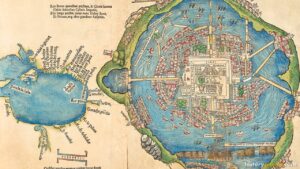
Aztec chinampas, often called floating gardens, were one of the most important agricultural achievements of the ancient Americas and a key reason the Aztec Empire was able to feed its huge population. These were small, rectangular plots of very fertile farmland that the Aztecs built directly into the shallow lakes of the Valley of Mexico. By raising farmland out of the water, the Aztecs turned swampy, marshy ground into some of the most productive farmland in the world. The chinampas surrounded the capital city of Tenochtitlan and supplied it with the food it needed to grow into one of the largest cities on Earth at the time.
In simple terms, a chinampa was a human-made island. The Aztecs built each one by fencing off a section of shallow lake, filling it with mud and plant material, and planting crops on top. The word chinampa comes from the Nahuatl language, which the Aztecs spoke, and it refers to a fence made of reeds or plants. Even though the plots looked as if they were floating on the water, they were actually anchored firmly to the lake bottom.
What Was the Aztec Empire?
The Aztec Empire was one of the most powerful civilizations in the history of the Americas, based in central Mexico and stretching across much of the region at its height. The Aztecs, who called themselves the Mexica, founded their capital city of Tenochtitlan in 1325 CE on an island in Lake Texcoco, in an area known as the Valley of Mexico. Over time this small settlement grew into one of the largest cities in the world.
The empire itself grew out of a political and military pact called the Aztec Triple Alliance, formed in 1428 between Tenochtitlan and the city-states of Texcoco and Tlacopan. Together these three powers defeated their rivals and came to dominate the Valley of Mexico. By the early 16th century, Tenochtitlan is estimated to have covered three to five square miles (eight to thirteen square kilometers) and had a population of between 200,000 and 300,000 people, making it larger than any city in Europe at the time.
Feeding a city this large was an enormous challenge. The Aztec economy was based heavily on agriculture, and much of the food came from the chinampas built up in the shallow waters of the lake, along with a tribute system that forced conquered peoples to send goods to Tenochtitlan. In this way, the floating gardens were tied directly to the wealth and power of the entire empire.
Why Did the Aztecs Build Chinampas?
The main reason the Aztecs built chinampas was a shortage of good farmland. Tenochtitlan sat on an island in the middle of a lake, which offered protection and easy travel by canoe, but it left very little dry land for growing crops. As the population of the city grew quickly, the Aztecs needed a way to produce far more food than the surrounding shores could provide.
The Aztecs did not actually invent the chinampa. Earlier peoples in the Valley of Mexico had built small versions of these plots for their own households, especially in the freshwater lakes of Xochimilco and Chalco to the south. What the Aztecs did was take this older idea and expand it on a massive scale, turning it into a large, organized farming system that could support an entire empire.
In fact, the growth of the chinampa system may have been directed by the Aztec state itself. Building, filling, and maintaining thousands of plots required enormous amounts of labor and materials, more than individual families could manage alone. For this reason, many believe the empire organized workers and even fought military campaigns to control the best chinampa lands in the southern lakes.
How Were Chinampas Built?
Building a chinampa was a slow and difficult process that took a great deal of skill. Workers began by choosing a shallow section of the lake and driving wooden stakes into the muddy bottom to mark out a long, narrow rectangle. Most plots measured roughly 20 to 35 feet (6 to 10 meters) wide and could stretch anywhere from about 100 to 650 feet (30 to 200 meters) long.
Next, the workers wove reeds, branches, and vines between the stakes to form a kind of underwater fence, creating an enclosed frame. They then filled this frame with layers of mud scooped from the lake bottom, along with rotting plants and other organic material. This mud was rich in nutrients, so the soil that built up inside the fence was extremely fertile and perfect for growing crops.
To keep the new plot from washing away, willow trees were often planted at the corners and along the edges. The roots of these trees spread down into the mud and held the whole structure firmly in place, while also protecting the soil from erosion. As stated above, this anchoring is the reason the plots did not truly float, even though the water all around them created that impression.
Between each chinampa, the Aztecs left narrow channels of open water called canals. These canals were wide enough for a canoe to pass through, which allowed farmers to move easily between their plots. The canals also gave the whole system its famous appearance, since the strips of green farmland seemed to float between the ribbons of water.
What Crops Were Grown on Chinampas?
The chinampas produced a wide variety of foods that formed the heart of the Aztec diet. The most important crop was maize, which is another word for corn, and it was grown alongside beans and squash. These three plants were often grown together because they supported one another as they grew.
Farmers also grew tomatoes, chili peppers, and a range of edible greens on their plots. In addition to food crops, the Aztecs planted large numbers of flowers on the chinampas. Flowers were not just decorative, since they were highly valued in Aztec religion and used as offerings in ceremonies and festivals.
What made the chinampas so remarkable was how much they produced. Because the soil was so rich and the water supply was constant, farmers could grow crops almost all year long and harvest several times a year from the same plot. This made the floating gardens one of the most productive farming systems anywhere in the world during this period.
How Did the Aztecs Manage Water and Soil?
Keeping the chinampas productive required careful control of water. During the rainy season, heavy rains could cause flooding that threatened to ruin the crops. To prevent this, the Aztecs built a sophisticated system of dams, canals, and gates that could control the flow and level of water across the lakes.
During the dry season, the opposite problem occurred, and the plots needed extra moisture. Farmers solved this by carrying water in containers from the canals and pouring it directly onto their crops. The lake water was also useful because it slowly seeped into the soil, carrying nutrients that fertilized the plants naturally.
The Aztecs also worked hard to keep the soil fertile. They regularly scooped up the rich mud and rotting plant matter that collected at the bottom of the canals and spread it over the top of the plots as fertilizer. In this way, the canals and the gardens worked together as a single system, with each part helping to keep the other healthy and productive.
What Happened to the Chinampas?
The chinampa system remained central to Aztec life until the arrival of the Spanish. In 1519 CE, Spanish conquistadors led by Hernan Cortés arrived in Mexico and formed alliances with groups who resented Aztec rule. After a long and destructive siege, Tenochtitlan fell in 1521 CE, bringing the Aztec Empire to an end.
After the conquest, the Spanish built their own capital on the ruins of Tenochtitlan and gradually drained the lakes of the Valley of Mexico. This draining destroyed much of the vast network of floating gardens that had once fed hundreds of thousands of people. Over the following centuries, the great chinampa system that had surrounded the Aztec capital was almost entirely lost.
Even so, the chinampas did not disappear completely. In reality, they survive today in the district of Xochimilco in the southern part of Mexico City, where farmers still grow flowers and vegetables on the ancient plots. In recent years, these surviving gardens have been recognized as an important heritage site, and some farmers are working to revive the old techniques.
Significance of Aztec Chinampas (Floating Gardens)
The significance of the Aztec chinampas lies in the way they made the entire Aztec Empire possible. Without the huge amounts of food produced by the floating gardens, the Aztecs could never have built and supported a capital city as large as Tenochtitlan. In this sense, the chinampas were the foundation of Aztec wealth, power, and daily life.
The chinampas also stand as a powerful example of Aztec engineering and problem-solving. Faced with a shortage of farmland, the Aztecs found a clever way to turn swampy lakes into some of the richest farmland in the world. More specifically, they created a farming system that was both highly productive and self-renewing, since the same plots could be used year after year without wearing out the soil.
Finally, the chinampas remain important because they still exist and still function today. Many people now look to this ancient method as a model for sustainable farming, especially in crowded cities where land and water are limited. In this way, an idea perfected by the Aztecs centuries ago continues to shape how people think about growing food in the modern world.
Frequently Asked Questions
What are Aztec chinampas in simple terms?
Aztec chinampas were human-made islands built on shallow lakes and used as farmland. The Aztecs fenced off strips of the lake, filled them with fertile mud, and planted crops on top. Even though people called them floating gardens, the plots were firmly anchored to the lake bottom and did not actually float.
Did the Aztecs invent the chinampa?
No, the Aztecs did not invent the chinampa, but they perfected it. Earlier peoples in the Valley of Mexico built small chinampas near their homes long before the Aztec Empire rose to power. The Aztecs took this older idea and expanded it into a large, organized system that could feed an entire city.
Why are chinampas called floating gardens?
Chinampas are called floating gardens because of the way they looked on the water. The narrow canals surrounding each plot gave the impression that the strips of green farmland were floating on the surface of the lake. In truth, the roots of willow trees and layers of mud held each plot firmly in place.
Where can you see Aztec chinampas today?
You can still see chinampas today in the Xochimilco district in the southern part of Mexico City. Farmers there continue to grow flowers and vegetables on the ancient plots, and visitors often travel through the canals in flat-bottomed boats. These surviving gardens are now recognized as a protected heritage site.
How productive were the chinampas?
The chinampas were extremely productive, thanks to their rich soil and constant water supply. Farmers could grow crops for most of the year and harvest the same plot several times in a single year. This high output allowed the gardens to feed the hundreds of thousands of people who lived in Tenochtitlan.
Cite This Article
To cite this article as a source, use one of the formats below.
MLA: Millar, B. “Aztec Chinampas (Floating Gardens): A Detailed Summary.” HistoryCrunch, 18 July 2026, https://historycrunch.com/aztec-chinampas-floating-gardens/.
APA: Millar, B. (2026). Aztec Chinampas (Floating Gardens): A Detailed Summary. HistoryCrunch. https://historycrunch.com/aztec-chinampas-floating-gardens/
Chicago: Millar, B. “Aztec Chinampas (Floating Gardens): A Detailed Summary.” HistoryCrunch. July 18, 2026. https://historycrunch.com/aztec-chinampas-floating-gardens/
Sources
- Matthew Restall, When Montezuma Met Cortés / Seven Myths of the Spanish Conquest.
- The Met (Heilbrunn Timeline) — Aztec art
- Michael E. Smith, The Aztecs.
- Richard Townsend, The Aztecs.