Aztec markets and trade formed the beating heart of the Aztec economy and helped make the Aztec Empire one of the most powerful civilizations in the history of the Americas. Every day, tens of thousands of people crowded into busy marketplaces to buy, sell, and trade goods that came from every corner of central Mexico. These markets did more than provide food and supplies. They tied together the many city-states of the empire, supported a special class of traveling merchants, and helped the Aztec capital of Tenochtitlan grow into one of the largest cities in the world.
In simple terms, an Aztec market was a public place, usually near the center of a city, where people gathered to exchange goods and services. Trade was the overall system of moving those goods from place to place, both within the empire and beyond its borders. Because the Aztec did not use coins the way people do today, most trade was carried out by bartering, which means swapping one good directly for another, or by using valued items such as cacao beans as a form of money.
What Was the Aztec Empire?
The Aztec Empire was a civilization in central Mexico that thrived in the time before the arrival of European explorers during the Age of Exploration. The Aztec people, who called themselves the Mexica, founded their capital city of Tenochtitlan in 1325 CE on an island in Lake Texcoco. Over the following centuries the empire expanded across most of central Mexico to become the most dominant and powerful society in the region.
Much of the empire’s growth came from the Aztec Triple Alliance, a pact formed in 1428 CE between Tenochtitlan and the city-states of Texcoco and Tlacopan. Together these three powers overthrew their rivals and spread their control across the region. The empire was ruled by a series of leaders known as the huey tlatoani, or Great Speaker, and it maintained its power through a tribute system that forced conquered peoples to send goods and resources to Tenochtitlan.
By the early 16th century, Tenochtitlan is estimated to have had a population of between 200,000 and 300,000 people, which made it one of the largest cities in the world at the time and larger than any city in Europe. This enormous population needed a steady supply of food, tools, and luxury goods, and it was the markets and trade networks of the empire that made this possible.
How Did the Aztec Economy Work?
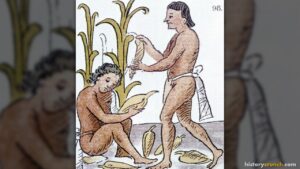
The Aztec economy was based on three main factors: agriculture, tribute, and trade. In relation to agriculture, the Aztec built floating gardens called chinampas in the shallow areas of Lake Texcoco, and these produced abundant crops such as maize, beans, and squash. This farming created a surplus of food, which means more was grown than the farmers needed, and the extra could be sold or traded at market.
Tribute was the second pillar of the economy. Conquered regions were forced to send goods to Tenochtitlan on a regular basis, which supplied the empire with resources and strengthened its overall wealth and power. The tribute system benefited the economy because it promoted trade and transport between the different city-states, which in turn led to new businesses and the rise of a merchant class.
Trade was the third pillar, and it connected everything together. Markets gave farmers, craftspeople, and merchants a place to exchange their goods, while long-distance trade brought in items that could not be produced in the Valley of Mexico. Together, agriculture, tribute, and trade created a strong and thriving economy that lasted right up until the arrival of Spanish conquistadors in 1519 CE.
What Were Aztec Markets Like?
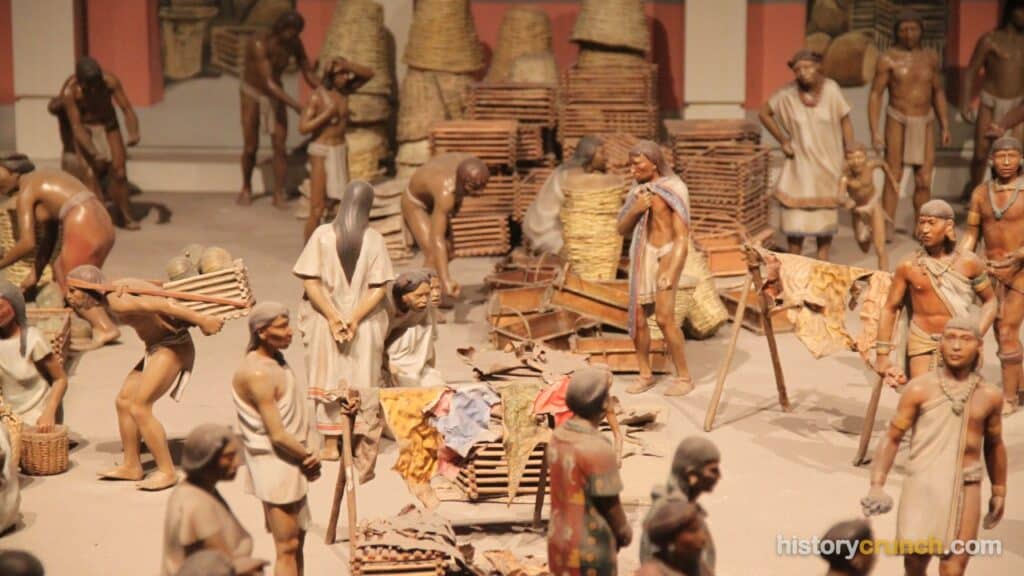
Aztec markets, known in the Nahuatl language as tianquiztli, were located near the main temple at the center of nearly every Aztec city and village. These markets supplied citizens with foods, luxury items, and crafts of all kinds. They greatly benefited both merchants, who could sell goods brought from far away, and artists and craftspeople, who were given a place to sell their finely made items.
The markets were more than just shopping centers. For many Aztec people they were also important social hubs where people from every walk of life could meet, share news, and exchange gossip. In fact, a large share of the population came to the market not only to buy and sell but also to visit with friends and neighbors.
Markets were carefully controlled to keep them fair. Government officials watched over the trading, made sure that prices were reasonable, and settled disputes between buyers and sellers. These same officials also collected tribute and taxes for the emperor, which meant the markets were closely tied to the government of the empire.
Some markets specialized in a single type of good. For instance, one market might be well known for fine pottery or jewelry, while another might focus on turkeys, dogs, or feathers from tropical birds. Larger markets were open every day, while many smaller village markets operated only once every five days, which allowed people across the region to trade on a regular schedule.
What Was the Tlatelolco Market?
The largest market in the entire Aztec Empire was located in a district of the capital called Tlatelolco, which was the sister city of Tenochtitlan. This enormous marketplace was famous throughout the region, and by some accounts it drew as many as 60,000 people to it each and every day. When Spanish conquistadors first saw it in 1519 CE, they were amazed by its size and by the huge variety of goods for sale.
Almost anything could be found at Tlatelolco. Shoppers could buy cloth and clothing, garden produce, food animals, obsidian knives and tools, medicines, wood, leather, furs, precious metals, gems, and pottery. More expensive items were also available, including gold ornaments, colorful feathers, and finely decorated clothing that only the wealthiest nobles could afford.
The Tlatelolco market showed just how organized and advanced the Aztec economy had become. Rows of stalls were arranged by the type of good being sold, and officials moved through the crowds to keep order and enforce fair trading. In many ways, this single marketplace was the beating heart of the whole empire’s economy.
Who Were the Pochteca?
The class of people who carried out long-distance trade in the Aztec Empire were known as the pochteca. These were professional merchants who traveled great distances to obtain rare and valuable goods that could not be found in the Valley of Mexico, such as feathers from tropical birds, jade, turquoise, cacao beans, and white cotton. The pochteca held a high position in Aztec society because of the wealth and rare goods they brought back.
The pochteca were more than simple traders. Because their journeys often took them into enemy territory, they were sometimes known to act as spies for the tlatoani, gathering information about roads, defenses, and the mood of distant peoples. They were so important that they had their own laws, their own section of the city, and even their own god who watched over traders.
Moving goods across the empire was difficult work. All goods were transported by human beings, because the Aztec lacked large domesticated animals such as horses to pull carts or carry loads. Merchants often carried heavy bundles on their backs using a forehead strap called a tumpline. As such, waterways were very important to Aztec trade, since canoes allowed goods to be moved quickly across the lakes and canals of the Valley of Mexico.
How Did the Aztec Pay for Goods?
The Aztec did not use coins, so most trade was carried out through bartering, which meant swapping one good directly for another. To make trade easier, however, the Aztec used certain valued items as a form of money. The most important of these was the cacao bean, which is the seed used to make chocolate.
The cacao bean is native to Mesoamerica and had a long history of use by many peoples, including the Olmec, the Maya, and the Aztec. The Aztec viewed cacao beans as a gift from the god Quetzalcoatl and held them in very high value. For example, the word chocolate itself comes from the Nahuatl word chocolātl. Cacao beans were so prized that the Aztec emperor Moctezuma II was said to drink dozens of cups of a spiced chocolate drink each day.
Besides cacao beans, the Aztec also used lengths of woven cotton cloth, called quachtli, as a kind of money for larger purchases. Thin, hoe-shaped pieces of copper were another accepted form of payment. These different types of currency made it possible to buy and sell goods of many different values in the crowded markets of the empire.
Significance of Aztec Markets and Trade
The markets and trade networks of the Aztec Empire were among the most important reasons for its wealth and power. They allowed a city as large as Tenochtitlan to feed and supply hundreds of thousands of people, even though the capital sat on an island with little farmland of its own. Trade brought in food, raw materials, and finished goods from every part of central Mexico and beyond.
Trade also helped hold the empire together. As goods moved between the many city-states, they connected distant communities and encouraged people to specialize in particular crafts or products. This overall system of exchange linked the empire’s regions in a way that pure military conquest could not, and it supported the rise of a respected merchant class in the pochteca.
Finally, Aztec markets and trade left a lasting mark on the wider world. When the Spanish arrived, they were astonished by the size and organization of markets such as Tlatelolco. They also carried the cacao bean back to Europe, where it eventually spread across the globe and became the chocolate enjoyed by people everywhere today. In this way, the trade of the Aztec Empire continues to shape daily life centuries after the empire itself came to an end in 1521 CE.
Frequently Asked Questions
What did the Aztec trade at their markets?
The Aztec traded a huge variety of goods at their markets, from everyday items to rare luxuries. Common goods included maize, beans, squash, cloth, pottery, obsidian tools, medicines, and animal skins, while wealthier shoppers could buy gold ornaments, jade, turquoise, and tropical feathers. Food such as tamales and drinks were also sold to hungry visitors who spent the day at the market.
What was the biggest Aztec market?
The biggest Aztec market was located at Tlatelolco, the sister city of the capital Tenochtitlan. By some Spanish accounts it attracted as many as 60,000 people every day, which made it one of the largest marketplaces in the world at the time. It was famous for offering nearly every good imaginable, all arranged in neat rows and watched over by market officials.
Did the Aztec use money?
The Aztec did not use coins, but they did use certain valued items as a form of money. Cacao beans were the most common, and they were used to pay for smaller purchases, while lengths of cotton cloth and thin pieces of copper were used for larger deals. Most everyday trade, however, was still done through bartering, which meant swapping one good directly for another.
Why were cacao beans so valuable to the Aztec?
Cacao beans were valuable to the Aztec both as money and as the main ingredient in a prized chocolate drink. The beans could not grow in the cool highlands around Tenochtitlan, so they had to be brought in from warmer regions to the south, which made them rare and desirable. The Aztec also believed cacao was a gift from the god Quetzalcoatl, which added to its high value.
How did the Aztec move goods without wheels or horses?
The Aztec moved goods mainly by having people carry them, since they had no horses or other large pack animals and did not use wheeled carts for hauling. Merchants often carried heavy loads on their backs using a forehead strap called a tumpline. Whenever possible they used canoes to travel the lakes and canals of the Valley of Mexico, which made moving goods much faster and easier.
Cite This Article
To cite this article as a source, use one of the formats below.
MLA: Millar, B. “Aztec Markets and Trade: A Detailed Summary.” HistoryCrunch, 18 July 2026, https://historycrunch.com/aztec-markets-and-trade/.
APA: Millar, B. (2026). Aztec Markets and Trade: A Detailed Summary. HistoryCrunch. https://historycrunch.com/aztec-markets-and-trade/
Chicago: Millar, B. “Aztec Markets and Trade: A Detailed Summary.” HistoryCrunch. July 18, 2026. https://historycrunch.com/aztec-markets-and-trade/
Sources
- The Met (Heilbrunn Timeline) — Aztec art
- Matthew Restall, When Montezuma Met Cortés / Seven Myths of the Spanish Conquest.