Cuauhtémoc was the last ruler of the Aztec Empire, and he is remembered as one of the most important figures in the history of Mexico. He led the defense of the Aztec capital of Tenochtitlan during the final stages of the Spanish conquest, and his refusal to give in to the Spanish has made him a lasting symbol of courage and resistance. As the eleventh and last Aztec emperor, his short reign marked the end of one of the most powerful civilizations in the Americas and the beginning of Spanish rule in Mexico.
Among the Aztec people, who called themselves the Mexica, the ruler was known as the tlatoani, a Nahuatl word that means “speaker” or “he who commands.” The most powerful of these leaders held the title of huey tlatoani, or “great speaker,” and served as the supreme military, political, and religious head of the empire. Cuauhtémoc held this position during the last desperate months of Aztec independence, ruling a capital that was already under attack.
Early Life and Background
Cuauhtémoc was born around 1495 into the royal family of the Aztec Empire, most likely in the capital city of Tenochtitlan. His exact birth date is unknown, since little was recorded about his life before he became emperor. What is known comes mostly from what historians can piece together about his rank, his family, and the world he grew up in.
His name, in the Nahuatl language, is usually translated as “one who has descended like an eagle” or “descending eagle,” an image meant to call to mind a bird of prey diving toward its target. As a member of the ruling class, he was closely related to the most powerful people in the empire. In fact, he was a relative of the emperor Moctezuma II, who ruled the Aztec Empire when the Spanish first arrived.
Like other boys of noble birth, Cuauhtémoc would have attended the calmecac, a special school where the sons of the elite were trained in religion, history, and the duties of leadership. He was raised to become a warrior and was devoted to Huitzilopochtli, the Aztec god of war and the sun. As a young man he took part in military campaigns, capturing enemy fighters who were then offered as sacrifices at the top of the Great Temple in Tenochtitlan.
His success as a warrior earned him a high position within the empire. More specifically, around 1515 he was named the ruler of Tlatelolco, a neighboring city that had long been joined to Tenochtitlan. To reach a position like this, a man had to be of high birth and had to prove himself in battle by taking captives. Cuauhtémoc also married a daughter of Moctezuma II, a young woman who was later baptized by the Spanish as Isabel Moctezuma.
Rise to Power
Cuauhtémoc came to power during the most dangerous moment in Aztec history. In 1519, the Spanish conquistador Hernan Cortés arrived on the coast of Mexico with roughly 500 men. As Cortés marched toward the capital, he formed alliances with peoples such as the Tlaxcala, who were old enemies of the Aztecs and hoped to break free of Aztec control.
Once inside Tenochtitlan, the Spanish took the emperor Moctezuma II captive and ruled the city through him for several months. Cuauhtémoc was among the Aztec nobles who believed that Moctezuma was too cautious and too willing to negotiate with the invaders. In reality, he favored armed resistance and wanted to drive the Spanish out by force.
The situation soon collapsed into open war. After the Spanish massacred Aztec nobles during a religious festival, the people of Tenochtitlan rose up, and Moctezuma II died during the fighting. The Aztecs then forced the Spanish to flee the city in an event the Spanish called the Noche Triste, or “Night of Sorrows.” Moctezuma’s brother Cuitláhuac was chosen as the next tlatoani and led the fight against the invaders, but he died of smallpox only a short time later.
Smallpox was one of several European diseases that spread quickly through the Aztec population, which had no protection against it. As stated above, this disease killed enormous numbers of people, including the ruler Cuitláhuac, and left the Aztecs without stable leadership at the worst possible time. In February of 1521, the highest nobles chose Cuauhtémoc, still a young man of about twenty-five, to become the new huey tlatoani. He took power knowing that Cortés was regrouping among his allies and preparing a full assault on the capital.
Defense of Tenochtitlan
As the new emperor, Cuauhtémoc made it clear that he would fight rather than surrender. He oversaw the funeral of Moctezuma II, but he deliberately held it without the usual grand ceremony. This was a way of showing that he rejected Moctezuma’s policy of negotiation and stood instead for resistance to the Spanish.
Cortés returned in the spring of 1521 with more Spanish soldiers, thousands of indigenous allies, and newly built ships that he floated on Lake Texcoco, the lake that surrounded the island city. The final siege of Tenochtitlan began in May of 1521 and lasted for roughly three months. During this time the Spanish and their allies cut off the city’s food and destroyed the aqueducts that carried fresh water into it.
Cuauhtémoc directed a fierce defense even as his people suffered from hunger, thirst, and disease. He called for reinforcements from the surrounding countryside, but by this point most of the Aztecs’ former subjects had abandoned them or joined the Spanish. For instance, of all the Nahua peoples, only the Tlatelolcans remained loyal, and the last defenders of Tenochtitlan gathered in Tlatelolco, where even women joined in the fighting.
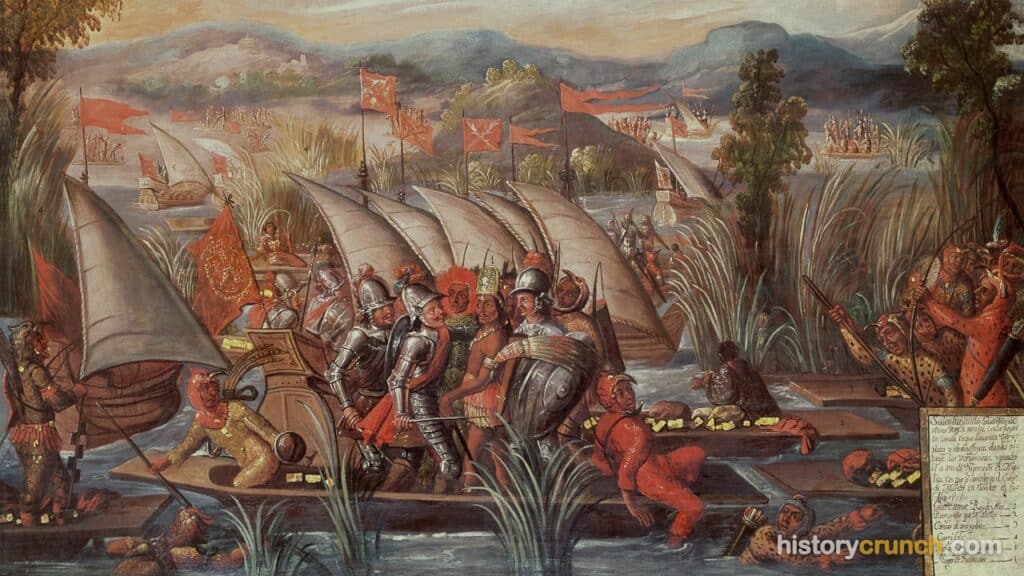
After about eighty days of brutal urban warfare, the city could hold out no longer. Huge sections of the temples and buildings had been leveled by fire and cannon. On August 13th, 1521, Cuauhtémoc was captured while trying to cross Lake Texcoco by canoe with his family and closest companions. His capture brought the fall of Tenochtitlan and the end of the Aztec Empire.
Capture, Torture, and Later Life
When he was brought before Cortés, Cuauhtémoc surrendered along with the surviving Aztec nobles. According to Spanish accounts, he asked Cortés to take his knife and kill him at once, since he had failed to save his people. At first Cortés treated the captured emperor with respect, and he even allowed the surviving Mexica to leave the ruined city.
That respect did not last. The Spanish were convinced that the Aztecs had hidden a great store of gold, and when the treasure they found was far smaller than expected, they turned to cruelty. Cuauhtémoc was tortured by having his feet held over hot coals in an attempt to force him to reveal where the gold was hidden. He endured the pain without giving in, and in the end only a small amount of gold was ever recovered, since much of the legendary “Aztec gold” was a myth.
After the conquest, Cuauhtémoc was baptized as a Christian and allowed to keep the title of tlatoani, but he no longer held any real power. From his surrender onward, he was kept under close guard by the Spanish. In 1525, Cortés took Cuauhtémoc along on a difficult expedition to Honduras, probably because he feared the former emperor might lead a rebellion if left behind in Mexico.
During that journey, Cortés claimed to have learned of a plot against the Spanish. On this charge, he ordered Cuauhtémoc put to death by hanging in early 1525. In this way, the last Aztec emperor was executed by the very man who had conquered his empire.
Significance of Cuauhtémoc
Cuauhtémoc is significant because he was the last independent ruler of the Aztec Empire, and his capture in 1521 marked the end of Aztec power and the start of centuries of Spanish rule in Mexico. His story is closely tied to the fall of Tenochtitlan, an event that historians view as one of the most important moments in the history of the Americas. The conquest opened the door to Spanish colonization across the continent and forever changed the lives of its native peoples.
Beyond his role in these events, Cuauhtémoc is remembered for how he faced defeat. He chose to fight rather than surrender, and he bore torture and death without betraying his people. Because of this, he has become a powerful national symbol in Mexico, honored as an example of bravery, dignity, and resistance against foreign conquest.
Today his memory lives on across Mexico, where streets, parks, towns, and monuments bear his name. In many ways he is seen as a hero who won respect even in defeat, standing in sharp contrast to Cortés, the conqueror who ordered his death. For millions of people, Cuauhtémoc represents the courage of the indigenous peoples of the Americas and the enduring spirit of Mexico itself.
Frequently Asked Questions
Who Was Cuauhtémoc?
Cuauhtémoc was the eleventh and last emperor of the Aztec Empire, ruling from 1520 to 1521. He led the defense of the capital city of Tenochtitlan against the Spanish and their indigenous allies. He is now considered a national hero in Mexico for his courage and resistance.
What Does the Name Cuauhtémoc Mean?
The name Cuauhtémoc comes from the Nahuatl language and is usually translated as “descending eagle” or “one who has descended like an eagle.” The image suggests a bird of prey swooping down toward its target, a fitting name for a warrior and ruler. Nahuatl was the language spoken by the Aztec people.
How Did Cuauhtémoc Die?
Cuauhtémoc was executed by hanging on the orders of Hernan Cortés in early 1525. Cortés had taken him on an expedition to Honduras and then accused him of plotting against the Spanish. He was about thirty years old at the time of his death.
Why Is Cuauhtémoc Important to Mexico?
Cuauhtémoc is important to Mexico because he is seen as a symbol of resistance, bravery, and national pride. Rather than give in to the Spanish, he fought to the end and endured torture without betraying his people. Many streets, parks, and monuments across Mexico are named in his honor.
How Was Cuauhtémoc Related to Moctezuma II?
Cuauhtémoc was a close relative of Moctezuma II and also married one of Moctezuma’s daughters, making him both a family member and a son-in-law. This royal connection helped him rise to power after the deaths of Moctezuma II and his successor Cuitláhuac. Unlike Moctezuma, however, Cuauhtémoc favored fighting the Spanish rather than negotiating with them.
Cite This Article
To cite this article as a source, use one of the formats below.
MLA: Millar, B. “Cuauhtémoc: A Detailed Biography.” HistoryCrunch, 18 July 2026, https://historycrunch.com/cuauht-moc/.
APA: Millar, B. (2026). Cuauhtémoc: A Detailed Biography. HistoryCrunch. https://historycrunch.com/cuauht-moc/
Chicago: Millar, B. “Cuauhtémoc: A Detailed Biography.” HistoryCrunch. July 18, 2026. https://historycrunch.com/cuauht-moc/
Sources
- J.M. Roberts & Odd Arne Westad, The Penguin History of the World.
- Jerry Bentley & Herbert Ziegler, Traditions & Encounters: A Global Perspective on the Past.