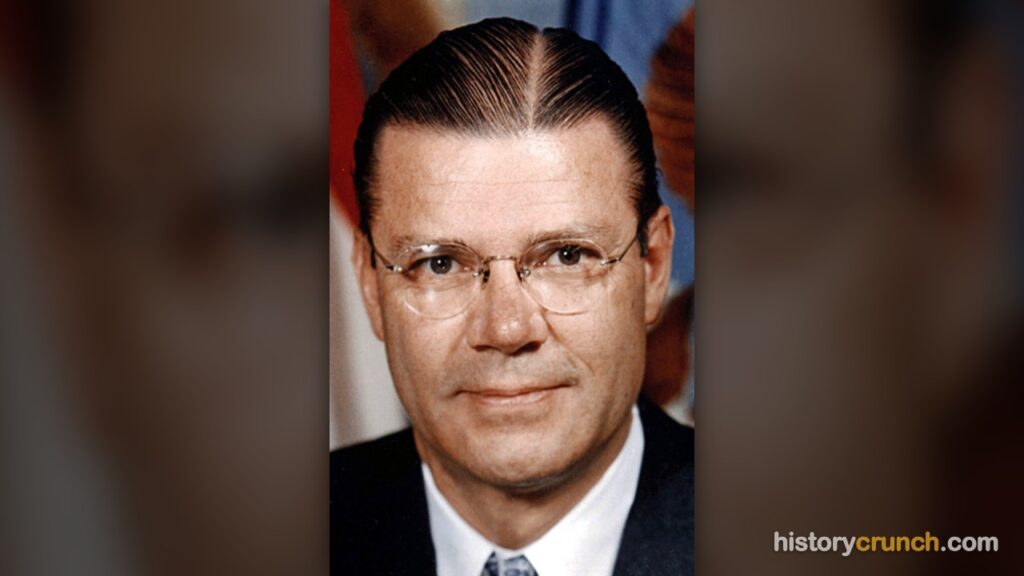
Robert McNamara was one of the most important and controversial figures in American government during the Cold War, serving as United States Secretary of Defense while the country escalated its involvement in the Vietnam War. Robert Strange McNamara was an American business executive and the eighth United States secretary of defense, serving from 1961 to 1968 under presidents John F. Kennedy and Lyndon B. Johnson, and he remains the longest serving secretary of defense, having remained in office over seven years. He is remembered both for reshaping how the American military was managed and for the enormous human cost of the war he helped direct.
The Secretary of Defense is the top civilian leader of the United States military and a key member of the president’s cabinet. The position exists to keep the armed forces under civilian control, meaning that an elected government, rather than generals, makes the final decisions about war and defense. McNamara held this role during a tense period of the Cold War, the decades-long rivalry between the United States and the Soviet Union, and his choices shaped both American strategy and the lives of millions of people.
Early Life and Background
Robert Strange McNamara was born in San Francisco, California, on June 9, 1916, to Robert James McNamara, a wholesale shoe industry executive, and Clara Nell McNamara. He grew up in a middle-class family and stood out as a gifted student from a young age. In fact, his sharp mind and love of numbers would guide the rest of his career.
McNamara attended the University of California, Berkeley, where he studied economics and philosophy and earned strong marks. He was elected to Phi Beta Kappa in his sophomore year, and earned a varsity letter in crew. After Berkeley, he continued his education at one of the leading business schools in the country. He earned an M.B.A. from Harvard Business School in 1939.
McNamara’s studies focused heavily on the use of statistics and data to solve problems, an approach that shaped how he later ran both businesses and the military. For a short time he worked for an accounting firm, but the outbreak of World War II soon changed the direction of his life.
World War II Service and Ford Motor Company
During World War II, McNamara did not serve as a combat soldier but instead used his skills as a numbers expert. He served as an analyst in the Army Air Force studying the missions of the B-17 bombers, and he left the military in 1946 with the rank of Lieutenant Colonel. His job was to study how the military could use its bombers and resources more efficiently, an early example of the data-driven thinking he became known for.
After the war, McNamara joined a struggling car company and helped turn it around. In 1946 McNamara joined Ford Motor Company, and he started there as manager of planning and financial analysis. He was one of a group of young veterans, nicknamed the “Whiz Kids,” who brought modern management and careful record keeping to the automaker.
At Ford, McNamara pushed for changes that improved both safety and sales. He helped reorganize, modernize and expand the company, introducing safety features like the seat belt and dished steering wheel and adding the popular Ford Falcon and a completely redesigned Lincoln Continental to Ford’s lineup. His success led to a historic promotion. He became on 9 November 1960 the first president of Ford from outside the family of Henry Ford, one day after President Kennedy’s election.
Rise to Power as Secretary of Defense
McNamara held the top job at Ford for only a matter of weeks before a new opportunity arrived. The newly elected president, John F. Kennedy, wanted talented and modern thinkers in his cabinet, and he offered McNamara one of the most powerful positions in the government. McNamara became the secretary of defense in January 1961.
As stated above, McNamara believed strongly in using data and business methods to run large organizations, and he applied those ideas to the military. In that post, he brought the military under greater and more centralized civilian control, and in doing so, he enlarged his staff and moved to centralize decision-making authority. More specifically, he introduced new budgeting and planning systems designed to measure the cost and value of every program.
McNamara was known for applying business management principles to military operations, introducing the Planning, Programming, and Budgeting System to improve efficiency within the Pentagon. These reforms made him one of the most powerful and hands-on defense secretaries in American history, though some military leaders resented a civilian who challenged their traditions.
Major Achievements and the Cuban Missile Crisis
One of McNamara’s most important early tests came in October of 1962 during the Cuban Missile Crisis, when the United States discovered that the Soviet Union was placing nuclear missiles on the island of Cuba. This event brought the world closer to nuclear war than at any other point in history. McNamara joined a small group of Kennedy’s closest advisors who met in secret to decide how the country should respond.
While some advisors pushed for immediate air strikes, McNamara offered a more cautious option. Secretary of Defense Robert McNamara floated a naval blockade as a possible alternative course of action, and the President, worried about a possible nuclear exchange, ultimately decided to pursue a blockade. Because a blockade was legally an act of war, the government called the action a “quarantine” instead. McNamara argued a quarantine would convey to Khrushchev the determination of the President to see those missiles were removed, without stimulating a military response.
The crisis ended peacefully when the Soviet Union agreed to remove the missiles, and McNamara’s careful approach was widely praised. He also helped shape American nuclear strategy in these years. McNamara sought to limit damage to the United States by developing a separate strategy for offense and defense, with the offensive strategy seeking to destroy Soviet military installations before this hardware could be used. This kind of planning became a central part of Cold War thinking about how to prevent nuclear war.
Role in the Vietnam War
The most famous, and most criticized, part of McNamara’s career was his role in the Vietnam War. After Kennedy was assassinated in 1963, McNamara continued as Secretary of Defense under President Lyndon B. Johnson. When Lyndon Johnson became president he was determined to prevent communism from spreading into Vietnam, and his Secretary of Defense, Robert McNamara, advised Johnson to try to overwhelm the communist forces of North Vietnam in order to cause their retreat.
In the early years, McNamara strongly supported a larger American role in Vietnam. Numbers of US military advisors increased from 900 to 16,000 under McNamara’s oversight. He believed that superior American technology and firepower could defeat the North Vietnamese and the Viet Cong, the communist fighters in South Vietnam. In mid-1965, he vehemently advocated escalation of the American role in the war, helping to persuade Johnson to send tens of thousands of combat troops to South Vietnam.
McNamara applied the same data-driven methods he had used in business to measuring success in the war. One of these was the “body count,” a system that tracked enemy deaths to judge how the war was going. Unfortunately this body count metric led to a war of attrition, a policy of inflicting massive casualties on the enemy until they have no choice but to surrender, and it was not an effective strategy for winning the Vietnam War. The heavy focus on numbers failed to capture the determination of the North Vietnamese to keep fighting.
In reality, McNamara’s confidence began to fade even as the war expanded. Within months, McNamara concluded the war was militarily unwinnable, and throughout his remaining time in the administration, he advised Johnson to temper the intensity of the conflict and seek a diplomatic resolution, all while faithfully carrying out the president’s orders to expand the war. The war became so closely tied to him that critics gave it a bitter nickname. He was so fiery an advocate that Vietnam became known as “McNamara’s War.”
By late 1967, the gap between McNamara’s private doubts and his public duties had become impossible to hide, and his relationship with President Johnson grew strained. His time leading the Pentagon was coming to an end.
Later Life and the World Bank
In early 1968, McNamara left the Department of Defense after nearly seven years in office. By the end of the month it was announced that McNamara would leave the office of Secretary of Defense to become president of the World Bank, he left in February of 1968, and he was later that year awarded the Presidential Medal of Freedom. His departure marked the end of one of the longest tenures ever for a defense secretary.
McNamara then turned his attention from war to development and poverty. After leaving the US defense department in 1968, McNamara went on to head the World Bank until 1981. There he shifted the focus of the institution toward helping the world’s poorest people. He increased the bank’s loans to developing countries and changed its focus from large-scale industrial projects to development in rural communities.
In his final decades, McNamara spent much of his time reflecting on Vietnam and speaking out about the dangers of nuclear weapons. He spent much of his life trying to explain the US role in Vietnam and apologizing for his mistakes. He shared these regrets with the public in a well-known memoir published in 1995, in which he admitted the war had been a mistake. He also became a subject of the 2003 Academy Award winning documentary “The Fog of War,” in which he discussed the difficulty of decision-making during the Vietnam war. McNamara died on July 6th, 2009, at the age of 93.
Significance of Robert McNamara
Robert McNamara is significant because his decisions shaped the American military, the Cold War, and the tragic course of the Vietnam War. As Secretary of Defense, he modernized how the Pentagon planned and spent its money, bringing business methods into government in ways that lasted long after he left office. His careful handling of the Cuban Missile Crisis helped the world avoid nuclear disaster.
At the same time, McNamara remains a deeply controversial figure because of the enormous human cost of the war he helped lead. The Kennedy Administration led the US into the Vietnam adventure, and the Johnson Administration widened the involvement to a war in which 58,000 American troops died. Millions of Vietnamese also lost their lives, and the war bitterly divided the American public.
For these reasons, McNamara’s story is often used as a lesson about the limits of data, technology, and confidence in war. His life shows how a brilliant and hardworking leader could still make disastrous choices, and how honestly admitting mistakes, even many years later, remains a difficult but important part of leadership.
Frequently Asked Questions
Who was Robert McNamara?
Robert McNamara was the United States Secretary of Defense from 1961 to 1968, serving under Presidents John F. Kennedy and Lyndon B. Johnson. Before entering government, he was a successful business leader who became president of the Ford Motor Company, and he later led the World Bank. He is remembered as a central figure in the Vietnam War.
Why is the Vietnam War called McNamara’s War?
The Vietnam War was nicknamed “McNamara’s War” because he was seen as its leading planner and strongest supporter during the years of American escalation. Critics used the name to blame him for the growing number of troops and casualties. The nickname stuck even after McNamara himself began to doubt whether the war could be won.
What did Robert McNamara do at Ford?
At Ford Motor Company, McNamara helped modernize the business and make its cars safer and more popular. He was part of a group of young veterans known as the “Whiz Kids” who used careful planning and data to improve the company. His success there led to him becoming the first company president who was not a member of the Ford family.
What was Robert McNamara’s role in the Cuban Missile Crisis?
During the Cuban Missile Crisis, McNamara helped guide the United States toward a peaceful solution by recommending a naval blockade of Cuba instead of an immediate attack. The action was called a “quarantine” to avoid appearing to declare war. His cautious advice is often credited with helping the two superpowers step back from nuclear conflict.
Did Robert McNamara admit the Vietnam War was a mistake?
Yes, McNamara later publicly admitted that the Vietnam War had been a mistake. He shared these regrets in a 1995 memoir and in the 2003 documentary The Fog of War, where he reflected on the errors of American leaders. His honesty surprised many people, though some critics felt his apology came far too late.
Cite This Article
To cite this article as a source, use one of the formats below.
MLA: Millar, B. “Robert McNamara: A Detailed Biography.” HistoryCrunch, 16 August 2026, https://historycrunch.com/robert-mcnamara/.
APA: Millar, B. (2026). Robert McNamara: A Detailed Biography. HistoryCrunch. https://historycrunch.com/robert-mcnamara/
Chicago: Millar, B. “Robert McNamara: A Detailed Biography.” HistoryCrunch. August 16, 2026. https://historycrunch.com/robert-mcnamara/
Sources
- Jerry Bentley & Herbert Ziegler, Traditions & Encounters: A Global Perspective on the Past.
- J.M. Roberts & Odd Arne Westad, The Penguin History of the World.