Napalm became one of the most controversial weapons used during the Vietnam War, and its images did as much to shape public opinion as any battle. In Vietnam, the United States essentially controlled the air and used their superiority to carry out many bombing campaigns against enemy targets including carpet-bombing with the burning agent napalm. Napalm was a thickened, jellied gasoline that clung to whatever it touched and burned at extreme temperatures. American forces used it heavily against enemy fighters hidden in the jungles, fields, and villages of Vietnam, and the terrible injuries it caused turned it into a lasting symbol of the war.
More specifically, napalm is an incendiary weapon, which is a weapon designed to start fires and burn a target rather than to blow it up. It is made by mixing a gelling agent into gasoline so that the fuel becomes sticky and thick, like jelly. When this mixture is set on fire, it spreads flames across a wide area, sticks to surfaces and skin, and keeps burning for a long time. Because it is so hard to put out and so damaging, napalm was used both to clear ground and to attack enemy positions.
What Was the Vietnam War?
The Vietnam War was fought between the communist government of North Vietnam and the government of South Vietnam, which was supported primarily by the United States, and it grew out of decades of tension related to the history of colonialism, nationalism and the ideological conflict of the Cold War between the United States and the Soviet Union. The Vietnam War lasted from 1955 until 1975 and involved the United States military in a direct combat role for much of the 1960s and early 1970s, and historians consider it to be a ‘proxy war’ within the larger Cold War.
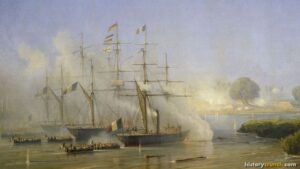
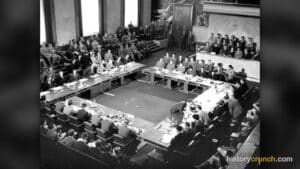
The roots of the conflict reached back to the end of French colonial rule. France’s attempt to regain control led to the rise to power of Ho Chi Minh, a communist revolutionary, and the Viet Minh independence movement, and France was defeated at the battle of Dien Bien Phu in 1954, after which North Vietnam came under the control of Ho Chi Minh and his communist forces. In 1954, at a conference in Geneva, the country of Vietnam was officially divided along the 17th parallel, with the northern half under the control of communists and Ho Chi Minh, while South Vietnam was controlled by Ngo Dinh Diem and was supported by western democracies such as the United States.
As stated above, the United States entered the war to stop the spread of communism. The main reason the United States got involved in Vietnam was the purpose of doing everything possible to keep communism from spreading around the world, since from the beginning of the Cold War the United States had practiced a policy of containment against the expansion of communism. This concern helped draw hundreds of thousands of American soldiers into a long and difficult war, one in which weapons like napalm would play a central role.
What Was Napalm and Where Did It Come From?
Napalm was not invented for the Vietnam War. In fact, similar fire weapons have existed for a very long time. Early versions date back to Greek times when it was called “sticky fire,” and Allied forces also used petroleum-based gels and gasoline during World War II. The modern version came out of a wartime laboratory in the United States during the Second World War.
The problem chemists faced was a shortage of natural rubber, which had been used to thicken gasoline. By the time the United States entered the war in the Pacific, natural rubber was in short supply due to the capture of rubber plantations in Malaya, Indonesia, Vietnam, and Thailand by the Japanese Army. To solve this, research teams at Harvard University, Du Pont, and Standard Oil competed to develop a replacement for natural rubber for the United States government. A team at Harvard led by chemist Louis Fieser succeeded in creating a dry powder that turned gasoline into a sticky, flammable gel.
By the time of the Vietnam War, a newer version called napalm B was in use. What distinguished napalm B, the variant employed in Vietnam, was how easily it could be made, since a simple mixture of gasoline, benzene, and polystyrene could be combined to make it. Napalm was also praised by the military in earlier conflicts. For instance, it was lauded as a success story following its use in the Korean War and the latter stages of World War II.
How Was Napalm Used in Vietnam?
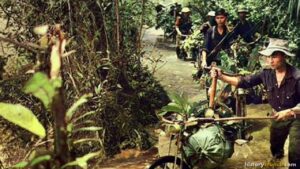
Napalm fit the kind of war the United States was fighting in Vietnam. The American ground war in Vietnam was commanded by General Westmoreland, and American soldiers were faced with intense guerrilla-style warfare in the jungles and fields of the countryside, where American forces did not attempt to make territorial gains but instead followed a policy in which the end goal was to kill as many enemy soldiers as possible in order to limit their ability to fight back and to destroy morale. Because enemy fighters often hid in thick jungle, tunnels, and villages, weapons that could burn out a wide area were seen as useful.
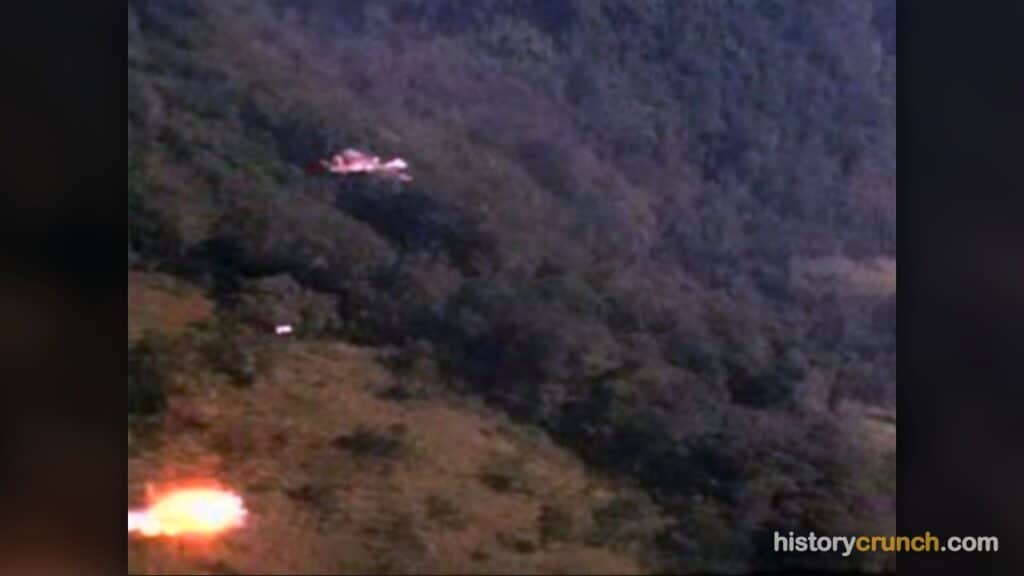
Napalm was dropped mostly from airplanes in the form of bombs that split open and spread burning gel across the ground. It was also sprayed from flamethrowers used by soldiers and even mounted on riverboats that patrolled Vietnam’s waterways. The weapon was used to burn away jungle cover, to destroy enemy bunkers and tunnels, and to support American troops during fighting on the ground.
The amount of napalm used in Vietnam was enormous. In the decade from 1963 to 1973, 388,000 tons of napalm were dropped on Vietnam, which was ten times the amount used in Korea and almost twenty times more than was used in the Pacific. By the mid-1960s it had become a regular part of the war effort. By 1966 napalm was an integral part of the United States war effort in Vietnam, with fighter-bombers dropping perhaps 4,500 tons per month in Indochina overall, about 13 percent of the total weight of munitions delivered by air.
Why Was Napalm So Feared?
Napalm was feared because of what it did to the human body. The gel stuck to skin and clothing and kept burning, which made the injuries especially cruel. For such a simple thing to make, napalm had horrific human consequences, since this bit of liquid fire, a sort of jellied gasoline, clung to human skin on contact and melted off the flesh. Because it burned at such high temperatures, it could injure or kill even people who were not directly hit.
In closed spaces, the danger was different but just as deadly. In fact, napalm caused carbon monoxide poisoning when used in enclosed environments that were not directly hit by fire. This meant that people hiding in bunkers or tunnels could be harmed by the fumes even without touching the flames.
The greatest source of horror, however, was the harm napalm did to civilians. Because it was dropped over wide areas, it often struck villages and hit people who were not soldiers. Photographs and film of burned Vietnamese civilians, especially children, shocked people in the United States and around the world. In reality, these images did more to change public opinion about napalm than any official report ever could.
How Did Napalm Become a Symbol of Protest?
Vietnam was the first war brought into American living rooms through television. In Vietnam, the first televised war, viewers began to see images of the civilian casualties caused by napalm bombs, and a January 1967 article in Ramparts magazine presented color photographs of mutilated Vietnamese children. These pictures had a powerful effect on public opinion. In fact, the pictures helped Martin Luther King Jr. decide to go public with his opposition to the war.
Much of the anger focused on the company that made the weapon. From 1965 to 1969, the Dow Chemical Company manufactured napalm B for the American armed forces, and after news reports of napalm B’s deadly and disfiguring effects were published, Dow Chemical experienced boycotts of its products, and its recruiters for new chemists and chemical engineers graduating from college were subject to campus boycotts and protests. This was striking because Dow was not primarily a weapons maker. Dow was only ranked 75th on a 1967 list of military contractors, and before getting into the napalm business it was best known as the maker of Saran Wrap.
These protests sometimes turned violent. For instance, in October of 1967, students at the University of Wisconsin Madison staged a massive protest against Dow Chemical Company recruiting on their campus because Dow made napalm, the chemical that had become a symbol of the war in Vietnam. As the war dragged on, napalm came to stand for everything many Americans found wrong with the conflict.
Significance of Napalm in the Vietnam War
Napalm was significant because it shaped both the fighting of the Vietnam War and the way people felt about it. On the battlefield, it was one of the main tools the United States used to attack an enemy that hid in jungles and villages, and it was dropped in far greater amounts than in any earlier war. In that sense, napalm reflected the overall American strategy of using massive firepower to wear down North Vietnamese and Viet Cong forces.
Napalm was also significant because of how it changed public opinion. The weapon went from being praised as a success in earlier wars to becoming a symbol of cruelty during Vietnam. Napalm’s reputation changed dramatically from its early years of acclaim to one of notoriety, most notably during the Vietnam War, and it was the images of napalm’s civilian casualties which led to a national campaign calling for a ban on its use and a boycott of its manufacturer, the Dow Chemical company. This helped fuel the growing anti-war movement in the United States.
Finally, napalm left a mark on international law and memory. Concern over incendiary weapons contributed to later efforts to limit their use against civilians. More broadly, the story of napalm in Vietnam remains a powerful example of how a single weapon can influence not only the outcome of battles but also the conscience of an entire nation.
Frequently Asked Questions
What is napalm made of?
Napalm is gasoline thickened with a gelling agent so that it becomes sticky and burns for a long time. The version used in Vietnam, called napalm B, was made by combining gasoline with benzene and polystyrene, which is a common plastic. This mixture let the fuel cling to surfaces and skin instead of quickly burning away, which made the fires much more damaging.
How much napalm was used in the Vietnam War?
About 388,000 tons of napalm were dropped on Vietnam between 1963 and 1973. This was far more than had been used in any earlier conflict, including the Korean War and the fighting in the Pacific during World War II. The huge amount reflected how central airpower and firepower were to the American war effort.
Who made the napalm used in Vietnam?
The Dow Chemical Company made napalm B for the United States military from 1965 to 1969. Dow was a fairly small company best known for making household products, but it became the sole supplier of napalm, which made it the main target of anti-war protests. After Dow’s contract ended, production shifted to another company.
Why did people protest against napalm?
People protested against napalm mainly because of the terrible burns it caused to civilians, including children. Vietnam was the first war widely covered on television, so Americans saw images of the harm napalm did, which shocked the public. These feelings turned into boycotts, campus demonstrations, and rallies across the country during the late 1960s.
Is napalm still used today?
Napalm and similar incendiary weapons still exist, but their use against civilians has been restricted by international agreements. A 1980 United Nations convention placed limits on how incendiary weapons may be used near civilian areas. The United States removed napalm from its own stockpiles in later years, though weapons that work in similar ways still exist in some militaries.
Cite This Article
To cite this article as a source, use one of the formats below.
MLA: Millar, B. “Napalm in the Vietnam War: A Detailed Summary.” HistoryCrunch, 16 August 2026, https://historycrunch.com/napalm-in-the-vietnam-war/.
APA: Millar, B. (2026). Napalm in the Vietnam War: A Detailed Summary. HistoryCrunch. https://historycrunch.com/napalm-in-the-vietnam-war/
Chicago: Millar, B. “Napalm in the Vietnam War: A Detailed Summary.” HistoryCrunch. August 16, 2026. https://historycrunch.com/napalm-in-the-vietnam-war/
Sources
- Wilson Center Digital Archive
- George C. Herring, America's Longest War.
- Fredrik Logevall, Embers of War.
- Max Hastings, Vietnam: An Epic Tragedy.