The Division of Vietnam was one of the most important turning points in the story of the Vietnam War, because it split a single nation into two rival states that would soon go to war with each other. In 1954, after years of fighting for independence, the country of Vietnam was formally divided along a line of latitude known as the 17th parallel. The northern half fell under the control of communist forces led by Ho Chi Minh, while the southern half came under an anti-communist government supported by Western nations, including the United States. This division set the stage for one of the longest and most destructive conflicts of the Cold War.
The Division of Vietnam refers to the temporary partition of the country created by an international agreement in 1954. The agreement was meant to be a short-term arrangement, with nationwide elections planned to reunite the country within two years. Instead, the two halves of Vietnam developed into separate governments with opposing political systems, and the promised elections were never held. This left Vietnam permanently split until the end of the Vietnam War in 1975.
What Was the Cold War?
The Cold War was a long period of tension and rivalry between the United States and the Soviet Union that lasted from the end of World War II in 1945 until the early 1990s. It was called a “cold” war because the two superpowers never fought each other directly in a full-scale battle. Instead, they competed for influence around the world through spying, an arms race, propaganda, and support for opposing sides in smaller conflicts.
At the heart of the Cold War was a clash between two systems. The United States and its allies supported capitalism and democracy, while the Soviet Union promoted communism, a system in which the government controls the economy and property is shared. The United States feared that communism would spread from one country to the next, an idea often called the Domino Theory. Because of this fear, the United States practiced a policy of containment, which meant working to stop the spread of communism wherever it appeared. Vietnam became one of the places where this global struggle played out, which is why its division mattered far beyond its own borders.
What Led to the Division of Vietnam?
To understand why Vietnam was divided, it is necessary to begin with French colonial rule. In the late 19th century, France took control of Vietnam and combined it with neighboring Cambodia and Laos into a colony known as French Indochina. This colonial history angered many Vietnamese and created a strong desire for independence. Over the following decades, resentment toward foreign control grew steadily throughout the country.
During World War II, Japan occupied Vietnam and pushed French influence aside. After Japan was defeated in 1945, a power vacuum opened across the country. On September 2nd, 1945, Ho Chi Minh, a communist revolutionary, declared the independence of the Democratic Republic of Vietnam. However, France was determined to regain its colony, and this set the stage for a long and bitter war.
The conflict that followed is known as the First Indochina War. It broke out in 1946 between French forces and the Viet Minh, the Vietnamese independence movement led by Ho Chi Minh. The fighting lasted for years and became the main struggle over who would control Vietnam after World War II. As stated above, the United States came to support France during this period, largely because of its fear of communism spreading in the region.
The war reached a turning point in 1954 at the Battle of Dien Bien Phu. There, the Viet Minh surrounded and defeated a large French force in a stunning victory. The French loss ended nearly a century of French colonial rule in Indochina. With France defeated and unwilling to continue the war, the different powers involved agreed to meet and settle the future of Vietnam through negotiation.
What Were the Geneva Accords?
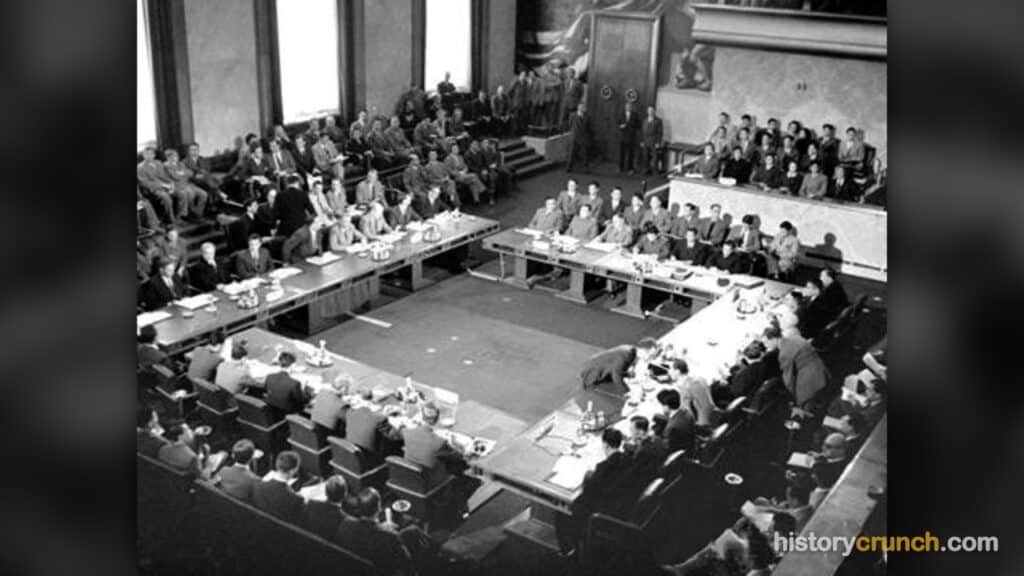
The Division of Vietnam was made official at a conference held in Geneva, Switzerland, in 1954. The agreements produced there are known as the Geneva Accords. Representatives from several countries attended, including France, the Viet Minh, the Soviet Union, China, the United Kingdom, and the United States. The goal of the conference was to end the fighting in Indochina and decide what would happen to Vietnam.
The most important decision reached at Geneva was to divide Vietnam along the 17th parallel, a line of latitude located roughly halfway down the country. The area north of the line would be controlled by the communist forces of Ho Chi Minh, while the area south of the line would be governed by a non-communist administration. A narrow strip of land called the demilitarized zone was created on either side of the line to help keep the two sides apart.
In reality, the division was never meant to be permanent. The agreement described the border as a temporary military line, not a lasting political boundary. To settle the country’s future, the accords called for nationwide elections to be held in 1956, after which a single government would rule a reunited Vietnam. During a period of 300 days, people were also allowed to move freely between the two zones. About one million people, many of them Catholics who feared communist rule, moved from the north to the south during this time.
Importantly, not everyone agreed to the terms. The United States and the government in the south refused to sign the accords, though they said they would not use force to disturb the agreement. This refusal would become very significant, because it meant that the promised elections rested on a shaky foundation.
How Were North and South Vietnam Governed?
After the division, the two halves of Vietnam developed into very different states. The north, officially the Democratic Republic of Vietnam, came under the firm control of Ho Chi Minh and his communist government, with its capital at Hanoi. It received support from communist allies, most importantly the Soviet Union and China. The north was committed to the goal of reuniting the entire country under communist rule.
The south, which became the Republic of Vietnam, was led by Ngo Dinh Diem, a strongly anti-communist leader, with its capital at Saigon. The south was supported by Western democracies, especially the United States. For instance, by 1960 the United States had sent nearly 700 military advisors into South Vietnam along with financial and military aid, hoping to build up the southern government as a barrier against communism.
The elections promised for 1956 never took place. Diem, backed by the United States, refused to hold them, largely because it was widely believed that Ho Chi Minh would win an overwhelming victory across the whole country. Diem then ruled South Vietnam as a dictator, and his government grew unpopular with many of its own people. As a result, the temporary division hardened into a lasting split between two hostile states.
How Did Division Lead to War?
The failure to hold elections and unite the country made conflict almost certain. In the south, opposition to Diem’s harsh government grew, and communist fighters known as the Viet Cong began an armed struggle against his rule. These fighters received support and supplies from North Vietnam, which was determined to bring the entire country under communist control.
As the fighting increased, the United States steadily deepened its involvement to prevent a communist victory in the south. What began as economic and military aid slowly grew into a large American military presence. In this way, the temporary division created at Geneva became the direct cause of a full-scale war between north and south, a war that would eventually draw in hundreds of thousands of American troops and last for years.
Significance of Division of Vietnam
The Division of Vietnam was significant because it transformed a war for independence from France into a Cold War conflict shaped by the rivalry between the United States and the communist world. By splitting the country into a communist north and an anti-communist south, the division created two governments that could not peacefully coexist. Each side claimed the right to rule the whole country, and neither was willing to accept permanent separation.
More specifically, the division and the broken promise of elections became the direct roots of the Vietnam War. The struggle that followed was at the same time a war over independence, a civil struggle over political control, and a Cold War confrontation involving outside powers. This mixture is a major reason the conflict became so violent and so difficult to end.
Finally, the Division of Vietnam left a lasting mark on world history. The war that grew out of it caused enormous loss of life and reshaped how the United States viewed its role in the world. Vietnam remained divided until 1975, when the north finally defeated the south, and the country was reunified the following year as the Socialist Republic of Vietnam. In the end, the reunited nation was communist, the very outcome the division had been meant to prevent.
Frequently Asked Questions
When Was Vietnam Divided?
Vietnam was divided in 1954 at the Geneva Conference. The agreement came shortly after France’s defeat at the Battle of Dien Bien Phu in May of that year, which ended French colonial rule in the region. The formal accords were reached in July of 1954.
Why Was Vietnam Divided at the 17th Parallel?
The 17th parallel was chosen because it fell roughly halfway down the country and offered a workable line to separate the two opposing forces. It was described as a temporary military demarcation line, not a true political border. The narrow demilitarized zone along the line was meant to keep the two armies apart until the country could be reunited.
Who Controlled North and South Vietnam After the Division?
North Vietnam was controlled by the communist leader Ho Chi Minh from the capital of Hanoi, while South Vietnam was led by the anti-communist Ngo Dinh Diem from Saigon. North Vietnam had the backing of the Soviet Union and China. South Vietnam relied heavily on support from the United States and other Western nations.
Why Were the 1956 Elections Never Held?
The elections were never held mainly because South Vietnam’s leader, Ngo Dinh Diem, refused to take part, and the United States supported his decision. Many observers believed Ho Chi Minh would easily win a nationwide vote, which would have placed the entire country under communist rule. By blocking the elections, the south helped turn a temporary division into a permanent split.
How Long Did Vietnam Stay Divided?
Vietnam stayed divided from 1954 until 1975, a period of about 21 years. The division ended when North Vietnamese forces captured the southern capital of Saigon in 1975, bringing the Vietnam War to a close. The country was then officially reunified in 1976 as a single communist nation.
Cite This Article
To cite this article as a source, use one of the formats below.
MLA: Millar, B. “Division of Vietnam: A Detailed Summary.” HistoryCrunch, 16 August 2026, https://historycrunch.com/division-of-vietnam/.
APA: Millar, B. (2026). Division of Vietnam: A Detailed Summary. HistoryCrunch. https://historycrunch.com/division-of-vietnam/
Chicago: Millar, B. “Division of Vietnam: A Detailed Summary.” HistoryCrunch. August 16, 2026. https://historycrunch.com/division-of-vietnam/
Sources
- National Archives
- Max Hastings, Vietnam: An Epic Tragedy.
- Wilson Center Digital Archive
- George C. Herring, America's Longest War.