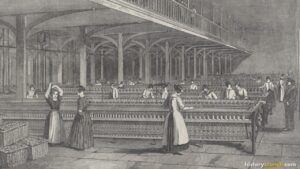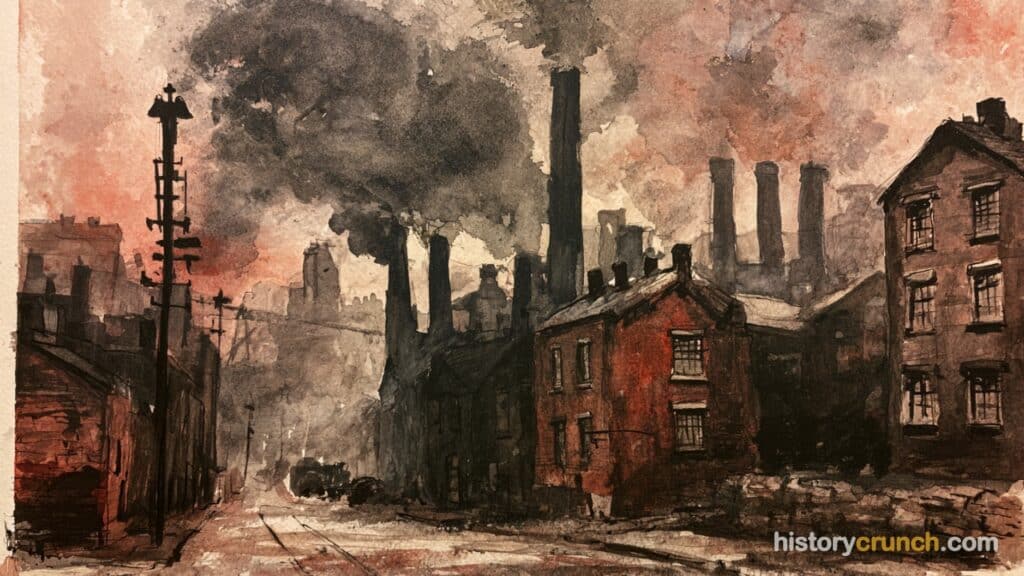
The Industrial Revolution was one of the most important events in world history, and it was driven by the rise of several major industries that changed the way people made goods, earned a living, and organized their societies. Beginning in Britain in the 18th century, industrialization transformed economies that had long been based on farming into economies built around factories, machines, and mass production. At the center of this transformation were a handful of key industries, including textiles, iron, coal, steam power, and transportation, each of which fed into and supported the others.
An industry is a group of businesses that produce a similar type of good or service. During the Industrial Revolution, industries grew rapidly as new inventions allowed goods to be produced faster, cheaper, and in far larger amounts than ever before. Understanding these industries helps explain why the period was such a powerful turning point in the history of the modern world.
 FactsthatCrunch
What Was the Industrial Revolution?
The Industrial Revolution was a period of rapid change in which societies shifted from producing goods by hand to producing them with machines in factories. Beginning in Britain in the late 18th century, the Industrial Revolution saw the development of new machines, factories, and technologies that replaced traditional methods of farming and hand production and created a new kind of society built around industry and urban life. It first began in Britain but soon spread to other parts of Europe and to North America.
Historians often divide the period into two stages. In fact, historians have identified two stages of industrialization: the First Industrial Revolution and the Second Industrial Revolution. The First Industrial Revolution began in the 18th century and focused primarily on textile manufacturing and steam power. While the First Industrial Revolution was based on advancements in the textile industry and steam power, the Second Industrial Revolution was focused on aspects such as steel production, railroad construction, and electricity.
Before this change, most goods were made in a system historians call the cottage industryA system where families made goods like cloth at home rather than in factories, before industrialization changed production.. Before the Industrial Revolution, textile production was a major cottage industry in Britain, and families spun yarn and wove cloth in their homes, a process that was labor-intensive and time-consuming. As stated above, the rise of factories and machines slowly replaced this older method and gave birth to the powerful industries described below.
Why Was the Textile Industry So Important?
The textile industry was the first industry to be transformed by the Industrial Revolution, and it set the pattern for all the others. One of the main industries that benefitted from the effects of the Industrial Revolution was the textile industry, which was based on the development of cloth and clothing. More specifically, textiles included the spinning of thread and the weaving of cloth from raw materials such as wool and cotton.
In the old system, cloth was made slowly by hand at home. People produced goods, such as wool, in their homes or on their own farms and then sold it to local communities since long distance transportation was uncommon, but this method of production was slow and inefficient and struggled to keep pace with the growing demand caused by the increased population. In contrast, industrialization allowed goods to be produced in a central location and on a mass scale.
A series of important inventions mechanizedReplaced human hand labor with machines that could do the same work faster and on a larger scale. the textile industry during the 1700s. John Kay was an English inventor who significantly advanced the textile industry with his invention of the flying shuttle in 1733, which greatly sped up the weaving process. Next, James Hargreaves created the spinning jennyA machine invented in 1764 that could spin many spindles of thread at the same time instead of just one. in 1764, a machine which allowed many spindles of thread to be spun at one time. Richard Arkwright added to this by developing the water frame in 1769, which allowed dozens of spindles of thread to be spun at one time but was so large and needed so much energy that he built it next to rivers and creeks in order to use the force of the water to spin the machine.
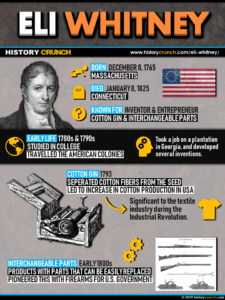
Other inventors pushed the industry forward as well. Edmund Cartwright developed the power loom in 1785, which allowed quicker production of cloth. Finally, American inventor Eli Whitney developed the cotton gin in 1793, which allowed for quicker production of cotton, because previously cotton had to be hand cleaned to separate the seeds from the fibers, and Whitney’s cotton gin sped up this process and allowed cotton to be cleaned and prepared for market much faster. In all, these inventions mechanized the textile industry and led to the establishment of factories throughout Britain, which was the first country to industrialize.
FactsthatCrunchIn what order were these textile inventions of the Industrial Revolution developed?
How Did the Coal Industry Power Industrialization?
Coal was one of the most important resources of the Industrial Revolution because it provided the energy that powered nearly everything else. Coal is a black rock made from the buried remains of ancient plants, and when it is burned it releases a great deal of heat energy. This heat was used to boil water into steam, which in turn powered the machines and engines of the new industrial age.
As machines and factories multiplied, the demand for coal grew quickly. The development of the Industrial Revolution led to the large-scale use of coal as the steam engine took over from the water wheel, and in 1700, five-sixths of the world’s coal was mined in Britain. Coal was central to the development of the steam engine, and in turn the steam engine dramatically increased the efficiency of coal mining. In this way, coal and steam power supported each other and grew together.
Coal mining was difficult and dangerous work, and one of the biggest problems was flooding in deep mines. In fact, the earliest steam engines were designed to solve exactly this problem by pumping water out of mines. As a result, the coal industry not only fueled the revolution but also encouraged the invention of the machines that defined it.
FactsthatCrunchWhy were the first steam engines built for coal mines?
Why Was the Iron Industry So Valuable?
The iron industry provided the strong, durable metal needed to build machines, factories, bridges, and railroads. For centuries, ironmakers had used charcoal, made from wood, to smeltTo melt ore using intense heat in order to extract pure metal from it. iron from ore, but this method was expensive and used up huge amounts of timber. A major breakthrough changed this process forever.
The process of smelting iron with cokeA fuel made by heating coal, used to smelt iron more cheaply and efficiently than charcoal from wood., developed by Abraham Darby, replaced the traditional charcoal method, making iron production more efficient and less expensive. Coke is a fuel made by heating coal, which meant the iron industry became closely tied to the coal industry. The increased availability of high-quality iron led to innovations in machinery and construction, and in fact iron and coal were both vitally important to the overall Industrial Revolution.
Because iron mines and coal deposits in Britain often lay near one another, ironmakers could produce metal cheaply and in large amounts. This cheap, strong iron then made it possible to build the very machines, engines, and rails that carried the Industrial Revolution forward. Later, during the Second Industrial Revolution, iron production would give way to the mass production of steel, an even stronger metal.
FactsthatCrunchHow did coke as a fuel make iron smelting cheaper and faster during the Industrial Revolution?
How Did Steam Power Change Industry?
Steam power was the driving force behind the entire Industrial Revolution, and the steam engine was its most important invention. The invention of the steam engine revolutionized industry and transportation, providing a powerful and efficient source of mechanical energy that propelled the Industrial Revolution. Steam engines burned coal to boil water, and the resulting steam pushed pistonsA moving part inside a steam engine that is pushed by steam pressure to turn machinery. that turned machinery.
The first steam engines were built to serve the mining industry. The first practical steam engine was created by Thomas Newcomen in 1712, who produced items for tin mine owners that often complained they were struggling to deal with flooding in their mines, since traditional methods of removing water from the mines were slow and hard work. His pump engine solved this problem and marked the beginning of a new age of machine power.
The engine was greatly improved a few decades later. The steam engine, developed by James Watt in the late 1760s, was another revolutionary invention that provided a new, powerful source of energy that was not dependent on waterways, enabling factories to be located anywhere. Steam engines were initially used to pump water out of mines, but their application soon expanded to power machinery in various industries, including textiles, iron, and transportation.
FactsthatCrunch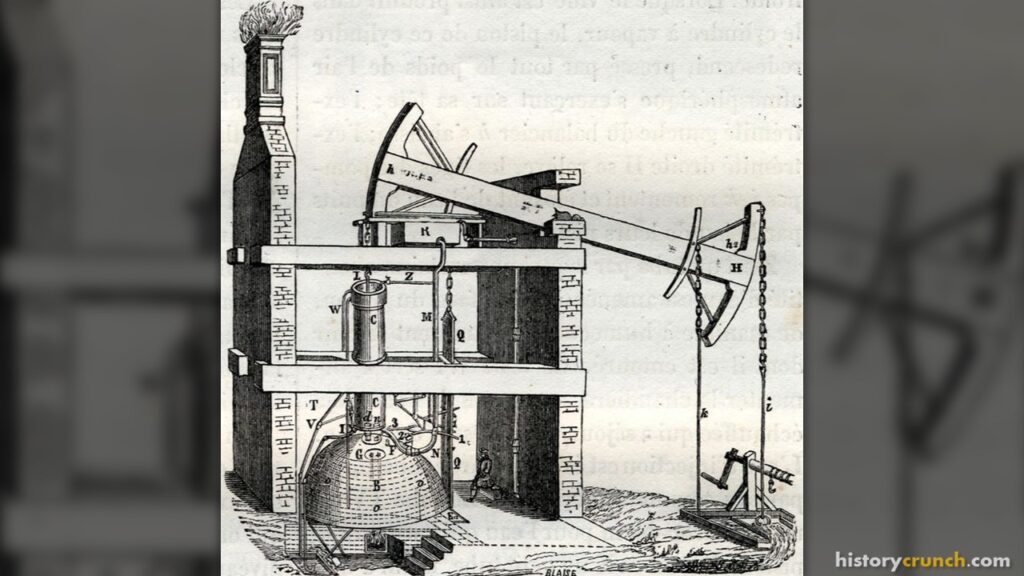
What Role Did the Transportation Industry Play?
The transportation industry allowed raw materials and finished goods to move quickly and cheaply across long distances, which was essential for factories that produced goods on a mass scale. Transportation saw dramatic improvements with the advent of steam-powered locomotivesA steam-powered engine on rails that pulled trains carrying goods and people across long distances. and ships. Before these inventions, goods were carried slowly by animals, wagons, or river boats.
Water transportation improved first. Canals were dug to connect rivers and lakes, and steam power soon transformed river travel. Boats could travel downstream quite easily using the current, but traveling upstream was much more difficult, and this problem was solved during the Industrial Revolution by the steam engine, since in 1807 Robert Fulton built the first commercially successful steamboat.
The greatest change in transportation came from the railroad. The invention of the railroad and the steam powered locomotive opened up a whole new world in transportation, since transportation was no longer limited to rivers and canals, and starting around 1830 railroads began to be constructed in the eastern part of the United States. Railroads carried coal, iron, cotton, and finished products between mines, factories, and cities. As railroads grew, so did manufacturing in the United States.
Significance of Industries in the Industrial Revolution
The industries of the Industrial Revolution were significant because they completely reshaped how people lived and worked. The Industrial Revolution is a significant event in world history because it transformed European and North American societies from being based on agriculture production to industrial production. The textile, coal, iron, steam, and transportation industries all worked together to make this change possible.
These industries also drew millions of people away from the countryside and into cities in search of factory work. With an increased population and a lessened need for workers in the fields due to increased production, many were freed to leave the farms and move to the cities looking for work. This rapid growth of cities created new opportunities but also new problems.
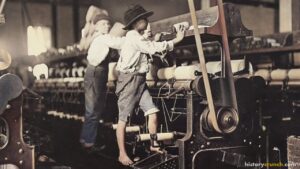
In reality, the rise of industry brought serious hardships as well as progress. This political and economic climate created a situation in which wealthy factory and mine owners were able to exploit working-class people, which led to horrible working conditions, and child labor was a common feature of the Industrial Revolution with children as young as four working in dirty and dangerous conditions without protection from the government. These industries, then, built the modern industrial world while also creating the social challenges that later reformers would work to fix.
FactsthatCrunchKey Vocabulary
Cottage industry
Mechanized
Spinning jenny
Smelt
Coke
Piston
Locomotive
Frequently Asked Questions
What were the main industries of the Industrial Revolution?
The main industries of the Industrial Revolution were textiles, coal, iron, steam power, and transportation. Textiles led the way in the First Industrial Revolution, while steel, oil, and electricity became more important during the Second Industrial Revolution in the late 1800s. Each industry depended on the others, so growth in one often triggered growth in the rest.
Which industry was first to industrialize?
The textile industry was the first to industrialize. Because cloth and clothing were always in high demand, inventors focused their earliest efforts on machines that could spin thread and weave cloth faster. The success of textile factories then encouraged owners in other industries to adopt machines and the factory system too.
Why was coal so important to the Industrial Revolution?
Coal was important because it provided the fuel that powered steam engines, factories, and railroads. Without a cheap and abundant source of energy, machines could not have run on such a large scale. Britain had rich coal deposits, which helped it become the first country to industrialize.
How did industries connect to one another?
The industries were deeply connected and depended on one another to grow. Coal fueled steam engines, steam engines powered textile factories and pumped water from mines, iron built the machines and rails, and transportation moved all of these goods between them. This close web of connections is a big reason the Industrial Revolution grew so quickly.
Where did the Industrial Revolution begin?
The Industrial Revolution began in Britain in the 18th century. Britain had the natural resources, wealth, and inventions needed to build the first factories and machines. From there, industrialization spread to the rest of Europe and to North America, where the United States developed its own powerful industries.
Cite This Article
To cite this article as a source, use one of the formats below.
MLA: Millar, B. “Industries in the Industrial Revolution: A Detailed Summary.” HistoryCrunch, 12 August 2026, https://historycrunch.com/industries-in-the-industrial-revolution/.
APA: Millar, B. (2026). Industries in the Industrial Revolution: A Detailed Summary. HistoryCrunch. https://historycrunch.com/industries-in-the-industrial-revolution/
Chicago: Millar, B. “Industries in the Industrial Revolution: A Detailed Summary.” HistoryCrunch. August 12, 2026. https://historycrunch.com/industries-in-the-industrial-revolution/
Sources
- The Science Museum Group
- Robert C. Allen, The Industrial Revolution: A Very Short Introduction.
- Emma Griffin, A Short History of the British Industrial Revolution.