The Third Industrial Revolution is one of the most important developments in modern history, and it reshaped how people work, communicate, and live in the second half of the twentieth century. Often called the Digital Revolution or the Information Age, this period saw the world shift away from mechanical and analogTechnology that stores information as continuous physical signals, rather than as numbers or digital code. technology and toward computers, electronics, and digital information. It built directly on the earlier stages of the Industrial Revolution, but instead of steam engines or electricity, its central force was the ability to store, process, and share information using machines.
The Third Industrial Revolution refers to the wave of technological change that began around the middle of the twentieth century and centered on digital electronics, computers, and communication networks such as the internet. In simple terms, it was the moment when human societies moved from an economy based on heavy industry and mechanical machines to one based on information, automationUsing machines and computers to perform tasks that people once did by hand., and digital technology. This shift transformed factories, offices, and homes, and it created the connected, computer-driven world that many people live in today.
 FactsthatCrunch
What Was the Industrial Revolution?
The Industrial Revolution was a period of major industrialization that transformed societies from being based on farming and hand production to being based on machines, factories, and industry. It first began in Britain in the late 1700s but soon spread to the rest of Europe, North America, and eventually much of the world. Over time, it completely changed how goods were made, how people worked, and where they lived.
Historians usually divide this long process into separate stages. The First Industrial Revolution centered on the steam engine, coal, iron, and the growth of the textile industry, and it lasted from roughly the late 1700s into the mid-1800s. The Second Industrial Revolution followed from around the 1870s into the early 1900s and focused on steel, electricity, chemicals, and mass production techniques such as the assembly line.
The Third Industrial Revolution is the next stage in this pattern. In fact, each stage was built on the inventions of the one before it. Just as electricity in the Second Industrial Revolution depended on earlier machines and factories, the digital technology of the Third Industrial Revolution depended on the electric power grids and electronics that came before it.
When Did the Third Industrial Revolution Begin?
The Third Industrial Revolution is generally dated to the years following World War II, beginning in the late 1940s and continuing through the rest of the twentieth century. Many historians point to the invention of the transistorA tiny electronic switch that controls the flow of electricity inside a device. in 1947 as a key starting point, since this small device made modern electronics possible. Others focus on the 1970s and 1980s, when personal computers and digital technology spread rapidly into workplaces and homes.
Unlike the earlier stages, this revolution did not have a single clear ending. Instead, it flowed gradually into what many people now call the Fourth Industrial Revolution, which focuses on artificial intelligence, robotics, and connected smart devices. As a result, there is some debate about exactly where the Third Industrial Revolution stops and the next stage begins.
The countries that led this period of change included the United States, Japan, Germany, and the United Kingdom. These nations already had strong industrial economies, advanced research universities, and the wealth needed to invest in expensive new technologies. Over time, digital technology spread far beyond these leading nations and reached almost every part of the world.
What Were the Main Technologies of the Third Industrial Revolution?
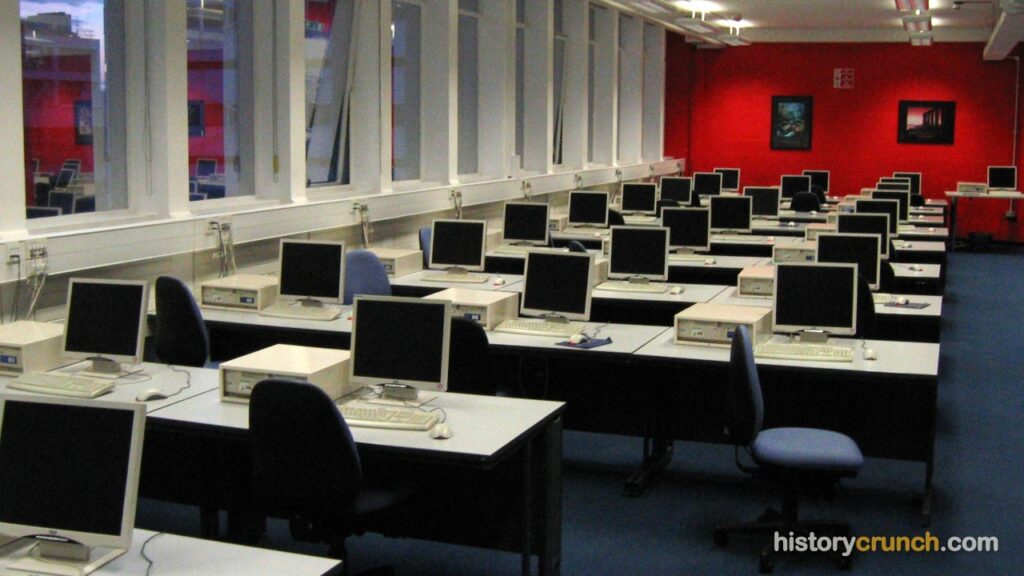
The most important technology of the Third Industrial Revolution was the computer. Early computers were huge machines that filled entire rooms and were used mainly by governments, universities, and large corporations. Over time, engineers found ways to make computers smaller, faster, and cheaper, which allowed them to spread into offices, schools, and eventually ordinary homes.
A major turning point was the invention of the transistor and later the microchipA small piece of silicon that packs millions of transistors onto it, enabling powerful yet compact machines., also known as the integrated circuitAnother name for a microchip; a single component containing millions of miniaturized electronic switches.. A transistor is a tiny electronic switch that controls the flow of electricity, and a microchip packs millions of these switches onto a single small piece of silicon. These inventions made it possible to build powerful machines that were small enough to sit on a desk, which led to the personal computer in the 1970s and 1980s.
Communication technology also advanced dramatically during this time. For instance, artificial satellites were launched into orbit and used to send signals across the globe, and fiber-optic cablesCables that carry huge amounts of information at high speed using light signals. carried huge amounts of information at high speed. More specifically, the development of the internet allowed computers around the world to connect and share information, which changed the way people communicated forever.
Beyond computers and communication, the Third Industrial Revolution also brought progress in other scientific fields. In reality, this era is often described as centering on several branches of science, including information technology, telecommunications, biotechnology, and energy engineering. New materials, automated machines, and early forms of renewable energy technology all emerged during this same period.
FactsthatCrunchA microchip is a tiny slice of silicon that holds many miniature electronic switches called transistors all in one place, from a handful on the first chips to billions on chips today. Those switches control the flow of electricity and allow the chip to store and process information at very high speed. Because a microchip packs so much computing power into a very small space, engineers could build machines far smaller and cheaper than the room-sized computers that came before.
"When engineers placed thousands of transistors onto a single microchip in the 1970s, computers shrank from the size of a room to the size of a desk, making personal computers possible for the first time."
How Did the Third Industrial Revolution Change Work and Industry?
The Third Industrial Revolution changed the nature of work by shifting economies away from traditional heavy industries such as steel and textiles and toward electronics, computers, and services. In many wealthy nations, factory jobs became less common while jobs involving information, technology, and knowledge grew rapidly. Because of this, some people describe the new society that emerged as an “information and knowledge society.”
Automation was one of the most important changes in industry during this period. Automation means using machines and computers to perform tasks that people once did by hand. In factories, computer-controlled machines and early robots could work quickly and accurately, which increased productivity but also reduced the need for some kinds of manual labor.
The organization of business also changed a great deal. As stated above, information technology combined with telecommunications to make production faster and more efficient. Large multinational corporationsLarge companies that manage production, marketing, and operations across many different countries at once. grew during this time, combining management, production, and marketing across many different countries and connecting the global economy in new ways.
FactsthatCrunchDuring the Cold War, governments in the United States, Japan, and Western Europe funded computer research, and by the 1970s computers had become cheap and small enough to control machines on factory floors.
From the 1970s onward, automation reshaped factory floors across industrialized nations. The shift reduced the need for certain manual jobs while creating demand for workers with technical and digital skills, producing a new kind of economy centered on information and knowledge.
How Did the Third Industrial Revolution Affect Daily Life?
The Third Industrial Revolution transformed daily life by bringing digital technology into ordinary homes. Personal computers, video game consoles, and household electronics became common in many countries during the 1980s and 1990s. For many families, these devices changed the way they worked, learned, and spent their free time.
Communication became faster and more personal than ever before. For instance, the spread of the internet and, later, mobile phones allowed people to send messages and share information almost instantly across long distances. This made the world feel smaller and connected people who lived thousands of miles apart.
Access to information also expanded dramatically. In the past, people relied on printed books, newspapers, and libraries to learn new things. During the Third Industrial Revolution, digital databases and the internet made vast amounts of information available quickly, changing education, business, and everyday problem solving.
FactsthatCrunchHow did the internet and mobile phones change daily life for ordinary people in the 1980s and 1990s?
Significance of Third Industrial Revolution
The Third Industrial Revolution is significant because it created the digital, connected world that shapes modern life today. It marked the shift from an economy based on machines and heavy industry to one based on information, computers, and communication networks. In doing so, it changed nearly every part of society, from how goods are made to how people talk to one another.
Its overall impact can be seen in the technology that surrounds people every day. Computers, the internet, satellites, and mobile devices all trace their roots to this period of rapid change. Without these developments, the modern global economy and the instant communication that people rely on would not exist.
Finally, the Third Industrial Revolution set the stage for the changes still unfolding today. The digital tools and networks it created became the foundation for newer technologies such as artificial intelligence, robotics, and smart devices. As such, understanding this stage of the Industrial Revolution helps explain how the world became so deeply connected and dependent on digital technology.
FactsthatCrunchFollow the chain from top to bottom. Tap any step to read what happened.
Key Vocabulary
Analog
Transistor
Microchip
Integrated circuit
Automation
Fiber-optic cables
Multinational corporations
Frequently Asked Questions
What is the Third Industrial Revolution in simple terms?
The Third Industrial Revolution is the period when the world shifted from mechanical and analog technology to digital electronics and computers. It is the stage of the Industrial Revolution most closely tied to the rise of the personal computer, the internet, and automated machines. Because of its focus on digital information, it is often simply called the Digital Revolution.
Why is the Third Industrial Revolution called the Digital Revolution?
It is called the Digital Revolution because its central change was the move from analog technology to digital technology. Analog devices store information as continuous physical signals, while digital devices store information as numbers, usually in a code of ones and zeros. This digital method made it possible to store, copy, and send huge amounts of information quickly and accurately.
What are some examples of Third Industrial Revolution inventions?
Key inventions include the transistor, the microchip, the personal computer, and the internet. Other important developments include communication satellites, fiber-optic cables, and early industrial robots. Together, these tools formed the backbone of the digital age and changed both industry and everyday life.
How is the Third Industrial Revolution different from the Second?
The main difference is that the Second Industrial Revolution focused on steel, electricity, and mass production, while the Third focused on computers, electronics, and digital information. The Second stage powered giant factories and assembly lines, while the Third stage used computers and automation to process information and control machines. In short, the earlier revolution was driven by machines, while the later one was driven by data.
Are we still in the Third Industrial Revolution today?
Many experts believe the world has moved into a Fourth Industrial Revolution, though the exact boundary is debated. The Fourth stage focuses on artificial intelligence, robotics, and connected smart devices known as the Internet of Things. However, these newer technologies grew directly out of the digital tools created during the Third Industrial Revolution, so the two stages are closely linked.
Cite This Article
To cite this article as a source, use one of the formats below.
MLA: Millar, B. “Third Industrial Revolution: A Detailed Summary.” HistoryCrunch, 12 August 2026, https://historycrunch.com/third-industrial-revolution/.
APA: Millar, B. (2026). Third Industrial Revolution: A Detailed Summary. HistoryCrunch. https://historycrunch.com/third-industrial-revolution/
Chicago: Millar, B. “Third Industrial Revolution: A Detailed Summary.” HistoryCrunch. August 12, 2026. https://historycrunch.com/third-industrial-revolution/
Sources
- The Science Museum Group
- Joel Mokyr, The Enlightened Economy.