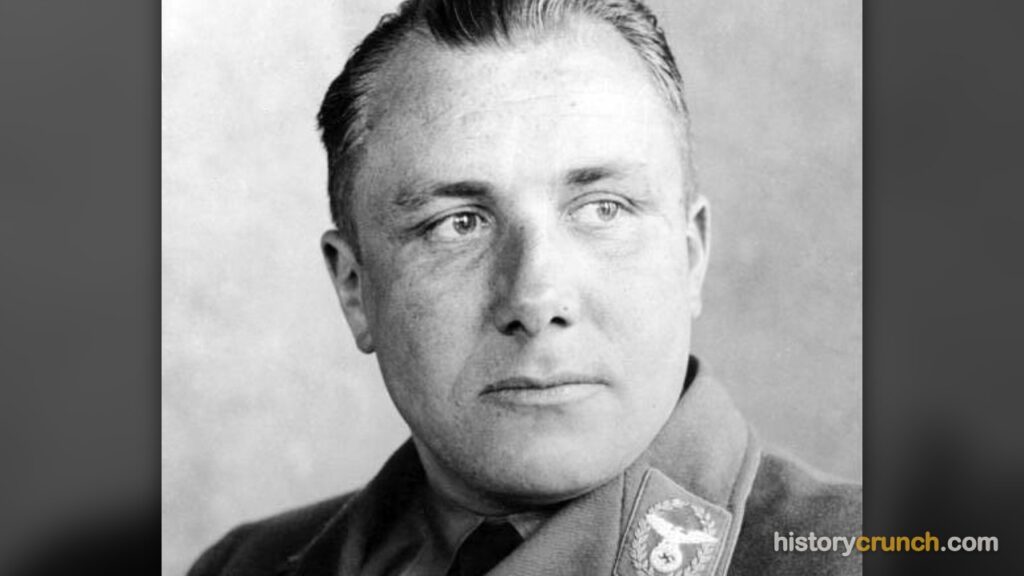
Martin Bormann was one of the most powerful figures in Nazi Germany, even though most Germans barely knew his name. As the head of the Nazi Party Chancellery and the private secretary to Adolf Hitler, he controlled who could reach the Führer and helped push through many of the regime’s most brutal policies. His work took place behind the scenes, which is why he is often described as the “shadow” of the Third Reich. Understanding his life helps explain how the Nazi dictatorship functioned during World War II and the Holocaust.
Bormann was not a public speaker like other Nazi leaders, and he did not command troops in the field. Instead, he was a bureaucrat, meaning an official who ran the day-to-day paperwork and administration of a large organization. His skill with files, schedules, and party rules allowed him to gather enormous power over time, until he stood second only to Hitler himself.
Early Life and Background
Martin Ludwig Bormann was born on June 17th, 1900, in Wegeleben, a small village near Halberstadt in what is now the German state of Saxony-Anhalt. His father worked for the post office, and the family belonged to the lower middle class. His father died when Bormann was only three years old, and his mother later remarried.
Bormann was not a strong student, and he left school early to work on a large farming estate in the region of Mecklenburg. In 1918, near the end of World War I, he served briefly as an artillery soldier, but the war ended before he saw real combat. This experience of coming of age just as Germany lost the war shaped his later politics.
After the war, Bormann joined the Freikorps, which were private armies made up of former soldiers who were angry about Germany’s defeat. These groups were violently nationalist, meaning they placed loyalty to the German nation above everything else, and many of their members hated the new democratic government. In fact, Bormann became connected to a group that carried out political killings.
In 1924, Bormann was sentenced to a year in prison for his part in the murder of a man the group accused of betrayal. This early violence showed how deeply he had already committed himself to extremist causes. After his release, he was ready to link his future to a rising political movement.
Rise to Power
Bormann joined the Nazi Party in 1927, at a time when the party was still a small movement led by Adolf Hitler. The Nazi Party, officially the National Socialist German Workers’ Party, was a far-right group that promoted extreme nationalism, anti-Semitism, and the idea of Aryan racial superiority. Bormann shared these beliefs and quickly found useful work inside the party’s growing organization.
At first he served as a regional press officer and then as a business manager, handling money and paperwork rather than making speeches. In 1929, he married Gerda Buch, the daughter of a powerful Nazi Party judge. This marriage connected him to important people at the top of the party and helped move him into its inner circle.
Bormann’s talent for organization stood out. He helped create and manage a large fund that collected “voluntary” donations from German business owners for Hitler, which gave him influence over money and access to the leader. By October of 1933, he had become a Reichsleiter, one of the highest ranks in the Nazi Party, and he was also elected to the Reichstag, the German parliament.
From 1933 to 1941, Bormann served as chief of staff to Rudolf Hess, who was Hitler’s deputy. In this role he acted as Hess’s right-hand man and learned to master the party’s bureaucratic machinery. More specifically, he made himself so useful and so reliable that Hitler began to trust him with countless small tasks that added up to real power.
A turning point came in May of 1941, when Hess flew alone to Scotland on a strange mission to try to make peace with Britain. Hitler treated this flight as a betrayal, and Hess was removed from his position. As a result, Hitler appointed Bormann to lead the newly created Party Chancellery, placing him in charge of the entire administrative structure of the Nazi Party.
Major Actions and Influence
As head of the Party Chancellery, Bormann controlled the flow of party business across all of Germany. He reviewed acts of legislation, approved promotions and appointments, and shaped decisions about internal security. In reality, very little could happen inside the Nazi Party without passing across his desk.
In April of 1943, Bormann was named Hitler’s private secretary, which brought him even closer to the center of power. He drew up Hitler’s daily schedule and decided who was allowed to meet with him and who was kept away. By controlling access in this way, Bormann could shape what information Hitler received and could weaken rivals by keeping them at a distance.
Bormann used this position to advance the most extreme Nazi policies. He was a fierce enemy of organized religion and worked to reduce the influence of the churches in Germany. He was also a devoted anti-Semite who helped enforce racist laws and supported the persecution and mass murder of Jewish and Slavic people.
His signature appeared on many decrees connected to persecution, forced labor, and the machinery of the Holocaust. He helped expand the Nazi slave labor program, which forced millions of people from occupied countries to work under terrible conditions. For this reason, later investigators linked him directly to the deportation of Jews and the abuse of forced laborers.
Within the Nazi leadership, Bormann was known for being harsh, blunt, and ruthless. Many officials and army officers disliked and even feared him, viewing him as crude and dangerous. Yet Hitler valued his loyalty and efficiency, which allowed Bormann to defeat rivals in the constant power struggles of the Third Reich.
Later Life and Death
By late 1944, Germany was clearly losing World War II, and Hitler’s health was failing. Bormann stayed at Hitler’s side as the situation grew desperate, following him into the underground bunker in Berlin in early 1945. There he remained one of the leader’s closest companions during the final weeks of the war.
Bormann was present for the last dramatic events in the bunker, including Hitler’s marriage to Eva Braun and Hitler’s suicide on April 30th, 1945. With Soviet forces closing in on the city, Bormann and several others tried to break out of Berlin and escape. Somewhere between the bunker and a nearby railway station, he disappeared into the chaos of the fighting.
For decades, no one knew for certain what had happened to him. Because his body was not found, rumors spread that he had escaped to South America, and reported sightings came from many countries around the world. In 1945 and 1946, at the Nuremberg Trials, the Allies put leading Nazi officials on trial for war crimes.
Since Bormann could not be found, he was tried in absentia, meaning while absent, and was sentenced to death. The mystery of his fate was finally solved by forensic science. In 1972, construction workers in West Berlin uncovered human remains, and later DNA testing in 1998 confirmed that they belonged to Bormann, showing that he had died in Berlin in the first days of May 1945, most likely by taking poison.
Significance of Martin Bormann
Martin Bormann is remembered as one of the most powerful men in Nazi Germany during World War II and the Holocaust, even though he worked almost entirely out of public view. His life shows that great power in a dictatorship does not always belong to the loudest speakers or the most famous faces. Instead, it can belong to the person who controls the paperwork, the schedules, and the access to the leader.
His career also reveals how the Nazi state actually operated on a daily basis. As stated above, Bormann turned bureaucratic skill into political control, using files and rules to push forward policies of persecution and mass murder. This makes him a key example of how ordinary administrative work was twisted to serve terrible crimes.
Finally, the long mystery surrounding his death made Bormann a symbol of the hunt for Nazi war criminals after 1945. For years, investigators and so-called Nazi hunters searched for him across the globe. The eventual confirmation of his death closed one of the most famous unsolved cases of the postwar era and reminded the world of the effort required to hold the leaders of the Third Reich accountable.
Frequently Asked Questions
Who was Martin Bormann?
Martin Bormann was a top Nazi official who served as head of the Party Chancellery and as Adolf Hitler’s private secretary. He was a bureaucrat rather than a public figure, and he used his control of the party’s administration to become one of the most powerful people in Germany during World War II.
Why was Martin Bormann so powerful?
Bormann’s power came from his control over access to Hitler and over the running of the Nazi Party. He decided who could meet with Hitler and managed the schedule, appointments, and paperwork, which allowed him to shape decisions and sideline rivals without ever giving a famous speech.
What role did Martin Bormann play in the Holocaust?
Bormann helped enforce anti-Semitic laws and signed decrees connected to the persecution of Jews, forced labor, and mass murder. As a strong supporter of Nazi racial policy, he pushed forward measures that were part of the machinery of the Holocaust, which is why he was later charged with war crimes.
How did Martin Bormann die?
Bormann died in Berlin in early May 1945 while trying to escape the city as Soviet forces captured it. Evidence suggests he took poison during the breakout, and his death was long a mystery because his body was not found until years later.
Did Martin Bormann escape to South America?
No, Martin Bormann did not escape to South America, though many people believed he had for decades. Reported sightings placed him in countries such as Argentina, but remains discovered in Berlin in 1972 and confirmed by DNA testing in 1998 proved that he had died in the German capital in 1945.
Cite This Article
To cite this article as a source, use one of the formats below.
MLA: Millar, B. “Martin Bormann: A Detailed Biography.” HistoryCrunch, 15 August 2026, https://historycrunch.com/martin-bormann/.
APA: Millar, B. (2026). Martin Bormann: A Detailed Biography. HistoryCrunch. https://historycrunch.com/martin-bormann/
Chicago: Millar, B. “Martin Bormann: A Detailed Biography.” HistoryCrunch. August 15, 2026. https://historycrunch.com/martin-bormann/
Sources
- Jerry Bentley & Herbert Ziegler, Traditions & Encounters: A Global Perspective on the Past.
- J.M. Roberts & Odd Arne Westad, The Penguin History of the World.