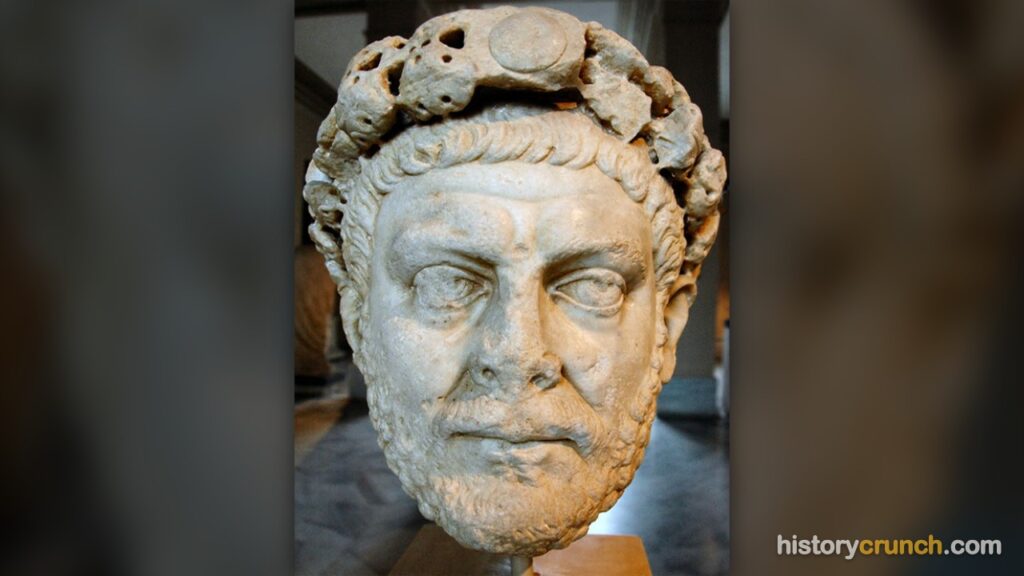
Emperor Diocletian was one of the most important rulers in the history of Ancient Rome, because he pulled the empire back from the edge of collapse and reshaped how it was governed for centuries to come. He came to power in 284 CE, at the end of a period of chaos known as the Crisis of the Third Century, when the Roman Empire had been torn apart by civil wars, invasions, and a rapid turnover of short-lived emperors. Through bold reforms, Diocletian brought order, security, and stable government to a state that many believed was about to fall apart.
Diocletian is best remembered for creating the Tetrarchy, a system of shared rule in which four leaders governed different regions of the empire at the same time. The word tetrarchy comes from Greek and means “rule of four.” Under this arrangement, two senior emperors, each called an Augustus, ruled alongside two junior emperors, each called a Caesar. The goal was to make an enormous empire easier to defend and to manage, and to solve the problem of who would take over when a ruler died.
Early Life and Background
Diocletian was born around 244 CE in the Roman province of Dalmatia, along the coast of what is now Croatia. He was born with the name Diocles to a family of low status, and he was either the son of a freed slave or the son of a scribe who worked for a senator. As a young man from a humble background, he had few advantages in life, and his chances of rising to a high position seemed slim.
Like many ambitious men from the region during this era, Diocletian sought his fortune in the Roman army. As with other Illyrian soldiers of the period, he rose through the ranks of the military early in his career, serving under the emperors Aurelian and Probus. He proved himself to be a capable and disciplined officer, and he steadily earned promotions.
In time, Diocletian reached important commands. He is first clearly recorded as the military governor of Moesia, a region along the lower Danube River, where he had responsibility for defending the border. By the early 280s, his skill had brought him close to the center of imperial power. He eventually became a cavalry commander for the army of the Emperor Carus.
Rise to Power
Diocletian’s path to the throne came during a military campaign in the East. After the deaths of Carus and his son Numerian on a campaign in Persia, Diocletian was proclaimed emperor by the troops, taking the name “Diocletianus.” The soldiers had turned to a trusted commander in a moment of crisis, a pattern that had repeated many times during the third century.
Numerian had been found dead, and suspicion fell on his father-in-law, the praetorian prefect named Aper. When the son and successor of Carus was murdered, the choice of the army fell upon Diocletian, who immediately killed the accused murderer Aper with his own hand. This dramatic act took place in front of the assembled soldiers and helped mark Diocletian as the new leader.
Diocletian did not yet control the whole empire, however. The title of emperor was also claimed by Carus’s surviving son, Carinus, but Diocletian defeated him at the Battle of the Margus. With this victory in 285 CE, Diocletian gained sole control of the Roman world and took the full name Gaius Aurelius Valerius Diocletianus.
Major Achievements
Diocletian understood that the Roman Empire was simply too large for one person to rule and defend alone. Enemies threatened the frontiers on many sides at once, from the Persians in the East to Germanic tribes along the Rhine and Danube. To solve this problem, he decided to share power. He appointed a fellow officer named Maximian as Augustus, or co-emperor, in 286, and Maximian ruled the Western Empire while Diocletian reigned in the East as the senior Augustus.
A few years later, Diocletian expanded this system further. In 293, he appointed Galerius and Constantius as junior colleagues, each with the title Caesar, under himself and Maximian respectively, so that under the Tetrarchy, or “rule of four,” each tetrarch would rule over a quarter-division of the empire. This shared rule allowed each leader to respond quickly to threats in his own region. It was also meant to provide a clear plan for succession, since a Caesar was expected to move up and replace an Augustus over time.
With the government reorganized, Diocletian and his colleagues won a series of important military victories. He defeated the Sarmatians and Carpi during several campaigns between 285 and 299, the Alamanni in 288, and usurpers in Egypt between 297 and 298. In the East, the traditional enemy of Rome was also defeated. Galerius, aided by Diocletian, campaigned successfully against Persia and in 299 sacked their capital, Ctesiphon, after which Diocletian led negotiations that achieved a lasting and favorable peace.
Diocletian also rebuilt the way the empire was administered. He separated and enlarged the empire’s civil and military services and reorganized the empire’s provincial divisions, establishing the largest and most bureaucratic government in the history of the empire. More specifically, he moved the seat of power away from the old capital. He established new administrative centers in cities such as Nicomedia, Milan, Sirmium, and Trier, all closer to the empire’s frontiers than the traditional capital at Rome.
Diocletian also changed the very image of the emperor. Building on third-century trends toward absolutism, he styled himself an autocrat, elevating himself above the empire’s masses with imposing forms of court ceremony and architecture. He presented himself as chosen by the gods, associating himself with Jupiter and Maximian with Hercules, which gave the rulers a sacred aura.
All of these projects, along with a growing army and constant warfare, cost enormous sums of money. Bureaucratic and military growth, constant campaigning, and construction projects increased the state’s expenditures and required a comprehensive tax reform, so that from at least 297 on, imperial taxation was standardized, made more equitable, and levied at generally higher rates. Not every reform worked as intended. The Edict on Maximum Prices of 301, his attempt to curb inflation through price controls, was counterproductive and quickly ignored.
Persecution of Christians
One of the darkest parts of Diocletian’s reign was his treatment of Christians. For most of his rule, Christians were left in peace, but this changed near the end. In the winter of 302, Galerius urged Diocletian to begin a general persecution of the Christians, and after consulting an oracle, a general persecution was called in early 303.
The persecution became the most severe that Christians in the empire ever faced. The Diocletianic, or Great, Persecution was the last and most severe persecution of Christians in the Roman Empire, as the emperors issued a series of edicts stripping Christians of their legal rights and demanding that they follow traditional religious practices. Churches were destroyed, sacred texts were burned, and many Christians were imprisoned, tortured, or executed for refusing to sacrifice to the Roman gods.
Despite its harshness, the persecution failed to reach its goal. The persecution, which lasted from 303 to 312, failed to eliminate Christianity in the empire, and after 324 Christianity became the empire’s preferred religion under the Emperor Constantine. The persecution also varied greatly from region to region. While Galerius and Diocletian were avid persecutors, Constantius was unenthusiastic, and the later edicts calling for universal sacrifice were not applied in his domain.
Later Life
Diocletian did something no Roman emperor had ever done before. Weakened by illness, he left the imperial office on May 1st, 305, becoming the first Roman emperor to abdicate the position voluntarily. He also insisted that his co-emperor Maximian step down at the same time, so that the two junior Caesars could be promoted to Augustus.
After leaving power, Diocletian retired to a magnificent home he had built on the Dalmatian coast. He lived out his retirement in his palace, famously tending to his vegetable gardens. According to a well-known story, when he was later asked to return to power, he replied that anyone who saw the vegetables he had grown would never ask him to trade his peaceful life for the burdens of ruling.
The Tetrarchy did not survive long once its creator stepped away. Although effective while he ruled, Diocletian’s tetrarchic system collapsed after his abdication because of the competing dynastic claims of Maxentius and Constantine, the sons of Maximian and Constantius. A new round of civil wars followed, and eventually Constantine emerged as the sole ruler of the empire. Diocletian died a few years later, around 311 or 312 CE. His palace eventually became the core of the modern-day city of Split in Croatia.
Significance of Emperor Diocletian
The significance of Diocletian lies in the way he rescued and rebuilt the Roman Empire at a moment when it was close to falling apart. His reign stabilized the empire and ended the Crisis of the Third Century. Before he took power, emperors had risen and fallen in quick succession, and the borders were under constant attack. Diocletian restored order and gave the state a stronger foundation.
His reforms had effects that lasted far beyond his own lifetime. Despite his failures and challenges, Diocletian’s reforms fundamentally changed the structure of the Roman imperial government and helped stabilize the empire economically and militarily, enabling it to remain essentially intact for another 150 years despite being near the brink of collapse in his youth. In this way, he bought the empire valuable time.
Diocletian’s ideas also shaped the future of the Roman world in a lasting way. His decision to split the administration of the empire between East and West set a pattern that later rulers followed. In reality, the reforms he began helped lay the groundwork for the later Eastern Roman Empire, better known as the Byzantine Empire, which survived for nearly a thousand years after the western half of the empire finally fell in 476 CE. For all of his flaws, including his brutal persecution of Christians, Diocletian remains one of the pivotal figures in the long history of Ancient Rome.
Frequently Asked Questions
Who was Emperor Diocletian?
Diocletian was a Roman emperor who ruled from 284 to 305 CE and ended the Crisis of the Third Century. He rose from humble beginnings in Dalmatia to command the army before being proclaimed emperor, and he is best known for creating the Tetrarchy and reforming the government of the Roman Empire.
What was the Tetrarchy?
The Tetrarchy was a system of government in which four rulers shared power over the Roman Empire. It included two senior emperors, called Augusti, and two junior emperors, called Caesars, each responsible for a different region so the huge empire could be defended and governed more easily.
Why did Diocletian persecute Christians?
Diocletian persecuted Christians because he saw himself as a restorer of traditional Roman religion and believed that loyalty to the old gods held the empire together. Encouraged by his junior emperor Galerius, he launched the harshest anti-Christian campaign in Roman history, though it ultimately failed to stamp out the faith.
Why did Diocletian retire from being emperor?
Diocletian retired in 305 CE because of failing health and because his system of rule was designed to allow an orderly handover of power. He became the first Roman emperor to give up the throne willingly, retiring to his palace on the Dalmatian coast, where he spent his final years in peace.
What happened to the Roman Empire after Diocletian?
After Diocletian abdicated, his four-ruler system quickly broke down into civil war. Rival leaders fought for control until Constantine defeated his opponents and became sole emperor, going on to legalize Christianity and to found the new capital of Constantinople.
Cite This Article
To cite this article as a source, use one of the formats below.
MLA: Millar, B. “Emperor Diocletian: A Detailed Biography.” HistoryCrunch, 9 July 2026, https://historycrunch.com/emperor-diocletian/.
APA: Millar, B. (2026). Emperor Diocletian: A Detailed Biography. HistoryCrunch. https://historycrunch.com/emperor-diocletian/
Chicago: Millar, B. “Emperor Diocletian: A Detailed Biography.” HistoryCrunch. July 9, 2026. https://historycrunch.com/emperor-diocletian/
Sources
- J.M. Roberts & Odd Arne Westad, The Penguin History of the World.
- Jerry Bentley & Herbert Ziegler, Traditions & Encounters: A Global Perspective on the Past.