Chariot racing was the most popular sport in ancient Rome, drawing crowds far larger than gladiator fights or the theater. The races were fast, dangerous, and deeply tied to Roman religion, politics, and daily life, and they filled the largest public arenas ever built in the ancient world. Teams of horses pulled small two-wheeled chariots around a long oval track while tens of thousands of fans screamed for their favorite colors. For centuries, chariot racing sat at the very center of Roman culture, and it belonged to the wider world of Roman public games known as the ludi, which the state and wealthy leaders paid for to honor the gods and entertain the people.
A chariot race in ancient Rome was a contest between small, light carts pulled by teams of horses, racing around a long track called a circus. Most races had a set number of chariots that each ran seven laps, and the drivers, called charioteers, belonged to professional teams known as factions. The sport combined speed, skill, danger, and spectacle, and it was one of the main events of the public games that were connected to Roman religious festivals.
What Was Ancient Rome?
Ancient Rome was one of the largest and most influential civilizations in world history. It began as a small city in central Italy and grew over many centuries into a power that ruled lands across Europe, North Africa, and the Middle East. Rome passed through several stages, including a period ruled by kings, then a republic governed by elected officials, and finally an empire led by emperors. At its height around the year 117 CE, the Roman Empire stretched across a huge portion of the known world.
The Romans were famous for their engineering, their armies, their laws, and their public entertainment. In fact, spectacle was a central part of Roman life, and leaders understood that games could keep the public happy and loyal. Roman politicians understood the power of these events to appease and unite the populace, a fact captured by the phrase “bread and circuses,” referring to the policy of providing free grain and thrilling games to keep the public content. Chariot racing grew up inside this world of public entertainment and became its most beloved event.
Where Did Chariot Racing Come From?
Chariot racing was already an old tradition long before Rome became powerful. Roman chariot racing had its roots in older Mediterranean traditions, and the early Romans likely adopted chariot spectacles from the Etruscans, who themselves had borrowed racing practices from the Greeks. In Greece, chariot races were featured in Panhellenic games and aristocratic funerals, and this influence filtered into Italy. The Etruscans, a people who ruled much of Italy before Rome rose to power, are thought to have passed the sport on to the Romans.
Roman legend even tied the sport to the founding of the city itself. According to tradition, Rome’s mythical founder, Romulus, staged chariot races at a festival honoring the harvest god Consus. As stated in the old story, the races were meant to distract the neighboring Sabine people so that the Romans could seize the Sabine women and grow their new community. This myth highlights how deeply racing was embedded in Rome’s cultural memory and early political narratives.
In reality, the early races were closely tied to religion. Early races in Rome were closely connected to the worship of gods such as Mars, the god of war, and Consus, the god of grain and harvest, and these ceremonies took place at the base of the Palatine Hill. Over time, the races grew from simple religious events into a regular and eagerly awaited part of Roman public life.
Where Were the Races Held?
Roman chariot races took place in special stadiums called circuses. The largest and most famous by far was the Circus Maximus in Rome. Located in the valley between the Aventine and Palatine hills, it was the first and largest stadium in ancient Rome and its later Empire, measuring 621 meters (2,037 feet) in length and 118 meters (387 feet) in width and able to hold over 150,000 spectators. Some ancient sources claimed the crowd could grow even larger, filling the stands and the surrounding hillsides.
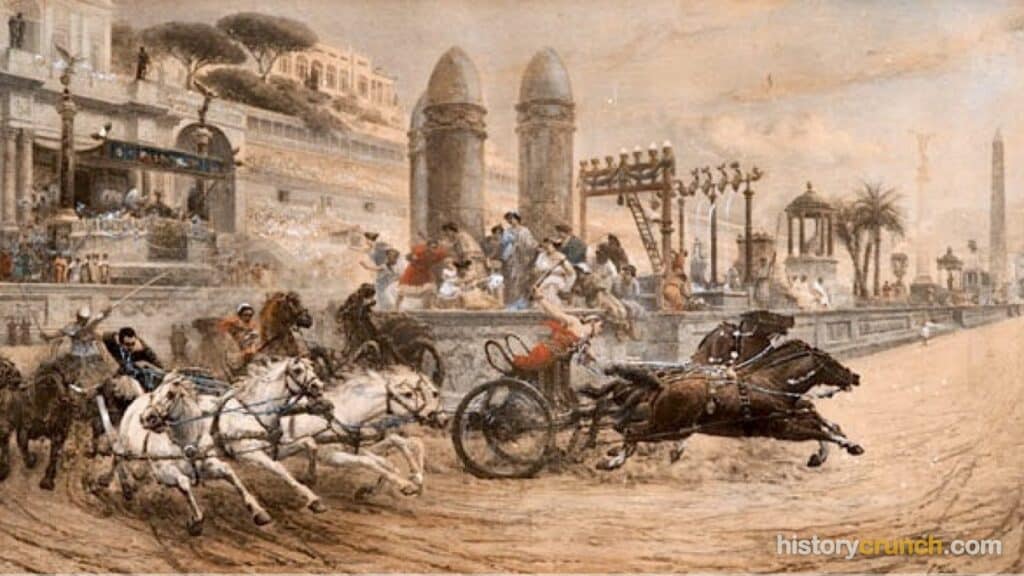
The circus was built in a long U shape, with a rounded end for the turns and a straight end where the races began. The design of a circus was long and U-shaped, with a rounded end for turning and a wide, straight end for the starting gates, and down the middle ran the spina, a raised central barrier decorated with statues, shrines, and lap counters. The chariots began behind starting gates called carceres, which opened together to launch all the teams at once.
The spina was a striking part of the track. Running down the central section, a low dividing wall about 1,100 feet long was known as the spina, and it was flanked by small ponds, shrines, and statues of gods as well as an obelisk brought from Egypt after its conquest by Emperor Augustus. At each end of the spina stood turning posts called metae, which were the most dangerous points on the track. At either end of the spina were the metae, each made of three cones, sometimes covered in bronze and used to mark the turning points and the finish line.
The circus was more than a sports arena. In fact, it was also a religious space. The Circus Maximus was more than just a race track, however, it was also a religious site, which held many temples and shrines for a wide number of deities. This blending of sport and sacred ritual made race day feel important and grand to everyone who attended.
How Did a Chariot Race Work?
A typical race featured twelve chariots that had to complete seven laps around the spina. A typical race had twelve chariots that had to complete seven laps around the spina of the circus. The most common chariot was the quadriga, which was pulled by four horses running side by side. Two-horse chariots, called bigae, were also used, usually driven by younger and less experienced racers.
The action began with a signal from the games’ sponsor. The sponsor, from a platform above the starting line, dropped a white handkerchief onto the track, the gates opened, and the racers burst onto the track and quickly began battling for the inside position that would give them an edge. Fans watched carefully to count the laps as the race went on. Also on the spina were counters to show how many laps had been run, and a large wooden egg was removed from a column and a metal dolphin was turned over every time a lap was completed.
The races were incredibly fast and short. More specifically, a single race lasted only a matter of minutes, with the horses reaching high speeds on the straight sections of the track. Each race ended when the leading chariot crossed the finish line, and then the crowd prepared for the next contest of the day.
Who Were the Charioteers and the Factions?
The drivers competed for professional teams called factions, each known by its color. Rome had four professional racing stables called factions: the Blues, Greens, Reds, and Whites. These teams were like large businesses. There was a whole industry built around the factions, providing all that was required for a race: horses, stable managers, blacksmiths, doctors, assistants to the charioteers, and operators for the starting gate mechanisms. Fans supported their color with fierce loyalty, and rivalries between the teams could be intense.
Most drivers came from the lowest levels of Roman society. Most drivers started out as slaves, and would hope to eventually accumulate enough winnings to purchase their freedom. A driver often began with a two-horse chariot and could rise to the four-horse teams as his skill grew. Even so, Roman society looked down on charioteers. Despite the appeal and stardom of successful charioteers, they were still viewed as disreputable by Roman society, and they possessed infamia in the same way that gladiators and actors did.
Yet the best drivers could become rich and famous. For instance, one of the most celebrated charioteers was Gaius Appuleius Diocles. The inscription about him explains that Diocles was born in a Roman province in Hispania, in what is now the Iberian Peninsula, in 104 CE, and that he competed from the age of 18 until his retirement at 42. Over his long career he raced thousands of times and won a fortune, becoming a symbol of hope for the poor who dreamed of rising to the top.
Why Was Chariot Racing So Dangerous?
The danger was a huge part of the sport’s appeal. Chariots raced close together at high speed, and drivers were allowed to bump and shove one another. Crashes were common, especially at the sharp turns around the metae, where several chariots could pile up at once. Drivers and horses risked serious injury or death through collisions and crashes, and this added to the excitement and interest for spectators.
The Romans even had a special word for a crash. Collisions and overturned chariots, called naufragia, or “shipwrecks,” were common and only added to the crowd’s excitement. A crash was especially deadly because of how the drivers held their reins. Charioteers often wrapped the reins around their bodies for better control, which meant that a fallen driver could be dragged across the track by his own horses. Because of these dangers, many charioteers died young, and even famous champions did not always live to retire.
What Was It Like to Be in the Crowd?
Race day was a massive public event that brought together Romans from every class. It combined high-speed competition with grand spectacle, drawing enormous crowds from all social classes. Before the racing began, a grand religious parade moved through the city. The event began with a sacred procession through Rome’s streets, which included statues of a dozen different Roman gods, along with dancers, musicians, temple attendants, and the drivers themselves, and eventually the parade reached the Circus Maximus, where spectators were already waiting.
The seating reflected the strict social order of Rome. The best seats near the track were saved for the wealthy and powerful, while ordinary people filled the higher tiers. Senators and elite aristocrats usually occupied the best seats close to the track, with comfortable cushions and shaded covers, while the general populace filled the upper tiers. The emperor himself often watched from a special viewing box. In Rome, the emperors built a special pulvinar, or royal seating area, that connected directly to the Palatine palace, allowing the emperor to appear before the people with appropriate grandeur.
The number of race days grew over the centuries as the sport became ever more popular. In the first century BCE, there were 17 circus days in Rome each year, a figure that by the fourth century CE had risen to 66. On those days, Romans of all backgrounds gathered to cheer, argue about the teams, and share in one of the greatest thrills their city could offer.
Significance of Chariot Racing in Ancient Rome
Chariot racing mattered because it stood at the heart of Roman public life for hundreds of years. It was the most popular entertainment in the city, and its crowds dwarfed those of the gladiator games and the theater. Chariot racing was by far the most popular spectacle of ancient Rome, and attendance at the races far surpassed theater performances and gladiatorial games. The sport gave Romans of every class a shared passion and a reason to gather together.
The races were also a tool of politics and religion. Leaders and emperors used the games to win the favor of the people and to display their own power and generosity. Games also aimed to show the competence, generosity, and fitness for higher office of those who organized them, and were a method of politics because of that. At the same time, the races honored the gods and were woven into the religious festivals of the Roman calendar.
The legacy of chariot racing can still be seen today. The Circus Maximus survives as a public park in Rome, and the sport lives on in books, art, and famous films. Its huge stadiums, with their tiered seating and central focal points, even influenced the design of modern sports arenas. In this way, a sport that thrilled the Romans thousands of years ago still shapes how people gather to watch competition in the present day.
Frequently Asked Questions
How fast did Roman chariots go?
Roman chariots could reach speeds of close to 40 miles per hour (64 km) on the straight sections of the track. The horses had to gallop at full stretch while pulling a light cart and a driver, and the greatest danger came when they had to slow and turn sharply around the posts at each end of the spina. This mix of speed and sudden turns is what made crashes so common.
How many people could the Circus Maximus hold?
The Circus Maximus could hold more than 150,000 spectators, and some ancient sources claimed the number could climb much higher. This made it one of the largest sporting venues ever built in the entire world. Even people who could not get a seat inside were able to watch from the surrounding hills, so a large share of the city could take part in the excitement at once.
What were the chariot racing teams called?
The teams were called factions, and the four main ones were the Blues, Greens, Reds, and Whites. Each faction ran like a large business, owning horses, hiring drivers, and employing many workers to prepare for races. Romans supported their chosen color for life, and the rivalries between the factions could spill over into arguments and even fights outside the circus.
Did women watch chariot races in ancient Rome?
Yes, women were allowed to attend chariot races in Rome, unlike some other public events. The circus was one of the few places where men and women could sit near one another and enjoy the spectacle together. This helped make race day a shared social occasion for entire families rather than just a gathering for men.
When did chariot racing end in Rome?
Chariot racing continued in Rome for centuries and slowly faded as the Western Roman Empire declined. The last official races at the Circus Maximus were held in the sixth century CE, long after the height of the empire. The sport carried on even later in the eastern Roman world, where crowds still filled great stadiums to cheer for their favorite teams.
Cite This Article
To cite this article as a source, use one of the formats below.
MLA: Millar, B. “Chariot Racing in Ancient Rome: A Detailed Summary.” HistoryCrunch, 7 July 2026, https://historycrunch.com/chariot-racing-in-ancient-rome/.
APA: Millar, B. (2026). Chariot Racing in Ancient Rome: A Detailed Summary. HistoryCrunch. https://historycrunch.com/chariot-racing-in-ancient-rome/
Chicago: Millar, B. “Chariot Racing in Ancient Rome: A Detailed Summary.” HistoryCrunch. July 7, 2026. https://historycrunch.com/chariot-racing-in-ancient-rome/
Sources
- Mary Beard, SPQR: A History of Ancient Rome.
- Fordham Ancient History Sourcebook
- H.H. Scullard, From the Gracchi to Nero.