Russia was one of the three main Allied Powers of World War I alongside Britain and France, and its entry into the conflict in August 1914 was one of the key events that transformed a regional crisis into a global war. Russia fielded the largest armed forces of any nation in the conflict, with over 12 million soldiers serving during the war. However, despite its enormous size, Russia was poorly industrialized and consistently struggled to supply and equip its forces. The catastrophic losses Russia suffered on the Eastern Front and the severe hardships on the home front ultimately led to the Russian Revolution of 1917, the abdication of Tsar Nicholas II and Russia’s withdrawal from the war. This infographic was designed for students to visually summarize Russia’s role in World War I and is based on the History Crunch articles on Russia in World War I.
Russia in World War I – Infographic
About This Infographic
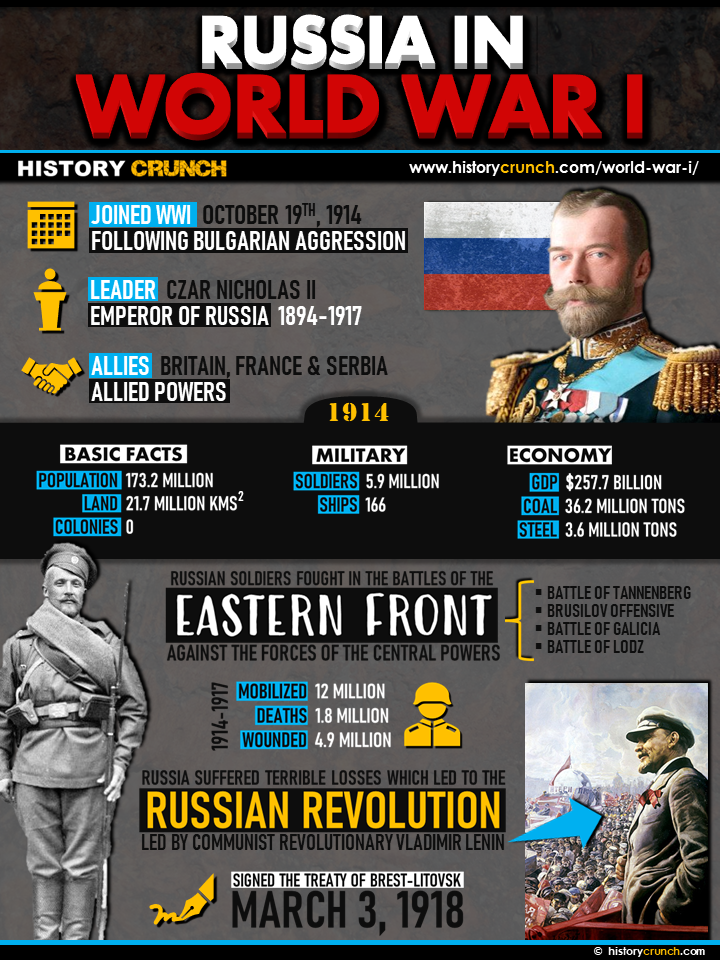
This Russia in World War I infographic was created by the History Crunch team to help students and teachers quickly understand the significance of Russia’s role in the First World War. It is designed as a visual learning and study tool, summarizing the essential information covered in our full article on Russia in World War I. Teachers may use it as a classroom display, a discussion prompt, or a study aid for students preparing for assessments.
What This Infographic Covers
The infographic begins with why Russia entered the war. Russia was a member of the Triple Entente alongside Britain and France. When Austria-Hungary threatened Serbia following the assassination of Franz Ferdinand, Russia came to Serbia’s defense based on the concept of Pan-Slavism, the idea that the Slavic peoples of Eastern Europe shared a common ethnic heritage and should support one another. Russia mobilized its forces on July 30th, 1914 and Germany declared war on Russia on August 1st. At the outbreak of the war Russia had approximately 5.9 million soldiers, which eventually grew to over 12 million serving over the course of the war, making it the largest fighting force of any nation in World War I.
The infographic covers Russia’s major battles on the Eastern Front. Russia mobilized faster than Germany had anticipated, which helped save France from defeat by forcing Germany to divert forces away from the Western Front. However, Russia’s early campaigns quickly revealed the severe weaknesses of its army. At the Battle of Tannenberg in August 1914, the German Eighth Army under Paul von Hindenburg and Erich Ludendorff surrounded and destroyed the Russian Second Army, with approximately 92,000 captured, 78,000 killed and only around 10,000 escaping. The Russian commander General Samsonov killed himself following the defeat. The battle devastated Russian morale and the Russian Army never again invaded Germany. On the southern Eastern Front Russia had more success against Austria-Hungary, capturing significant territory in Galicia in 1914, though these gains were largely reversed in 1915 when a combined German and Austro-Hungarian offensive drove Russia back in what became known as the Great Retreat.
The infographic covers the distinctive character of the Eastern Front compared to the Western Front. While the Western Front was defined by static trench warfare with minimal movement, the Eastern Front was far more dynamic, with front lines regularly shifting over great distances across the vast stretches of Eastern Europe. This was due partly to the enormous geographic scale of the front, which extended from the Baltic Sea in the north to the Black Sea in the south, and partly to Russia’s inability to fully equip and supply its forces. Many Russian soldiers went into battle without adequate weapons, ammunition or equipment.
The infographic covers the Russian home front and the political collapse that ended Russia’s involvement in the war. Support for the war was low among Russian farmers from the beginning, and it fell further as catastrophic losses mounted. Food shortages became severe as millions of workers were conscripted into the army. Tsar Nicholas II, who had led Russia since 1894, struggled to manage the crisis and in 1915 took personal command of the military, meaning he became personally associated with every subsequent military failure. In 1917 Vladimir Lenin led the Bolshevik Revolution against Tsar Nicholas II. The Tsar was imprisoned and Lenin and the Bolsheviks assumed power over Russia. Lenin pulled Russia out of the war by negotiating the Treaty of Brest-Litovsk with Germany, signed on March 3rd, 1918, which required Russia to give up large sections of territory. Russia’s withdrawal allowed Germany to shift its forces entirely to the Western Front for the final phase of the war.
How to Use This Infographic in the Classroom
This infographic works well as a visual introduction to Russia in World War I before students read the full article. It can also be used as a discussion prompt asking students to consider how Russia’s early mobilization helped prevent a German victory in the west, or to examine the connections between Russia’s wartime failures and the Russian Revolution of 1917. Teachers may also use it alongside the Eastern Front map and the WWI alliances map to help students understand Russia’s geographic and strategic position in the conflict.
Related Articles
To learn more about the topics covered in this infographic, visit the following History Crunch articles: