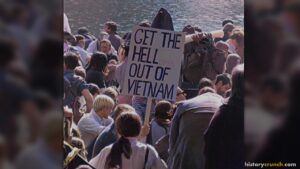
The Vietnam War was one of the most culturally significant conflicts of the 20th century. As the war escalated throughout the 1960s and into the 1970s, it created a powerful response in American popular culture. In general, historians consider the Vietnam War’s impact on popular culture to have been driven by several factors, including: the rise of television coverage that brought the realities of war into American homes, the growth of the anti-war protest movement, and the widespread distrust with government among the American public.
WHAT WAS THE VIETNAM WAR?
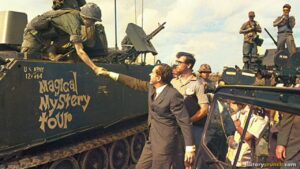
The Vietnam War was fought between the communist government of North Vietnam and the government of South Vietnam, which was supported primarily by the United States. The war grew out of decades of tension related to the history of colonialism, nationalism and the ideological conflict of the Cold War between the United States and the Soviet Union. The Vietnam War lasted from 1955 until 1975 and involved the United States military in a direct combat role for much of the 1960s and early 1970s. As such, historians consider the Vietnam War to be a ‘proxy war‘ within the larger Cold War. Regardless, the Vietnam War ended on April 30th, 1975, when North Vietnamese forces captured Saigon, the capital of South Vietnam, bringing the conflict to an end.
VIETNAM WAR IN POPULAR CULTURE – MUSIC
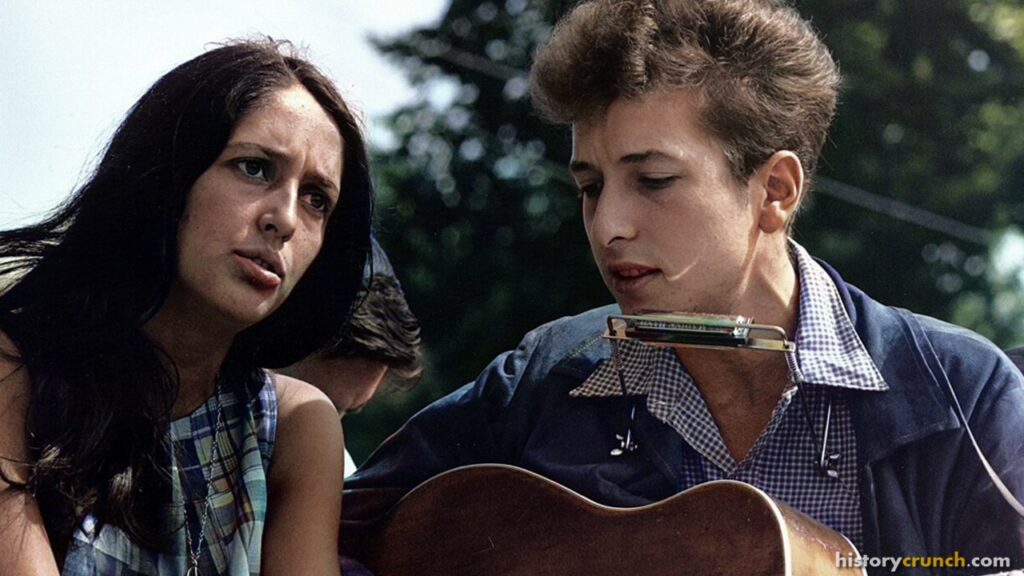
Throughout the 1960s and 1970s, popular musicians began expressing opposition to the war and the values of the anti-war movement through their songs. For instance, prominent artists such as Bob Dylan, Joan Baez, Jimi Hendrix and John Lennon created songs that touched on the divided nature of the American public, in regards to the Vietnam War. As a result, these musicians became important cultural figures in the anti-war movement and helped spread anti-war ideas to a wide public audience.
Several specific songs became anthems of the anti-war movement and are closely associated with the Vietnam War era. For instance, Bob Dylan’s ‘Blowin’ in the Wind’, released in 1962, became one of the most recognized protest songs of the era and was widely adopted by the anti-war movement as a symbol of its cause. Similarly, John Lennon’s ‘Give Peace a Chance’, released in 1969, became another powerful statement against the war and was sung by protesters at demonstrations across the United States. As well, Country Joe and the Fish performed their anti-war song ‘I-Feel-Like-I’m-Fixin’-to-Die Rag’ at the Woodstock Music Festival in August of 1969, in front of an audience of more than half a million people. The Woodstock festival itself became one of the most iconic events of the era and was closely linked to the anti-war sentiment that dominated much of American youth culture at the time.
VIETNAM WAR IN POPULAR CULTURE – FILM
The Vietnam War also had a major impact on the American film industry. In fact, the most significant wave of Vietnam War movies came in the years after the war ended. For instance, ‘The Deer Hunter’, released in 1978, examined the devastating psychological effects of the war on a group of working-class American soldiers from a small Pennsylvania town. The film was awarded the Academy Award for Best Picture and was widely praised for its serious and humanizing portrayal of the war’s impact on ordinary Americans. Similarly, ‘Apocalypse Now’, released in 1979 and directed by Francis Ford Coppola, used the Vietnam War as a backdrop to explore themes of madness, moral collapse and the destructive nature of war itself. The film became one of the most studied and discussed films in the history of American cinema.
Furthermore, the 1980s saw a continuing wave of Vietnam War films, including ‘Platoon’, released in 1986 and directed by Oliver Stone, who was himself a Vietnam veteran. ‘Platoon’ was awarded the Academy Award for Best Picture and was praised for its realistic portrayal of life as an American soldier in Vietnam. As well, ‘Full Metal Jacket’, released in 1987 and directed by Stanley Kubrick, explored the dehumanizing effects of military training and combat in Vietnam. Together, these films helped shape the way that many Americans and people around the world understood and remembered the Vietnam War in the decades after it ended.
VIETNAM WAR IN POPULAR CULTURE – LITERATURE
The Vietnam War also led to the publication of several significant works that made important contributions to American literature and helped bring the realities of the war to a wider audience.
One of the most important works of Vietnam War literature was ‘The Things They Carried’, published in 1990 by Tim O’Brien, who served as a soldier in Vietnam. The book is a collection of linked short stories that blend fiction and memoir to explore the experiences of American soldiers in the war. It became widely used in American high school and university classrooms and is considered one of the most important American war narratives of the 20th century. As well, Michael Herr’s ‘Dispatches’, published in 1977, was a first-hand account of the war by a journalist who covered the conflict for Esquire magazine. The book was praised for its vivid and unflinching portrayal of the chaos and violence of the war and was influential on the writers and filmmakers who came after it.
VIETNAM WAR IN POPULAR CULTURE – TELEVISION
It should also be noted that television played a particularly important role in shaping the cultural impact of the Vietnam War. The Vietnam War was the first major conflict in which much of the fighting was broadcast directly into American homes through nightly news coverage. For instance, images of combat, wounded soldiers, civilian casualties, and the chaos of battles such as the Tet Offensive in January of 1968 were seen by millions of American viewers. Furthermore, this had a direct effect on public opinion about the war. Historians generally agree that the televised nature of the Vietnam War distinguished it from earlier conflicts and contributed significantly to the growth of the anti-war movement and the overall cultural response to the conflict.
VIETNAM WAR IN POPULAR CULTURE – SIGNIFICANCE
The Vietnam War’s impact on popular culture was significant. The cultural response to the war helped bring the realities of the conflict to millions of people who were not directly involved in the fighting and contributed to the growing public pressure that ultimately influenced American policy decisions about the war. As well, the music, films, and literature produced in response to the Vietnam War have left a lasting legacy on American culture that continues to be studied and discussed today. In general, the Vietnam War in popular culture remains one of the clearest examples of how a major conflict can produce a profound and lasting cultural response that extends far beyond the battlefield.