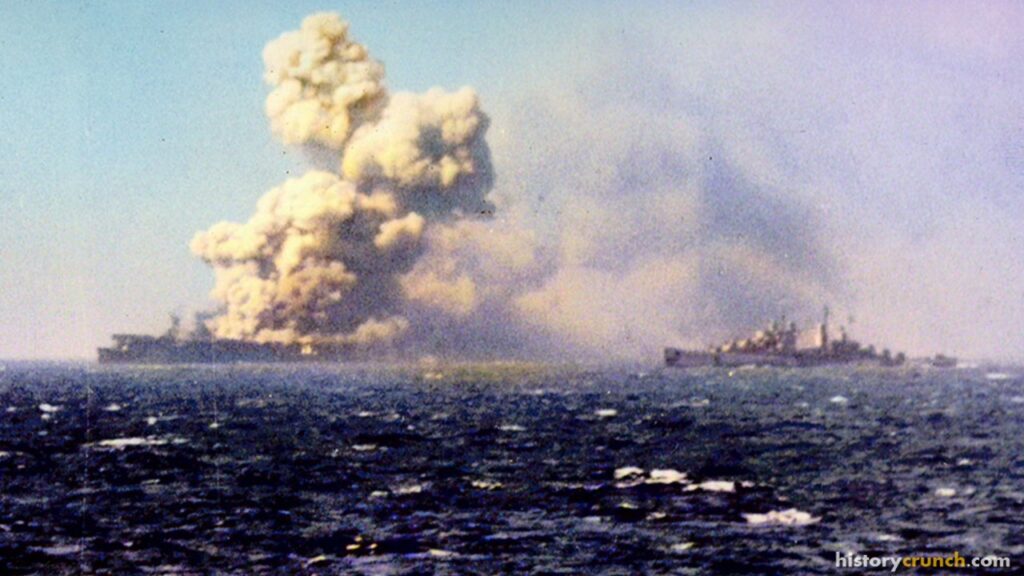
The Battle of Leyte Gulf was one of the most important naval battles of World War II and is often described as the largest naval battle in history. Fought from October 23rd to October 26th, 1944, in the waters around Leyte, Samar, and Luzon, in the Philippines, the Battle of Leyte Gulf ended in a major Allied victory and shattered Japan’s ability to fight a large offensive naval war. As such, the battle was one of the most significant during the Pacific Theater of World War II.
 FactsthatCrunch
The Battle of Leyte Gulf, fought from the 23rd to the 26th of October 1944, killed an estimated 12,000 Japanese sailors and pilots in four days of fighting across the Philippine Sea.
American losses in the same battle came to roughly 3,000 killed. Japan also lost 26 warships, including three battleships and four carriers, losses it could not replace. The defeat ended Japan's ability to challenge the United States for control of the Pacific.
Battle of Leyte Gulf – Background
The Battle of Leyte Gulf took place during the Allied return to the Philippines. By 1944, Japan had already lost many of its key positions in the Pacific, while the United States had grown much stronger at sea and in the air. The invasion of Leyte, Philippines, began on October 20th, 1944, because Allied leaders wanted to cut Japan’s supply lines to Southeast Asia, open the way for further attacks, and fulfill Douglas MacArthur’s promise to return to the Philippines. More than 130,000 men were ashore by the end of the first day.
This made the Battle of Leyte Gulf much larger than a simple sea clash. It was directly connected to the larger campaign to liberate the Philippines. If Japan could smash the invasion fleet and the supply ships supporting the landings, it might still damage the Allied advance in the Pacific. Therefore, the naval battle became a desperate Japanese attempt to stop a major turning point in the war.
FactsthatCrunchTap each impact to read what it led to.
Battle of Leyte Gulf – the Japanese Plan
The Japanese response was a plan called Sho-GoJapan’s naval plan to destroy the Allied invasion fleet at Leyte, using carrier ships as bait to draw away American forces., which means “Victory Operation.” The basic idea was to use a decoySomething used to lure an enemy away from the real target by pretending to be a valuable threat. carrier force in the north to lure William Halsey’s powerful Third Fleet away from the Leyte landing area. While that happened, heavier Japanese surface forces would move in from other directions and attack the vulnerable transports and support ships near Leyte Gulf, Philippines.
This plan showed how much Japanese naval strategy had changed by late 1944. Earlier in the war, Japanese carriers had been central to offensive operations. However, after the Battle of the Philippine Sea in June of 1944, Japan’s naval air power had been badly weakened. As a result, the northern carriers at the Battle of Leyte Gulf were used more as bait than as a true striking force.
Battle of Leyte Gulf – the Battle Begins
The Battle of Leyte Gulf opened just after midnight on October 23rd, 1944, when the Japanese central force under Takeo Kurita was discovered near Palawan, Philippines, by the submarines Darter and Dace. These submarines attacked and sank the heavy cruisers Atago and Maya and badly damaged Takao. This was important because it weakened Kurita’s force before the main battle had fully developed and also removed much of the surprise from the Japanese attack.
On October 24th, the battle spread into the Sibuyan Sea and Sulu Sea, near the central Philippines. For instance, United States carrier aircraft attacked Kurita’s ships repeatedly and sank the huge battleship Musashi. At the same time, the light carrier Princeton was badly damaged by Japanese attack and later had to be scuttledDeliberately sunk by one’s own crew, usually to prevent a ship from falling into enemy hands.. Regardless, Kurita did not turn back for long. After briefly seeming to retreat, he pushed onward toward the San Bernardino Strait, hoping still to reach the Allied shipping off Leyte.
Battle of Leyte Gulf – Surigao Strait
Another major part of the Battle of Leyte Gulf took place in Surigao Strait, Philippines, during the early hours of October 25th. There, a Japanese southern force under Shoji Nishimura tried to break through from the south, but it was met by destroyers, cruisers, and battleships of the United States Seventh Fleet, along with Australian ships. The Japanese force was crushed in a night battle.
The conflict at the Surigao Strait is especially famous because it was one of the last battleship-against-battleship actions in naval history. Jesse Oldendorf arranged his force so that he “crossed the TA naval tactic where one fleet crosses in front of the enemy line, allowing full sideways fire while the enemy can only use front guns.” of the Japanese line. This meant the American ships could fire full broadsidesSimultaneous firing of all the guns along one side of a warship. while the Japanese could mainly use only their forward guns. The result was devastating, and Nishimura’s force was effectively destroyed.
FactsthatCrunchCrossing the T is a naval battle tactic in which one fleet sails in a line directly across the path of an enemy fleet sailing toward it. The fleet crossing the T can fire all of its guns forward at the enemy, while the enemy fleet can only fire the front guns of its lead ships. This gives the crossing fleet a major firing advantage.
"At the Battle of Surigao Strait on October 25th, 1944, American battleships under Rear Admiral Jesse Oldendorf crossed the T against a Japanese force, allowing nearly every American gun to fire on the approaching Japanese ships at once."
Battle of Leyte Gulf – Battle Off Samar
The most dramatic part of the Battle of Leyte Gulf came off Samar, Philippines. While Halsey moved north to attack the Japanese decoy carriers, Kurita’s powerful surface force came through the San Bernardino Strait and suddenly appeared near the lightly protected escort carriersSmall, lightly armed aircraft carriers used mainly to support ground troops and protect supply ships rather than fight fleet battles., destroyers, and destroyer escorts of “Taffy 3.” These ships were far weaker than the Japanese battleships and cruisers now threatening the Leyte landings.
What followed became one of the most famous last stands in naval history. The small American force attacked with extraordinary aggression. Destroyers such as Johnston charged much larger enemy ships, while escort carriers launched aircraft again and again even though many had been armed mainly for ground support missions. The Japanese force lost three cruisers, while the Americans lost the escort carrier Gambier Bay, the escort carrier St. Lo, two destroyers, and one destroyer escort. St. Lo became the first United States ship sunk by a kamikazeA Japanese tactic in which pilots deliberately crashed their explosive-loaded aircraft into enemy ships to destroy them. attack.
Kurita eventually withdrew. He had been hurt by earlier attacks, confused by the violence of the American response, and uncertain about the true strength of the enemy in front of him. Therefore, the Battle off Samar became one of the most remarkable moments of the Battle of Leyte Gulf because a much smaller force helped save the Leyte invasion from disaster.
Off Samar, the small American force known as Taffy 3 was destroyed before it could fight back against Kurita's battleships and cruisers.
Battle of Leyte Gulf – Cape Engaño
While the fighting off Samar was unfolding, Halsey’s Third Fleet attacked the northern Japanese decoy force off Cape Engaño, near Luzon, Philippines. This force included the carrier Zuikaku, the last surviving Japanese carrier that had taken part in the Pearl Harbor attack. Because Japanese carrier air strength had already been badly weakened earlier in 1944, the northern force was no match for Halsey’s carriers and aircraft.
The result was a one-sided victory. All four Japanese carriers in the decoy force were sunk. However, this success also remained controversial because Halsey had taken his main striking force north and left the San Bernardino Strait unguarded. That decision almost allowed Kurita’s force to crash into the Leyte invasion area. As such, the Battle of Leyte Gulf included both a major American victory and one of the most debated command decisions of the Pacific War.
FactsthatCrunchIt is late October 1944, during the Battle of Leyte Gulf in World War II, and you are Admiral William Halsey, commander of the U.S. Third Fleet in the Pacific. Japanese forces have split into several groups, and your scouts have spotted Admiral Ozawa's carrier force moving south from the north, while other Japanese fleets are threatening the American landing beaches at Leyte Gulf from the west. If you take your fleet north to chase Ozawa's carriers, the San Bernardino Strait will be left unguarded, putting the smaller escort ships and the troops on the beaches at serious risk.
Battle of Leyte Gulf – Significance
The Battle of Leyte Gulf was significant because it destroyed Japan’s ability to conduct major offensive fleet operations. Japanese losses included battleships, carriers, cruisers, and destroyers on a scale the Imperial Japanese Navy could not replace. After the Battle of Leyte Gulf, Japan still had ships afloat, but it had largely ceased to exist as an effective offensive naval force.
The Battle of Leyte Gulf was also important because it secured the Allied return to the Philippines. The Japanese plan failed to break up the Leyte landings, and the Allies kept the initiative in the Pacific. In that sense, the Battle of Leyte Gulf helped clear the way for later campaigns that brought the war closer to Japan itself.
Finally, the Battle of Leyte Gulf is remembered because it showed the full complexity of modern naval war. It involved submarines, carrier aircraft, destroyers, escort carriers, cruisers, and battleships, all fighting across a huge area in several connected actions. It also marked the growing importance of kamikaze attacks in the final stage of the Pacific War. For all of these reasons, the Battle of Leyte Gulf stands as one of the decisive battles of World War II.
FactsthatCrunchThe Battle of Leyte Gulf, fought from October 23rd to 26th, 1944, destroyed Japan's ability to move a fleet in force and left the Imperial Navy unable to challenge Allied amphibious operations for the rest of the war.
Japan lost three battleships, four aircraft carriers, ten cruisers, and nine destroyers in the battle, a combined tonnage the country had no resources to replace.
Japan's carrier air groups had already been gutted at the Philippine Sea in June 1944, and Leyte Gulf wiped out the surface fleet that was supposed to compensate for that loss, leaving neither arm of naval power intact.
After the battle, Japan could no longer protect its supply lines between the home islands and Southeast Asia, cutting off oil, rubber, and raw materials that kept its war industries running.
The defeat forced Japan to rely on kamikaze attacks rather than conventional fleet tactics, a shift that showed its commanders understood organized fleet warfare was no longer a realistic option.
Explore World War II · 1939 – 1945
Keep exploring World War II with these History Crunch resources.
Key Vocabulary
Decoy
Sho-Go
Scuttled
Broadsides
Crossed the T
Escort carriers
Kamikaze
Frequently Asked Questions
When and where was the Battle of Leyte Gulf fought?
The Battle of Leyte Gulf was fought from October 23rd to October 26th, 1944, in the waters around Leyte, Samar, and Luzon in the Philippines. It took place during the Allied effort to retake the Philippines from Japan. The fighting spread across a huge area in several connected actions.
Why is the Battle of Leyte Gulf called the largest naval battle in history?
It is often called the largest naval battle in history because it involved so many ships across such a wide area. The fighting included submarines, carrier aircraft, destroyers, escort carriers, cruisers, and battleships. These forces fought in several separate but linked actions over four days.
What was the Japanese plan called Sho-Go?
Sho-Go, meaning “Victory Operation,” was Japan’s plan to stop the Leyte landings. A decoy carrier force in the north would lure William Halsey’s Third Fleet away from the beaches. Then heavier Japanese surface forces would attack the vulnerable transports and support ships near Leyte Gulf.
What happened in the Battle off Samar?
Off Samar, Kurita’s powerful ships surprised the lightly protected escort carriers and destroyers of “Taffy 3.” The small American force fought back with great aggression, charging much larger enemy ships and launching aircraft again and again. Kurita eventually withdrew, which helped save the Leyte invasion from disaster.
Why was Halsey’s decision at Cape Engaño controversial?
Halsey took his main striking force north to attack the Japanese decoy carriers near Luzon. This left the San Bernardino Strait unguarded, which almost allowed Kurita’s force to reach the Leyte landings. The move sparked one of the most debated command decisions of the Pacific War.
Why was the Battle of Leyte Gulf so important?
The battle was important because it destroyed Japan’s ability to carry out major offensive fleet operations. Japan lost battleships, carriers, cruisers, and destroyers it could not replace. The victory also secured the Allied return to the Philippines and kept the initiative in the Pacific.
Cite This Article
To cite this article as a source, use one of the formats below.
MLA: Millar, B. “Battle of Leyte Gulf: A Detailed Summary.” HistoryCrunch, 4 October 2026, https://historycrunch.com/battle-of-leyte-gulf/.
APA: Millar, B. (2026). Battle of Leyte Gulf: A Detailed Summary. HistoryCrunch. https://historycrunch.com/battle-of-leyte-gulf/
Chicago: Millar, B. “Battle of Leyte Gulf: A Detailed Summary.” HistoryCrunch. October 4, 2026. https://historycrunch.com/battle-of-leyte-gulf/
Sources
- Gerhard L. Weinberg, A World at Arms.
- Antony Beevor, The Second World War.