The Battle of the Atlantic in World War II was the long struggle for control of the sea routes between North America and Europe. It lasted from September of 1939 to May of 1945, and it was important because Allied victory depended on keeping Britain supplied with food, fuel, weapons, and troops while Nazi Germany tried to cut those lifelines with submarines, aircraft, and warships.
 FactsthatCrunch
Battle of the Atlantic – Background
The Battle of the Atlantic in World War II began almost as soon as the war started in Europe. The first Atlantic convoyA group of merchant ships traveling together under naval escort for protection against attack. sailed on September 2nd, 1939, and on September 3rd, 1939, the passenger liner Athenia was sunk by a German U-boatA German submarine used to attack Allied ships, shortened from the German word Unterseeboot meaning ‘undersea boat.’. Britain’s position made the struggle especially dangerous because, as an island nation, it depended heavily on merchant shipping crossing the Atlantic Ocean.
Nazi Germany hoped to defeat Britain by destroying those supply lines. Its most important naval weapon was the U-boat, a shortened form of the German word Unterseeboot, which means “undersea boat.” At first, Germany attacked with submarines, surface raiders, and aircraft, but the campaign became much more dangerous after the fall of France in June of 1940. Once Germany controlled ports on the French Atlantic coast, its submarines could reach the ocean more easily and stay at sea longer.
FactsthatCrunchA German U-boat sank the British passenger liner Athenia on September 3rd, 1939, the same day Britain declared war on Germany.
Battle of the Atlantic – the Nazi German U-Boat Campaign
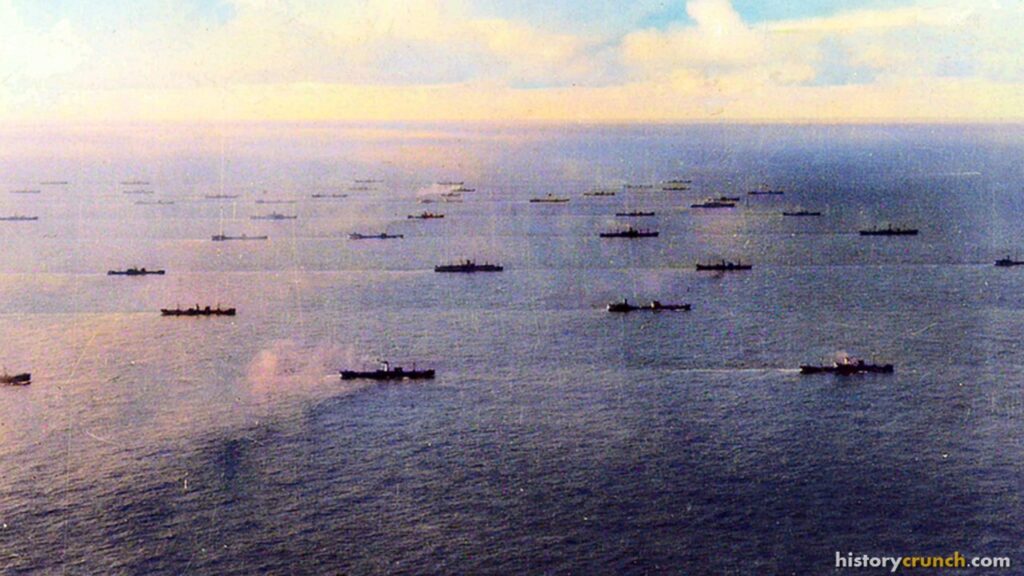
The central struggle in the Battle of the Atlantic in World War II was between Allied convoys and Nazi German U-boats. The convoy system grouped merchant ships together and placed them under naval escort. This made merchant traffic easier to protect, but it did not end the danger. In September of 1940, German submarines increasingly began using “wolf-packA tactic where groups of U-boats attacked Allied convoys together, usually at night, for greater destructive effect.” tactics, in which groups of U-boats attacked convoys together, usually at night. These attacks could be devastating, and in some cases as much as 20 percent of a convoy’s cargo ships were sunk.
A major problem for the Allies was the mid-Atlantic air gapAn area of ocean too far from land for most Allied aircraft to reach, giving German submarines room to attack freely., often called the “Black Pit.” This was the area of the ocean beyond the reach of many land-based aircraft, and it gave German submarines more freedom to attack convoys far from air cover. The campaign widened even more after the United States entered the war. From January to July of 1942, nearly 400 ships were sunk off the North American coast for the loss of only seven U-boats, while June of 1942 became the worst single month of the campaign for Allied shipping, with about 830,000 tons lost.
By 1942, the Battle of the Atlantic in World War II had become the longest continuous campaign of the war and one of its most dangerous. More than 1,300 Allied ships were sunk in the Atlantic in 1942 alone. Germany seemed close to doing the one thing that could have changed the whole war in the west: starving Britain into defeat and blocking the transport of American men and supplies across the ocean.
Why did German U-boats reach the Atlantic Ocean more easily after June 1940?
Battle of the Atlantic – Turning of the Tide
The turning point came through a combination of tactics, technology, and production. The Allies improved escort groups, expanded convoy protection, and used new tools such as sonarAn underwater detection tool used by Allied warships to locate submerged German submarines., radar, and HF/DFHigh-Frequency Direction Finding, a technology that let Allied escorts track U-boats by detecting their radio transmissions., which stood for High-Frequency Direction Finding and allowed escorts to track U-boat radio transmissions. Long-range aircraft also became more important, and new patrol planes helped close the “Black Pit” over the Atlantic.
CodebreakingThe work of secretly reading enemy military communications, used by the Allies to counter German naval operations. also played an important role. By the end of 1942, the Allies had made major progress against German naval communications, while improved air coverage and anti-submarine weapons made convoy attacks far more costly for Germany. In March of 1943, the campaign reached a major climax, with 108 Allied ships sunk that month. However, Allied escorts and aircraft were now inflicting rising losses on the U-boats.
The clearest sign of change came in May of 1943, often called “Black May” by the Germans. That month, 41 U-boats were sunk, and on May 24th, 1943, Karl Dönitz pulled many of his submarines back from the North Atlantic. Regardless, German submarines continued fighting later in the war, but they never recovered the same ability to threaten Allied shipping on that scale. By summer of 1943, the Atlantic sea lanes between Britain and North America were much more secure.

Battle of the Atlantic – Significance
The Battle of the Atlantic in World War II was significant because it affected nearly every other part of the war. If Germany had cut the Atlantic supply routes, Britain could have been starved into submission, and the Western Allies would have struggled to build the strength needed for later operations. Winston Churchill later wrote that the submarine threat was the thing that frightened him most during the war, which shows how serious the danger was.
The campaign was also important because it showed how modern war depended on industry, technology, intelligence, and transport as much as battlefield fighting on land. Small escort ships, long-range aircraft, codebreakers, and merchant sailors all played key roles. Canada, for instance, became one of the foremost Allied powers in the Atlantic war, and convoys from Halifax, Nova Scotia, Canada, became a major part of the Allied lifeline across the ocean.
In the end, the Battle of the Atlantic in World War II ended in Allied victory. Nazi Germany failed to stop the flow of troops and supplies, and that success helped make possible later offensives such as the Normandy landings in June of 1944 and the liberation of western Europe. For that reason, the Battle of the Atlantic in World War II stands as one of the most decisive campaigns of the entire war.
FactsthatCrunchHalifax became a major convoy assembly point for the Allied Atlantic lifeline, and Canada grew into one of the foremost Allied naval powers in the Battle of the Atlantic, escorting merchant ships loaded with food, fuel, and weapons across the ocean to keep Britain from being starved into defeat.
Because Britain is an island nation dependent on merchant shipping, the convoy routes running from Halifax across the North Atlantic were central to Allied survival throughout the war from 1939 to 1945.
Explore World War II · 1939 – 1945
Keep exploring World War II with these History Crunch resources.
Key Vocabulary
Convoy
U-boat
Wolf-pack
Mid-Atlantic air gap
HF/DF
Sonar
Codebreaking
Frequently Asked Questions
How long did the Battle of the Atlantic last?
The Battle of the Atlantic lasted from September of 1939 to May of 1945, the entire length of the war in Europe. This made it the longest continuous campaign of World War II. The fighting began almost as soon as the war started, when the liner Athenia was sunk on September 3rd, 1939.
What was a U-boat?
A U-boat was a German submarine and Germany’s most important naval weapon in the Atlantic. The name is a shortened form of the German word Unterseeboot, which means “undersea boat.” These submarines often attacked in groups called wolf packs, usually striking convoys at night.
What was the “Black Pit” in the Battle of the Atlantic?
The “Black Pit” was the mid-Atlantic air gap that lay beyond the reach of many land-based aircraft. Without air cover there, German submarines could attack convoys more freely and with less risk. Long-range patrol planes later helped close this gap and protect shipping.
Why did the Allies win the Battle of the Atlantic?
The Allies won through a mix of better tactics, new technology, and heavy production. Tools such as sonar, radar, and High-Frequency Direction Finding helped escorts track and sink U-boats. Codebreaking against German naval messages and more long-range aircraft also turned the tide by 1943.
What was “Black May” in 1943?
“Black May” was the name the Germans gave to May of 1943, when they lost 41 U-boats. The losses were so heavy that Karl Dönitz pulled many submarines back from the North Atlantic on May 24th, 1943. Germany’s submarines kept fighting afterward but never threatened Allied shipping on the same scale.
Why was the Battle of the Atlantic so important?
The battle kept Britain supplied with food, fuel, weapons, and troops from across the ocean. If Germany had cut these routes, Britain could have been starved into defeat. The Allied victory made later operations possible, including the Normandy landings in June of 1944.
Cite This Article
To cite this article as a source, use one of the formats below.
MLA: Millar, B. “Battle of the Atlantic in World War II: A Detailed Summary.” HistoryCrunch, 2 October 2026, https://historycrunch.com/battle-of-the-atlantic-in-world-war-ii/.
APA: Millar, B. (2026). Battle of the Atlantic in World War II: A Detailed Summary. HistoryCrunch. https://historycrunch.com/battle-of-the-atlantic-in-world-war-ii/
Chicago: Millar, B. “Battle of the Atlantic in World War II: A Detailed Summary.” HistoryCrunch. October 2, 2026. https://historycrunch.com/battle-of-the-atlantic-in-world-war-ii/
Sources
- Antony Beevor, The Second World War.
- Imperial War Museum