The Battle of the Philippines was the Japanese conquest of the Philippine Islands in the opening months of the Pacific Theater of War in World War II. Fought from December 8th, 1941, to May 9th, 1942, the Battle of the Philippines ended in Japanese victory, the fall of Bataan and Corregidor, and the beginning of Japanese occupation in the islands. As such, historians consider the Battle of the Philippines to be an important conflict from the timeframe of World War II.
Battle of the Philippines – Background
The Battle of the Philippines began only hours after the Japanese attack on Pearl Harbor, which occurred on December 7th, 1941. The Philippines was an important American position in the western Pacific, and Japan wanted to seize it so that it could protect its expansion into Southeast Asia and remove a threat to its southern advance. In 1941, the islands were still under the Philippine CommonwealthA self-governing territory closely tied to the United States that controlled the Philippine Islands in 1941., closely tied to the United States, and their defense was placed under General Douglas MacArthur.
The defenders in the Battle of the Philippines included both Filipino and American forces. In general, this looked like a large defense, but the buildup was incomplete, training was uneven, and many units lacked equipment. Japan, by contrast, struck quickly with air attacks and landings designed to break resistance before the defenders could fully organize.
 FactsthatCrunch
Battle of the Philippines – The Japanese Invasion
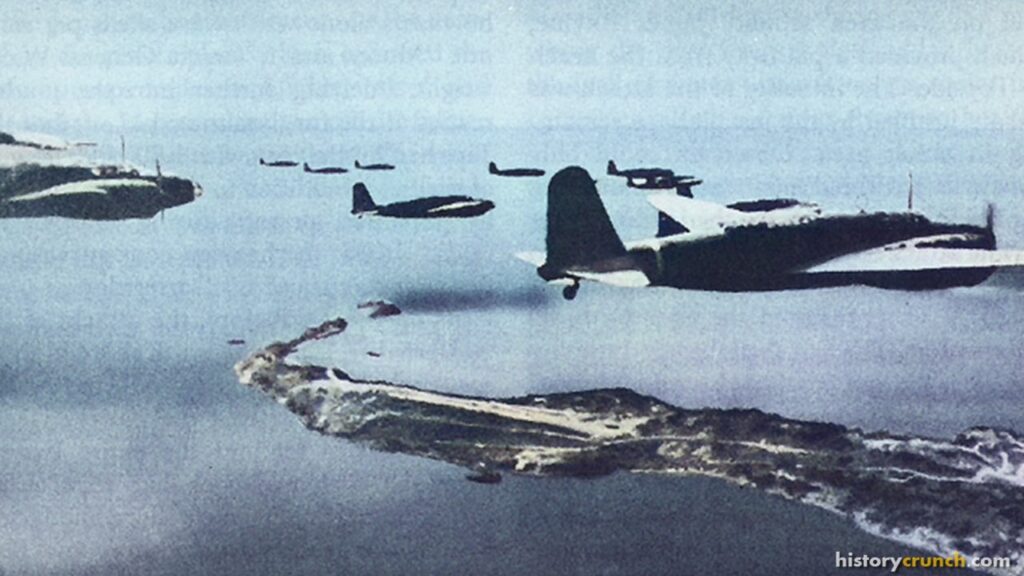
On December 8th, 1941, Japanese aircraft attacked targets in the Philippines, including Clark Field on Luzon, Philippines. This badly weakened Allied air power early in the campaign. Japanese landings then followed on northern Luzon, Philippines, and larger invasion forces came ashore at Lingayen Gulf on December 22nd, 1941 and at Lamon Bay on December 24th, 1941. These attacks opened the main stage of the Battle of the Philippines on Luzon, the largest and most important island in the archipelagoA large group of islands, used here to describe the Philippine Islands as a whole..
The Japanese advance was rapid. Manila, Philippines, was declared an open cityA city declared undefended and abandoned by military forces to prevent its destruction during wartime. before Christmas in an effort to avoid destruction, and Japanese troops entered it on January 2nd, 1942. By that point, the defenders had already begun falling back toward the Bataan Peninsula and Corregidor Island at the entrance to Manila Bay, Philippines. This retreat followed earlier defense planning, which recognized Bataan and Corregidor as the strongest positions for a last stand on Luzon.
FactsthatCrunchBattle of the Philippines – Bataan and Corregidor
The most intense stage of the Battle of the Philippines came in Bataan and Corregidor. The Battle of Bataan began in early January of 1942, and the combined Filipino and American defenders held out for about three months under terrible conditions. Food shortages, disease, exhaustion, and lack of outside support steadily weakened the defense. Regardless, the troops on Bataan delayed the Japanese much longer than Tokyo had planned.
A major change came on March 11th, 1942, when MacArthur left Corregidor for Australia under orders, and General Jonathan Wainwright took command in the Philippines. By then, the situation was becoming hopeless. Bataan fell on April 9th, 1942, and about 76,000 Filipino and American defenders surrendered there, making it one of the largest surrenders under American command.
After the surrender on Bataan, thousands of prisoners were forced onto what became known as the ‘Bataan Death March‘. The prisoners, already starving and sick, were marched north under brutal conditions, and many died from abuse, neglect, and exhaustion. This became one of the most infamous atrocitiesExtremely cruel and violent acts committed against people, especially during war. of the Pacific Theater of World War II and permanently shaped how the Battle of the Philippines was remembered.
Corregidor held out for a few more weeks after Bataan fell. Japanese aircraft and artillery pounded the island fortress, and Japanese troops landed there on the night of May 5th to 6th, 1942. Wainwright surrendered on May 6th, and the remaining organized resistance in the southern Philippines capitulatedGave up and surrendered to an enemy force after being unable to continue fighting. by May 9th. With that, the Battle of the Philippines came to an end.
FactsthatCrunchYou have taken me out of the jaws of death, and I won't forget it.
MacArthur said this to Lieutenant John Bulkeley after Bulkeley's PT boats carried him about 560 miles (900 km) through Japanese-patrolled seas away from the fall of the Philippines.
Battle of the Philippines – Significance
The Battle of the Philippines was important because it showed both the speed of early Japanese victories and the determination of Filipino and American resistance. Japan won the campaign and occupied the islands, but the long defense of Bataan and Corregidor disrupted the Japanese timetableA planned schedule for completing military operations within a certain period of time. and tied down forces that Tokyo had hoped to use elsewhere more quickly.
The Battle of the Philippines was also important because it became one of the defining early defeats for the United States in World War II and one of the most painful wartime experiences in Philippine history. The fall of the islands led to occupation, guerrilla resistanceFighting by small, informal groups using hit-and-run tactics against an occupying enemy force., and the suffering of prisoners and civilians. As well, the Bataan Death March and later wartime atrocities made the campaign a lasting symbol of endurance, sacrifice, and wartime brutality in the Pacific.
FactsthatCrunchWhy did the long defense of Bataan and Corregidor matter to Japan's overall Pacific campaign?
Explore World War II · 1939 – 1945
Keep exploring World War II with these History Crunch resources.
Key Vocabulary
Philippine Commonwealth
Archipelago
Open city
Capitulated
Atrocities
Guerrilla resistance
Timetable
Frequently Asked Questions
When was the Battle of the Philippines fought?
The Battle of the Philippines was fought from December 8th, 1941, to May 9th, 1942. It began only hours after the Japanese attack on Pearl Harbor the day before. The fighting ended with a Japanese victory and the start of Japanese occupation in the islands.
Why did Japan want to seize the Philippines?
Japan wanted the Philippines to protect its expansion into Southeast Asia. The islands were an important American position in the western Pacific. Taking them removed a threat to Japan’s southern advance and secured its supply routes.
What happened at Bataan and Corregidor?
Bataan and Corregidor were the sites of the campaign’s last and most intense stand. Filipino and American troops held Bataan for about three months before it fell on April 9th, 1942. The fortress island of Corregidor surrendered on May 6th, 1942, after heavy bombing and a Japanese landing.
What was the Bataan Death March?
The Bataan Death March was the forced movement of thousands of prisoners after Bataan fell. The captives were already starving and sick, yet they were marched north under brutal conditions. Many died from abuse, neglect, and exhaustion, making it one of the most infamous atrocities of the Pacific war.
Why did General MacArthur leave the Philippines?
General Douglas MacArthur left Corregidor for Australia on March 11th, 1942, under direct orders. By then the defenders’ situation was becoming hopeless. General Jonathan Wainwright took command of the forces that remained in the Philippines.
Why was the Battle of the Philippines important?
The Battle of the Philippines was important because it was one of the first major American defeats of World War II. The long defense of Bataan and Corregidor disrupted Japan’s timetable and tied down its forces. The campaign also became a lasting symbol of endurance, sacrifice, and wartime brutality in the Pacific.
Cite This Article
To cite this article as a source, use one of the formats below.
MLA: Millar, B. “Battle of the Philippines: A Detailed Summary.” HistoryCrunch, 2 October 2026, https://historycrunch.com/battle-of-the-philippines/.
APA: Millar, B. (2026). Battle of the Philippines: A Detailed Summary. HistoryCrunch. https://historycrunch.com/battle-of-the-philippines/
Chicago: Millar, B. “Battle of the Philippines: A Detailed Summary.” HistoryCrunch. October 2, 2026. https://historycrunch.com/battle-of-the-philippines/
Sources
- Antony Beevor, The Second World War.
- The National WWII Museum
- Imperial War Museum
- Gerhard L. Weinberg, A World at Arms.