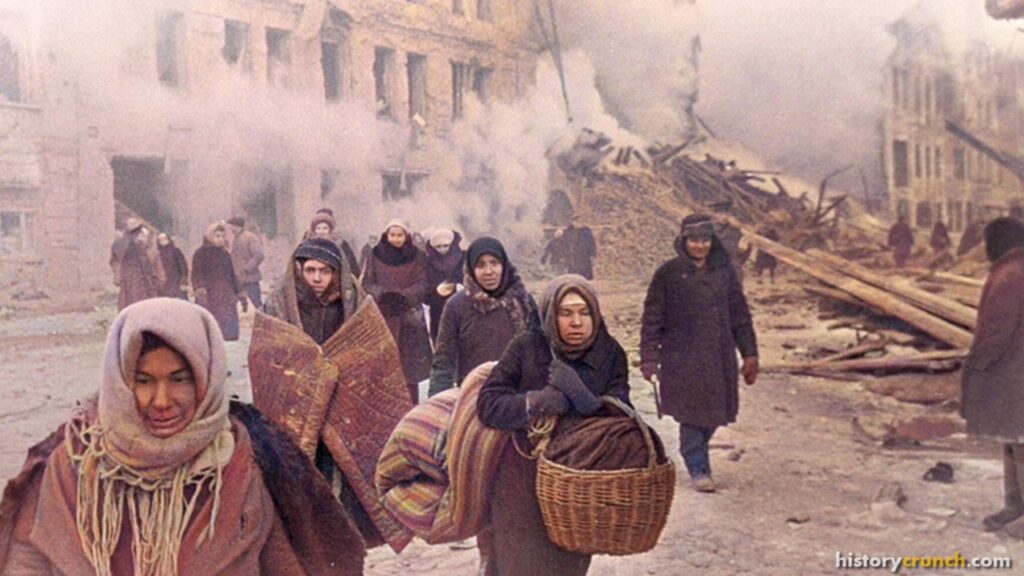
The SiegeA military strategy of surrounding a city to cut off supplies and force it to surrender without direct street fighting. of Leningrad was one of the longest and deadliest sieges in modern history and became one of the most important battles on the Eastern Front of World War II. It lasted from September 8th, 1941, to January 27th, 1944, for 872 days, and it was fought around Leningrad, Soviet Union, now St. Petersburg, Russia, as Nazi German and Finnish forces tried to isolate and destroy the city rather than capture it in a direct assault.
Siege of Leningrad – Background
The siege took place during Operation Barbarossa, which was Nazi Germany’s invasion of the Soviet Union. After invading on June 22nd, 1941, German forces advanced rapidly across a huge front, and Leningrad became one of their main objectives because it was the Soviet Union’s second-largest city, a major industrial center, and an important symbol of Soviet power. Finland also advanced from the north after entering the war against the Soviet Union.
By early September of 1941, German forces had approached Leningrad from the south and west, while Finnish forces had moved into position to the north. On September 8th, 1941, German troops captured Shlisselburg, Soviet Union, east of the city, cutting the last land route into Leningrad and formally beginning the siege. This was significant because the city was now largely cut off from the rest of the Soviet Union and had to survive under blockadeThe cutting off of a city or region from outside supplies, people, and communication..
Siege of Leningrad – the Siege Begins
The German plan was not mainly to storm the city street by street. Instead, the goal was to surround Leningrad, bomb it, shell it, and starve it into collapse. Hitler’s forces expected that hunger, cold, and fear would destroy resistance. Therefore, the siege quickly became not only a military struggle, but also a direct attack on civilians.
Leningrad’s defenders and civilians responded immediately. Large numbers of residents were mobilizedOrganized and called into active service for a military or emergency purpose. to build fortifications, trenches, and anti-tank defenses around the city. The population also had to prepare for a long struggle while factories continued working and the Red Army tried to hold the lines outside the city. This is important because the siege was fought not only by soldiers at the front, but also by ordinary people inside the city itself.
The German plan for Leningrad was to capture the city in direct street fighting.

Siege of Leningrad – Life Inside the City
Life inside besieged Leningrad became horrifying, especially during the winter of 1941 to 1942. Food supplies collapsed, fuel was scarce, electricity failed in many areas, and people faced intense cold as well as constant bombardment. The worst suffering came from starvation. During the lowest rationA fixed, limited amount of food officially allowed to each person during a shortage. period from November 20th to December 25th, 1941, industrial workers received 250 grams [8.8 ounces] of bread a day, while clerks, dependents, and children received only 125 grams.
The human cost was enormous. Official Soviet-era figures later recorded about 632,000 civilian deaths, but later estimates have often placed the civilian death toll much higher, commonly around 800,000 to 1 million or more, mostly from starvation, disease, exposure, and shelling. For high school students, this is one of the clearest examples of how total war affected civilians as much as soldiers. The Siege of Leningrad was not only a military event. It was also a humanitarian disaster on a massive scale.
Even under these conditions, the city did not surrender. Factories continued producing war materials, anti-aircraft defenses remained active, and cultural life did not disappear entirely. One of the most famous examples came on August 9th, 1942, when Dmitri Shostakovich’s Seventh Symphony, often called the “Leningrad” Symphony, was performed in the city during the siege. This mattered because it became a symbol of resistance and survival under extreme conditions.
Siege of Leningrad – Road of Life
Because land routes were cut, the main connection to the outside world ran across Lake Ladoga, Soviet Union, which is now in Russia. In warmer months, supplies crossed by water, and in winter they crossed over the frozen lake on what became known as the ‘Road of Life’. This route brought in food and ammunition and allowed many civilians, especially children and the sick, to be evacuated. Without it, the city would likely have suffered even greater losses.
Even so, the Road of Life could not fully solve the city’s problems. Deliveries were dangerous and often inadequate, and vehicles crossing the ice faced bombing, shelling, and the risk of breaking through the frozen surface. Therefore, the Road of Life helped keep Leningrad alive, but it did not end the siege or remove the terrible shortages inside the city.
FactsthatCrunchThe Road of Life was a supply route across Lake Ladoga that kept Leningrad connected to the rest of the Soviet Union after German forces cut every land route into the city in September of 1941.
Siege of Leningrad – Breaking the Blockade
The siege was not ended all at once. In January of 1943, the Soviet Union launched Operation Iskra, which means “Spark.” Soviet forces opened a narrow land corridorA narrow passage or strip of land connecting two areas that are otherwise cut off from each other. to the city on January 18th, 1943, south of Lake Ladoga. This did not fully end the siege, but it was a major turning point because it allowed a rail link to be built and improved the flow of supplies into Leningrad.
The siege was fully lifted a year later. On January 27th, 1944, Soviet forces drove German troops far enough back that the blockade ended. This final lifting of the siege was part of a larger Soviet offensiveA large, organized military attack intended to push the enemy back over a wide area. that pushed Germany backward on the northern part of the Eastern Front. Therefore, the survival of Leningrad became part of the wider Soviet recovery that was turning the war against Germany.
FactsthatCrunchOperation Iskra did not fully end the siege, but it was the turning point that changed Leningrad's situation. The corridor and its rail link eased the worst shortages and set the stage for the full lifting of the blockade in 1944.
Siege of Leningrad – Significance
The Siege of Leningrad was significant because it showed both the brutality of Nazi warfare and the endurance of the Soviet war effort. Nazi Germany failed to destroy or capture one of the Soviet Union’s most important cities, even after nearly two and a half years of blockade. As such, the siege became a symbol of Soviet resistance in World War II.
The siege is also important because it helps students understand the larger nature of the Eastern Front. It was a war fought across huge distances, with massive armies, but it was also a war of starvation, destruction, and suffering for civilians. The Siege of Leningrad stands out not only as a military event, but also as one of the clearest examples of how World War II devastated entire cities and populations.
FactsthatCrunch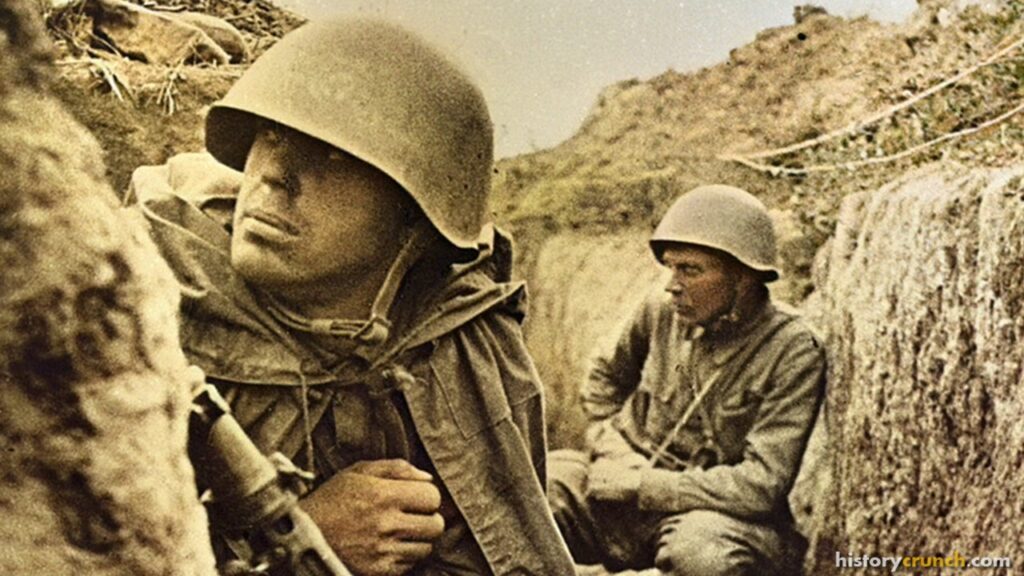 Black & whiteColor
Explore World War II · 1939 – 1945
Keep exploring World War II with these History Crunch resources.
Key Vocabulary
Siege
Blockade
Mobilized
Ration
Corridor
Offensive
Frequently Asked Questions
How long did the Siege of Leningrad last?
The Siege of Leningrad lasted 872 days, from September 8th, 1941, to January 27th, 1944. This made it one of the longest sieges in modern history. The city was cut off when German forces captured Shlisselburg and closed the last land route.
Why did Germany lay siege to Leningrad instead of capturing it?
Germany chose to surround Leningrad and starve it rather than storm it street by street. The plan was to use hunger, cold, and bombardment to break the city’s resistance. As a result, the siege became a direct attack on civilians as well as soldiers.
How many people died during the Siege of Leningrad?
Official Soviet-era figures recorded about 632,000 civilian deaths, but later estimates often reach 800,000 to 1 million or more. Most people died from starvation, disease, cold, and shelling. The worst suffering came during the winter of 1941 to 1942.
What was the Road of Life?
The Road of Life was the main supply route to Leningrad across Lake Ladoga. In warmer months supplies came by water, and in winter they crossed over the frozen lake. It brought in food and ammunition and let many children and sick people escape the city.
How was the Siege of Leningrad finally broken?
Soviet forces opened a narrow land corridor on January 18th, 1943, during Operation Iskra. This allowed a rail link and improved the flow of supplies, but it did not end the siege. The blockade was fully lifted on January 27th, 1944, as Soviet troops pushed German forces back.
What is the Leningrad Symphony?
The Leningrad Symphony is Dmitri Shostakovich’s Seventh Symphony, performed in the city on August 9th, 1942. Musicians played it during the siege under terrible conditions. The performance became a powerful symbol of resistance and survival.
Cite This Article
To cite this article as a source, use one of the formats below.
MLA: Millar, B. “Siege of Leningrad: A Detailed Summary.” HistoryCrunch, 2 October 2026, https://historycrunch.com/siege-of-leningrad/.
APA: Millar, B. (2026). Siege of Leningrad: A Detailed Summary. HistoryCrunch. https://historycrunch.com/siege-of-leningrad/
Chicago: Millar, B. “Siege of Leningrad: A Detailed Summary.” HistoryCrunch. October 2, 2026. https://historycrunch.com/siege-of-leningrad/
Sources
- Gerhard L. Weinberg, A World at Arms.
- Max Hastings, Inferno / All Hell Let Loose.
- The National WWII Museum