Yuri Andropov was a Soviet leader who ruled for a short time in the early 1980s after the death of Leonid Brezhnev. He is remembered for trying to improve discipline in the Soviet system and for leading during a tense stage of the Cold War. He was the main Soviet leader from November 12th, 1982, until his death on February 9th, 1984, and he is remembered for his years as head of the KGB, his efforts to improve discipline inside the Soviet system, and the tense Cold War climate of the early 1980s.
 FactsthatCrunch
Andropov rose from modest jobs including telegraph operator and boatman on the Volga River to become the top leader of the Soviet Union. He is remembered for his long tenure heading the KGB, his anti-corruption drive as Soviet leader, and his role in mentoring reformers such as Mikhail Gorbachev, whose later changes reshaped the Soviet Union.
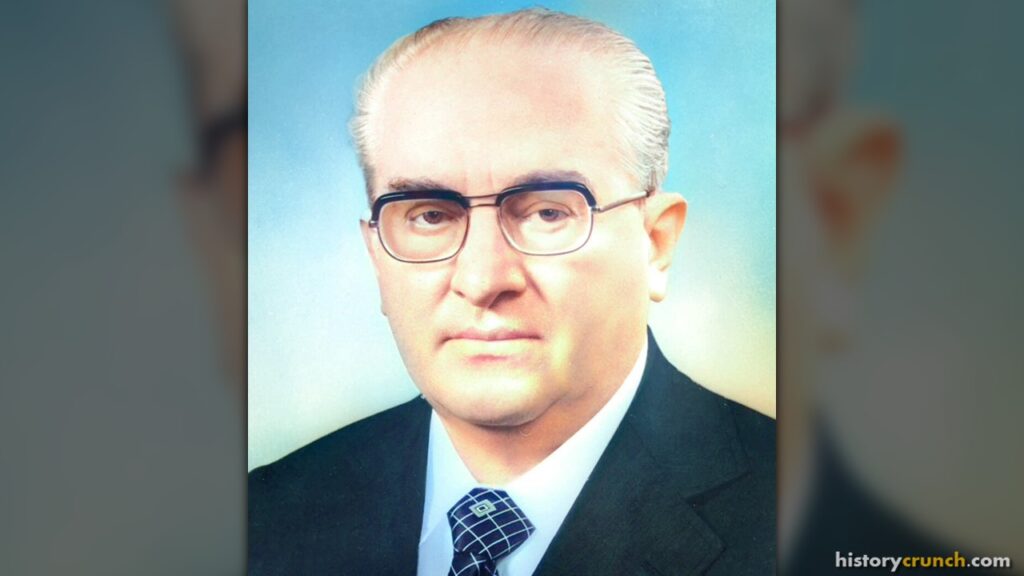
Yuri Andropov – Early Life
Yuri Vladimirovich Andropov was born on June 15th, 1914, in Nagutskoye, Russia. He came from a modest background, and before rising in Soviet politics he worked as a telegraph operatorA person who sends and receives messages using electrical signals over long wires., film projectionist, and boatman on the Volga River. He later attended technical school and became active in the Young Communist LeagueA Soviet youth organization that trained future Communist Party members and officials., which helped begin his political career.
As a young party activist, Andropov developed a reputation as an effective organizer. He joined the Communist Party in 1939, and his abilities were quickly noticed by party leaders. Therefore, his early rise was tied to the Soviet system’s habit of promoting disciplined and loyal officials through party organizations.
FactsthatCrunchWhat jobs did Yuri Andropov hold before he entered Soviet politics?
Yuri Andropov – Rise in Soviet Politics
A major turning point in Andropov’s career came when he was transferred to Moscow in 1951. This brought him closer to the center of Soviet power. In July of 1954, he was appointed ambassadorAn official sent by one country to represent its government in another country. to Hungary, and during the Hungarian Crisis of 1956 he played a major role in coordinating the Soviet response to the uprising there. This was important because it showed party leaders that he could be trusted during a major Cold War crisis.
After returning to Moscow, Andropov continued rising through the Communist Party. In 1967, he became head of the KGB, which was the Soviet Union’s main state security and intelligence organization. His years in that position were marked by the suppression of political dissidentsPeople who openly oppose or criticize their government’s policies or system., which gave him a reputation as a hard and disciplined Soviet official.
By 1982, Leonid Brezhnev’s health was failing, and Andropov was in a strong position to succeed him. He left the KGB in 1982, entered the Central Committee secretariat, and after Brezhnev died on November 10th, 1982, Andropov was chosen as general secretaryThe top leadership position in the Soviet Communist Party, making the holder the most powerful person in the USSR. on November 12th. This made him the top leader of the Soviet Union.
FactsthatCrunchIn 1956, Yuri Andropov was serving as Soviet ambassador to Hungary when a major uprising broke out against communist rule there. He coordinated the Soviet response to the crisis on the ground, sending reports to Moscow and working to manage the situation. Party leaders in Moscow were watching closely to see whether Andropov could be trusted in a dangerous Cold War moment.
Yuri Andropov – Leadership of the Soviet Union
When Andropov took power, the Soviet Union was already facing serious economic and political problems. Unlike later reformers, he did not believe the socialist system itself needed to be replaced. Instead, he thought the country could improve through greater discipline, efficiency, and anti-corruption efforts. As such, he focused on problems such as absenteeismThe habit of workers regularly missing work without a good reason., alcoholism, and corruption.
Andropov’s leadership style was different from Brezhnev’s. He cut back some elite privileges and tried to show a more serious and active style of rule. He also targeted weaknesses in transportation, retail trade, industry, and agriculture. However, these reforms had limited results because the Soviet economy was already in deep decline. Therefore, although Andropov recognized many of the Soviet Union’s problems, he was not able to solve them in his short time in office.
His leadership also came during a tense stage of the Cold War. Relations with the United States worsened during the presidency of Ronald Reagan, and tensions grew even further after the Soviet shooting down of Korean Air Lines Flight 007 in September of 1983. Later that year, Soviet negotiators broke off important arms-control talksNegotiations between countries meant to limit or reduce their weapons. with the United States. This increased fear and distrust between the two superpowers during an already dangerous period.
Even so, Andropov’s rule mattered for the future of the Soviet Union. Under him, a group of cautious reformers began to rise, including Mikhail Gorbachev. In fact, Andropov wanted Gorbachev to succeed him, although that did not happen immediately after his death. This is significant because it connected Andropov’s short rule to the much larger reforms that came a few years later under Gorbachev.
FactsthatCrunchFollow the chain from top to bottom. Tap any step to read what happened.
Yuri Andropov – Later Years and Death
Andropov’s health declined badly during 1983. By August of that year, he was no longer seen in public, and his illness greatly limited what he could do as Soviet leader. Because of this, his time in power was both short and politically restricted.
Yuri Andropov died on February 9th, 1984, in Moscow, at the age of 69. After his death, he was succeeded by Konstantin Chernenko rather than Gorbachev. However, the larger questions about Soviet decline remained unresolved, and they would soon become even more serious.
FactsthatCrunchKonstantin Chernenko succeeded Yuri Andropov as Soviet leader, following Andropov's death in February 1984
Yuri Andropov – Significance
Yuri Andropov was significant because he represented an important transition in late Soviet history. He came to power after Brezhnev, recognized that the Soviet Union was weakening, and tried to restore discipline and efficiency without completely changing the system.
At the same time, Andropov remains a debated historical figure. Some people view him as a serious leader who understood that the Soviet Union needed reform. Others focus on his KGB background, his role in repression, and the fact that his policies did not solve the deeper crisis facing the Soviet state. Regardless, Yuri Andropov played a key role in the final years before the Soviet Union moved toward much larger change under Mikhail Gorbachev.
FactsthatCrunchHow do historians disagree about Yuri Andropov's legacy as a late Soviet leader?
Explore Cold War · 1947 – 1991
Keep exploring Cold War with these History Crunch resources.
Key Vocabulary
Telegraph operator
Young Communist League
Ambassador
Dissidents
Absenteeism
Arms-control talks
General secretary
Frequently Asked Questions
Who was Yuri Andropov?
Yuri Andropov was a Soviet leader who ruled from November 12th, 1982, until his death in 1984. He took over after Leonid Brezhnev and led during a tense stage of the Cold War. Before that, he spent many years as head of the KGB, the Soviet state security agency.
What was the KGB and what did Andropov do there?
The KGB was the Soviet Union’s main state security and intelligence organization. Andropov led it from 1967 until 1982, making him one of its longest-serving heads. His years there were marked by the suppression of political dissidents, which earned him a reputation as a hard and disciplined official.
What reforms did Andropov try to make?
Andropov tried to fix the Soviet system through greater discipline, efficiency, and anti-corruption efforts rather than major change. He targeted problems such as absenteeism, alcoholism, and corruption, and he cut back some elite privileges. These reforms had limited results because the Soviet economy was already in deep decline.
How was Andropov connected to Mikhail Gorbachev?
Andropov helped a group of cautious reformers rise, including Mikhail Gorbachev. He wanted Gorbachev to succeed him, though that did not happen right away. Instead, Konstantin Chernenko followed Andropov before Gorbachev finally took power a few years later.
How did Andropov die?
Andropov died on February 9th, 1984, in Moscow at the age of 69 after his health declined badly. By August of 1983 he was no longer seen in public, and illness greatly limited his work as leader. His time in power was both short and politically restricted.
Cite This Article
To cite this article as a source, use one of the formats below.
MLA: Millar, B. “Yuri Andropov: A Detailed Biography.” HistoryCrunch, 12 October 2026, https://historycrunch.com/yuri-andropov/.
APA: Millar, B. (2026). Yuri Andropov: A Detailed Biography. HistoryCrunch. https://historycrunch.com/yuri-andropov/
Chicago: Millar, B. “Yuri Andropov: A Detailed Biography.” HistoryCrunch. October 12, 2026. https://historycrunch.com/yuri-andropov/
Sources
- John Lewis Gaddis, The Cold War: A New History.
- State Department — Office of the Historian