Mikhail Gorbachev was the last leader of the Soviet Union and a major figure in the end of the Cold War. He is remembered for reforms such as perestroika and glasnost, which opened Soviet society but also helped speed up the collapse of the Soviet state. Mikhail Gorbachev was significant because he led the Soviet Union during its final years and introduced reforms that changed both his country and the wider world.
 FactsthatCrunch
Gorbachev introduced perestroika, meaning restructuring, and glasnost, meaning openness, to strengthen the Soviet system, but the reforms loosened the Communist Party’s control. He worked with Ronald Reagan to reduce Cold War tensions and refused to use Soviet troops to keep communist governments in power in Eastern Europe in 1989. He resigned on December 25th, 1991, and the Soviet Union formally ceased to exist the next day.
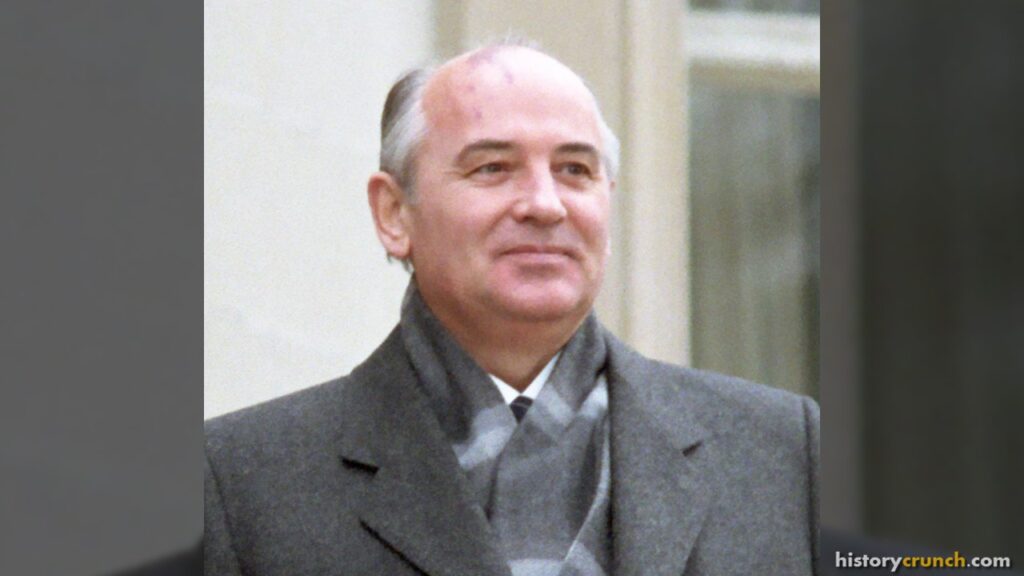
Mikhail Gorbachev – Early Life
Mikhail Sergeyevich Gorbachev was born on March 2nd, 1931, in Privolnoye, Stavropol Krai, in the Soviet Union. He was raised in a peasant family and grew up during a difficult period in Soviet history that included collectivizationA Soviet policy that forced peasants to give up private farms and work on government-controlled collective farms., political repression and World War II. These early experiences exposed him to both the hardships and the strict control of Soviet life.
As a young man, Gorbachev worked on collective farms and showed strong academic ability. He later studied law at Moscow State University, one of the most important universities in the Soviet Union. While there, he joined the Communist Party, which was the ruling political party of the Soviet state. Therefore, his education and party membership helped place him on the path toward a career in government.
FactsthatCrunchUnder Soviet collectivization, which began in the late 1920s, the government forced peasants to give up their private farms and move onto large, government-controlled collective farms. Families who had worked their own land for generations lost control over what they grew, how they worked, and what they kept. Gorbachev grew up in this system in the Stavropol region and worked on collective farms as a young man, experiencing firsthand how little freedom rural Soviet families had.
Private farming returned to Russia and other former Soviet republics after the Soviet Union collapsed in December of 1991. Today, farmers in those countries can own land, choose what to grow, and sell their products on open markets, rights that were forbidden for most of the Soviet era. The memory of collectivization still shapes how rural communities in Russia and Eastern Europe think about government control over land and food.
Collectivization shaped Gorbachev's understanding of Soviet hardship, and its eventual end shows how completely the system he grew up in was dismantled within his own lifetime.
Mikhail Gorbachev – Rise in Soviet Politics
After finishing university, Gorbachev returned to the Stavropol region and worked his way up through the Communist Party structure. In the Soviet Union, political advancement often came through party service rather than open elections. As such, ambitious leaders needed to build support within the party system. Gorbachev proved to be intelligent, organized, and politically skilled, which helped him rise steadily.
By the 1970s, Gorbachev had become an important regional party leader. He gained a reputation as a younger and more energetic official at a time when many top Soviet leaders were elderly and resistant to change. In fact, this helped him stand out within the upper levels of Soviet politics. In 1980, he entered the PolitburoThe top decision-making committee of the Communist Party that held the real power in the Soviet Union., which was one of the most powerful decision-making bodies in the Soviet Union.
When Soviet leader Konstantin Chernenko died on March 10th, 1985, Gorbachev was chosen as the new leader soon afterward. He became General Secretary of the Communist Party on March 11th, 1985. This was a very important moment because the Soviet Union was facing serious economic weakness, political stagnationA condition in which there is little growth, progress, or change over a long period of time., and growing competition with the United States during the Cold War.
Mikhail Gorbachev – Leadership of the Soviet Union
When Gorbachev took power, he understood that the Soviet Union needed major change. The Soviet economy was struggling, productivity was low, and many people were frustrated with corruption and inefficiency. Therefore, Gorbachev introduced major reforms that became known as perestroika and glasnost. PerestroikaA Russian word meaning ‘restructuring,’ referring to Gorbachev’s reforms to fix the Soviet economy and government. meant “restructuring,” and it referred to attempts to reform the Soviet economy and government. GlasnostA Russian word meaning ‘openness,’ referring to Gorbachev’s policy of allowing more free speech and less censorship. meant “openness,” and it encouraged greater freedom of speech, more open discussion, and less censorship.
These reforms were meant to strengthen the Soviet system, not destroy it. However, they had much wider effects than Gorbachev expected. As censorship weakened, people began to speak more openly about problems in Soviet society. For instance, criticism of government mistakes, economic failure, and past political repression became much more common. This change was important because it reduced the strict control that Soviet leaders had maintained for decades.
Gorbachev also changed Soviet foreign policy. Unlike earlier Soviet leaders, he did not rely only on military pressure and confrontation. Instead, he pursued better relations with the United States and the West. This resulted in several important meetings with United States President Ronald Reagan during the 1980s. Together, the two leaders helped reduce Cold War tensions and moved toward nuclear arms control agreements. One of the most important of these was the Intermediate-Range Nuclear Forces Treaty, signed on December 8th, 1987, which eliminated an entire class of nuclear missiles.
At the same time, Gorbachev changed Soviet policy in Eastern Europe. For decades, the Soviet Union had used force or the threat of force to keep communist governments in power across Eastern Europe. Gorbachev moved away from this approach. As reform movements grew in countries such as Poland, Hungary, and East Germany, the Soviet Union did not intervene in the old way. This decision was extremely important because it helped allow communist rule in Eastern Europe to collapse in 1989.
One of the clearest symbols of this change was the fall of the Berlin Wall on November 9th, 1989. Gorbachev did not tear down the wall himself, but his refusal to use Soviet military power to preserve communist control made the event possible. Therefore, he became a central figure in the ending of the Cold War in Europe.
FactsthatCrunchMay December 8, 1987, become a date that will be inscribed in the history books, a date that will mark the watershed separating the era of a mounting risk of nuclear war from the era of a demilitarization of human life.
Mikhail Gorbachev · The White House, Washington, D.C. · December 8th, 1987
Gorbachev spoke these words moments before he and President Ronald Reagan signed the Intermediate-Range Nuclear Forces Treaty. The treaty eliminated an entire class of nuclear weapons, all ground-launched missiles with ranges of approximately 310 to 3,400 miles (500 to 5,500 kilometers). It was the first superpower agreement to destroy existing nuclear missiles instead of only limiting new ones, and it allowed on-site inspections to verify the destruction.
Mikhail Gorbachev – Decline of the Soviet Union
Even though Gorbachev’s reforms gained international praise, they created serious problems inside the Soviet Union. The economy did not improve quickly, and in some ways it grew worse. Shortages, confusion, and instability increased. At the same time, greater openness encouraged nationalist movementsPolitical efforts by people in a region or republic to gain independence or self-rule from a larger controlling state. in different Soviet republics, such as Lithuania, Ukraine, and Georgia. Many people in these republics wanted more independence or complete separation from Soviet rule.
As stated above, Gorbachev had hoped to reform and preserve the Soviet Union. Instead, his policies weakened the control of the Communist Party and exposed deep problems that had been hidden for years. Conservatives in the Soviet government thought he had gone too far, while reformers often thought he had not gone far enough. This left Gorbachev in a very difficult position.
In August of 1991, hardline communist officials launched a coupAn illegal seizure of political power, usually carried out suddenly by a group against an existing government. attempt against him. A coup is an illegal seizure of political power. The attempt failed, but it badly damaged Gorbachev’s authority. In fact, the failed coup helped speed up the collapse of the Soviet Union because it showed how weak the central government had become. Afterward, leaders in several Soviet republics pushed even more strongly for independence.
By the end of 1991, the Soviet Union could no longer hold together. On December 25th, 1991, Gorbachev resigned as president of the Soviet Union. The next day, the Soviet Union formally ceased to exist. This was one of the most important political events of the 20th century because it ended a superpower that had shaped global affairs for decades. The Cold War was essentially over in terms of how it had been viewed for the previous four decades.
FactsthatCrunchIt is the autumn of 1989, and you are Mikhail Gorbachev, leader of the Soviet Union during the final years of the Cold War. Reform movements are sweeping across Eastern Europe, with citizens in Poland, Hungary, and East Germany demanding an end to communist rule. If you send Soviet forces to crush these movements, you may preserve communist governments across the region, but at enormous cost to your reforms, your relationships with the West, and the people living under those governments. If you do not act, communist rule in Eastern Europe may collapse entirely, and no one can predict what follows.
Mikhail Gorbachev – Later Years and Death
After leaving office, Gorbachev remained active in public life. He wrote books, gave speeches, and commented on world events. He also created foundations and organizations that focused on political and social issues. In the West, many people continued to admire him for reducing Cold War tensions and allowing greater freedom in the Soviet sphere.
However, his reputation inside Russia was much more mixed. Many Russians blamed him for the collapse of the Soviet Union, the economic difficulties of the late 1980s and early 1990s, and the loss of Soviet power. As such, he was often respected internationally more than he was at home.
Mikhail Gorbachev died on August 30th, 2022, in Moscow, Russia, at the age of 91.
FactsthatCrunchWhy did Gorbachev's reputation look so different abroad than it did inside Russia?
Mikhail Gorbachev – Significance
Mikhail Gorbachev was significant because he tried to reform the Soviet Union and, in doing so, helped transform global politics. His policies of perestroika and glasnost reduced censorship, opened political discussion, and weakened the rigid control of the Soviet state. As well, his willingness to work with Western leaders helped lower Cold War tensions and reduce the danger of nuclear conflict.
At the same time, Gorbachev remains a debated historical figure. Some people see him as a courageous reformer who helped bring greater freedom to millions of people in Eastern Europe and the Soviet Union. Others view him as the leader who lost control of events and oversaw the collapse of a superpower. Regardless, Mikhail Gorbachev played a central role in one of the biggest turning points in modern world history.
FactsthatCrunch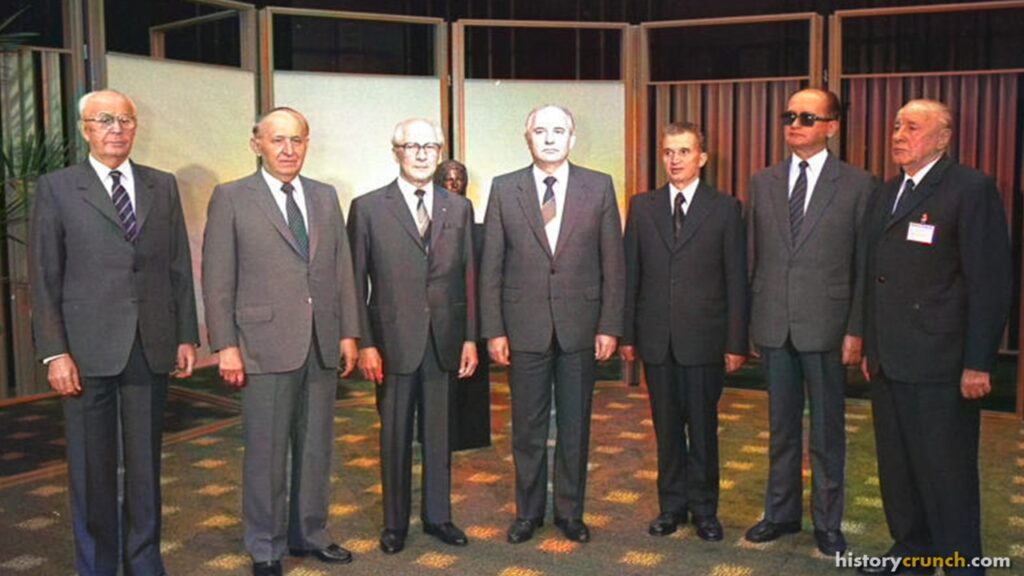 Black & whiteColor
Explore Cold War · 1947 – 1991
Keep exploring Cold War with these History Crunch resources.
Key Vocabulary
Collectivization
Politburo
Perestroika
Glasnost
Stagnation
Coup
Nationalist movements
Frequently Asked Questions
What were perestroika and glasnost?
Perestroika and glasnost were Gorbachev’s two main reforms. Perestroika meant “restructuring” and aimed to fix the weak Soviet economy and government. Glasnost meant “openness” and allowed more free speech and less censorship. Both were meant to strengthen the Soviet system, not destroy it.
When did Mikhail Gorbachev become leader of the Soviet Union?
Gorbachev became General Secretary of the Communist Party on March 11th, 1985. He was chosen soon after the death of Konstantin Chernenko on March 10th, 1985. At the time, the Soviet Union faced a weak economy and growing tension with the United States.
How did Gorbachev help end the Cold War?
Gorbachev sought better relations with the West instead of military confrontation. He met several times with President Ronald Reagan and signed the Intermediate-Range Nuclear Forces Treaty on December 8th, 1987. He also refused to use Soviet force to keep communist governments in power across Eastern Europe. These choices helped lower Cold War tensions.
Why did the Soviet Union collapse under Gorbachev?
Gorbachev’s reforms exposed deep problems and weakened the Communist Party’s control. The economy did not improve, and nationalist movements grew in republics such as Lithuania, Ukraine, and Georgia. A failed coup in August of 1991 damaged his authority and pushed republics toward independence. The Soviet Union formally ceased to exist on December 26th, 1991.
Why is Gorbachev viewed differently in Russia and the West?
Many in the West admired Gorbachev for reducing Cold War tensions and allowing greater freedom. Inside Russia, however, his reputation was more mixed. Many Russians blamed him for the collapse of the Soviet Union and the economic hardship that followed. As a result, he was often respected more abroad than at home.
Cite This Article
To cite this article as a source, use one of the formats below.
MLA: Millar, B. “Mikhail Gorbachev: A Detailed Biography.” HistoryCrunch, 12 October 2026, https://historycrunch.com/mikhail-gorbachev/.
APA: Millar, B. (2026). Mikhail Gorbachev: A Detailed Biography. HistoryCrunch. https://historycrunch.com/mikhail-gorbachev/
Chicago: Millar, B. “Mikhail Gorbachev: A Detailed Biography.” HistoryCrunch. October 12, 2026. https://historycrunch.com/mikhail-gorbachev/
Sources
- Wilson Center Digital Archive
- Vladislav Zubok, A Failed Empire.
- Odd Arne Westad, The Global Cold War.
- John Lewis Gaddis, The Cold War: A New History.