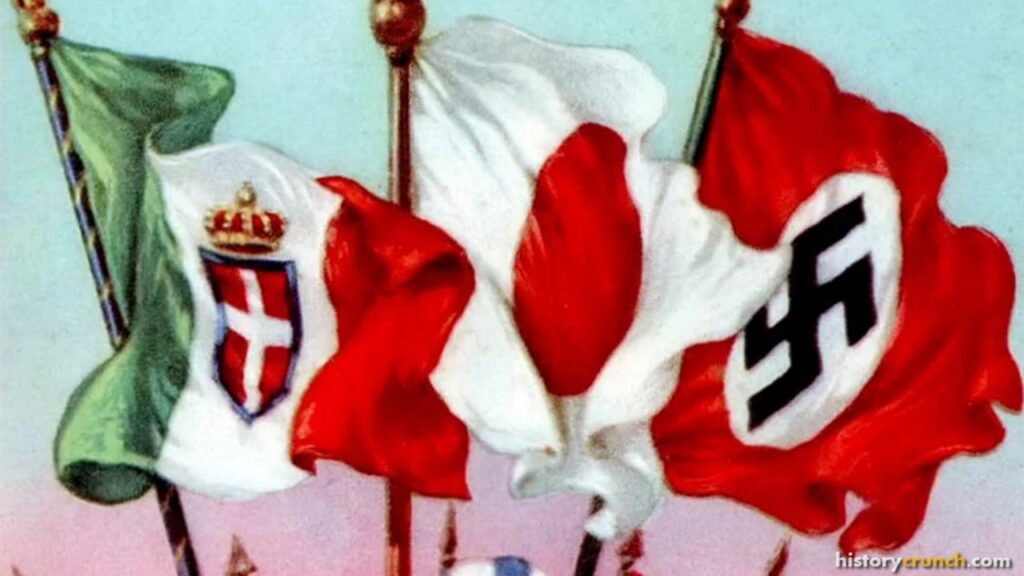
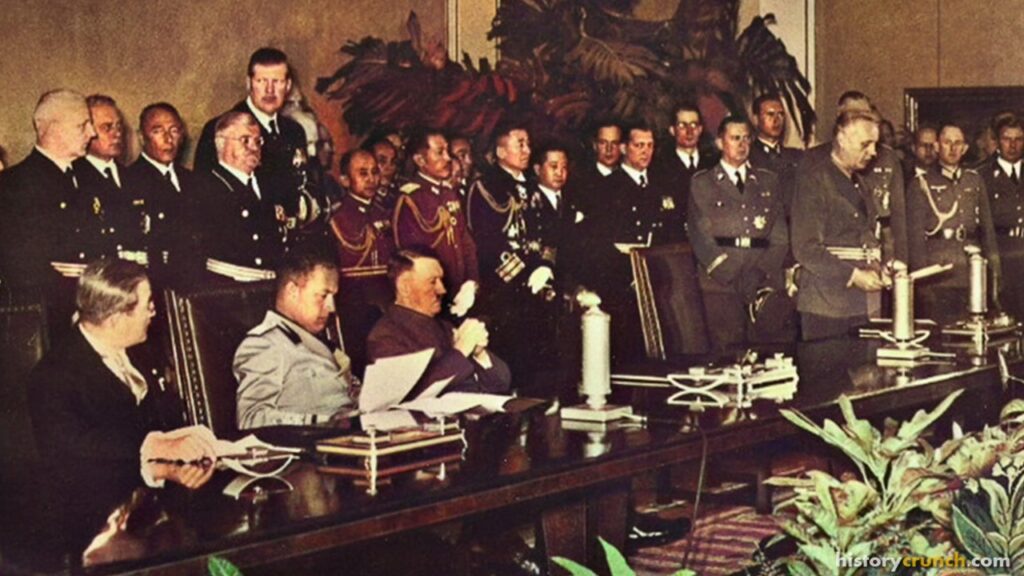
The Tripartite Pact was an agreement between Nazi Germany, fascist Italy and Imperial Japan during World War II. It was signed in Berlin, Germany on September 27th, 1940, and it formally linked the three countries in what became the main Axis Powers of World War II. This was significant because it turned earlier cooperation among the three powers into a more official partnership at a time when the conflict of the Second World War was spreading across Europe, North Africa and Asia.
 FactsthatCrunch
The Tripartite Pact promised help if a member was attacked by a power not yet in the war, a clause aimed mainly at the United States.
What Was the Tripartite Pact?
The Tripartite Pact was an agreement that brought together the leading Axis PowersThe alliance of nations led by Nazi Germany, fascist Italy, and Imperial Japan that fought against the Allies in World War II. of World War II. In simple terms, it said that Nazi Germany, fascist Italy and Imperial Japan would recognize one another’s leadership in different parts of the world and would assist one another if one of them was attacked by a country not already involved in the war. This was significant because it gave the Axis powers a formal diplomaticRelating to official agreements and formal relations between countries. structure and made their cooperation appear stronger and more unified.
Under the pact, Japan recognized the leadership of Nazi Germany and Italy in creating a new orderThe term used in the pact for the political and territorial dominance each Axis partner sought in its region of the world. in Europe, while Nazi Germany and Italy recognized Japan’s leadership in establishing a new order in East Asia. The agreement also called for joint technical commissionsCommittees made up of members from all three signing countries, called for by the pact to coordinate cooperation. and stated that the pact would remain in force for 10 years. These details mattered because they show that the Tripartite Pact was not just symbolic. It was written as a formal agreement with specific political goals.
The Tripartite Pact grew out of earlier agreements that had already brought the future Axis Powers closer together. For instance, Nazi Germany and Italy aligned with one another with the Rome-Berlin Axis on October 25th, 1936, and Nazi Germany and Japan signed the Anti-Comintern Pact on November 25th, 1936. These earlier agreements were significant because they created the diplomatic path that eventually led to the Tripartite Pact.
FactsthatCrunchJapan recognizes and respects the leadership of Germany and Italy in the establishment of a new order in Europe. Germany and Italy recognize and respect the leadership of Japan in the establishment of a new order in Greater East Asia.
Tripartite Pact, Articles 1 and 2 · Berlin · September 27th, 1940
These are the first two articles of the Tripartite Pact, the treaty that formed the Axis alliance of Germany, Italy, and Japan in World War II. Foreign Minister Joachim von Ribbentrop, Foreign Minister Galeazzo Ciano, and Ambassador Saburo Kurusu signed it in Berlin. The two articles split the world into zones, with Germany and Italy leading in Europe and Japan leading in East Asia, and the pact warned the United States to stay out of the war.
Tripartite Pact – History and Goals
The Tripartite Pact soon expanded beyond Nazi Germany, Italy, and Japan. For instance, Hungary joined on November 20th, 1940, Romania joined on November 23rd, 1940, and Slovakia joined on November 24th, 1940. Later, Bulgaria joined on March 1st, 1941. These additions were significant because they show how Germany used the pact to pull more European states into the Axis camp and develop the military strength of the Axis Powers in the early years of World War II.
One of the main purposes of the Tripartite Pact was to discourage the United States from entering the war. The wording of the pact, especially the reference to a power not already involved in the war, was widely understood as a warning to the United States. This was significant because it shows that the pact was designed not only to strengthen Axis ties, but also to influence the decisions of countries outside the alliance.
In the end, however, the Tripartite Pact did not keep the United States out of the conflict. After Japan attacked Pearl Harbor on December 7th, 1941, the United States declared war on Japan and formally entered the fighting of the Second World War. Four days later, on December 11th, 1941, Nazi Germany and Italy declared war on the United States. This was one of the most important turning points of World War II because it brought American industrial and military power fully into the war against all three major Axis Powers.
FactsthatCrunchWhich countries joined the Tripartite Pact, and when?
Tripartite Pact – Significance
The Tripartite Pact was significant because it formalized the alliance between Nazi Germany, fascist Italy and Imperial Japan during World War II. Earlier agreements had already brought these states closer together, but the Tripartite Pact made their partnership far more official and visible. In that sense, the pact helped define who the Axis Powers were and what they hoped to achieve.
The Tripartite Pact was also significant because it revealed how international agreements can help push the world toward wider conflict. It was meant to strengthen Axis cooperation, intimidateTo make someone afraid in order to influence what they decide to do. the Allied Powers, and support military aggression and expansion in Europe and Asia. As such, historians consider the Tripartite Pact to be a significant event in the early years of World War II.
FactsthatCrunchWhy Did Germany Declare War on the United States in 1941?
Germany declared war on the United States on December 11th, 1941, four days after Japan attacked Pearl Harbor. The Tripartite Pact only promised help if a member was attacked, and Japan had struck first, so Hitler was not required to act. He chose war anyway, partly because the United States was already sending weapons to Britain through Lend-Lease and fighting German submarines in the Atlantic.
Explore World War II · 1939 – 1945
Keep exploring World War II with these History Crunch resources.
Key Vocabulary
Axis Powers
Anti-Comintern Pact
Diplomatic
New order
Joint technical commissions
Intimidate
Frequently Asked Questions
When and where was the Tripartite Pact signed?
The Tripartite Pact was signed in Berlin, Germany, on September 27th, 1940. It joined Nazi Germany, fascist Italy, and Imperial Japan in a formal alliance. The signing turned their earlier cooperation into an official partnership known as the Axis Powers.
What did the Tripartite Pact actually say?
The pact said the three nations would recognize one another’s leadership in different parts of the world. Japan accepted German and Italian leadership in Europe, while they accepted Japanese leadership in East Asia. The countries also promised to help one another if attacked by a nation not already in the war.
Which other countries joined the Tripartite Pact?
Several European states joined after the three main powers signed. Hungary joined on November 20th, 1940, followed by Romania on November 23rd and Slovakia on November 24th. Bulgaria later joined on March 1st, 1941, which helped Germany pull more states into the Axis camp.
Was the Tripartite Pact meant to warn the United States?
Yes, one main goal was to discourage the United States from entering the war. The phrase about a power not already involved in the war was widely seen as a warning to America. The pact tried to influence countries outside the alliance, not just strengthen the Axis ties.
Did the Tripartite Pact keep the United States out of the war?
No, the pact failed to keep the United States neutral. After Japan attacked Pearl Harbor on December 7th, 1941, the United States declared war on Japan. Then on December 11th, 1941, Nazi Germany and Italy declared war on the United States, bringing American power fully into the conflict.
Cite This Article
To cite this article as a source, use one of the formats below.
MLA: Millar, B. “Tripartite Pact: A Detailed Summary.” HistoryCrunch, 1 October 2026, https://historycrunch.com/tripartite-pact/.
APA: Millar, B. (2026). Tripartite Pact: A Detailed Summary. HistoryCrunch. https://historycrunch.com/tripartite-pact/
Chicago: Millar, B. “Tripartite Pact: A Detailed Summary.” HistoryCrunch. October 1, 2026. https://historycrunch.com/tripartite-pact/
Sources
- Imperial War Museum
- Gerhard L. Weinberg, A World at Arms.
- Antony Beevor, The Second World War.