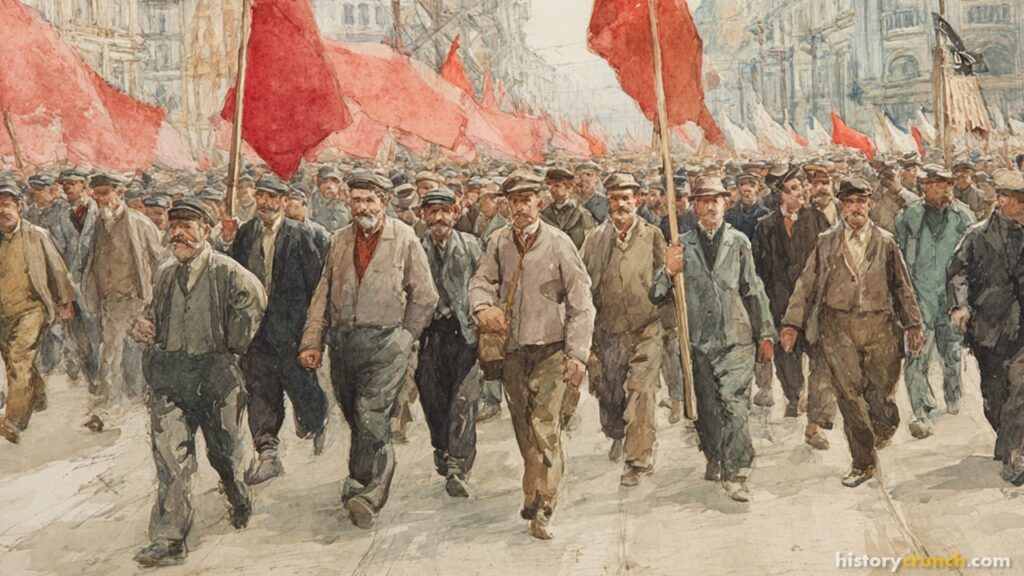
Socialism is a political and economic system that focuses on the principles of economic equality, cooperation, and public ownershipThe idea that the government should have the ability to own property such as land, businesses, products, or ideas.. As an ideology, socialism is based on collectivism, meaning it is centered on the belief that the goal of any society is to achieve the best common good for all or most citizens. This means that economic or political systems based on the principles of collectivismA belief system centered on achieving the best common good for all or most citizens, rather than focusing on individual gain., such as socialism, favor policies that allow for a high degree of government intervention in the economy in order to promote the greatest good for most people.
 FactsthatCrunch
Socialism – Main Principles
Ideologically, socialism is considered to be on the left side of the political and economic spectrum. This is because socialism favors trying to achieve the best common good for all or most people in society. As such, socialism is directly connected to the larger concept of collectivism. Collectivism has several main principles, including: economic equality, public ownership, cooperation, collective-interestThe principle that a society should act economically in the interest of all people for the common good. and government regulation. Historians consider these principles of collectivism to be directly related to socialism.
Public ownership is a central principle of socialism. It is the idea that the government should have the ability to own property, which could include: land, businesses, products, ideas, etc. This concept can be seen in modern democracies in the form of government owned land or businesses. For instance, in Canada, mail delivery is carried out by Canada Post, which is a government-owned corporation. As such, mail delivery is publicly owned and carried out as a common good for the people of Canada.
Cooperation is another important principle of socialism. It is the idea that citizens in a country should work towards a common goal rather than competing against each other. It is similar to another socialist principle which is collective-interest. It is the idea that a society should act, economically, in the interest of all people for the common good. For instance, socialist societies would support the idea that the government should fund and operate social programsA government-funded program that is generally provided universally to all citizens of a country. that are in the best interest of most, if not all people. A social program is a government-funded program that is, in general, universally provided to all citizens of the country. As such, it involves both cooperation and collective-interest because citizens are cooperating in order to provide a service or program that will benefit most or all people in society. There are many examples of social programs in modern democratic nations, including: old age pensions, some form of government funded healthcare, public education, welfare, etc.
The final principle of socialism is government regulation to ensure the equitable distribution of incomeA government goal of spreading earnings more equally among people in society to reduce income gaps.. It is the idea that the government has a role to play in the economy in terms of solving issues related to wages and income gaps. Economists refer to this as ‘economic equality’ because it involves the government trying to create more equality among people in society in terms of their income. For example, at different times in history, such as the Industrial Revolution or the Great Depression, there has been a wide income gap between the highest earners and the lowest earners. Some economists have even argued that a wide income gap was one of the main causes of the Great Depression. Governments across North America and Europe have sought to solve this issue through government regulation. For instance, minimum wage laws were created to protect working class citizens from being taken advantage of by wealthy owners.
FactsthatCrunchSocialism – History
During the early 19th century many people began to question whether or not laissez-faire capitalismAn economic system based on little or no government intervention in the economy, dominant in early 19th-century Europe. was meeting the needs of all people in society. Laissez-faire capitalism was the dominant economic system in Europe at the time and, in general, was based upon little or no government intervention in the economy. In fact, some argued that laissez-faire capitalism was causing a wide income gap in society between business owners and the working class.
Socialism developed as a response to how some felt about laissez-faire capitalism and its apparent failings. For example, early socialists argued that laissez-faire capitalism led to several issues of the Industrial Revolution, including: child labor, dangerous and dirty working conditions and a lack of basic workers’ rights. Therefore, socialism is a left-wing economic system that favors government intervention in the economy in order to try to decrease the imbalances created by laissez-faire capitalism.
Prominent thinkers, such as Karl Marx and Friedrich Engels, criticized capitalism for exploiting workers and creating class divisions between the people in society. In 1848, they wrote ‘The Communist Manifesto’, which called for the working class to unite against the ruling class. Although socialism and communism are related, socialism generally supports gradual reform through democratic means, while communism calls for revolutionary change. Regardless, the ideas of Marxism, as expressed by Marx and Engels, had a profound influence on the development of socialist ideologies in the 19th and 20th centuries.
In the 20th century, socialism played an important role in several major events, including: the Great Depression and the Cold War. This is because the rise of socialist movements during this time put pressure on governments to implement more collectivist principles in society. For instance, socialist movements influenced many governments, especially in Europe, where countries like Sweden, Norway, and Denmark adopted democratic socialismA type of socialism that combines free markets with social welfare programs through democratic political systems. to combine free markets with social welfare programs. The rise of socialist movements can also be seen in Franklin D. Roosevelt’s response to the Great Depression, with his famous ‘New Deal‘.
Today, most modern countries contain elements of socialist ideas in their economic and political structures. For instance, modern liberalism and the welfare state, which are two common concepts in most modern democracies, are directly related to the earlier development of socialism.
FactsthatCrunchLaissez-faire capitalism is an economic system based on little or no government intervention in the economy. Under this system, businesses, prices, and wages are left to operate freely through market competition. Governments that follow laissez-faire principles do not set minimum wages, regulate working conditions, or control what businesses can own or produce.
During the early 19th century, laissez-faire capitalism was the dominant economic system in Europe, and critics argued that it created a wide income gap between business owners and the working class.
Socialism – Different Types
In general, socialism was favored by working class people, as it sought to create a more equitable distribution of income. With that said, historians acknowledge several different types of socialism that each formed over different periods of time. For instance, early socialist movements included Utopian Socialism and Marxism, while Communism and Democratic Socialism are more modern. The central difference between these types of socialism is the degree to which they support government intervention and what types of political systems they are combined with. As well, although socialism and communism are related, socialism generally supports gradual reform through democratic means, while communism calls for revolutionary change.
FactsthatCrunchThree major types of socialism differed in when they appeared, how they believed change should happen, and what role they gave to government.
Socialism – Positives
Just like any other ideology, socialism has both positive and negative attributes associated with it. On the positive side, supporters of socialism argue that it promotes justice and equality in society. For instance, socialism tries to solve the imbalances created by early forms of capitalism and promote more economic equality. As well, it ensures access to basic needs, reduces poverty, and limits the concentration of wealth and power in the hands of a few. Modern social programs are the product of socialist movements, and include programs that many people count on, such as: old age pensions, welfare programs, food assistance, education and healthcare.
FactsthatCrunchWhat everyday programs grew out of socialist movements?
Many modern social programs came from socialist ideas, including old age pensions, welfare programs, food assistance, public education, and government-funded healthcare. Supporters say these programs reduce poverty, make sure people can meet their basic needs, and keep wealth and power from piling up in the hands of a few.
Socialism – Negatives
While there are several positives to socialism, there are also people that argue it has many negative qualities as well. On the negative side, critics argue that socialism can limit personal freedom and reduce motivation to work or innovate. For instance, some have argued that if the government provides you with the basic necessities of life, then it can limit a person’s desire to work harder. As well, some people argue that when the government controls too much of the economy, it can lead to inefficiency and a lack of competition, which causes a lack of consumer choice. Historical examples, such as the Soviet Union, also show how centralized socialist systems can sometimes turn authoritarian and harm individual rights and freedoms. This is especially true in communist societies that have developed dictatorships.
FactsthatCrunchCritics argue that heavy government control of the economy reduces competition and consumer choice, making socialist systems less efficient than market-based ones.
Key Vocabulary
Collectivism
Laissez-faire capitalism
Public ownership
Collective-interest
Social program
Equitable distribution of income
Democratic socialism
Frequently Asked Questions
What is socialism in simple terms?
Socialism is a political and economic system built on equality, cooperation, and public ownership. It favors a high degree of government involvement in the economy to promote the common good for most people. Because it puts society ahead of individual profit, it sits on the left side of the political spectrum.
What are the main principles of socialism?
The main principles are economic equality, public ownership, cooperation, collective interest, and government regulation. Public ownership lets the government own property such as land and businesses. Together these ideas aim to spread wealth more evenly and help most people in society.
How did socialism begin?
Socialism grew in the early 19th century as a response to laissez-faire capitalism. Many people felt that system created a wide income gap between owners and the working class. Early socialists also blamed it for problems of the Industrial Revolution, such as child labor and dangerous working conditions.
What is the difference between socialism and communism?
Socialism supports gradual reform through democratic means, while communism calls for revolutionary change. Both criticize capitalism and want to reduce class divisions. Karl Marx and Friedrich Engels shaped both ideas in ‘The Communist Manifesto’, published in 1848.
What are examples of socialism today?
Most modern countries contain socialist ideas in their economic and political systems. Social programs like old age pensions, public education, welfare, and government funded healthcare all grew from socialist movements. Nordic countries like Sweden, Norway, and Denmark mix free markets with strong social welfare programs.
What are the positives and negatives of socialism?
Supporters say socialism promotes justice, reduces poverty, and ensures access to basic needs for all. Critics argue it can limit personal freedom and reduce the motivation to work or innovate. Some centralized socialist systems, such as the Soviet Union, also turned authoritarian and harmed individual rights.
Cite This Article
To cite this article as a source, use one of the formats below.
MLA: Woida, K.L. “Socialism: A Detailed Summary.” HistoryCrunch, 27 September 2026, https://historycrunch.com/socialism/.
APA: Woida, K. L. (2026). Socialism: A Detailed Summary. HistoryCrunch. https://historycrunch.com/socialism/
Chicago: Woida, K.L. “Socialism: A Detailed Summary.” HistoryCrunch. September 27, 2026. https://historycrunch.com/socialism/
Sources
- The Science Museum Group
- Joel Mokyr, The Enlightened Economy.
- Emma Griffin, A Short History of the British Industrial Revolution.