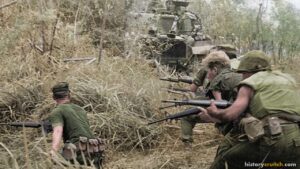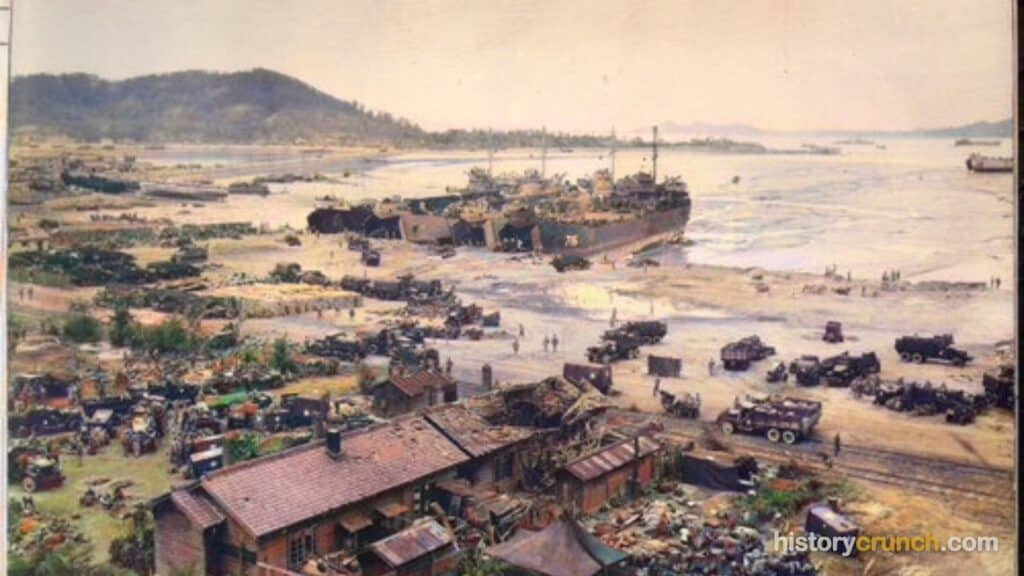
The Battle of Inchon was one of the most important turning points of the Korean War, and it dramatically reversed the fortunes of the war in a matter of days. In September of 1950, forces of the United Nations, led by the United States, carried out a surprise amphibious landingA military attack in which troops travel by ship and come ashore from the sea to fight an enemy-held coast. at the port city of Inchon on the west coast of Korea. The daring attack struck far behind North Korean lines, cut the enemy’s supply routes, and opened the road to the recapture of the South Korean capital of Seoul.
An amphibious landing is a military operation in which troops are carried by ships and then come ashore from the sea to attack an enemy-held coast. These operations are extremely difficult because soldiers must cross open water, climb out of landing craft, and fight their way onto a defended beach all at once. The landing at Inchon, code-named Operation Chromite, became one of the most famous amphibious operations in military history.
 FactsthatCrunch
Background of the Battle of Inchon
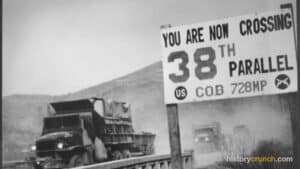
To understand the Battle of Inchon, it helps to understand how badly the Korean War had gone for South Korea in its first months. The war began on June 25th, 1950, when North Korean forces poured across the 38th parallelThe line dividing communist North Korea from pro-Western South Korea before and during the war., the line that divided communist North Korea from the pro-Western South. The invasion caught South Korean and American forces off guard and pushed them into a hasty retreat.
The North Korean People’s Army, often shortened to NKPA, advanced quickly and captured Seoul within days. By early August of 1950, South Korean and United Nations forces had been driven into a small corner of southeastern Korea. This shrinking area was known as the Pusan PerimeterA shrinking defensive line about 140 miles long around the port city of Pusan where UN forces made a last stand., a defensive line around the port city of Pusan that measured roughly 140 miles (230 km) long.
Inside the Pusan Perimeter, United Nations forces made a desperate stand. American commanders feared that a single major enemy breakthrough could end the war in disaster. At this critical moment, General Douglas MacArthur, the American commander of United Nations forces, proposed a bold plan to change the entire course of the fighting.
MacArthur’s idea was to bypass the front lines completely and strike far behind the enemy. He chose Inchon, a port located about 100 miles (161 km) south of the 38th parallel and only about 25 miles (40 km) from Seoul. The chosen landing site posed extreme challenges due to its narrow harbor and dramatic tides in a very crowded city area, yet those same features made a landing there so improbable that it offered strategic surprise. In short, the very reasons that made Inchon a poor target were the reasons the North Koreans would not expect an attack there.
Many of MacArthur’s own advisors objected to the plan. Naval warfare experts noted the Yellow Sea’s hazardous tides, coastal sandbars and mudflats, and the difficulty of mounting a full-scale amphibious landing into an urban area with a high seawall. The tides at Inchon rose and fell by about 30 feet (9 m), which meant the landing craft could only reach the shore during a few short hours of high water. At low tide, the harbor turned into wide stretches of mud that could trap boats and men alike.
Despite these concerns, MacArthur insisted on carrying out the operation. The landing force was substantial and included well-trained units. The landing force included more than 8,000 South Korean augmenteesSoldiers added to strengthen a main fighting unit, here referring to over 8,000 South Korean troops joining the landing force., as well as the 1st Marine Division and the U.S. Army’s 7th Infantry Division, stationed in Japan. The plan was a serious gamble, because it required the United Nations to commit its only combat-ready reserves to an operation fraught with difficulties.
FactsthatCrunchIt is August 1950, and you are General Douglas MacArthur, the American commander of United Nations forces during the Korean War. North Korean troops have pushed UN and South Korean forces into a shrinking defensive pocket around Pusan, and a single enemy breakthrough could end the war in defeat. You must choose where to strike with your only combat-ready reserves, and the wrong choice could cost South Korea everything.
How the Battle of Inchon Unfolded
The battle began on September 15th, 1950, and the first objective was a small island in the harbor called Wolmi-do, which guarded the approach to Inchon. Before any troops came ashore, warships pounded the enemy positions from the water. As the landing groups neared, cruisers and destroyers from several United Nations navies shelled Wolmi-do and checked for mines in Flying Fish Channel.
The heavy shelling was so effective that the island fell quickly. By 8:00 in the morning, the United Nations task force had seized Wolmi-do and the causewayA raised road or path connecting two areas, here linking the island of Wolmi-do to the city of Inchon. connecting it to Inchon. Because of the tides, the main landings could not begin until the evening high tide, so the troops on Wolmi-do had to hold their gains for several hours while they waited.
Later that day, the main assault came ashore in two places. Two other assault waves, involving 500 landing craft, carried the 1st and 5th Marine Regiments to Red and Blue Beaches on the north and south of the city. As the Marines hit the shore, the warships offshore continued to fire in support. Naval artillery from the cruisers HMS Jamaica and USS Rochester battered the communists as the United Nations troops hit the beach.
At Red Beach, the fighting was especially difficult because of the high stone seawall the Marines had to climb. At Red Beach, the 5th Marines clambered over the seawall and overcame stiff resistance to capture the high ground of Cemetery Hill and Observatory Hill. Meanwhile, the assault at Blue Beach faced enemy fire as well. At Blue Beach, naval rockets silenced a North Korean mortar team that had destroyed one of the landing craft.
Once the Marines were firmly ashore, they pushed inland to control the routes leading toward the capital. The 1st Marines seized the main road to Seoul. The North Koreans had been caught almost completely off guard. In fact, so few defenders were prepared that the city itself was secured by the early evening after only moderate resistance.
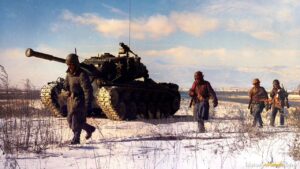
The North Korean command was slow to react, but on the second day of the battle it tried to strike back with armor. On September 16th, 1950, the North Koreans, realizing their blunder, sent six columns of T-34 tanks to the beachhead. United Nations air power responded at once. In response, two flights from an F4U Corsair squadron bombed the attackers, damaging or destroying half of the tank column, and a quick counterattack by M26 Pershing tanks destroyed the remainder of the North Korean armored force and cleared the way for the capture of Inchon.
With the beachhead secure, the United Nations forces began landing enormous amounts of men and equipment through the port. Engineers moved quickly to reopen roads and rail lines. On September 19th, 1950, the Army Corps of Engineers repaired the local railroad up to eight miles (13 km) inland, the Kimpo airstrip was captured, and transport planes began flying in gasoline and ordnanceMilitary weapons, ammunition, and related supplies, here flown in to support aircraft stationed at Inchon. for the aircraft stationed at Inchon.
The scale of the buildup was remarkable and it happened at high speed. By the seventh day, the task force had landed 53,882 people, 6,629 vehicles and 25,512 tons of cargo. The battle itself proved far less costly for the attackers than many had feared. The battle had cost the United Nations 222 casualties, including 22 killed, while the North Koreans, taken completely by surprise, endured more than 1,350 casualties.
The success at Inchon set up a pincer movementA military tactic in which an enemy is attacked from two directions at the same time, squeezing them between two forces., meaning the enemy would be squeezed from two directions at once. As the Inchon force pushed inland toward Seoul, the United Nations forces trapped inside the Pusan Perimeter launched a breakout attack from the south. Caught between the two forces, the North Korean army was thrown into retreat.
FactsthatCrunchIn what order did the key stages of the Inchon Landing unfold?
Significance of Battle of Inchon
The most important result of the Battle of Inchon was that it completely reversed the course of the Korean War. Only weeks earlier, United Nations and South Korean forces had been on the brink of defeat inside the Pusan Perimeter. After Inchon, the same forces held the initiative and were driving the enemy back.
More specifically, the landing struck a crippling blow to the North Korean war effort. The landing cut the North Korean forces in two, and the United Nations force pushed inland to recapture Seoul, the South Korean capital that had fallen to the communists in June. Seoul was liberated about two weeks after the landing, on September 28th, 1950. Losing both their supply lines and their captured capital shattered the North Korean army as an organized fighting force.
The victory also lifted the reputation of General MacArthur, who had insisted on the plan against the advice of many experts. Because the gamble paid off so completely, Inchon became one of the most studied examples of a successful amphibious operation. It showed how surprise, careful planning, and a willingness to accept risk could reverse a losing position.
At the same time, the victory at Inchon did not end the war, and it helped lead to a new and dangerous phase of the conflict. With the North Korean army in retreat, United Nations forces crossed the 38th parallel and advanced deep into North Korea toward the Chinese border. That advance alarmed China, which entered the war in October of 1950 and pushed the United Nations forces back once more. The Korean War would eventually settle into a long stalemateA deadlocked situation in which neither side can win, lasting until the 1953 armistice ended the Korean War. that did not end until an armistice was signed on July 27th, 1953.
FactsthatCrunchThe Battle of Inchon shattered the North Korean army as an organized fighting force and handed the United Nations the initiative after months of near-defeat.
Losing Seoul on September 28th, 1950 cost North Korea its most important occupied prize, roughly two weeks after the landing.
Cut off from supplies and squeezed between two advancing forces, large North Korean formations collapsed rather than retreating in order.
The pincer movement from Inchon in the north and the Pusan Perimeter breakout in the south trapped thousands of North Korean troops with no clear escape route.
The battle proved that careful planning and a willingness to accept risk could reverse a losing position, making Operation Chromite one of the most studied amphibious operations in military history. However, the victory did not end the war. China entered the fighting in October 1950 after United Nations forces crossed the 38th parallel and advanced toward the Chinese border, pushing UN forces back and leading to a long stalemate that lasted until the armistice of July 27th, 1953.
Korean War timeline · 1950 – 1953
Key Vocabulary
Amphibious landing
38th parallel
Augmentees
Causeway
Pincer movement
Ordnance
Stalemate
Frequently Asked Questions
When was the Battle of Inchon?
The Battle of Inchon began on September 15th, 1950, and the main fighting ended on September 19th, 1950. The operation took place during the early months of the Korean War, less than three months after the war began in June of 1950. The follow-up drive to recapture Seoul continued through late September.
Who led the Battle of Inchon?
General Douglas MacArthur planned and led the Battle of Inchon as the American commander of United Nations forces in Korea. He personally observed the shelling of Inchon from a command ship in the harbor. MacArthur pushed the plan forward even though many of his own military advisors warned that the landing was too risky.
Why was Inchon chosen for the landing?
Inchon was chosen because it sat close to Seoul and behind North Korean lines, which made it perfect for cutting enemy supply routes. Its difficult tides and mudflats made an attack there seem so unlikely that the North Koreans left it lightly defended. That element of surprise was exactly what MacArthur wanted to exploit.
What was Operation Chromite?
Operation Chromite was the official code name for the Battle of Inchon. Military planners often give operations secret code names to keep the details hidden from the enemy. The plan combined the amphibious landing at Inchon with a breakout attack from the Pusan Perimeter in the south to trap the North Korean army between two forces.
What happened after the Battle of Inchon?
After the Battle of Inchon, United Nations forces recaptured Seoul and drove the North Korean army back across the 38th parallel. They then advanced deep into North Korea, which prompted China to enter the war in October of 1950. The Chinese intervention pushed United Nations forces back and helped turn the conflict into a long stalemate that lasted until the 1953 armistice.
Cite This Article
To cite this article as a source, use one of the formats below.
MLA: Millar, B. “Battle of Inchon: A Detailed Summary.” HistoryCrunch, 15 August 2026, https://historycrunch.com/battle-of-inchon/.
APA: Millar, B. (2026). Battle of Inchon: A Detailed Summary. HistoryCrunch. https://historycrunch.com/battle-of-inchon/
Chicago: Millar, B. “Battle of Inchon: A Detailed Summary.” HistoryCrunch. August 15, 2026. https://historycrunch.com/battle-of-inchon/
Sources
- Jerry Bentley & Herbert Ziegler, Traditions & Encounters: A Global Perspective on the Past.
- J.M. Roberts & Odd Arne Westad, The Penguin History of the World.