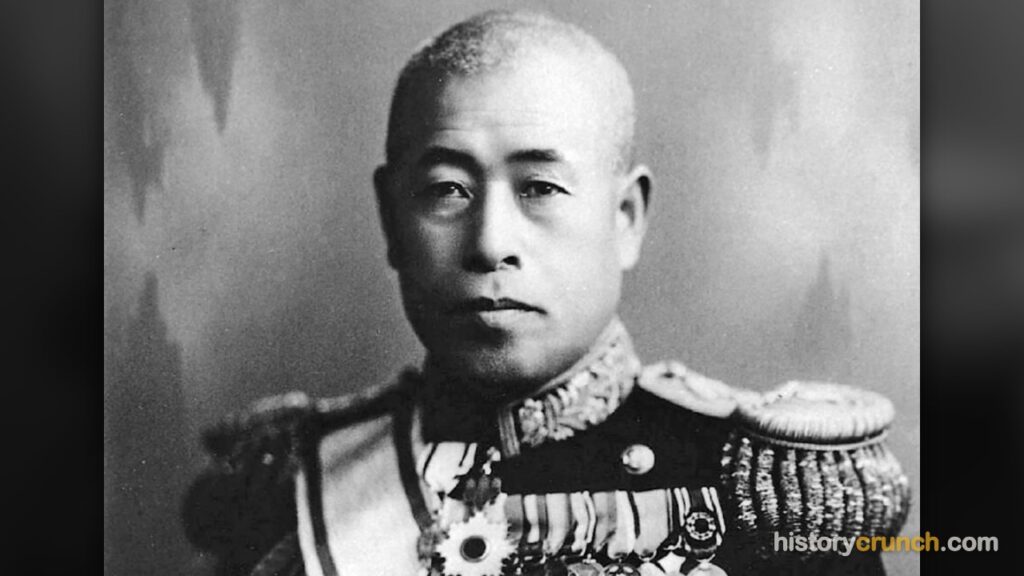
Isoroku Yamamoto was one of the most important military leaders of World War II, and he remains the naval commander most closely tied to Japan’s entry into the war against the United States. As the head of Japan’s Combined Fleet, he planned the surprise attack on Pearl Harbor in December of 1941, an event that pulled the United States directly into the fighting. Yet Yamamoto is a complicated figure, because he had studied in the United States, understood its enormous industrial power, and privately warned that a long war with the Americans could not be won.
An admiral is the highest rank of officer in a navy, responsible for commanding large groups of warships called fleets. As Commander-in-Chief of the Imperial Japanese Navy’s Combined Fleet, Yamamoto held one of the most powerful military positions in Japan. He shaped the strategy Japan followed in the Pacific Ocean during the first two years of the war, from its early string of victories to its stunning defeat at the Battle of Midway.
Early Life and Background
Yamamoto was born on April 4th, 1884, in a small village near Nagaoka in Niigata Prefecture, in northern Japan. He was born Isoroku Takano, the son of a poor schoolteacher, and was named after his father’s age at his birth, which was fifty-six. In fact, the name Isoroku means “fifty-six” in Japanese, an unusual reminder of the family he came from.
His father was a former low-ranking samurai, a member of the old warrior class that had held power in Japan for centuries. His boyhood was difficult, as food was scarce, winters were cold, and the demands of both school and family work were heavy, and he was often ill but still took part in sports and military drills at school. These early years of hardship shaped a young man who valued discipline and hard work.
As a teenager, Yamamoto decided to test for the Imperial Japanese Naval Academy at Etajima, an island off the coast near Hiroshima. He decided that if he failed the exam, he would instead become a teacher like his father. He passed, however, and he graduated from the Naval Academy in 1904, beginning a career that would carry him to the top of the Japanese navy.
Rise to Power
Yamamoto’s first taste of war came almost immediately. In 1905, during the war with Russia, he saw action as a young officer aboard the cruiser Nisshin at the Battle of Tsushima against the Russian Baltic Fleet and was slightly injured. More specifically, he was wounded in combat, losing two fingers and suffering scars from shrapnel. The Battle of Tsushima was a crushing Japanese victory, and it made a strong impression on the young officer.
After the war, Yamamoto continued to rise through the ranks. Upon graduating from the Naval Staff College in 1916, he was appointed to the staff of the Second Battle Squadron and was adopted by the Yamamoto family, taking the name by which he is remembered today. In Japanese tradition, adoption into a family without a male heir was a way to carry on the family line and its honor.
One of the most important experiences of his career came in the United States. From 1919 to 1921, he studied at Harvard University, and during this time he refined his English and inspected the capabilities of the country, noticing how important oil and airplanes would be in future naval warfare. He later returned as a senior naval attaché in Washington, D.C., a diplomatic post that let him study the American military up close.
These years in the United States gave Yamamoto something few Japanese leaders had, which was a firsthand understanding of American factories, resources, and determination. In 1924, at age 40, he changed his specialty from gunnery to aviation, recognizing the coming trend in naval warfare. In reality, this decision placed him at the center of a revolution in how navies would fight, moving away from big battleships and toward aircraft carriers.
As stated above, Yamamoto became an early believer in air power. He perceived the transformational power of naval aviation early and moved the Japanese navy away from big-gun battleships in favor of aircraft carriers. This idea would soon prove central to Japan’s war plans.
In the 1930s, Yamamoto reached the highest levels of the navy. In December of 1936, he was made vice minister of the Japanese navy, from which position he argued passionately for more naval air power and opposed the construction of new battleships, and he also opposed the invasion of Manchuria and the army’s hopes for an alliance with Germany. His stand against Japan’s growing ties with Nazi Germany made him unpopular with powerful groups. In fact, he became the target for right-wing assassination attempts, and the entire naval ministry had to be placed under constant guard. Despite this danger, on August 30th, 1939, Yamamoto was promoted to full admiral and appointed commander-in-chief of the entire fleet.
Major Achievements
Yamamoto’s most famous achievement, and the one that defines his place in history, was the planning of the attack on Pearl Harbor. Although he had warned against war with the United States, once Japan’s leaders chose that path, he set out to strike the first blow as hard as possible. In 1939, he had been tasked with creating a strategy for war with the United States, and he favored a surprise attack, which was carried out at the start of the war with the attack on Pearl Harbor in December of 1941.
Pearl Harbor was the home of the American Pacific Fleet, located on the Hawaiian island of Oahu. It had great strategic importance for the United States in the Pacific Ocean, because the Americans were the only challenge to the expansion of Japan in the Pacific, and Pearl Harbor, halfway between the United States and Japan, was a great place for the Americans to lead a potential war effort against Japan. For this reason, Japanese military leaders hoped to eliminate the American fleet in one decisive attack.
The attack was planned by Yamamoto and carried out by Vice Admiral Chuichi Nagumo, and it involved a fleet of six aircraft carriers and over 350 aircraft that were launched to carry out a surprise assault against American ships and defenses on the morning of December 7th. The strike caused heavy damage. Hundreds of Japanese planes destroyed or damaged nearly 20 American naval vessels, including eight battleships, and over 300 airplanes, while more than 2,400 Americans died in the attack and another 1,000 were wounded.
The attack succeeded in the short term, but it did not achieve everything Yamamoto had hoped. The Pacific Fleet’s three aircraft carriers were not present at Pearl Harbor, as one had been scheduled to return the day before the attack but was delayed by bad weather. Those surviving carriers would later prove decisive against Japan. Even so, in the early months of the war, Yamamoto’s fleet was almost unstoppable, and the Japanese fleet scored a series of decisive naval victories.
Yamamoto’s next major operation, however, ended in disaster. Hoping to finish the job begun at Pearl Harbor, he planned a huge attack on the American base at Midway Atoll in the central Pacific in June of 1942. Just as in its earlier attack on Pearl Harbor, Japan went into the Battle of Midway with the goal of destroying the United States’ Pacific Fleet, hoping to draw it into a battle near Midway Atoll and surprise the American ships.
Instead, the American navy was waiting. The victory at Midway was mostly caused by the United States’ ability to decode Japanese communications, so that instead of a Japanese surprise attack, the United States decoded the Japanese plans and ordered their own surprise attack against the Japanese Imperial Navy. The result was catastrophic for Japan. The battle cost Japan four irreplaceable fleet carriers, while only one of the three U.S. carriers present was lost. As a result, many historians now view the Battle of Midway as the turning point of the war because the American victory was so decisive.
Later Life and Death
After Midway, the war turned against Japan, and Yamamoto found himself fighting a defensive struggle. He committed to the defense of the Solomon Islands in the Guadalcanal campaign, but was unable to prevent their capture. With Japanese morale sinking after the loss of Guadalcanal, Yamamoto decided to make an inspection tour of Japanese bases in the South Pacific to encourage his men.
That decision would cost him his life. On April 14th, 1943, United States code breakers deciphered a Japanese message that gave a detailed account of the naval chief’s planned visit around Bougainville Island in the South Pacific, including a flight from Rabaul to an airbase near Bougainville. The Americans quickly organized a mission, code-named Operation Vengeance, to shoot down his plane.
On April 18th, 1943, Yamamoto was killed on Bougainville Island when his transport bomber was shot down by U.S. Army fighter aircraft operating from Guadalcanal. More specifically, the mission used long-range P-38 Lightning fighters, the only American planes able to reach the distant target. Yamamoto was fifty-nine years old at his death, and he remains the highest-ranking figure the United States deliberately targeted and killed during the war.
His death was a heavy blow to Japan. The death of Yamamoto reportedly damaged the morale of Japanese naval personnel, was considered the equivalent of a major defeat in battle, and raised the morale of the Allied forces. He was later given Japan’s highest honors after his death, a sign of the respect he still commanded at home.
Significance of Isoroku Yamamoto
Isoroku Yamamoto is significant because he shaped the opening years of the war in the Pacific more than any other Japanese commander. As the planner of the attack on Pearl Harbor, he set in motion the events that brought the United States into World War II, a turning point that helped decide the outcome of the entire conflict.
Yamamoto is also remembered as a leader who understood the risks he was taking. Because of his years in the United States, he grasped its industrial strength better than most Japanese officials. In fact, he predicted that he would “win victory upon victory” in the first 6 to 12 months of war, but after that he had “no expectation of success.” His warning proved accurate, as the defeat at Midway just six months into the war turned the tide against Japan.
Finally, Yamamoto’s career marks an important shift in the history of naval warfare. His belief in the power of aircraft carriers, rather than battleships, proved correct, and carrier battles like Pearl Harbor and Midway defined the war in the Pacific. For this reason, he is studied as both a brilliant strategist and a tragic figure who helped launch a war he believed his country could not win.
Frequently Asked Questions
Why did Isoroku Yamamoto plan the attack on Pearl Harbor if he was against war with the United States?
Yamamoto planned Pearl Harbor because, once Japan’s leaders had decided on war, he believed the only chance of success was to strike a fast and crushing first blow. He hoped a surprise attack would cripple the American fleet long enough for Japan to build a strong position in the Pacific before the United States could recover. As a naval officer, he followed the orders of his government even though he personally doubted Japan could win a long war.
What does the name Isoroku mean?
The name Isoroku means “fifty-six” in Japanese, and it was chosen because his father was fifty-six years old when he was born. This kind of naming was unusual, and it reflects the modest, old-fashioned samurai family he came from. He was born with the surname Takano and only later took the name Yamamoto after being adopted by another family.
How did Isoroku Yamamoto die?
Yamamoto was killed on April 18th, 1943, when American fighter planes shot down his aircraft over Bougainville Island in the South Pacific. The United States had broken Japan’s secret codes and learned the exact schedule of his inspection tour, which allowed American pilots to ambush him. The mission was called Operation Vengeance, and it was carried out roughly one year after the American Doolittle Raid on Japan.
Why did Yamamoto believe aircraft carriers were so important?
Yamamoto believed aircraft carriers were the future of naval war because planes could strike enemy ships from far greater distances than the guns on battleships. He switched his own specialty from gunnery to aviation in 1924 and pushed the Japanese navy to build up its air power. His judgment proved correct, as carrier battles decided the major fights in the Pacific.
Was Yamamoto respected by his enemies?
Yes, American commanders considered Yamamoto a clever and dangerous opponent, and their high opinion of him was one reason they went to such lengths to target his plane. His time studying at Harvard University and serving in Washington, D.C. gave him a deep knowledge of the United States. Even today he is remembered in both Japan and the United States as one of the most skilled naval leaders of the war.
Cite This Article
To cite this article as a source, use one of the formats below.
MLA: Millar, B. “Isoroku Yamamoto: A Detailed Biography.” HistoryCrunch, 14 August 2026, https://historycrunch.com/isoroku-yamamoto/.
APA: Millar, B. (2026). Isoroku Yamamoto: A Detailed Biography. HistoryCrunch. https://historycrunch.com/isoroku-yamamoto/
Chicago: Millar, B. “Isoroku Yamamoto: A Detailed Biography.” HistoryCrunch. August 14, 2026. https://historycrunch.com/isoroku-yamamoto/
Sources
- Jerry Bentley & Herbert Ziegler, Traditions & Encounters: A Global Perspective on the Past.
- J.M. Roberts & Odd Arne Westad, The Penguin History of the World.