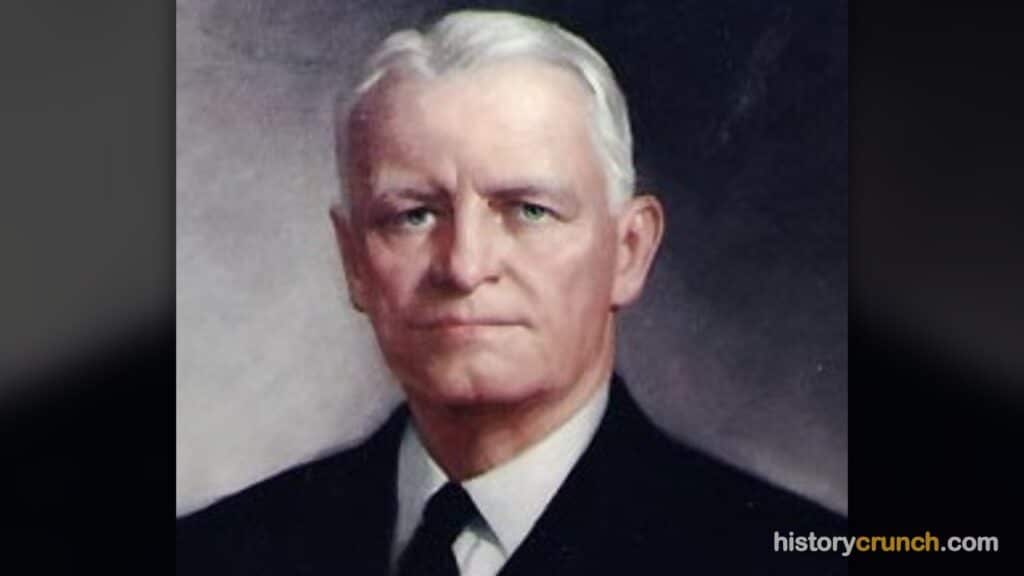
Chester Nimitz was one of the most important military commanders in the history of the United States, and he played a central role in leading the country to victory in the Pacific during World War II. As Commander in Chief of the United States Pacific Fleet, he directed the naval war against Imperial Japan from the dark days that followed the attack on Pearl Harbor all the way to Japan’s surrender in 1945. His steady leadership, careful planning, and use of intelligence helped turn a badly damaged fleet into a force that swept across the Pacific Ocean.
A fleet admiral is the highest rank an officer can reach in the United States Navy, above even a full admiral, and it has been held by only a handful of people in American history. The rank is awarded for extraordinary service in wartime, and Nimitz earned it for his command of the vast Pacific Theater. His authority stretched across an ocean that covers roughly one third of the surface of the Earth, and he was responsible for the ships, aircraft, and troops that fought there.
Early Life and Background
Chester William Nimitz was born on February 24th, 1885, in the small town of Fredericksburg, Texas. His family was of German descent, part of a community of German immigrants who had settled in the Texas Hill Country in the 1800s. His father had died before Chester was born, and his mother later married his father’s brother.
As a young boy, Nimitz was strongly influenced by his grandfather, Charles Nimitz, a former seaman who ran a hotel in Fredericksburg. His grandfather shared stories of life at sea and offered advice that Nimitz would remember for the rest of his life. In fact, Nimitz later credited his grandfather with shaping his calm and steady character.
As a teenager, Nimitz hoped to attend the United States Military Academy at West Point and become an army officer. When no appointment to West Point was available, he was instead offered a place at the United States Naval Academy in Annapolis, Maryland. He left high school without a diploma to accept the opportunity in 1901, when he was just sixteen years old. He graduated in 1905, finishing seventh in a class of 114, which pointed to the sharp mind that would serve him well throughout his career.
Rise Through the Navy
After graduating, Nimitz began his long career as a naval officer. Early on he traveled to Germany and Belgium to study diesel engines, which were a new technology for warships at the time. When he returned, he supervised the building and installation of the first diesel engine used to power a United States Navy vessel, showing an early talent for engineering and problem solving.
Nimitz became one of the navy’s leading experts on submarines, a new and important type of warship. During World War I, he served as chief of staff to the commander of the Atlantic Submarine Force. Afterward he was sent to Pearl Harbor in Hawaii, where he helped build the submarine base and commanded a submarine division.
Between the two world wars, Nimitz continued to move up through the ranks and take on new assignments. More specifically, he studied at the Naval War College, where officers examined how a future war in the Pacific against Japan might be fought. He later said that this training prepared him for the very conflict he would one day lead. By 1939 he was serving in Washington, D.C., as chief of the Bureau of Navigation, a senior position in charge of navy personnel.
Command After Pearl Harbor
On December 7th, 1941, Japan launched a surprise attack on the American naval base at Pearl Harbor, drawing the United States into World War II. The attack sank or damaged many ships and shocked the nation. In the days that followed, President Franklin D. Roosevelt needed a leader who could rebuild confidence and take command of the shattered Pacific Fleet.
Just ten days after the attack, Roosevelt chose Nimitz to become Commander in Chief of the United States Pacific Fleet. This was a remarkable decision, because Nimitz was junior to many other admirals who were passed over for the job. He formally took command on December 31st, 1941, in a small ceremony held aboard a submarine, since the base’s battleships had been wrecked in the attack.
Nimitz took over a fleet that was weakened and short of resources. He understood that the navy could not go on the offensive right away, and that it would need time to rebuild. In reality, he also recognized that the fleet still had powerful weapons in its aircraft carriers, cruisers, and destroyers, which had escaped the worst of the Pearl Harbor attack.
Major Achievements in the Pacific
One of the keys to Nimitz’s success was his use of intelligence gathered by codebreakers. American cryptanalysts had begun breaking Japanese naval codes, which gave Nimitz early warning of enemy plans. This advantage helped shape his greatest victory, the Battle of Midway.
The Battle of Midway was fought from June 3rd to the 7th in 1942, near the Midway Atoll in the northern Pacific Ocean. Japan hoped to lure the American fleet into a trap and destroy it, but thanks to broken codes Nimitz knew the attack was coming and set a trap of his own. The result was a decisive American victory that many historians view as the turning point of the war in the Pacific. In fact, Japan lost four aircraft carriers and many of its best pilots, losses it could never fully replace.
After Midway, Nimitz shifted from defense to offense and helped guide the strategy known as island hopping. This plan involved capturing key islands and bypassing heavily defended ones, building a chain of bases that moved American forces steadily closer to Japan. As stated above, the goal was to reach Japan quickly without wasting time, troops, and supplies on every enemy stronghold.
Nimitz commanded the central Pacific drive, pushing through island groups such as the Gilberts, the Marshalls, and the Marianas. At the same time, General Douglas MacArthur led a second advance in the southwest Pacific, and the two commands worked together to keep Japan off balance. Their combined offensives led American forces through hard-fought battles at places such as Guadalcanal, Iwo Jima, and Okinawa.
The long campaign came to an end in the summer of 1945, after the United States dropped atomic bombs on Hiroshima and Nagasaki and Japan agreed to surrender. On September 2nd, 1945, Nimitz signed the formal surrender agreement on behalf of the United States aboard the battleship USS Missouri in Tokyo Bay. The signing marked the official end of World War II and stood as the crowning moment of his career.
Later Life
After the war, Nimitz returned home to a hero’s welcome. On October 5th, 1945, he spoke before a joint session of Congress and was honored by President Harry Truman. Shortly afterward he became Chief of Naval Operations, the top uniformed position in the entire navy, a post he held from 1945 to 1947.
When he stepped down from that office in 1947, Nimitz settled with his wife, Catherine, in Berkeley, California. He remained involved in public life and worked to improve relations between the United States and Japan. Nimitz died on February 20th, 1966, at the age of eighty, at the naval quarters on Yerba Buena Island in San Francisco Bay.
Significance of Chester Nimitz
Chester Nimitz is remembered as one of the greatest naval commanders in American history. His leadership steadied a fleet that had been badly damaged and guided it to a series of victories that decided the outcome of the war in the Pacific. His calm manner, his skill at planning, and his trust in the officers who served under him became a model of wartime leadership.
His use of intelligence and his support for the island hopping strategy showed how careful thinking could overcome an enemy that once seemed unstoppable. These decisions saved lives and shortened the war, and they are still studied by military leaders today. For this reason, Nimitz is often ranked among the most influential figures of the entire conflict.
Nimitz’s memory has been honored in many ways since his death. A class of large aircraft carriers, along with the lead ship of that class, was named after him, keeping his name at sea long after the war ended. His childhood town of Fredericksburg is also home to a national museum dedicated to the Pacific War, which preserves the story of the conflict he helped to win.
Frequently Asked Questions
Who was Chester Nimitz?
Chester Nimitz was an American fleet admiral who commanded the United States Pacific Fleet during World War II. He was born in Texas in 1885 and spent more than half a century in the navy, becoming one of the highest-ranking officers the country has ever had.
Why is Chester Nimitz famous?
Chester Nimitz is famous for leading American naval forces to victory over Japan in the Pacific during World War II. He is especially known for the win at Midway and for signing the Japanese surrender aboard the USS Missouri, which ended the war.
What was Chester Nimitz’s rank?
Chester Nimitz reached the rank of fleet admiral, the highest rank in the United States Navy. This five-star rank has been held by only a small number of people, and it is awarded for the most outstanding wartime service.
How did Chester Nimitz help win the Battle of Midway?
Chester Nimitz used information from codebreakers who had cracked Japan’s naval codes to prepare for the Battle of Midway. Knowing the enemy’s plans in advance, he positioned his aircraft carriers to ambush the Japanese fleet, turning what Japan hoped would be a trap into an American victory.
Is anything named after Chester Nimitz?
Yes, a class of United States Navy aircraft carriers is named after Chester Nimitz, and its first ship carries his name. Schools, highways, and other landmarks across the country also honor him, keeping his memory alive for later generations.
Cite This Article
To cite this article as a source, use one of the formats below.
MLA: Millar, B. “Chester Nimitz: A Detailed Biography.” HistoryCrunch, 14 August 2026, https://historycrunch.com/chester-nimitz/.
APA: Millar, B. (2026). Chester Nimitz: A Detailed Biography. HistoryCrunch. https://historycrunch.com/chester-nimitz/
Chicago: Millar, B. “Chester Nimitz: A Detailed Biography.” HistoryCrunch. August 14, 2026. https://historycrunch.com/chester-nimitz/
Sources
- J.M. Roberts & Odd Arne Westad, The Penguin History of the World.
- Jerry Bentley & Herbert Ziegler, Traditions & Encounters: A Global Perspective on the Past.