The steel industry was one of the most important developments of the Industrial Revolution, and it helped shape the modern world in ways that are still visible today. Steel is a metal made mostly of iron, but with a small and carefully controlled amount of carbon mixed in, which makes it much stronger and more useful than iron on its own. During the Industrial Revolution, inventors and engineers found new ways to produce iron and, later, steel in far larger amounts and at a much lower cost. As a result, steel became the material used to build railroads, bridges, ships, machines, and eventually the tall buildings of growing industrial cities.
Steel is what scientists call an alloyA mixture of a metal with one or more other elements, such as iron combined with carbon., which is a mixture of a metal with one or more other elements. In the case of steel, iron is combined with a small percentage of carbon, usually somewhere between a fraction of one percent and around two percent. This small amount of carbon is what gives steel its useful qualities, since it makes the metal harder and stronger than pure iron while keeping it less brittle than cast iron. By carefully controlling the carbon and removing unwanted impurities, metalworkers could create steel with different properties for different jobs.
 FactsthatCrunch
An alloy is a material made by combining a metal with one or more other elements, usually to produce a mixture that is stronger or more useful than the original metal alone. The added element changes how the metal behaves, such as making it harder, more flexible, or better able to resist breaking. Steel is a common alloy made from iron combined with a carefully controlled amount of carbon.
"Steel is an alloy of iron and carbon, and by adjusting the carbon content, metalworkers could produce steel with different qualities suited to different jobs, such as building rail tracks or bridges."
What Was the Industrial Revolution?
The Industrial Revolution was a period of major industrialization that took place from the late 1700s until the early 1900s. It began first in Britain in the 1700s but soon expanded to the rest of Europe and North America. During this time, societies that had been based mainly on farming shifted toward economies based on factories, machines, and the mass production of goods. This change transformed how people lived and worked, moving many families from the countryside into fast-growing industrial cities.
The Industrial Revolution was powered by several key resources and inventions working together. For instance, coal provided fuel, the steam engine provided a reliable new source of power, and iron and steel provided the strong materials needed to build machines, tracks, and structures. In fact, historians often describe iron and steel as the backbone of industrialization, since so many other industries depended on a steady supply of metal. Because Britain had large amounts of coal and iron ore, it was well positioned to lead this transformation.
How Was Iron Made Before Steel Became Common?
Before the rise of steel, iron was the most important metal of the early Industrial Revolution. The traditional way of making iron was called smeltingHeating iron ore in a furnace until the metal separates from the rock so it can be shaped., which involved heating iron ore in a furnace until the metal separated from the rock and could be shaped. For centuries, this process used charcoal, a fuel made by slowly burning wood. The problem was that charcoal required enormous amounts of timber, and Britain’s forests could not keep up with the growing demand for iron.
A major breakthrough came in 1709, when an English ironmaster named Abraham Darby developed a way to smelt iron using cokeA light, porous fuel made by heating coal in an oven until the gases are driven off, leaving a very hot-burning material. instead of charcoal. Coke is made by heating coal in an oven until the gases are driven off, leaving behind a light, porous fuel that burns very hot and clean. Darby made this discovery at Coalbrookdale, a village in Shropshire that is often called a cradle of the Industrial Revolution. More specifically, using coke allowed ironmakers to build larger furnaces and produce far greater quantities of iron than charcoal ever could.
The results of this change were dramatic. British iron production grew from only a few tens of thousands of tons a year in the early 1700s to around 2.5 million tons a year by 1850. This cheap and abundant iron became the material for the machines, tools, and structures of the new industrial age. For example, the world’s first major iron bridge was built across the River Severn at Ironbridge Gorge in the late 1770s, showing how strong and versatile the metal could be.
FactsthatCrunchWhat Was the Difference Between Iron and Steel?
Even though iron was extremely useful, it had important limits. Cast iron, which contained a large amount of carbon, was hard but brittle, meaning it could crack or shatter under heavy strain. Wrought iron, which contained very little carbon, was tougher and could bend without breaking, but it was slow and expensive to make. Neither type was ideal for large projects that had to carry heavy, shifting loads over long periods of time.
Steel offered a middle path between these two forms of iron. Because it contained a controlled amount of carbon, steel was stronger and harder than wrought iron but far less brittle than cast iron. In reality, steel was also lighter for its strength, which made it excellent for weight-bearing items such as rail tracks and for large structures such as bridges. The main drawback was that, before the Industrial Revolution, steel was extremely expensive and could only be made in small batches.
One early improvement came in the 1740s, when an inventor named Benjamin Huntsman developed the crucible steelA steelmaking method that melted rough steel in small containers called crucibles to produce higher-quality steel with fewer impurities. technique in the city of Sheffield. This method melted rough steel in small containers called crucibles to produce a higher quality steel with fewer impurities. As a result, Sheffield gained an international reputation for fine steel and became especially famous for knives and cutlery. Even so, crucible steel remained costly, and steel was still a luxury metal used only where iron would not do.
FactsthatCrunchThese three metals shaped what builders and engineers could make during the Industrial Revolution, but each came with different trade-offs in strength and cost.
How Did the Bessemer Process Change Steelmaking?
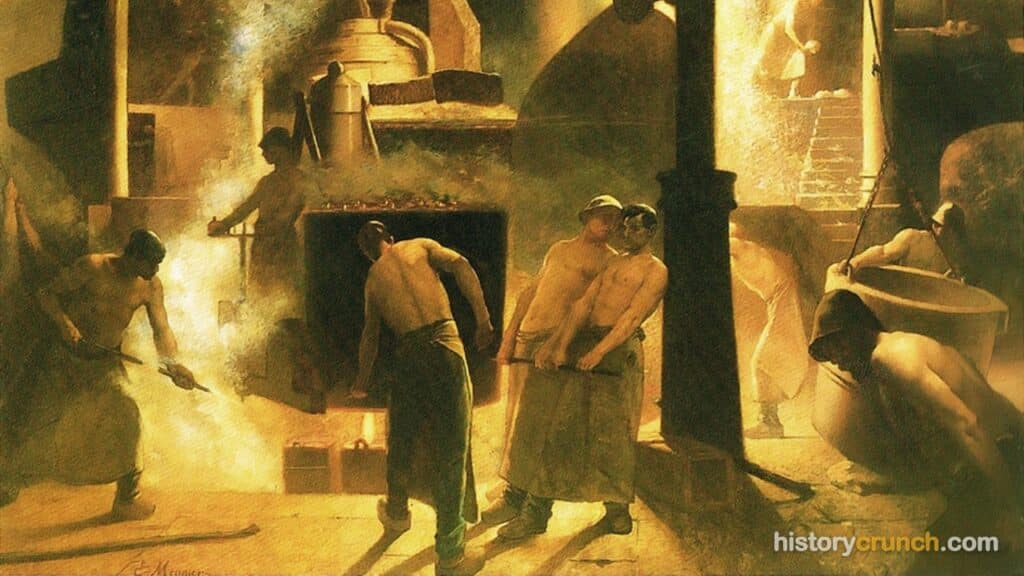
The single most important change in the steel industry came in the 1850s with the invention of the Bessemer processA fast, low-cost method of making steel by blowing air through molten pig iron in a large tilting container called a converter.. This method was created by an English inventor named Henry Bessemer, who patented his design in 1856. His invention was built around a large tilting container called a converter, which held molten pig ironMolten iron taken from a blast furnace and used as the raw material fed into a Bessemer converter. from a blast furnace. By blowing air through the molten iron, the process burned away carbon and other impurities and turned the iron into steel.
What made the Bessemer process so revolutionary was its speed and low cost. Before this invention, steel was measured in only pounds per week, but the new converter could turn several tons of iron into steel in around half an hour. Because of this, the price of steel dropped sharply, and the metal changed from a rare luxury into a material that could be produced on a huge scale. Sheffield once again became a center of this new industry and produced a large share of the country’s steel output.
Other inventors soon added new methods that improved steel production even further. For instance, the open hearth methodA steelmaking process developed in the 1860s, also called the Siemens-Martin process, that allowed closer control over steel mixture and quality., sometimes called the Siemens-Martin process, was developed in the 1860s and allowed even closer control over the mixture and quality of the steel. Together, these advances meant that steel could now be made cheaply, reliably, and in enormous quantities. As stated above, this combination of low cost and high quality is what allowed steel to replace iron in project after project.
How Did Steel Transform Industry and Daily Life?
Once cheap steel became available, it quickly reshaped the industrial world. The superior strength and durability of steel made it the preferred choice of engineers who built bridges, tunnels, and railway tracks. In fact, railroads were among the biggest customers of the new steel industry, since steel rails lasted far longer than iron ones and could carry heavier trains at higher speeds. As railroad networks spread across Britain, Europe, and North America, the demand for steel grew even larger.
Steel also made possible many new kinds of construction and manufacturing. For example, cheap steel allowed engineers to build larger bridges, bigger ships, and, later in the century, the tall steel-framed buildings that would become known as skyscrapers. Steel cable, steel rods, and sheet steel were used in machinery, high-pressure boilers, and countless factory tools. Military equipment such as guns and armored ships also improved as stronger steel became available.
These changes helped drive the later period sometimes called the Second Industrial Revolution, which took place from the late 1800s into the early 1900s. During this time, the United States joined Britain and Germany as a major steel producer, and cities such as Pittsburgh grew rapidly because they sat close to large coal deposits. Overall, the mass production of steel became one of the key foundations of modern industry and helped fuel enormous economic growth.
FactsthatCrunchTap each impact to read what it led to.
Significance of Steel Industry in the Industrial Revolution
The steel industry is significant because it provided the strong, affordable material that made modern industrial society possible. Before the Industrial Revolution, steel was a rare and costly metal, but new methods such as coke smelting, crucible steel, and especially the Bessemer process turned it into a material that could be made cheaply and in vast amounts. This shift allowed steel to replace iron in railroads, bridges, ships, machines, and buildings all around the world.
Just as importantly, the growth of the steel industry connected many other parts of the economy together. It depended on coal and iron ore, it supported the railroad and shipbuilding industries, and it encouraged the growth of large industrial cities. In this way, steel was not simply one product among many but a material that helped tie the entire industrial system together. Its influence can still be seen today in the bridges, buildings, and transportation networks that shape everyday life.
FactsthatCrunchSteel helped connect coal, iron ore, railroads, and industrial cities into one linked economic system during the Industrial Revolution.
Key Vocabulary
Alloy
Smelting
Coke
Crucible steel
Bessemer process
Pig iron
Open hearth method
Frequently Asked Questions
What is the difference between iron and steel?
The main difference is the amount of carbon in the metal, which is carefully controlled in steel. Cast iron holds a lot of carbon and is hard but brittle, while wrought iron holds very little and is soft but tough. Steel falls between the two, giving it both strength and flexibility, which is why it eventually replaced iron in most large projects.
Who invented the Bessemer process?
The Bessemer process was invented by Henry Bessemer, an English engineer who patented his design in 1856. His method used a tilting converter that blew air through molten iron to remove impurities quickly. Later inventors, including Robert Mushet, helped solve technical problems so that the process could produce reliable steel on a large scale.
Why was Sheffield important to the steel industry?
Sheffield became one of the world’s leading steel-making centers during the Industrial Revolution. The city was already famous for its knives and cutlery, and it was home to Benjamin Huntsman’s crucible steel method in the 1740s. Later, Sheffield became a major hub for Bessemer steel and at one point produced a large share of all the steel made in Britain.
Why did coke replace charcoal in making iron?
Coke replaced charcoal because it was made from plentiful coal and did not depend on huge supplies of wood. Charcoal required cutting down vast forests, and Britain’s woodlands could not meet the growing demand for iron. Coke was also strong enough to hold up heavy loads of ore, which allowed ironmakers to build larger furnaces and greatly increase how much iron they could produce.
How did steel affect railroads?
Steel made railroads safer, faster, and longer lasting. Steel rails could bear far more weight than iron rails and did not wear out as quickly, which meant trains could be heavier and travel at higher speeds. This helped railroad networks expand rapidly across Britain, Europe, and the United States during the second half of the 1800s.
Cite This Article
To cite this article as a source, use one of the formats below.
MLA: Millar, B. “Steel Industry in the Industrial Revolution: A Detailed Summary.” HistoryCrunch, 12 August 2026, https://historycrunch.com/steel-industry-in-the-industrial-revolution/.
APA: Millar, B. (2026). Steel Industry in the Industrial Revolution: A Detailed Summary. HistoryCrunch. https://historycrunch.com/steel-industry-in-the-industrial-revolution/
Chicago: Millar, B. “Steel Industry in the Industrial Revolution: A Detailed Summary.” HistoryCrunch. August 12, 2026. https://historycrunch.com/steel-industry-in-the-industrial-revolution/
Sources
- Joel Mokyr, The Enlightened Economy.
- Emma Griffin, A Short History of the British Industrial Revolution.
- The Science Museum Group
- Fordham Modern History Sourcebook