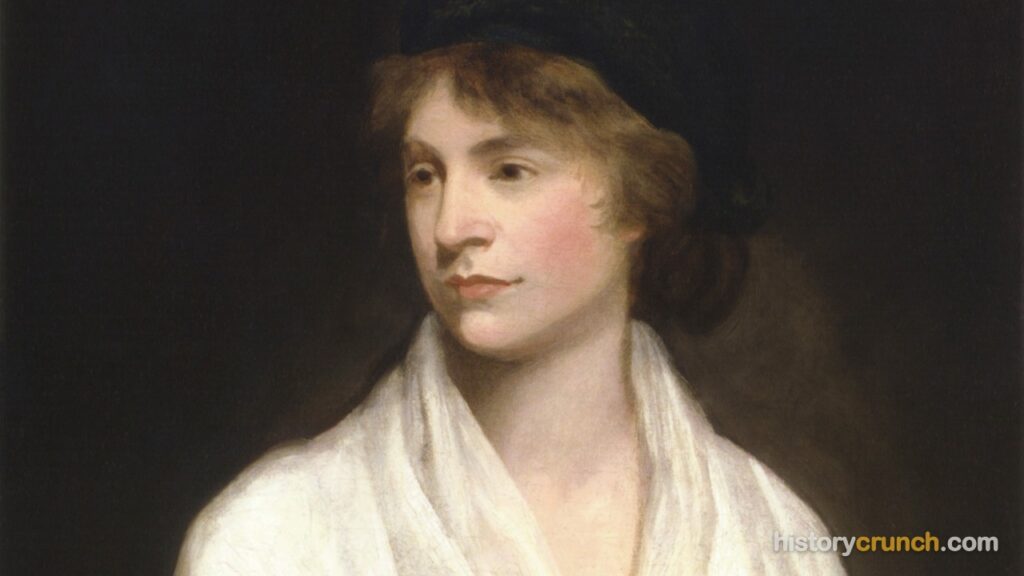
Mary Wollstonecraft is widely regarded as one of the most important early thinkers in the history of women’s rights and is often called the founder of modern feminism. She was an English writer and philosopher who lived during the Enlightenment, a period when new ideas about reason, liberty, and human rights spread across Europe. In her most famous work, she argued that women were not naturally inferior to men and that they appeared less capable only because society denied them a proper education. Her ideas would go on to shape debates about equality for generations after her death.
Feminism is the belief that women should have the same political, social, economic, and educational rights as men. In Wollstonecraft’s time, this idea was radical, because most people accepted that a woman’s proper place was in the home under the authority of her father or husband. Her writing challenged this view by insisting that women were rational human beings who deserved the chance to develop their minds.
Early Life and Background
Mary Wollstonecraft was born on April 27th, 1759, in the Spitalfields district of London. She was the second of seven children in a family that had once been comfortable but slid into hardship over time. Her grandfather had been a successful weaver who left behind a sizeable inheritance, but her father, Edward John Wollstonecraft, mismanaged the money in a series of failed attempts to become a gentleman farmer.
Because of her father’s poor decisions, the family moved many times, and each move marked a further decline in their fortunes. In addition, her father was a harsh and sometimes violent man. As a young girl, Mary often stepped in to protect her mother and her sisters from his rages, an experience that shaped her later views on the unfair power that men held over women.
Education in this period was very unequal between boys and girls. In fact, only her brother Edward, known as Ned, received a formal education and went on to become a lawyer. Mary was left to teach herself, and she read widely and learned several foreign languages largely through her own effort. This lack of opportunity left a deep impression on her and became a central theme in everything she later wrote.
Struggles and Early Career
As a young woman, Wollstonecraft faced the same problem that limited nearly all women of her class. There were very few respectable ways for a woman to earn her own living. To support herself, she worked as a paid companion to a wealthy lady in the resort city of Bath and later as a governess, teaching the children of a rich family in Ireland.
During these years she formed a close friendship with a young woman named Fanny Blood, who became one of the most important people in her life. In 1784, Wollstonecraft, her sister Eliza, and Fanny opened a school for girls, first in Islington and then in the community of Newington Green just outside London. The school did not last, but the experience deepened her thinking about how girls should be taught.
The failure of the school pushed Wollstonecraft toward writing. In 1787, she published her first book, called Thoughts on the Education of Daughters. The work was brought out by a publisher named Joseph Johnson, who became her long-time supporter and gave her steady work as a translator and reviewer. This connection allowed her to make a rare and daring choice for a woman of the age, which was to earn her living entirely through her pen.
Rise to Fame as a Writer
Wollstonecraft’s rise to fame was closely tied to the French Revolution, which began in 1789 and stirred fierce debate across Europe about liberty and the rights of ordinary people. When the British writer Edmund Burke published a famous attack on the Revolution defending the monarchy and the aristocracy, Wollstonecraft responded quickly. In 1790, she published A Vindication of the Rights of Men, a pamphlet that defended the ideals of the Revolution and earned her wide attention.
This success set the stage for her greatest work. In 1792, she published A Vindication of the Rights of Woman, a book now considered one of the founding texts of feminism. More specifically, the work argued that women only seemed weaker or less intelligent than men because they were denied a real education, not because of any natural difference.
In the book, Wollstonecraft insisted that women were rational beings who deserved the same schooling as men. She argued that the educational system of her day deliberately trained girls to be silly and helpless, focused only on beauty and pleasing men. In reality, she believed that if girls were educated equally, they would become better wives and mothers, capable workers, and thoughtful citizens, and that this change would benefit all of society.
Her arguments drew directly on the ideas of the Enlightenment, especially the belief in reason and natural rights. She challenged the popular views of thinkers such as Jean-Jacques Rousseau, who argued that girls should be educated mainly to serve and please men. The book caused a great deal of controversy, but it also sold well enough to be reprinted and translated into French.
Time in France and Personal Life
Not long after her famous book appeared, Wollstonecraft traveled to France to witness the Revolution for herself and to gather material for a history of the events. She arrived at a dangerous moment. King Louis XVI was executed, and the period known as the Reign of Terror swept the country, making it a frightening place for foreigners, especially those from Britain.
While in France, she fell in love with an American named Gilbert Imlay, and the couple had a daughter named Fanny. The relationship, however, ended painfully when Imlay abandoned her. Heartbroken, Wollstonecraft attempted to take her own life more than once during this difficult period.
She eventually returned to England and slowly rebuilt her life. As stated above, she had known the writer and philosopher William Godwin from earlier years, and the two began a relationship. When she became pregnant, they married in 1796, even though both had criticized the institution of marriage in their writings.
Later Life and Death
Wollstonecraft’s marriage to Godwin was brief but happy. In 1797, she gave birth to a second daughter, also named Mary. Tragically, complications during the birth led to a serious infection.
Just days after giving birth, Mary Wollstonecraft died on September 10th, 1797, at the age of 38. Her daughter survived and grew up to become the writer Mary Shelley, the author of the famous novel Frankenstein. In this way, Wollstonecraft’s family remained connected to the world of literature long after her death.
After she died, Godwin published an honest account of her life along with her private writings. He meant it as a loving tribute, but the public reacted with shock at the details of her unconventional life, including her relationships and her suicide attempts. As a result, her reputation suffered for much of the following century, and her ideas were often dismissed rather than studied.
Significance of Mary Wollstonecraft
The significance of Mary Wollstonecraft lies in the way her writing laid the groundwork for modern movements for women’s equality. Other people before her had called for better treatment of women, but her work was unique in arguing that real change should come through political reform and a complete overhaul of the educational system. She concluded that improving the status of women would strengthen society as a whole.
Although her most famous book did not bring about immediate change, its influence grew over time. By the late nineteenth and early twentieth centuries, campaigners for women’s voting rights and other reformers looked back to her writing for inspiration. In this way, she became both a symbol and a source for the movement that would later be called feminism.
Today, Wollstonecraft is honored as one of the founding thinkers of feminist philosophy. Her insistence that women are rational human beings deserving of education and rights remains a powerful idea, and her courage in living an independent life continues to draw admiration. For this reason, she holds a lasting place among the major thinkers of the Enlightenment.
Frequently Asked Questions
Why is Mary Wollstonecraft important?
Mary Wollstonecraft is important because she is often called the founder of modern feminism. Beyond her most famous book, she also worked as one of the first women in England to earn a full living as a professional writer, which itself broke the social rules of her day and showed that women could support themselves through their own minds.
What did Mary Wollstonecraft write?
Mary Wollstonecraft wrote A Vindication of the Rights of Woman in 1792, which is her best known work. She was also a very productive author overall, producing novels, a children’s book, a history of the French Revolution, a travel account of her journey through Scandinavia, translations, and dozens of book reviews.
What did Mary Wollstonecraft believe about education?
Mary Wollstonecraft believed that girls should receive the same education as boys. She thought that the schooling of her time taught girls to focus only on their appearance and on charming men, which left them dependent and unable to think for themselves, and she argued that equal schooling would produce stronger families and a healthier society.
How was Mary Wollstonecraft related to Mary Shelley?
Mary Wollstonecraft was the mother of Mary Shelley, the author of Frankenstein. Wollstonecraft died only days after giving birth to her, so the two never knew each other, but her daughter grew up reading her mother’s writings and became a celebrated author in her own right.
How did Mary Wollstonecraft die?
Mary Wollstonecraft died from an infection following the birth of her second daughter in 1797. This condition, known as childbed fever, was common and often deadly in the eighteenth century because doctors did not yet understand how infections spread, and it claimed her life at just 38 years old.
Cite This Article
To cite this article as a source, use one of the formats below.
MLA: Millar, B. “Mary Wollstonecraft: A Detailed Biography.” HistoryCrunch, 9 August 2026, https://historycrunch.com/mary-wollstonecraft/.
APA: Millar, B. (2026). Mary Wollstonecraft: A Detailed Biography. HistoryCrunch. https://historycrunch.com/mary-wollstonecraft/
Chicago: Millar, B. “Mary Wollstonecraft: A Detailed Biography.” HistoryCrunch. August 9, 2026. https://historycrunch.com/mary-wollstonecraft/
Sources
- J.M. Roberts & Odd Arne Westad, The Penguin History of the World.
- Jerry Bentley & Herbert Ziegler, Traditions & Encounters: A Global Perspective on the Past.