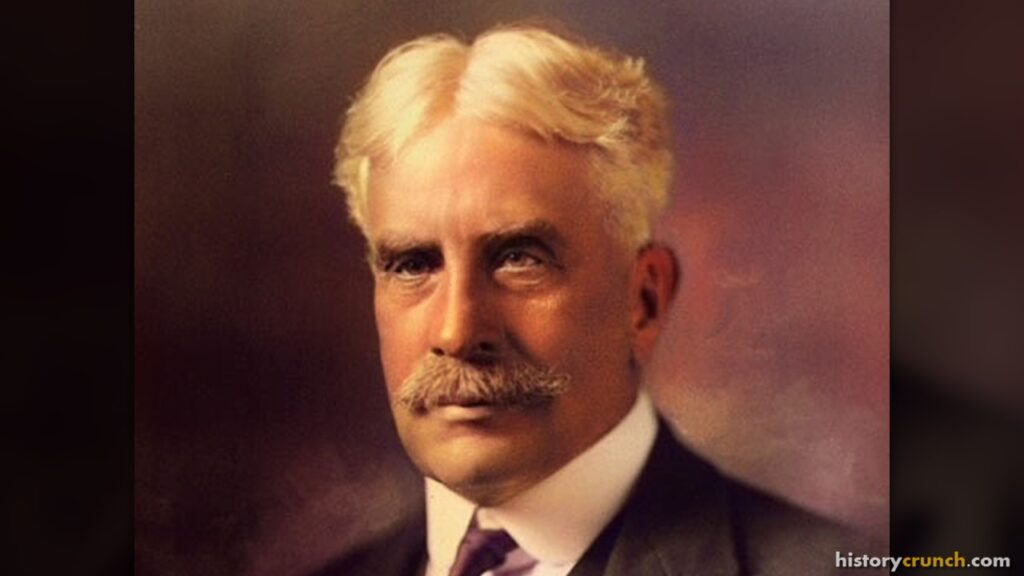
Robert Borden served as Canada’s eighth Prime Minister from 1911 to 1920, and his time in office was defined almost entirely by the challenge of leading Canada through World War I. He oversaw Canada’s enormous military contribution to the war effort, introduced conscriptionA law requiring citizens to join the military by force rather than by choice. in the face of fierce opposition, fought to secure Canada a greater degree of autonomyThe right of a country or group to govern itself and make its own decisions. within the British Empire, and ensured that Canada signed the Treaty of Versailles and gained its own seat in the newly formed League of Nations as a distinct nation rather than simply as part of Britain. His legacy is genuinely mixed. He was a determined and effective wartime leader whose actions strengthened Canada’s international standing, but the conscription crisis he triggered left deep and lasting divisions between English and French Canada that shaped the country’s politics for decades.
 FactsthatCrunch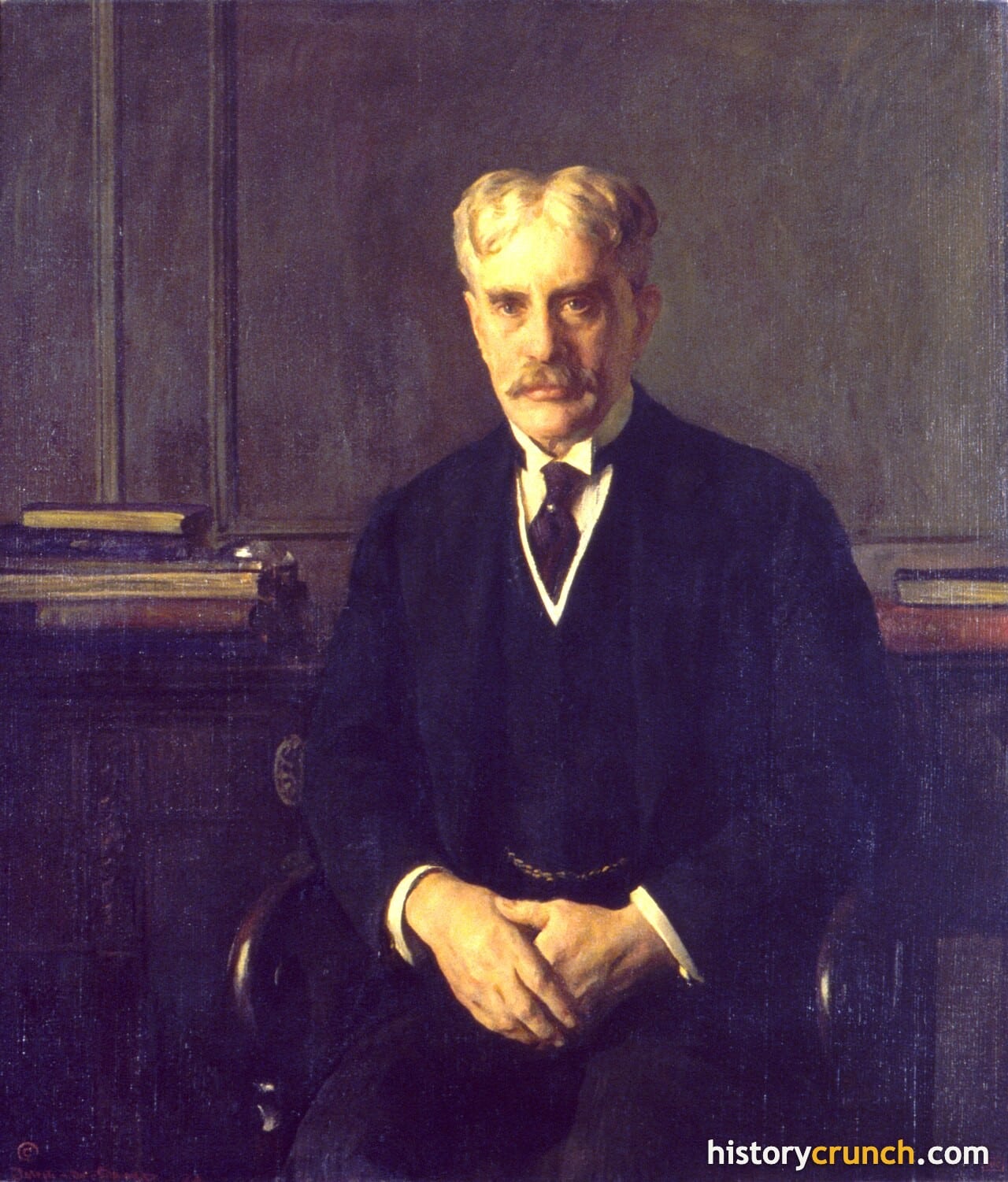
Early Life of Robert Borden
Robert Laird Borden was born on June 26th, 1854, in Grand-Pré, Nova Scotia, a small farming community on the Bay of Fundy. He was the eldest of six children born to Andrew Borden, a railway station agent, and his wife Eunice Laird. The family was of modest means and Borden’s formal education was limited. He left school at the age of fourteen to work as an assistant teacher of classical studies at the same school he had been attending, demonstrating an early aptitude for academic work that would shape his subsequent career.
In 1873, Borden traveled to New Jersey in the United States, where he spent a year teaching classics and mathematics before returning to Nova Scotia the following year with the intention of studying law. He articled with a Halifax law firm and was called to the Nova Scotia bar in 1878. He proved an exceptionally capable lawyer and quickly built a prominent reputation in Halifax legal circles. His intelligence, discipline, and capacity for hard work made him one of the most respected barristers in the province. In 1889, he married Laura Bond, and the following year he established his own law firm, which became one of the most successful in Nova Scotia.
FactsthatCrunchHow did Robert Borden's early career shape the man who became Prime Minister?
Robert Borden – Entry into Politics
Borden entered federal politics in 1896 when he was elected to the House of Commons representing Halifax as a Conservative. He proved himself a capable parliamentarian and was recognized within the party as one of its most talented members. In 1901, he was chosen as leader of the federal Conservative Party, taking over a party that had been out of power for five years under the enormously popular Liberal Prime Minister Wilfrid Laurier.
Borden spent a decade as leader of the opposition, losing the federal elections of 1904 and 1908 to Laurier’s Liberals. He was a persistent and effective opposition leader who worked to modernize the Conservative Party and broaden its appeal. His opportunity came in 1911 when Laurier’s government proposed a reciprocityA trade deal where two countries lower barriers for each other, similar to free trade. agreement with the United States that would have established a form of free trade between the two countries. Borden opposed the agreement vigorously, arguing that it would loosen Canada’s ties to Britain and draw the country too closely into the American economic orbit. His campaign against reciprocity resonated strongly with Canadian voters, particularly in Ontario and the Maritime provinces, and the Conservatives won the 1911 federal election, ending fifteen years of Liberal government. Borden became Prime Minister on October 10th, 1911.
Robert Borden – Canada and World War I
The defining event of Borden’s entire political career was the outbreak of World War I in August of 1914. Canada, as a dominionA self-governing territory that was part of the British Empire but had its own government, like Canada in 1914. of the British Empire, was automatically at war when Britain declared war on Germany, but the extent of Canada’s contribution was a matter for the Canadian government to determine. Borden felt a strong moral and imperial obligation to support Britain with the maximum effort Canada could sustain, and he committed the country to a substantial military contribution from the very beginning.
Borden’s government established the Canadian Expeditionary Force as Canada’s overseas military force and enacted the War Measures Act, which granted the federal government sweeping emergency powers to manage the war effort. He promised that Canada would raise 500,000 soldiers for overseas service, a remarkable commitment for a country of only approximately eight million people. He also worked to finance the war effort through Victory Bonds, raised tariffs, and in 1917 introduced the federal income tax as a temporary wartime measure, though it would prove anything but temporary. In 1916, he dismissed Sam Hughes, the controversial Minister of Militia and Defence, whose management of the military had been marked by incompetence, patronageGiving government jobs or contracts to supporters as a reward rather than based on merit., and the insistence on equipping Canadian soldiers with the Ross rifle, a weapon that frequently jammed in the muddy conditions of the Western Front.
Borden visited the Western Front in France in the spring of 1917 and was profoundly affected by what he saw. He met with Canadian soldiers in the trenches and witnessed the enormous casualties the Canadian Corps was sustaining. He returned to London convinced that Canada needed to do more and that voluntary recruitment, which had produced impressive numbers but was no longer keeping pace with casualties, would have to be replaced by compulsory military service. In July of 1917, he introduced the Military Service Act, which made all male Canadian citizens aged 20 to 45 eligible for conscription.
Robert Borden – The Conscription Crisis
The introduction of conscription was the most controversial act of Borden’s entire political career and produced the most serious domestic political crisis in Canada since Confederation. Opposition to conscription was particularly intense in French Canada, where many people felt little connection to Britain or France, resented the predominantly English-speaking character of the Canadian Corps, and saw the war as a British imperial conflict that was not their own. Anti-conscription sentiment was also strong among recent immigrants, organized labour, and the farming community, which feared losing its workforce during critical harvests.
The opposition from Quebec was particularly fierce. Riots broke out in Montreal and Quebec City. The conscription debate inflamed tensions between English and French Canada that had been building for years and poisoned relations between the two communities in ways that would not be fully resolved for generations. Henri Bourassa, the influential Quebec nationalist, led the anti-conscription movement and argued that French Canadians were being forced to fight and die for an empire to which they owed no loyalty.
Borden responded to the political crisis by forming a coalition Union Government of Conservatives and pro-conscription Liberals, effectively splitting the Liberal Party and isolating the opposition under Wilfrid Laurier, who had opposed conscription. To improve his chances in the resulting election of December of 1917, Borden’s government took the controversial step of extending the vote to soldiers serving overseas and to their female relatives while removing the vote from recent immigrants from enemy countries who were deemed likely to oppose conscription. These measures were deeply questionable in terms of democratic principle but proved effective. The Union Government won the election decisively, dominating English-speaking regions of the country, though winning only three seats in Quebec.
FactsthatCrunchRobert Borden – Canada’s Autonomy and the Peace Settlement
One of the most significant and lasting achievements of Borden’s wartime leadership was his persistent campaign to secure greater autonomy for Canada and the other British dominions within the imperial structure. Borden was deeply committed to the British Empire but believed strongly that the dominions, having contributed so massively to the war effort, deserved a genuine voice in imperial policy rather than simply being expected to follow decisions made in London.
He pushed British Prime Minister David Lloyd George to include dominion prime ministers in an Imperial War CabinetA wartime council that gave leaders of Britain’s dominions direct say in setting overall war strategy. that would give them direct participation in setting overall war strategy. He argued consistently that the dominions were not colonies but nations, and that their contributions to the war earned them the right to be treated as such. His persistence on this point helped lay the foundations for the eventual transformation of the British Empire into the Commonwealth, in which the dominions would enjoy full sovereign equality.
At the Paris Peace Conference of 1919, Borden insisted that Canada and the other dominions sign the Treaty of Versailles as distinct entities rather than simply as part of a single British delegation. He also secured separate membership for Canada in the newly formed League of Nations, a symbolically important step in establishing Canada’s identity as an independent actor in international affairs rather than simply an extension of British foreign policy. These achievements significantly advanced the cause of Canadian sovereignty and national identity on the world stage.
What did Robert Borden secure for Canada at the 1919 Paris Peace Conference?
Later Years and Death of Robert Borden
Borden stepped down as Prime Minister because of poor health, and his successor Arthur Meighen took office on July 10th, 1920. His health recovered, and he remained active in public life for many years afterward. He attended the Washington Naval Conference of 1921 and 1922, served as Chancellor of Queen’s University from 1924 to 1930, and was president of the Canadian Historical Association in 1930 and 1931. He also took on several business roles, serving as president of Barclays Bank of Canada and the Crown Life Insurance Company. He wrote his memoirs, which were published after his death.
Robert Borden died on June 10th, 1937, in Ottawa, at the age of 82. He was buried in Beechwood Cemetery in Ottawa. At his funeral, a thousand World War I veterans lined the streets of the capital in tribute, a testament to the central place the war occupied in his legacy.
FactsthatCrunchAfter leaving office in 1920, Borden did not step away from public life. He went on to serve as Chancellor of Queen's University for six years and as president of the Canadian Historical Association.
Borden left office on July 10th, 1920, because of poor health, but he recovered and attended the Washington Naval Conference of 1921 and 1922 as a delegate. He then served as Chancellor of Queen's University from 1924 to 1930, and as president of the Canadian Historical Association in 1930 and 1931. A man who had led Canada through its most demanding period since Confederation spent his final active years in academic and scholarly public life rather than stepping away from it.
Significance of Robert Borden
The significance of Robert Borden in Canadian history is considerable. He led Canada through the most demanding period the country had faced since Confederation, mobilizing an enormous military and industrial effort that made Canada’s contribution to World War I one of the most significant of any Allied nation relative to its population. The Canadian Corps that served under his government earned a reputation as one of the finest fighting forces on the Western Front, and the Battle of Vimy Ridge in April of 1917, often considered a defining moment in the emergence of Canadian national identity, took place during his tenure.
His persistent advocacy for Canadian autonomy within the Empire was equally significant in the longer term. The principles he fought for at the Imperial War Cabinet and the Paris Peace Conference contributed directly to the Statute of WestminsterA 1931 law that formally recognized the full legislative independence of British dominions like Canada. of 1931, which formally recognized the full legislative independence of the British dominions and marked Canada’s emergence as a genuinely sovereign nation.
At the same time, the conscription crisis he triggered left wounds in Canadian society, particularly in the relationship between English and French Canada, that took many years to heal. His manipulation of the electoral rules during the 1917 election to maximize the conscriptionist vote was a troubling episode that sits uneasily alongside his genuine achievements. As such, Robert Borden stands as one of the most significant and complex figures in Canadian history, a leader whose wartime decisions shaped both the country’s development as a nation and some of its most enduring social divisions.
FactsthatCrunchAt the Paris Peace Conference in 1919, Borden insisted that Canada sign the Treaty of Versailles as a distinct nation and secured separate Canadian membership in the League of Nations, establishing principles of dominion sovereignty that were formally written into law with the Statute of Westminster in 1931.
Canada had no separate international voice and followed British foreign policy decisions
Canada held full legislative independence, recognized in law as a sovereign nation equal to Britain
Explore World War I
Keep exploring World War I with these History Crunch resources.
Key Vocabulary
Dominion
Reciprocity
Conscription
Patronage
Imperial War Cabinet
Autonomy
Statute of Westminster
Frequently Asked Questions
When was Robert Borden Prime Minister of Canada?
Robert Borden served as Canada’s eighth Prime Minister from 1911 to 1920. He became Prime Minister on October 10th, 1911, after his Conservatives defeated Wilfrid Laurier’s Liberals. His years in office were shaped almost entirely by World War I.
What was the conscription crisis under Robert Borden?
The conscription crisis was the fierce national conflict over forcing men into military service during World War I. Borden introduced the Military Service Act in July of 1917, making men aged 20 to 45 eligible for conscription. Opposition was strongest in French Canada, where it sparked riots in Montreal and Quebec City and deepened divisions that lasted for generations.
How did Robert Borden increase Canada’s independence?
Borden argued that Canada’s huge war effort earned it a real voice in imperial affairs rather than taking orders from London. He pushed for dominion leaders to join an Imperial War Cabinet and insisted Canada sign the Treaty of Versailles on its own. He also won Canada a separate seat in the League of Nations in 1919.
Did Robert Borden introduce income tax in Canada?
Yes, Borden’s government introduced the federal income tax in 1917 to help pay for the war. It was presented as a temporary wartime measure, but it was never removed. His government also raised money through Victory Bonds and higher tariffs.
When and where did Robert Borden die?
Robert Borden died on June 10th, 1937, in Ottawa, at the age of 82. He had stepped down as Prime Minister in July of 1920, and stayed active in business and education afterward. At his funeral, a thousand World War I veterans lined the streets of the capital in tribute.
Cite This Article
To cite this article as a source, use one of the formats below.
MLA: Millar, B. “Robert Borden: A Detailed Biography.” HistoryCrunch, 1 October 2026, https://historycrunch.com/robert-borden/.
APA: Millar, B. (2026). Robert Borden: A Detailed Biography. HistoryCrunch. https://historycrunch.com/robert-borden/
Chicago: Millar, B. “Robert Borden: A Detailed Biography.” HistoryCrunch. October 1, 2026. https://historycrunch.com/robert-borden/
Sources
- Fordham Modern History Sourcebook
- Margaret MacMillan, The War That Ended Peace.