
The Renaissance, French for 'rebirth', is the three centuries in which Europe rediscovered ancient Greece and Rome and made from them new art, new learning and, in the end, new science. It began in the trading cities of Italy, Florence above all, with a poet who read a dead Roman's letters as if they were written to him, and it ended with an astronomer on his knees before the Inquisition. In between came the Medici Bank, the Black Death, Brunelleschi's dome, the printing press, the fall of Constantinople, Leonardo, Michelangelo and Raphael, the voyages of Columbus, Luther's theses, and the book that moved the Earth. This timeline runs from the Venetian galleys of 1204 to the death of Galileo in 1642, and every card on it sits on a real date.
From Cicero’s letters to Galileo’s telescope.
The Renaissance, French for 'rebirth', is the three centuries in which Europe rediscovered ancient Greece and Rome and made from them new art, new learning and, in the end, new science. It began in the trading cities of Italy, Florence above all, with a poet who read a dead Roman's letters as if they were written to him, and it ended with an astronomer on his knees before the Inquisition. In between came the Medici Bank, the Black Death, Brunelleschi's dome, the printing press, the fall of Constantinople, Leonardo, Michelangelo and Raphael, the voyages of Columbus, Luther's theses, and the book that moved the Earth. This timeline runs from the Venetian galleys of 1204 to the death of Galileo in 1642, and every card on it sits on a real date.
Because the money, the ruins and the merchants were all in the same place.
The Fourth Crusade, the florin, Genoa's colonies, Petrarch's Rome.
Half of Florence died in 1348; the survivors were richer, freer and less sure of God.
The Great Famine, the plague ships, Florence, the Decameron, the Ciompi.
He read a dead Roman's letters as if they were written to him, and spent his life looking for more.
Birth, the laurel, Cicero's letters, the collector, the death at his desk.
In the luggage of refugees, over a century, ending with the fall of a city.
Chrysoloras, the Council of Florence, Constantinople's fall, Ficino's Plato, the Venetian presses.
Loans to popes, quiet gifts, and a taste for buildings.
The bank, Cosimo's return, the peace of Lodi, Lorenzo, the fall of 1494.
Wool, banks, a coin everyone trusted, and a republic that liked to argue.
The florin, the plague, the Ciompi, the doors competition, Cosimo.
The same sea, the same spices, the same customers, for 120 years.
The Fourth Crusade, Genoa's Black Sea, Marco Polo, the Treaty of Turin, printing in Venice.
Not by republics but by dukes and kings, with hired soldiers and borrowed artists.
The Visconti, Sforza takes Milan, Alfonso takes Naples, Leonardo in Milan, the French take Milan.
By coming home, taxing Europe, and hiring Florentines.
Avignon, the return, Martin V, Nicholas V, Julius II.
The study of ancient books to live better now; not, at first, a rejection of God.
Cicero's letters, Greek arrives, Alberti, the Platonic Academy, Erasmus's New Testament.
The price of a book, the number of readers, and who got to decide what was true.
Gutenberg's press, the Bible, his death, Venice's presses, Luther's German Testament.
A Dutch monk, a French lawyer and a Gascon landowner, each in his own century.
Erasmus in Paris, the Praise of Folly, Bude's college, Bude's death, Montaigne's Essays.
Someone who could do everything, and a book that told courtiers to pretend to.
Alberti, the flying machine, the Vitruvian Man, Leonardo's death, the Courtier.
A goldsmith worked it out with a mirror, a painter proved it, and a scholar wrote it down.
Ugolino's flat room, the dome begins, Masaccio, Alberti, the School of Athens.
By digging up the Romans and then trying to beat them.
Saint John, the bronze David, Gattamelata, the Pieta, Michelangelo's David.
A dozen paintings, thousands of pages, and a way of looking.
Born at Vinci, Milan, the Last Supper, the Mona Lisa, France.
Alone, in a bad temper, for 75 years.
The Medici garden, David, the ceiling, the Last Judgment, St Peter's.
Because he made the hard things Leonardo and Michelangelo discovered look calm and easy.
Born at Urbino, Florence, Rome, the School of Athens, death at 37.
Yes, in Flanders, in oil, and it looked at the world even more closely.
The Ghent Altarpiece, van Eyck's self-portrait, Cosimo's Florence, the Last Supper, Antwerp's atlas.
Mountains, war, feudal lords and a Church that liked things as they were.
Avignon, the Hundred Years War, Crecy, Agincourt, Joan of Arc.
Peace, print, refugees, and a French king who wanted a Leonardo.
Constantinople falls, the war ends, the press, Leonardo goes to France, the royal readers.
Same curiosity, same maps, same Italian sailors, different ocean.
Marco Polo, Constantinople's fall, Columbus, Tordesillas, Magellan.
After a civil war, with a Dutch scholar, a German painter and a king who broke with Rome.
The Wars of the Roses, Bosworth, the Praise of Folly, the Act of Supremacy, the Armada.
Print, a prince, and a pope who did not read it in time.
Julius II's indulgences, Leo X, the theses, Worms, the German Bible.
It gave the reformers their tools, and then most humanists refused to join.
Erasmus's New Testament, the theses, Zwingli, Calvin, Erasmus's death.
With a council, a list of books, a new order of priests, and a darker Sistine wall.
The Sack of Rome, the Last Judgment, Trent, the Index, the Peace of Augsburg.
A century of war in which Christians killed Christians over how to be Christian.
Zwingli killed, Augsburg, St Bartholomew's Day, the Armada, the Index.
By reading Greeks, doing mathematics, and waiting thirty years.
Born at Torun, the little commentary, the book of 1543, Kepler, the ban of 1616.
He proved the Earth moved, said so in Italian, and made the pope look foolish.
The telescope, the Starry Messenger, the warning of 1616, the Dialogue, the trial.
The same habits, looking hard, measuring, doubting authority, turned from the body to the sky.
The Vitruvian Man, Vesalius, Galileo at Pisa, Bacon, Two New Sciences.
Pick your year: 1527, 1564, 1600, 1633 or 1642. Each says something different.
The Sack of Rome, Michelangelo's death, Bruno, the trial, Galileo's death.
The Renaissance did not start on a date. It grew out of the Italian trading cities of the 1200s, Venice and Genoa on the sea, Florence on its wool and its gold florin, Milan under its dukes, which had money, merchants and the ruins of Rome under their feet, and no king to tell them what to think. While France and England began a hundred years of war and the popes moved to Avignon, a Florentine notary's son named Petrarch taught himself to read the ancient Romans as living men, had himself crowned with laurel on the Capitol in 1341, and in 1345 found Cicero's private letters in a cathedral library in Verona. That is the usual starting point. The chapter ends with the Genoese galleys of 1347.
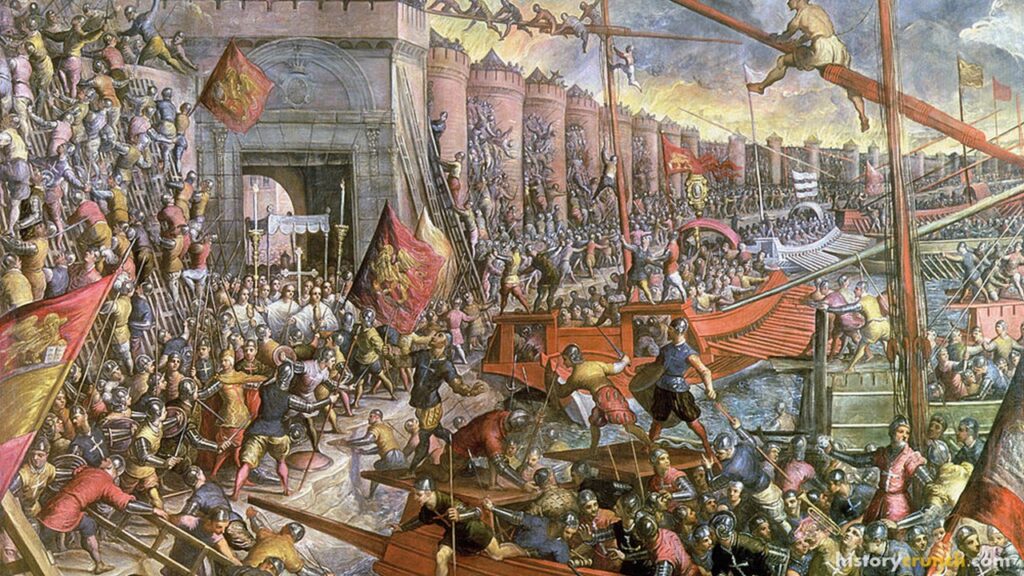
On April 12th, 1204 the army of the Fourth Crusade, carried to the walls by the galleys of Venice, broke into Constantinople and sacked the richest Christian city in the world. The crusaders had hired Venetian ships to reach the Holy Land and could not pay, so the Venetians turned the crusade against the Byzantine capital instead. Venice took three-eighths of the empire, its best harbors, and the four bronze horses that still stand over St Mark's.
LEARN MORESHOW LESSwhy it mattersTRADEThe wealth of the Italian trading cities is where the Renaissance begins, and no city gained more from the Middle Ages than Venice did in 1204. The sack also scattered Greek manuscripts and Greek scholars westward, a trickle that became a flood in 1453.
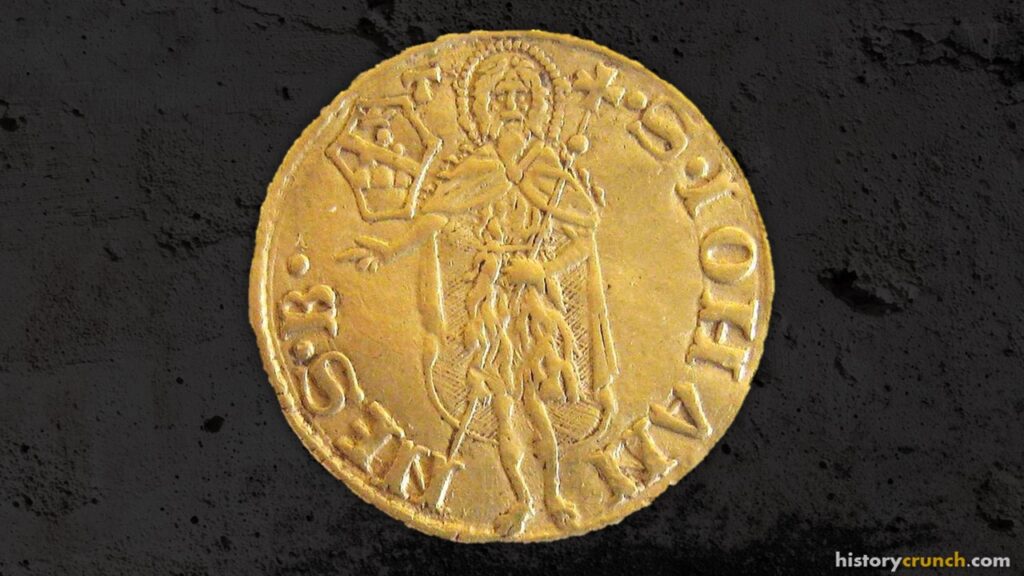
In 1252 the Republic of Florence struck a gold coin of 54 grains, stamped with the city's lily on one side and John the Baptist on the other. The florin kept the same weight and design for nearly three centuries, until 1533, and because it could be trusted it became the money of Europe: bankers in London, Bruges and Avignon kept their books in florins. Florence's wool guilds and banks grew rich on it.
LEARN MORESHOW LESSwhy it matters · key numbersMONEYA coin that everyone trusted let Florentine bankers lend to kings and popes across Europe, and the profits paid for the Renaissance. The Medici Bank, founded in 1397, was built on the florin.
In 1261 Genoa lent its navy to the Byzantine emperor Michael VIII to recapture Constantinople from the Latin rulers Venice had installed in 1204. In return Genoa was given the suburb of Galata across the Golden Horn and the right to trade through the straits into the Black Sea, where its merchants set up colonies at Caffa in the Crimea. Wine, olive oil, wool and slaves moved through Genoese ships.
LEARN MORESHOW LESSwhy it mattersTRADEGenoa and Venice now faced each other across every sea route to the East, and their wars ran for 120 years. The Black Sea colonies made Genoa rich, and in 1347 they were the door through which the plague entered Europe.
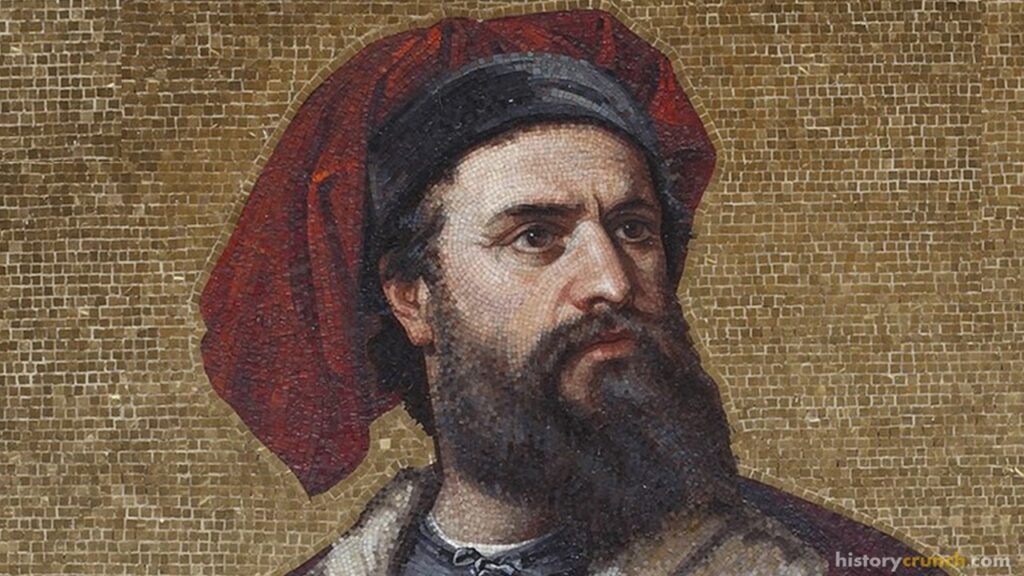
In 1271 a seventeen-year-old Venetian named Marco Polo set out with his father and uncle along the Silk Road to the court of Kublai Khan in China. He stayed 24 years, serving the Khan and traveling across Asia, and came home to Venice in 1295 with stories of paper money, coal, porcelain and cities larger than any in Europe. His book, dictated in a Genoese prison in 1298, was read for two centuries.
LEARN MORESHOW LESSwhy it matters · key numbers · 1 key figureTRADEThe Silk Road carried ideas as well as silk, and Polo's book was the West's window on the East. Columbus owned a copy and wrote notes in its margins; the search for a sea route to Polo's China is where the Age of Exploration begins.
On January 21st, 1277 Archbishop Ottone Visconti defeated the Della Torre family at Desio and took control of Milan. The Visconti ruled the city for the next 170 years, became dukes in 1395, and by 1400 held most of northern Italy. Their court paid for artists, scholars and the great cathedral of Milan, begun in 1386, and their armies threatened Florence more than once.
LEARN MORESHOW LESSwhy it mattersPOWERMilan is the clearest case of the Italian city-state run by a single family, the pattern the Sforza and the Medici later followed. The wars between Milan and Florence shaped the politics, and the propaganda, of the early Renaissance.
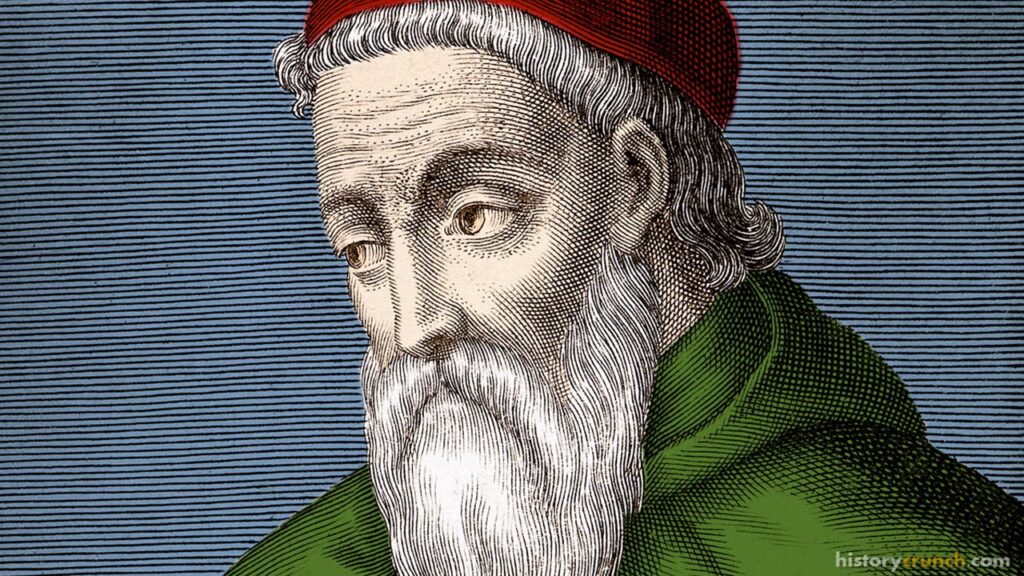
Francesco Petrarca, known in English as Petrarch, was born in Arezzo on July 20th, 1304, the son of a Florentine notary who had been exiled from the city in the same purge as the poet Dante. The family moved to Avignon in 1312 to follow the papal court, and Petrarch was sent to study law at Montpellier and Bologna. He hated law and loved the Latin authors, and when his father died in 1326 he gave the law up.
LEARN MORESHOW LESSwhy it matters · 1 key figurePEOPLEPetrarch is the man historians call the father of humanism. His life runs from the plague years to the first collectors of ancient manuscripts, and the Renaissance is usually dated from him.
About 1305 the Florentine painter Giotto di Bondone finished the frescoes of the Scrovegni or Arena Chapel in Padua, 38 scenes of the lives of Mary and Christ. His figures have weight and stand on the ground, they grieve and embrace, and the rooms they stand in have depth. Medieval painters had drawn flat, golden, holy signs; Giotto painted people.
LEARN MORESHOW LESSwhy it mattersARTRenaissance artists from Masaccio to Michelangelo said the new painting began with Giotto, a century before the Renaissance proper. His chapel is the first place where the change from medieval to Renaissance art can be seen on a wall.
In 1309 Pope Clement V, a Frenchman elected under pressure from the king of France, settled the papal court at Avignon in southern France instead of Rome. Seven popes ruled from Avignon over the next 67 years, in a palace that was the largest in Europe, while Rome shrank to a town of ruins and cattle. Petrarch, who grew up in Avignon, called it 'the Babylon of the West'.
LEARN MORESHOW LESSwhy it mattersCHURCHWith the popes gone, Rome fell into decay and the Church's authority in Italy weakened, which gave the city-states room to grow. When the popes came back in 1377 they rebuilt Rome as a Renaissance capital.
In the spring of 1315 the rains did not stop, the crops rotted in the fields across northern Europe, and they failed again in 1316. The Great Famine of 1315 to 1317 killed perhaps 10 to 25 percent of the people in the worst-hit regions, from Ireland to Poland. Europe's population had grown for three centuries and had reached the limit of what medieval farming could feed.
LEARN MORESHOW LESSwhy it mattersSOCIETYThe famine opened the hardest century of the Middle Ages. The people it weakened were the people the Black Death found a generation later, and the labor shortage the two disasters created is one reason feudalism began to break.
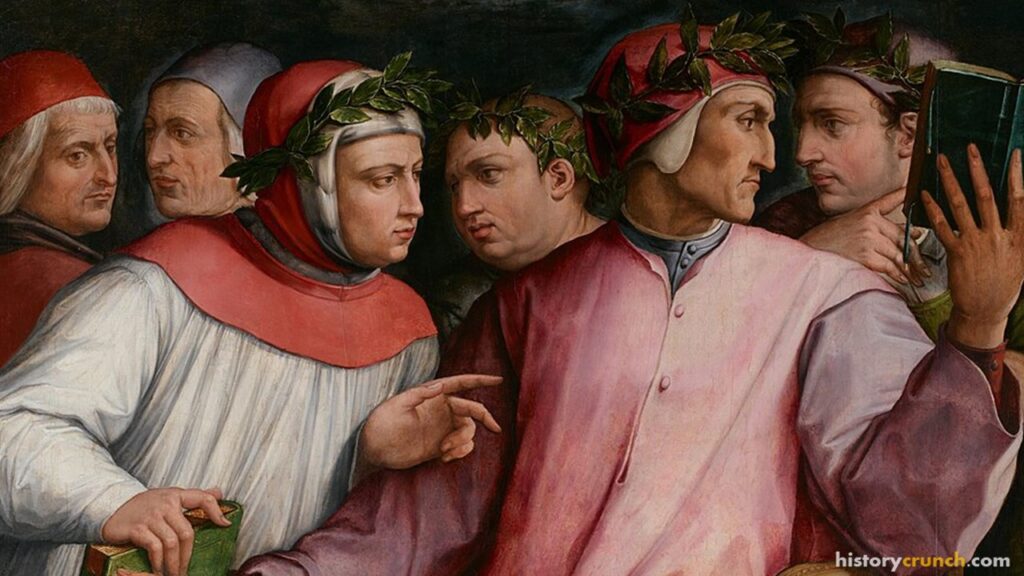
About 1320, a year before his death in exile at Ravenna, the Florentine poet Dante Alighieri completed the Divine Comedy, a journey through hell, purgatory and heaven in 14,233 lines. He wrote it not in Latin, the language of scholars, but in the Tuscan Italian of his own city, and filled it with the politics, gossip and people of his time. His guide through hell is the Roman poet Virgil.
LEARN MORESHOW LESSwhy it mattersLETTERSDante wrote the first great book in a modern European language and made the Tuscan of Florence the Italian that is spoken today. His love of the ancient Romans, and his fights with the popes, are the Renaissance a generation early.
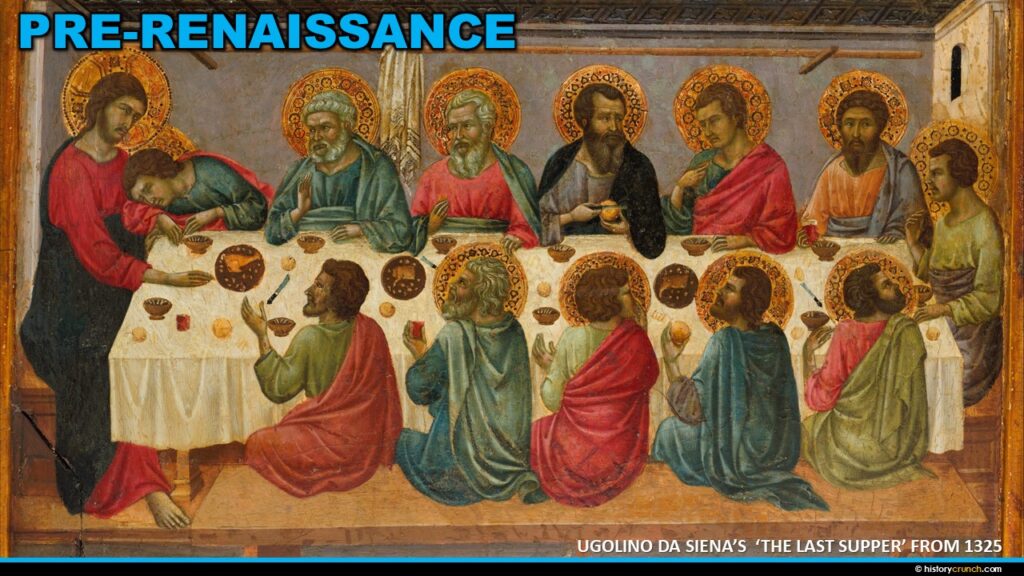
About 1325 the Sienese painter Ugolino da Siena painted a Last Supper for an altarpiece in Florence. It is a fine piece of medieval art: a gold sky, a table seen from above and from the front at once, twelve haloed men in a row, no shadow and no depth. Every face is calm and every angle of the room points a different way. It hangs today in the Metropolitan Museum in New York.
LEARN MORESHOW LESSwhy it mattersARTPut beside Leonardo's Last Supper of the 1490s, this panel shows what the Renaissance changed. Medieval painting told a holy story with signs; Renaissance painting showed a real room with real people in it.
On May 24th, 1337 King Philip VI of France declared the English king's lands in France forfeit, and Edward III answered by claiming the French crown for himself. The war that followed lasted, with pauses, for 116 years, involved five kings on each side, and was fought almost entirely on French soil. Its battles, Crecy, Poitiers and Agincourt, were won by ordinary English archers against armored French knights.
LEARN MORESHOW LESSwhy it matters · key numbersWARWhile Italy's cities grew rich and curious, France and England spent a century destroying each other, which is one reason the Renaissance was slow to cross the Alps. The war also made the knight, the symbol of feudal Europe, obsolete.
On September 23rd, 1339 a crowd in Genoa proclaimed Simone Boccanegra, a popular leader from a merchant family, the city's first doge, a title borrowed from Venice. He was elected for life, as the Venetian doges were, though Genoa's doges rarely lasted that long: the city changed rulers by riot as often as by vote. In 1528 the office was cut to a term of two years.
LEARN MORESHOW LESSwhy it mattersPOWERGenoa, like Venice and Florence, called itself a republic, which in the Renaissance meant government by the merchant families rather than by a king. That merchant rule is why the Italian cities were open to new money and new ideas.
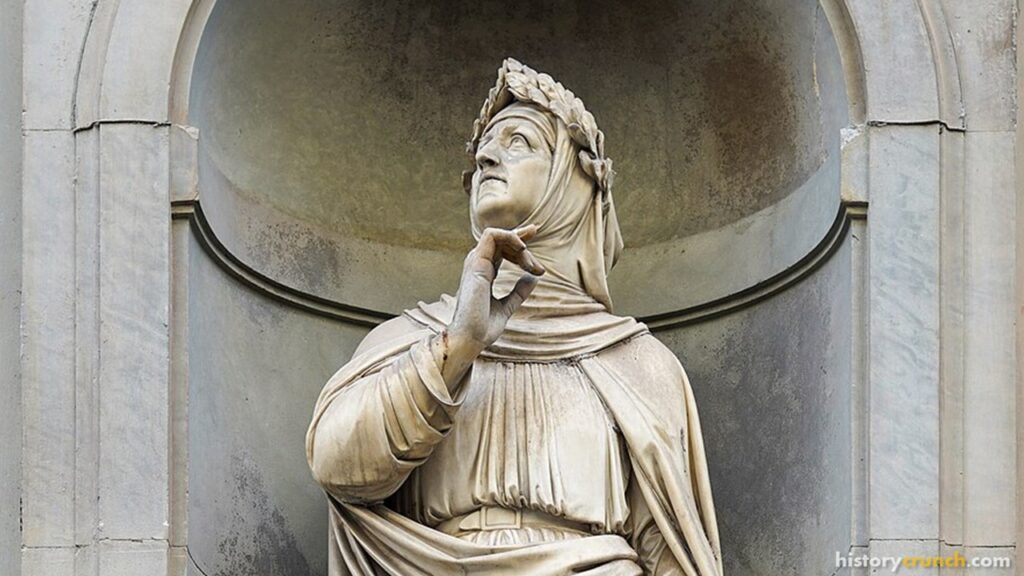
On April 8th, 1341 Petrarch was crowned with laurel on the Capitoline Hill in Rome, the first poet laureate since ancient times, an honor he had arranged for himself by offering his Latin epic 'Africa', about the Roman general Scipio and the war against Hannibal, to both Paris and Rome. He chose Rome. Two years earlier he had begun 'Africa'; he never finished it.
LEARN MORESHOW LESSwhy it matters · 1 key figureLETTERSThe crowning was a piece of theater, and it worked: it announced that a living man could stand beside the ancient Romans. Petrarch spent the rest of his life collecting their books, and the Renaissance began as the habit of reading them.
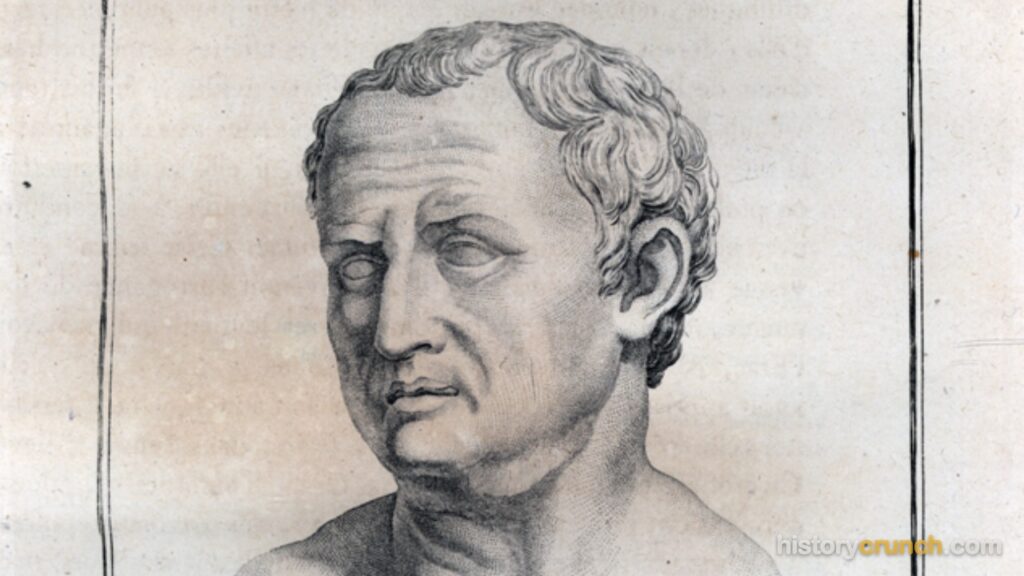
In 1345, in the cathedral library at Verona, Petrarch found a manuscript of the letters of the Roman statesman Cicero to his friend Atticus, unread for centuries. He copied them out himself, and was shocked: the great philosopher turned out to be an anxious, scheming politician. Petrarch wrote Cicero a letter in reply, addressed to the dead man, and went on searching monasteries for other lost Roman authors.
LEARN MORESHOW LESSwhy it matters · 2 key figuresLETTERSThis is the moment historians point to as the spark of the Renaissance: a man reading an ancient book as a letter from a real person, not a holy relic. The hunt for manuscripts Petrarch started filled the libraries of Florence and Rome within a century.
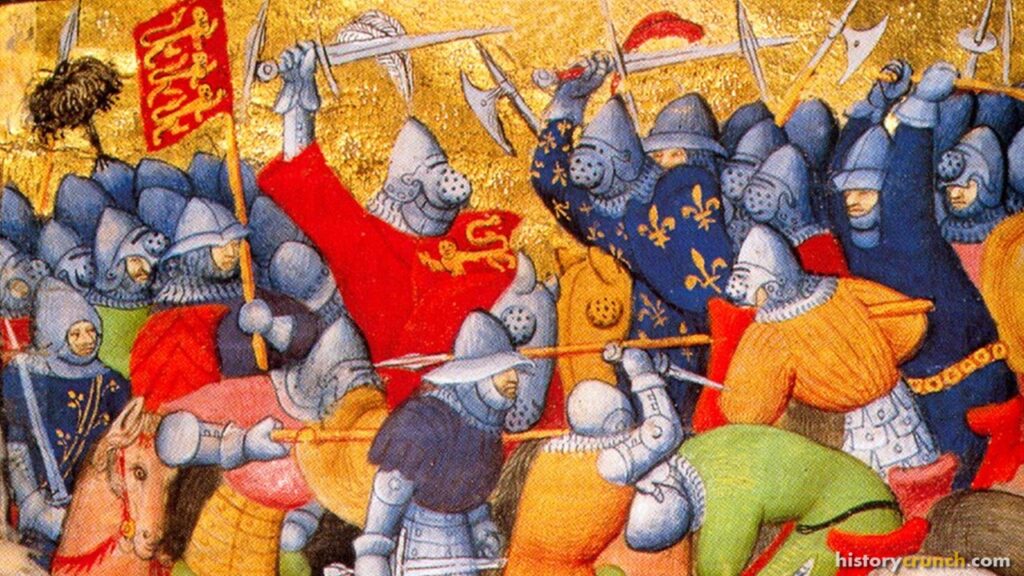
On August 26th, 1346 Edward III's army of about 12,000, most of them longbowmen, stood on a hill near Crecy in northern France against a French army perhaps twice its size. The French knights charged uphill in the late afternoon, wave after wave, into the arrows, and by nightfall more than 1,500 of them were dead, including the blind king of Bohemia. Edward lost a few hundred men.
LEARN MORESHOW LESSwhy it mattersWARA knight's armor, horse and training cost a fortune; a longbow cost a few pence. At Crecy the feudal army of nobles was beaten by paid commoners, and the balance of power in Europe began to shift away from the men on horseback.
The Black Death killed something like half the people of Europe between 1347 and 1351, and the world that came out of it was different: workers scarce and wages high, land and money in fewer hands, and a Church that could neither explain the plague nor stop it. Florence lost half its people and Boccaccio wrote the Decameron in the ruins. Petrarch died at his desk in 1374 with the largest library in Europe; the popes came back to a ruined Rome in 1377 and promptly split into two; Venice and Genoa fought their last war and made peace in 1381. By 1397 Greek was being taught in Florence for the first time in seven centuries and a banker named Giovanni de' Medici had opened a bank.
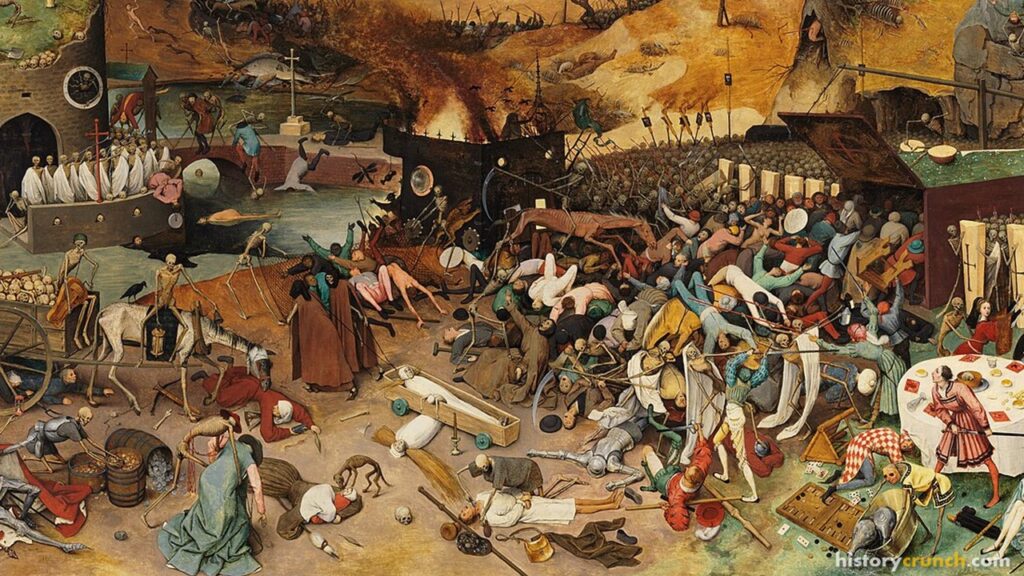
In October 1347 twelve Genoese galleys from the Black Sea colony of Caffa put in at Messina in Sicily with dying men aboard. The plague they carried, spread by the fleas of rats, moved with the ships to Genoa, Venice and Marseille by January and reached Florence, Paris and London in 1348. In four years it killed somewhere between a third and a half of the people of Europe, perhaps 25 million.
LEARN MORESHOW LESSwhy it matters · key numbersPLAGUEThe Black Death is the dividing line between the medieval world and the Renaissance. It broke the feudal labor system, shook faith in a Church that could not explain or stop it, and left the survivors richer, freer and more inclined to ask questions.
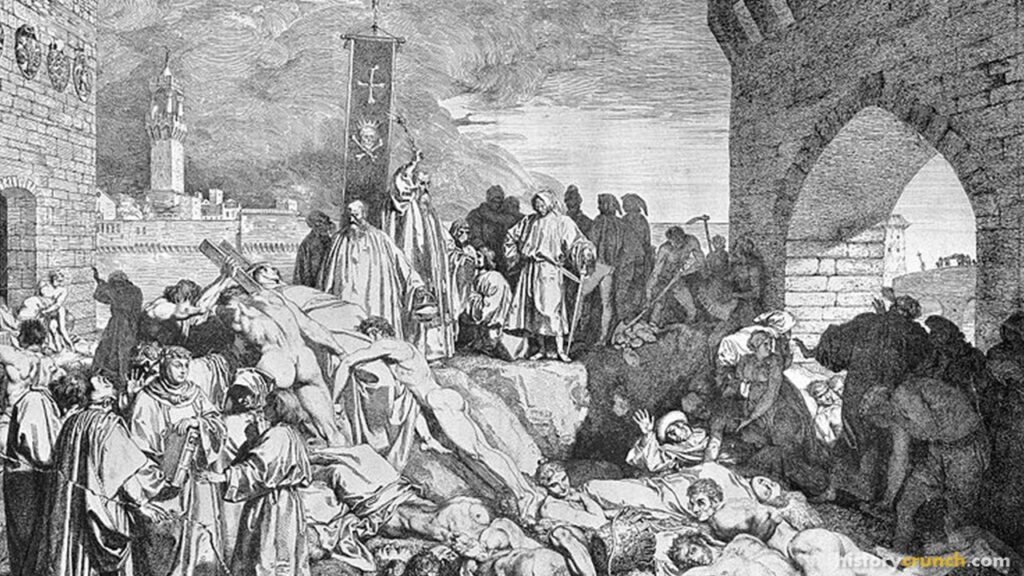
The plague entered Florence in the spring of 1348 and by the end of the year had killed roughly half of a city of 90,000, including Petrarch's Laura and most of the government. Giovanni Boccaccio, who lived through it, described families abandoning their sick, bodies stacked in trenches, and the rich fleeing to the countryside to eat, drink and tell stories while the city died.
LEARN MORESHOW LESSwhy it mattersPLAGUEFlorence lost half its people and came out of the plague, within a generation, richer per head than before, with land, wages and money concentrated in fewer hands. Those hands paid for the art.
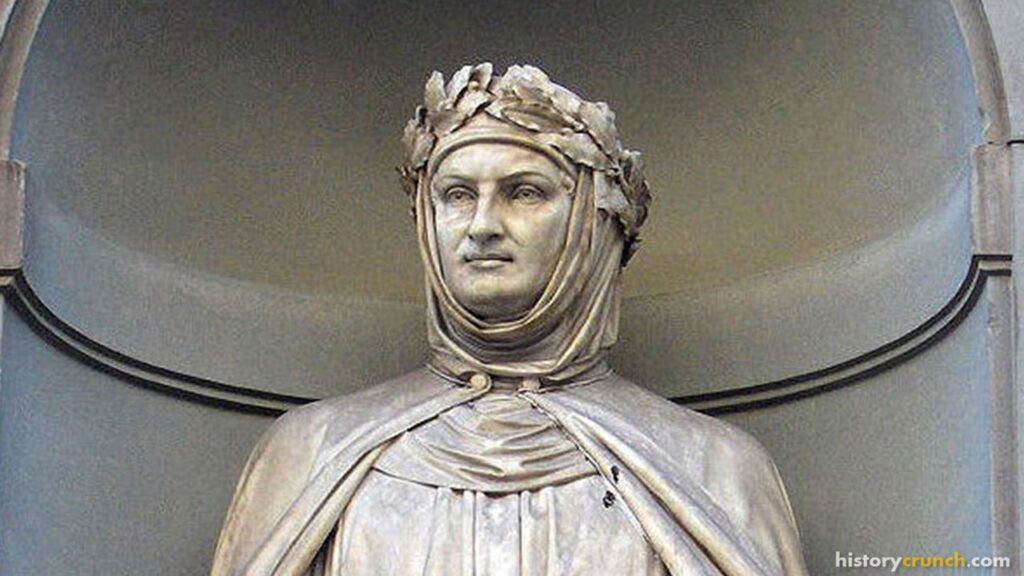
By 1353 Giovanni Boccaccio, a Florentine banker's son and Petrarch's friend, had finished the Decameron: a hundred stories told over ten days by seven young women and three young men who have fled plague-struck Florence to a villa in the hills. The stories are about love, luck, cheating merchants, foolish husbands and dishonest priests, told in the plain Italian of the street, with a firsthand description of the plague as the opening.
LEARN MORESHOW LESSwhy it mattersLETTERSThe Decameron is the first great book of the Renaissance in prose: it is about people, not saints, and it laughs at the Church. Chaucer borrowed from it, and so did Shakespeare.
Petrarch died on the night of July 18th to 19th, 1374, the day before his seventieth birthday, at his house in the village of Arqua in the hills near Padua, and was found in his study with his head resting on a manuscript of Virgil. He left behind the largest private library in Europe, more than 350 Italian poems to Laura that would be imitated for three centuries, and hundreds of letters written to be published.
LEARN MORESHOW LESSwhy it matters · 1 key figurePEOPLEPetrarch had made reading the ancients a way of life and taught a generation of Florentines to do the same. The humanist movement he founded ran the schools, chanceries and libraries of Italy by 1400.
On January 17th, 1377 Pope Gregory XI entered Rome, ending 67 years at Avignon. Petrarch had begged the popes to return and so had Catherine of Siena, who traveled to Avignon to tell Gregory so in person. He found a city of perhaps 20,000 people living among ruins, its churches roofless and its streets grazed by goats. He died fourteen months later.
LEARN MORESHOW LESSwhy it mattersCHURCHThe return of the popes is the start of Rome's Renaissance. Over the next 150 years the popes rebuilt the city, paid Donatello, Michelangelo and Raphael, and made Rome the capital of the High Renaissance.
On July 22nd, 1378 the ciompi, the lowest-paid wool workers of Florence, who had no guild and no vote, stormed the town hall and forced the creation of three new guilds and a share in the government. Their leader, a wool carder named Michele di Lando, was made chief magistrate. Within six weeks the greater guilds had crushed the revolt, and by 1382 every gain was undone.
LEARN MORESHOW LESSwhy it mattersSOCIETYThe Ciompi revolt shows the other side of the wealthy city-state: 25,000 people worked in Florence's wool trade and most were poor. The families who put the revolt down, the Albizzi and then the Medici, ruled the city for the next century.
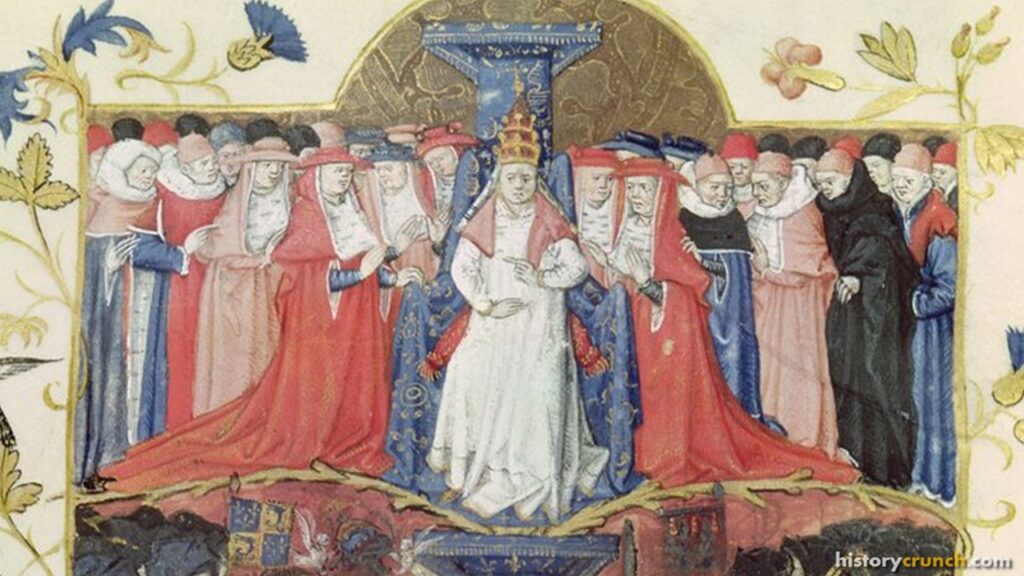
On September 20th, 1378 a group of French cardinals, declaring that the election of the Italian Urban VI in April had been forced by a Roman mob, elected a second pope, Clement VII, who went back to Avignon. For 39 years Europe had two popes, and from 1409 three, each excommunicating the others, each backed by different kingdoms. France, Scotland and Naples followed Avignon; England, the Empire and most of Italy followed Rome.
LEARN MORESHOW LESSwhy it mattersCHURCHA Church with two heads could not claim to be the single source of truth, and the scandal fed the criticism that ended in the Reformation. The schism was closed in 1417 at Constance, and the pope who closed it, Martin V, began Rome's rebuilding.
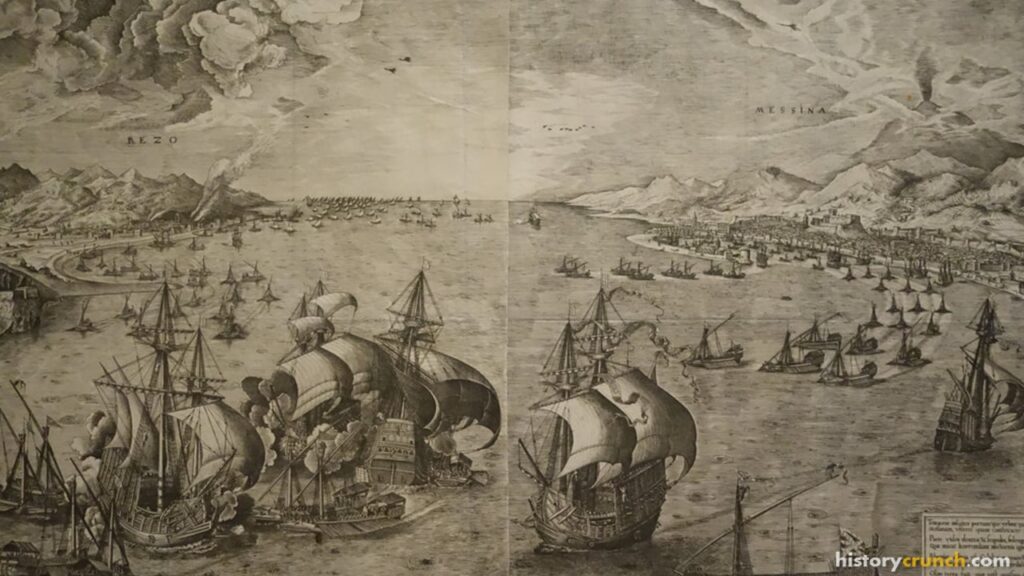
On August 8th, 1381 Venice and Genoa signed a peace at Turin ending the War of Chioggia, the last of four wars fought between them since 1256. Genoa had come within sight of Venice itself in 1379, taking the town of Chioggia at the edge of the lagoon, before the Venetians trapped and starved the Genoese fleet there. Both cities were exhausted, and Venice gave up territory to get the peace.
LEARN MORESHOW LESSwhy it mattersTRADEAfter 1381 the two rivals stopped fighting and went back to making money, and both grew: Genoa to about 100,000 people by 1400, Venice into the master of the eastern Mediterranean. The peace paid for their Renaissance.
Donato di Niccolo di Betto Bardi, called Donatello, was born in Florence in 1386, the son of a wool comber. Filippo Brunelleschi, born in 1377 to a notary, was training as a goldsmith across the same city. The two became friends, went to Rome together to measure the ancient ruins, and between them worked out the two things Renaissance art rests on: sculpture that looks alive and painting that looks deep.
LEARN MORESHOW LESSwhy it matters · 2 key figuresPEOPLEThe generation born in Florence between 1377 and 1400, Brunelleschi, Donatello, Ghiberti, Masaccio, made the early Renaissance. Their teachers were medieval; their pupils were Leonardo's teachers.
On February 2nd, 1397 the Byzantine scholar Manuel Chrysoloras, invited from Constantinople by the chancellor of Florence at a salary of 100 florins a year, gave his first lesson in Greek at the University of Florence. Almost no one in western Europe could read the language; Petrarch had owned a Homer he could not read. Within a generation Chrysoloras's pupils had translated Plato, Plutarch and Ptolemy into Latin.
LEARN MORESHOW LESSwhy it mattersLETTERSThe Latin classics had survived in Europe; the Greek ones, Plato, the historians, the scientists, had to be brought from the East. Chrysoloras's arrival is the day the Greek half of the ancient world came back to the West.
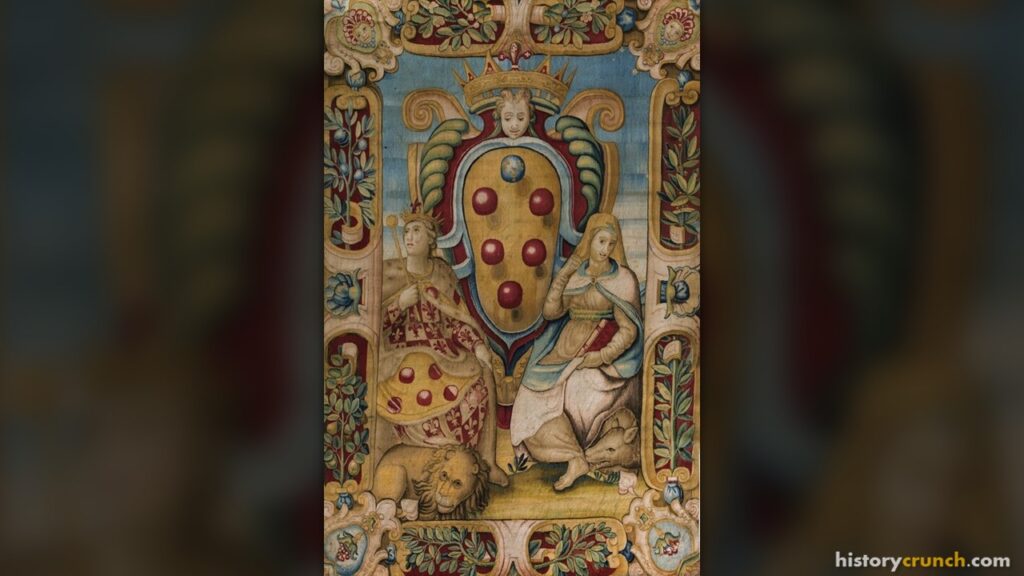
On October 1st, 1397 Giovanni di Bicci de' Medici moved his bank from Rome to Florence and set it up in his own name. The Medici lent to merchants, cities and, above all, the popes, whose taxes from all Europe flowed through their branches in Rome, Venice, Geneva, Bruges and London. Giovanni kept out of politics, gave money quietly, and left his son Cosimo the richest firm in Europe.
LEARN MORESHOW LESSwhy it matters · key numbersMONEYThe Medici Bank paid for the Renaissance in Florence. Its profits built churches and libraries, hired Donatello and Brunelleschi, and bought the family a city.
For fifty years one city made the Renaissance. Florence's guilds held a competition for a pair of bronze doors in 1401, and the loser, Brunelleschi, went to Rome, measured the ruins, worked out linear perspective and came back to raise a dome 143 feet across without a frame. His friend Donatello carved saints with real faces and cast the first nude statue since antiquity for Cosimo de' Medici, who came home from exile in 1434 and ran the republic for thirty years without holding office. Masaccio painted in perspective, Alberti wrote its rules, and the pope came to consecrate the finished dome in 1436. In Flanders, meanwhile, Jan van Eyck was doing something the Italians had not thought of, in oil.
In 1401 the cloth merchants' guild of Florence held a competition for a pair of bronze doors for the Baptistery, the city's oldest building. Seven sculptors submitted a panel of Abraham sacrificing Isaac. The judges chose the 23-year-old goldsmith Lorenzo Ghiberti over Filippo Brunelleschi, whose panel was more violent and more real. Ghiberti spent 21 years on the doors; Brunelleschi, in disgust, gave up sculpture and left for Rome.
LEARN MORESHOW LESSwhy it matters · 1 key figureARTHistorians often call 1401 the first year of the Renaissance, because the competition set the pattern: a rich guild, public money, a contest between artists, and a loser who went off and invented something better. Brunelleschi came back an architect.
By the summer of 1402 the Duke of Milan, Gian Galeazzo Visconti, had taken Bologna, Pisa, Siena and Perugia and had Florence surrounded, its trade routes cut and its people expecting a siege. On September 3rd, 1402 he died of plague at 50, and his empire broke up among his sons and generals within months. Florence called it deliverance.
LEARN MORESHOW LESSwhy it mattersPOWERFlorence's leaders said their republic had been saved by God because it stood for liberty against tyranny, and their chancellor Leonardo Bruni wrote a history to prove it. That civic pride, and the money that came from the peace, fed the city's Renaissance.
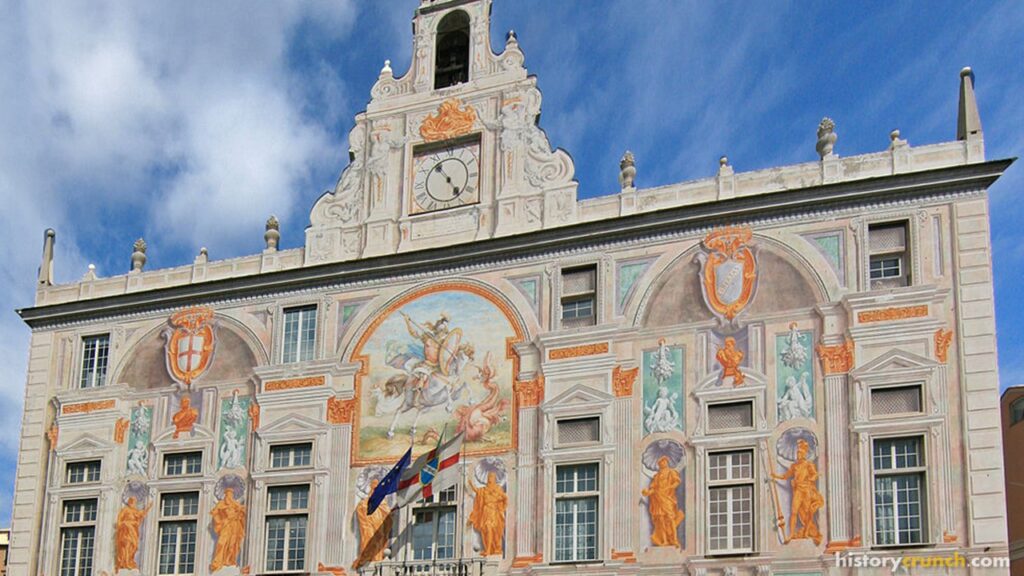
In 1407 the leading families of Genoa, who had lent the republic money for its wars with Venice, combined their claims into the Casa di San Giorgio, the Bank of Saint George, housed in the palace by the harbor. The bank collected the city's taxes to pay its creditors, ran Genoa's colonies in Corsica and the Black Sea, and lent to kings. Christopher Columbus kept an account there. It lasted until 1805.
LEARN MORESHOW LESSwhy it mattersMONEYThe Bank of Saint George was one of the first banks in the modern sense and a model for the Bank of England three centuries later. Genoese money later paid for Spain's empire in the New World.
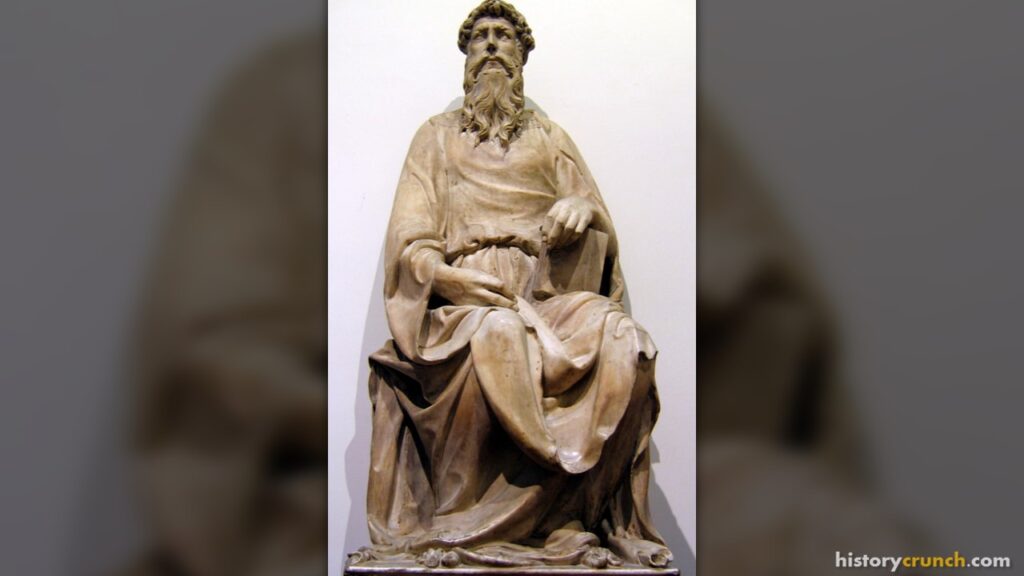
Between 1409 and 1411 the young Donatello carved a seated marble Saint John the Evangelist for the front of Florence Cathedral. It is a Gothic commission and a Gothic subject, but the old man's face is a real face, tired and thinking, and his body has weight under the robes. Michelangelo studied it a century later when he carved his Moses.
LEARN MORESHOW LESSwhy it matters · 1 key figureARTSaint John is the step between medieval sculpture and the Renaissance: still a saint on a church front, but a human being first. Donatello's next thirty years took the idea as far as it could go.
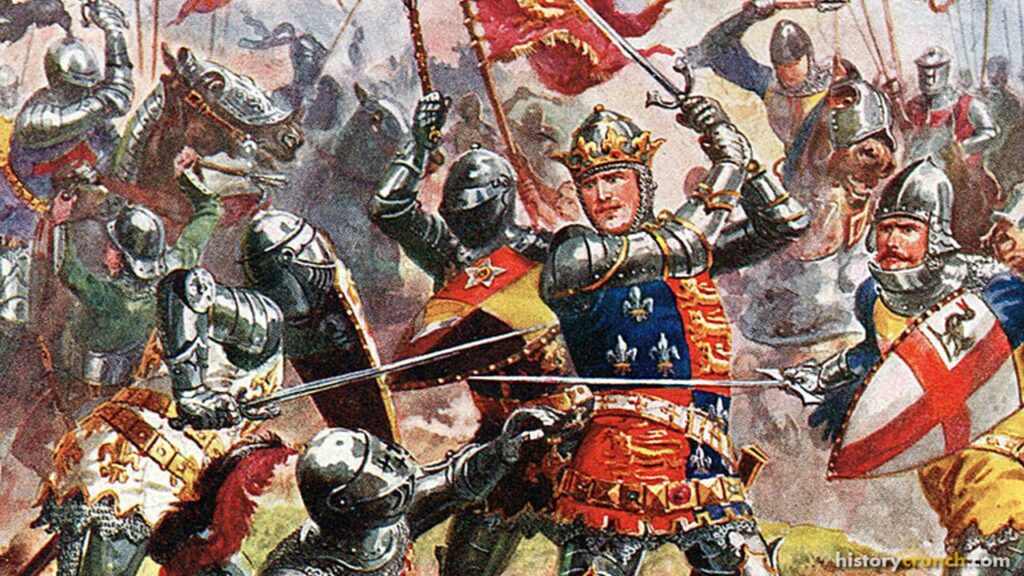
On October 25th, 1415 Henry V of England, with a tired and sick army of about 6,000 on the road to Calais, met a French army perhaps three or four times larger at Agincourt. The French knights, on foot in mud a plowed field deep, walked into the English arrows and into each other, and thousands died, including the flower of the French nobility. Henry lost a few hundred men and went on to conquer Normandy.
LEARN MORESHOW LESSwhy it mattersWARAgincourt was the Hundred Years War at its worst for France, and the war is a large part of why northern Europe took another century to catch up with Italy. The Renaissance needed peace and money, and France had neither.
On November 11th, 1417 the Council of Constance, a gathering of the whole Church in a German town that had already deposed two rival popes and accepted the resignation of the third, elected the Roman noble Oddone Colonna as Pope Martin V. For the first time in 39 years there was one pope. Martin's first task was to get back to a Rome that had been ungoverned for a generation.
LEARN MORESHOW LESSwhy it mattersCHURCHA single pope could rebuild Rome and act as a patron, and Martin V's arrival in 1420 begins the city's Renaissance. The council also taught reformers that a Church council could overrule a pope, an idea Luther would use.
In 1419 the silk guild of Florence commissioned Brunelleschi to build the Ospedale degli Innocenti, a hospital for abandoned children, and he gave it a front of nine round arches on slender columns, the first building in Europe designed on the proportions of ancient Rome rather than the pointed lines of the Gothic. In the same year Giovanni di Bicci de' Medici hired him to rebuild the family's parish church of San Lorenzo.
LEARN MORESHOW LESSwhy it matters · 1 key figureBUILDINGThe Innocenti front is the first Renaissance building. Its arches and columns, copied from the ruins Brunelleschi had measured in Rome, became the look of the next three centuries, from Florence to Washington.
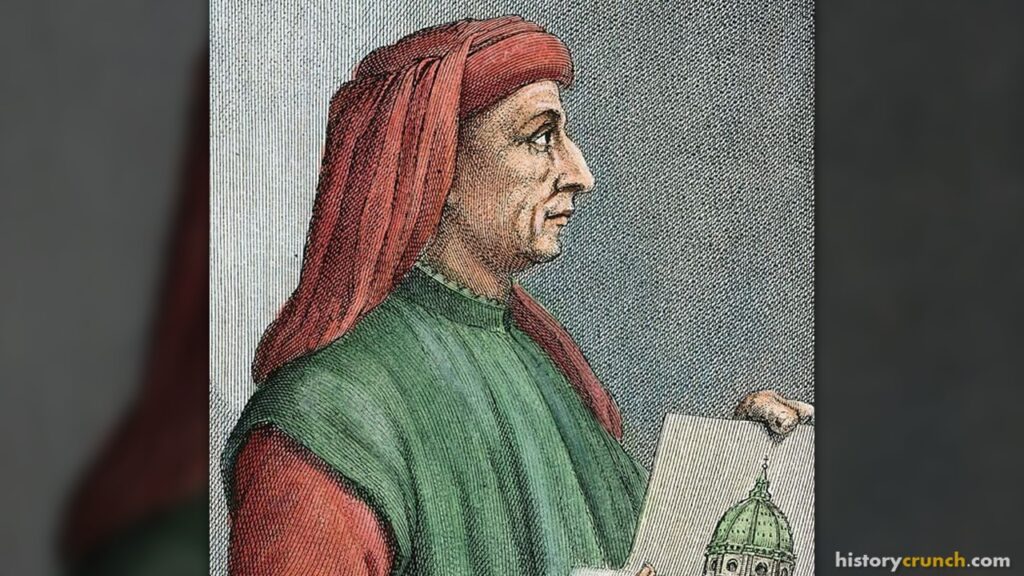
On August 7th, 1420 the builders of Florence Cathedral began raising the dome over a hole 143 feet (44 m) across that had stood open since 1296, because no one had known how to close it. Brunelleschi had won the competition with a plan that used no wooden centering, the usual frame that held a dome up as it was built: his dome would hold itself up as it rose, a shell within a shell, its bricks laid in a herringbone pattern that locked each ring in place.
LEARN MORESHOW LESSwhy it matters · key numbers · 1 key figureBUILDINGNobody had built a dome this size since the Pantheon in Rome, 1,300 years before, and Brunelleschi had studied the Pantheon to do it. The dome is the Renaissance in brick: the ancient world's knowledge recovered and then beaten.
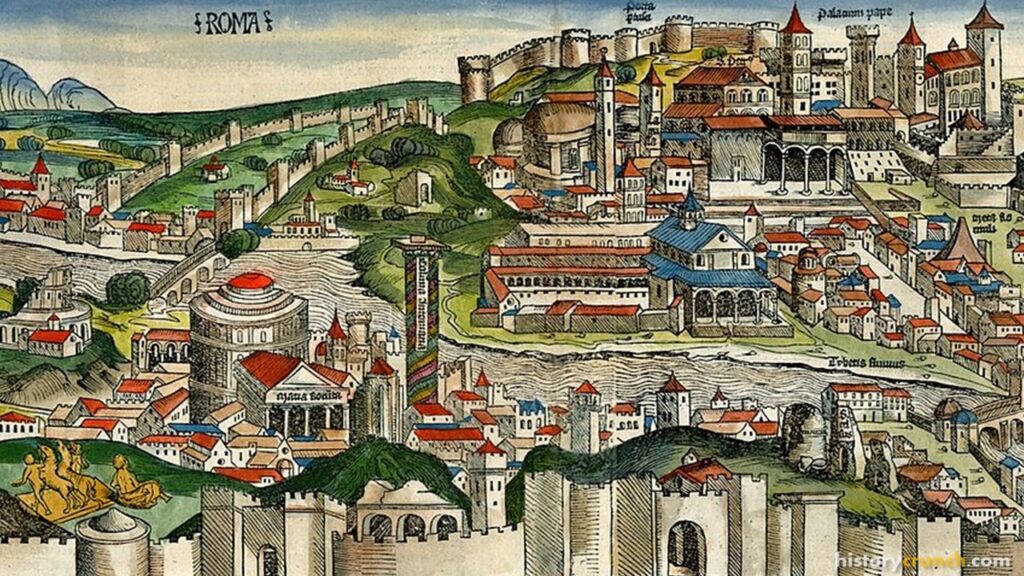
On September 28th, 1420 Pope Martin V rode into Rome, a city of perhaps 20,000 living among the ruins of a million. He set about repairing the churches, roads and bridges, hired the painter Masolino and then Masaccio and Gentile da Fabriano for the basilica of St John Lateran, and drew Donatello to the city to study the ancient statues. Rome began to compete with Florence for artists.
LEARN MORESHOW LESSwhy it mattersCHURCHFrom Martin V to Leo X the popes made Rome the capital of the Renaissance, and their spending on it, paid for with indulgences sold across Europe, is what Luther objected to in 1517.
About 1425 the 24-year-old painter Masaccio, a friend of Brunelleschi and Donatello, painted the Trinity in the church of Santa Maria Novella in Florence: a crucifixion set inside a painted Roman chapel that seems to open into the wall, every line of its vault meeting at a single point at the viewer's eye level. It was the first painting built on the mathematical perspective Brunelleschi had worked out. Masaccio died in Rome three years later, at 27.
LEARN MORESHOW LESSwhy it mattersARTLinear perspective, a set of rules for drawing depth on a flat surface, is the technical heart of Renaissance painting. Masaccio proved it worked, and every painter of the next two centuries learned it from his walls.
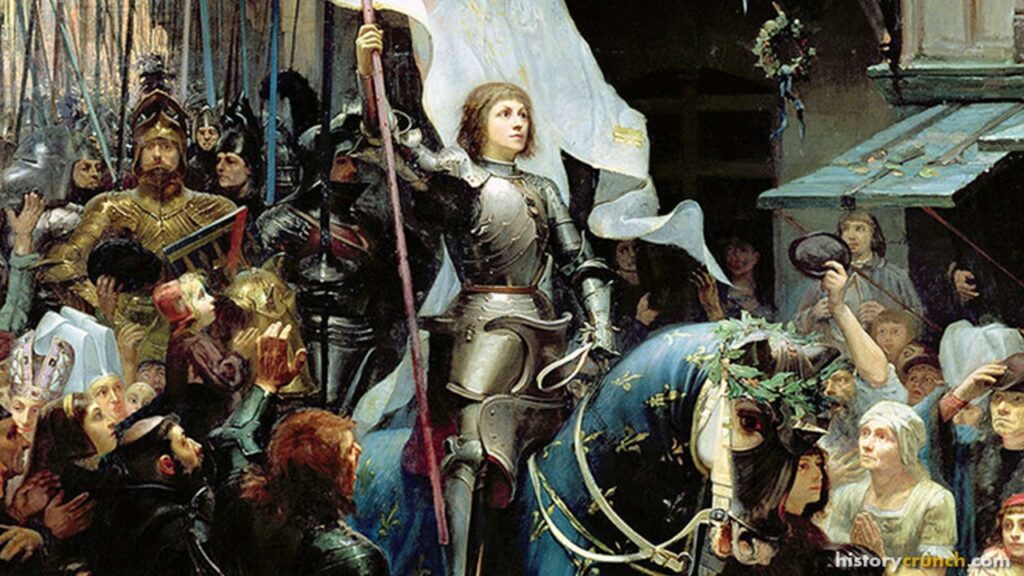
On May 8th, 1429 the English army abandoned the siege of Orleans, nine days after a seventeen-year-old peasant girl from Lorraine named Joan had ridden into the city with a relief force, saying that God had sent her to save France. The French, who had been losing for fourteen years, began to win. Joan was captured a year later and burned by the English at Rouen on May 30th, 1431.
LEARN MORESHOW LESSwhy it matters · 1 key figureWARJoan's year turned the Hundred Years War, and the war's end in 1453 is one of the reasons the Renaissance finally spread north: a France at peace could afford Italian artists and Italian ideas.
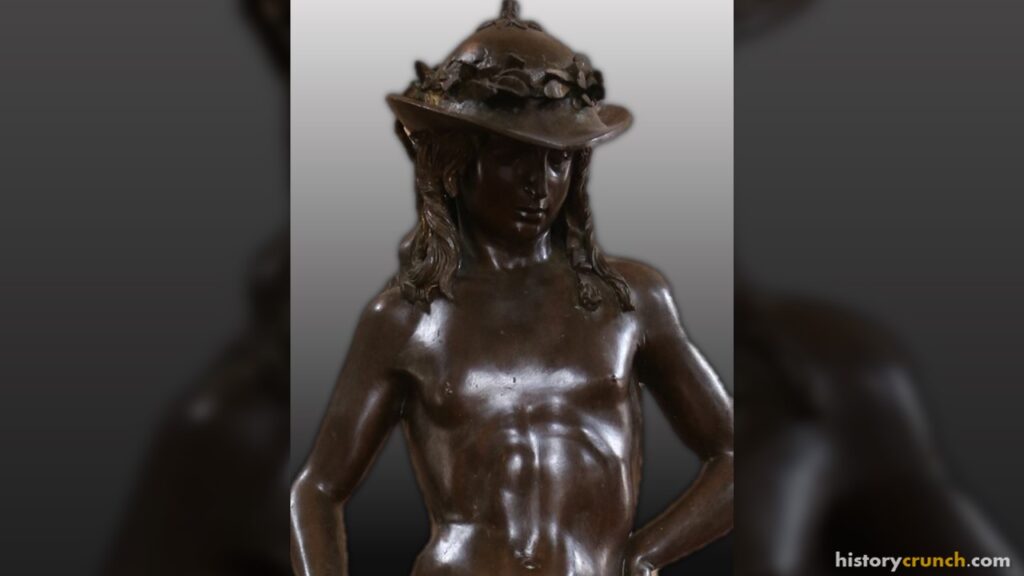
Around 1430, the exact year is not known, Donatello cast for Cosimo de' Medici a bronze statue of David, a boy in a hat and boots and nothing else, one foot resting on the severed head of Goliath. It was the first free-standing nude statue made in Europe since the fall of Rome, and it stood in the courtyard of the Medici palace, not in a church. It is a little over five feet (1.6 m) tall.
LEARN MORESHOW LESSwhy it matters · 2 key figuresARTMedieval sculpture belonged to church fronts and tombs. A naked bronze boy made for a banker's courtyard, in the style of the ancient Romans, is the Renaissance in a single object.
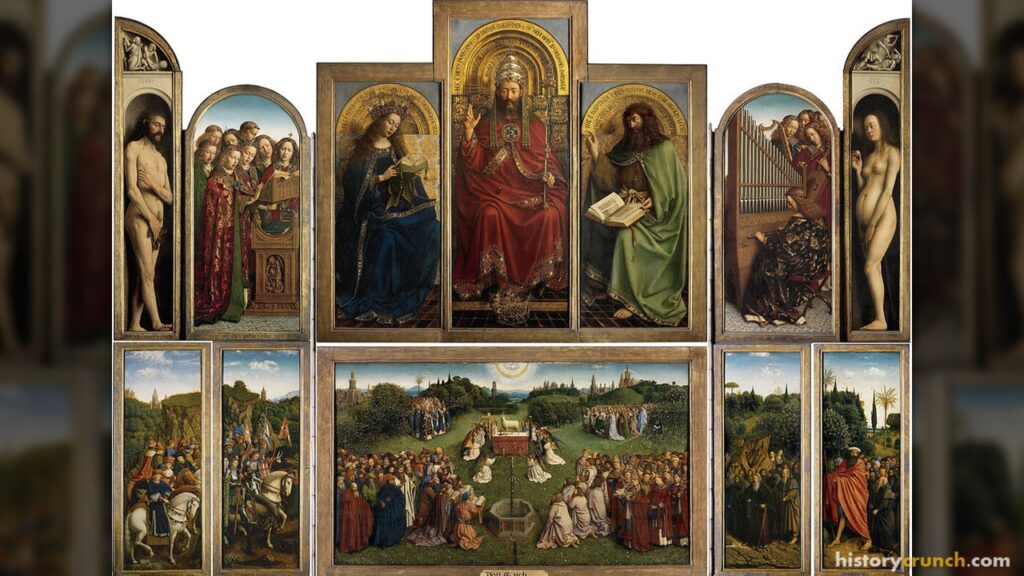
On May 6th, 1432 the Ghent Altarpiece, twelve painted oak panels that open like doors to show the Lamb of God adored by hundreds of figures, was set up in the cathedral of St Bavo in Ghent. Jan van Eyck, court painter to the Duke of Burgundy, had finished it after his brother Hubert's death. Its jewels shine, its grass has separate blades, and its faces have pores, because van Eyck painted in oil rather than the egg tempera of the Italians, and oil dries slowly and can be layered until light seems to come out of the picture.
LEARN MORESHOW LESSwhy it matters · 1 key figureARTThe Renaissance was not only Italian. In the rich cities of Flanders, van Eyck and his followers built painting on oil and close observation rather than on ancient Rome, and Italian painters learned oil from them.
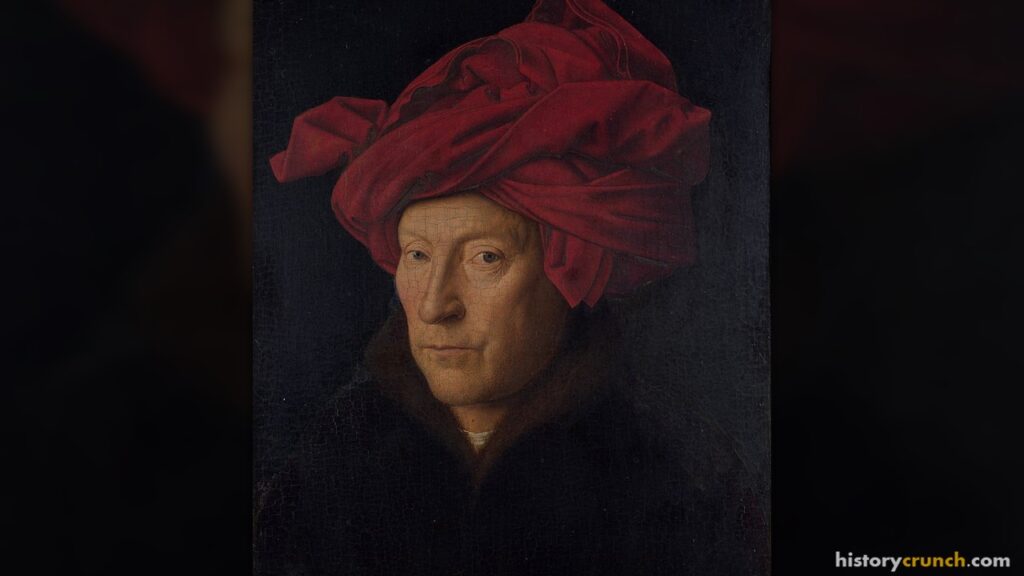
On October 21st, 1433, according to the date he painted on the frame, Jan van Eyck finished a small portrait of a man in a red turban looking straight out at the viewer, which most historians take to be a self-portrait. On the frame he wrote his motto, 'As I can', in Greek letters, and 'Jan van Eyck made me'. It is one of the first portraits in Europe in which the sitter looks the painter in the eye.
LEARN MORESHOW LESSwhy it matters · 1 key figureARTMedieval artists were craftsmen who rarely signed their work. A painter putting his own face and his own name on a picture is the Renaissance idea of the individual, arriving in Flanders at the same moment as in Florence.
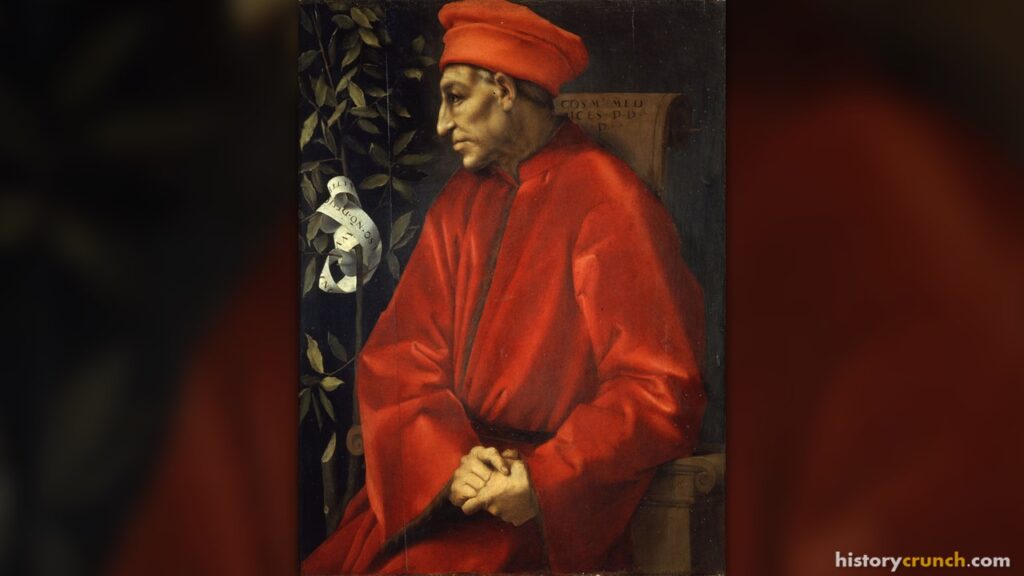
In September 1433 the Albizzi faction, alarmed at the Medici Bank's wealth, had Cosimo de' Medici arrested and exiled to Venice. A year later a new government recalled him, and on October 6th, 1434 he rode back into Florence and the Albizzi went into exile instead. Cosimo held no office of importance for the next thirty years and ran the city anyway, through friends, marriages, loans and the vote.
LEARN MORESHOW LESSwhy it matters · 1 key figurePOWERFrom 1434 Florence was a republic on paper and a Medici state in fact, and its Renaissance was paid for by one family. Cosimo spent more than 600,000 florins on buildings, books and artists before he died.
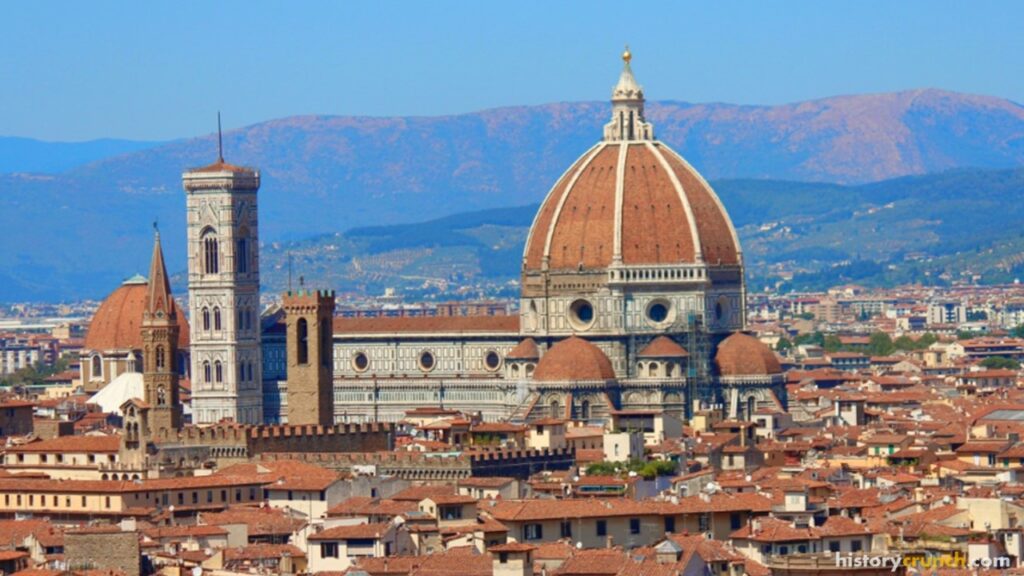
On March 25th, 1436, the Florentine New Year, Pope Eugene IV walked from Santa Maria Novella to the cathedral along a raised wooden walkway and consecrated Florence Cathedral under Brunelleschi's finished dome. Sixteen years of work had laid more than four million bricks in a double shell rising 375 feet (114 m) above the street, with machines Brunelleschi had invented to lift them. The lantern on top was not finished until 1461, fifteen years after his death.
LEARN MORESHOW LESSwhy it matters · key numbers · 1 key figureBUILDINGThe dome was the largest in the world for four centuries and is still the largest of brick. It proved that the moderns could do what the ancients had done, and Alberti dedicated his book on painting to the man who built it.
In 1435 Leon Battista Alberti, a papal secretary, athlete, architect and scholar born to an exiled Florentine family, wrote 'On Painting' in Latin, and on July 17th, 1436 he dated the Italian version he made for the painters of Florence. It was the first book to explain linear perspective step by step, and it told painters to study nature, anatomy and the ancients and to tell stories that moved the viewer. He dedicated it to Brunelleschi.
LEARN MORESHOW LESSwhy it mattersLETTERSAlberti wrote down what the artists of Florence had worked out by hand, and made it teachable anywhere. He is also the model of the Renaissance Man: a man, he said, can do anything he wants, if he wills it.
On July 6th, 1439, in Brunelleschi's cathedral, the Greek and Latin churches signed a union that lasted only on paper. The council had come to Florence at Cosimo de' Medici's invitation and expense, bringing the Byzantine emperor John VIII, the patriarch of Constantinople and 700 Greeks, among them scholars who lectured on Plato to audiences that had never read him. The philosopher Gemistos Plethon so impressed Cosimo that he later founded an academy to study Plato.
LEARN MORESHOW LESSwhy it matters · 1 key figureLETTERSThe council put the leading minds of the Greek world in a room with the leading minds of Italy fourteen years before Constantinople fell. Plato came to Florence with them, and Florentine thought for the next century was Platonic.
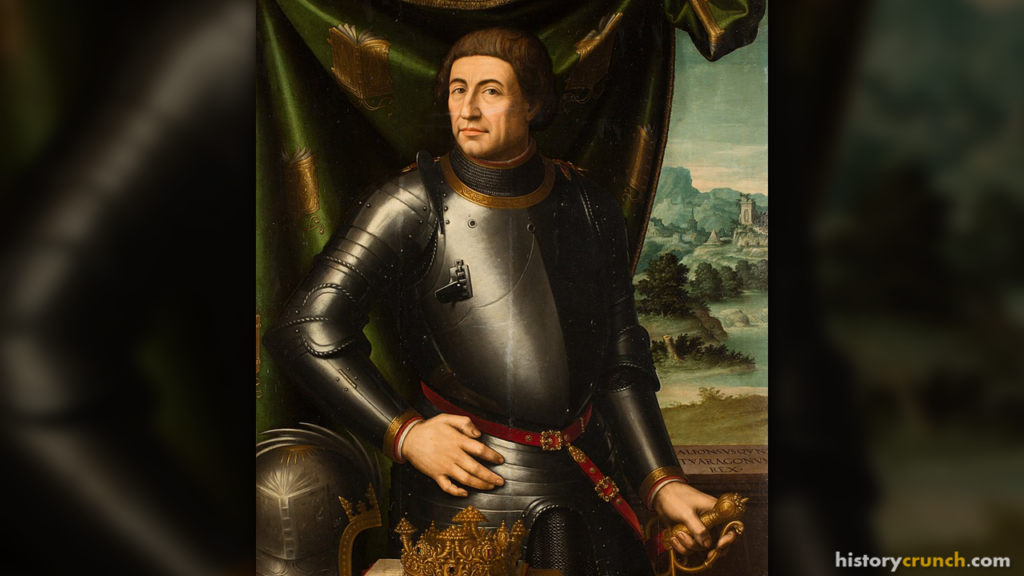
On June 2nd, 1442 Alfonso V of Aragon entered Naples after a siege, ending twenty years of war with the French house of Anjou for the kingdom of southern Italy. He ruled it as Alfonso I, kept his court there rather than in Spain, and filled it with scholars: he had Livy read to him at dinner, paid the humanist Lorenzo Valla, and built a marble triumphal arch in the Roman style at the gate of the Castel Nuovo to celebrate his entry.
LEARN MORESHOW LESSwhy it mattersPOWERNaples under Alfonso 'the Magnanimous' shows the Renaissance spreading beyond the merchant republics to a royal court. It was also a Spanish court, and the Spanish presence in Italy that began here ended the independence of the city-states after 1494.
In 1445 the Florentine sculptor Antonio Averlino, called Filarete, finished the pair of bronze doors Pope Eugene IV had commissioned for the old basilica of St Peter's, twelve years in the making. Their six panels show Christ, the Virgin, St Peter handing the keys to a kneeling Eugene, and St Paul with his sword, and their borders are crowded with Roman emperors, myths and the Council of Florence. They were kept when the old church was pulled down and still hang in the new one.
LEARN MORESHOW LESSwhy it mattersARTA Florentine artist working in bronze in the Roman style, for a pope, on the most important church in Christendom: Rome was learning from Florence, and the popes were becoming the biggest patrons in Europe.
Filippo Brunelleschi died in Florence on April 15th, 1446, aged 69, with the lantern of his dome just begun. He was buried inside the cathedral, an honor almost never given to an artist, under a stone that reads 'the body of a man of great genius'. He left no drawings of the dome, and how he built it has been argued about ever since.
LEARN MORESHOW LESSwhy it matters · 1 key figurePEOPLEBrunelleschi invented linear perspective, revived the architecture of ancient Rome, and built the impossible dome. He was the first modern engineer and the first artist Florence buried as a hero.
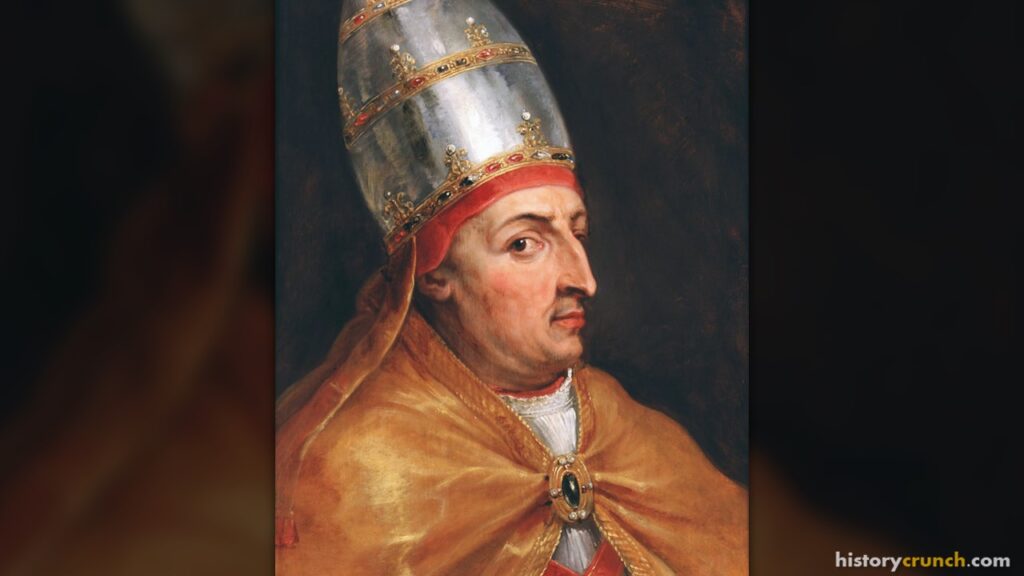
On March 6th, 1447 Tommaso Parentucelli, a poor scholar from Liguria who had once catalogued Cosimo de' Medici's library, was elected Pope Nicholas V. He spent his eight years and the Church's money on books and buildings: agents sent across Europe and to Constantinople to buy Greek manuscripts, a team of translators, a collection of 1,200 volumes that became the Vatican Library, and a plan drawn with Alberti to rebuild St Peter's and the whole Vatican quarter.
LEARN MORESHOW LESSwhy it mattersCHURCHNicholas V made the papacy a patron of humanist learning and began the rebuilding of St Peter's that the next century finished. The Vatican Library he started is still one of the greatest in the world.
On August 13th, 1447 Duke Filippo Maria Visconti died without a legitimate son, and the next day the leading citizens of Milan proclaimed the Ambrosian Republic, named for the city's patron saint. The republic hired the mercenary captain Francesco Sforza, who was married to the dead duke's daughter, to defend it against Venice. He defeated Venice, then turned his army on the city that employed him.
LEARN MORESHOW LESSwhy it mattersPOWERThe Italian city-states depended on hired captains, and a condottiere with an army could take the city he was paid to protect. Sforza did, and Milan's Renaissance happened under his family.
Three things happened in the 1450s that carried the Renaissance beyond Florence. Gutenberg printed a Bible in Mainz; Constantinople fell to the Ottomans and its Greek scholars fled west with their books; and the Hundred Years War ended, so that the north could finally afford to be curious. In Italy the Peace of Lodi gave forty years of quiet, and under Lorenzo the Magnificent Florence had Botticelli, Ficino's Plato, the young Leonardo and a boy named Michelangelo at the family table. Venice became the printing capital of Europe. Then in 1492 Lorenzo died and Columbus landed, and the world the Italian cities had made money from was suddenly much larger and on the wrong side of the continent.
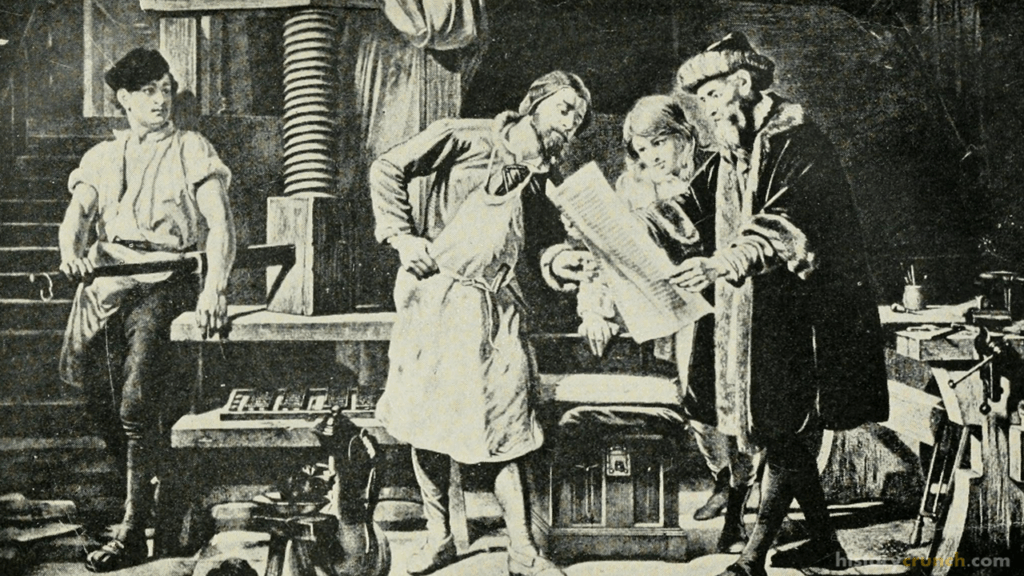
About 1450, the exact year is not recorded, Johannes Gutenberg, a goldsmith of Mainz on the Rhine, began printing with a press of his own design. His invention was not the press, which wine makers had used for centuries, but a hand mold that cast identical metal letters by the thousand, an oil-based ink that stuck to metal, and a way of locking the letters into a page. He borrowed 800 guilders from the lawyer Johann Fust to build the workshop.
LEARN MORESHOW LESSwhy it matters · 1 key figurePRINTINGBefore Gutenberg a book was copied by hand and cost as much as a farm; after him a press could print 300 pages a day. The printing press is the machine that carried the Renaissance, and then the Reformation, out of Italy and into every town in Europe.
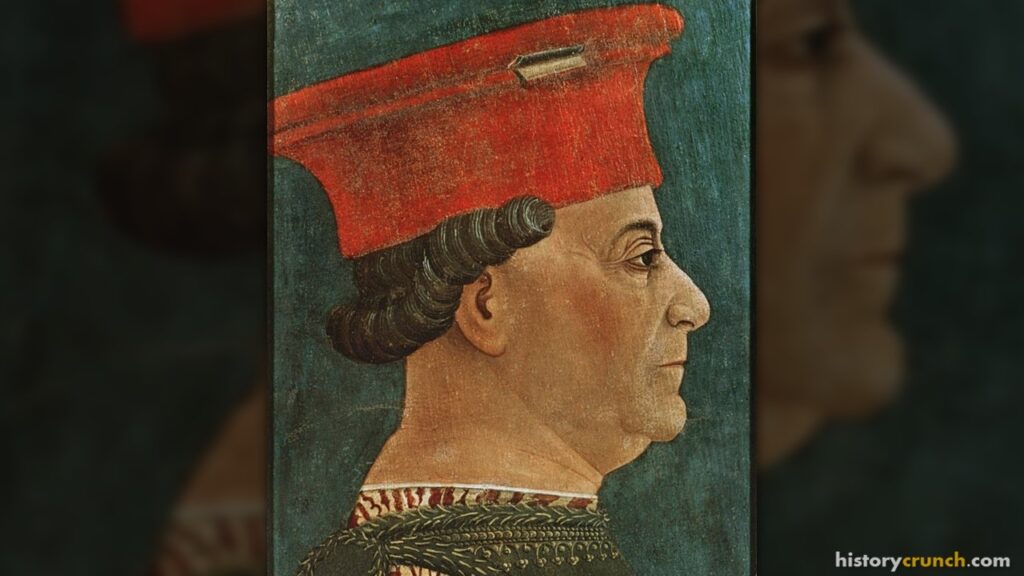
On March 26th, 1450, after starving the city through a winter's siege, the mercenary captain Francesco Sforza was carried into Milan by a crowd that had overthrown the Ambrosian Republic to end the famine. He was proclaimed duke. Under Sforza and his sons Milan built the Castello Sforzesco and the church of Santa Maria delle Grazie, allied with the Medici, and hired Leonardo da Vinci.
LEARN MORESHOW LESSwhy it mattersPOWERSforza rule, 1450 to 1499, was Milan's Renaissance. It also shows how the city-states worked: the peace of Italy for the next forty years rested on a deal between a hired soldier in Milan and a banker in Florence.
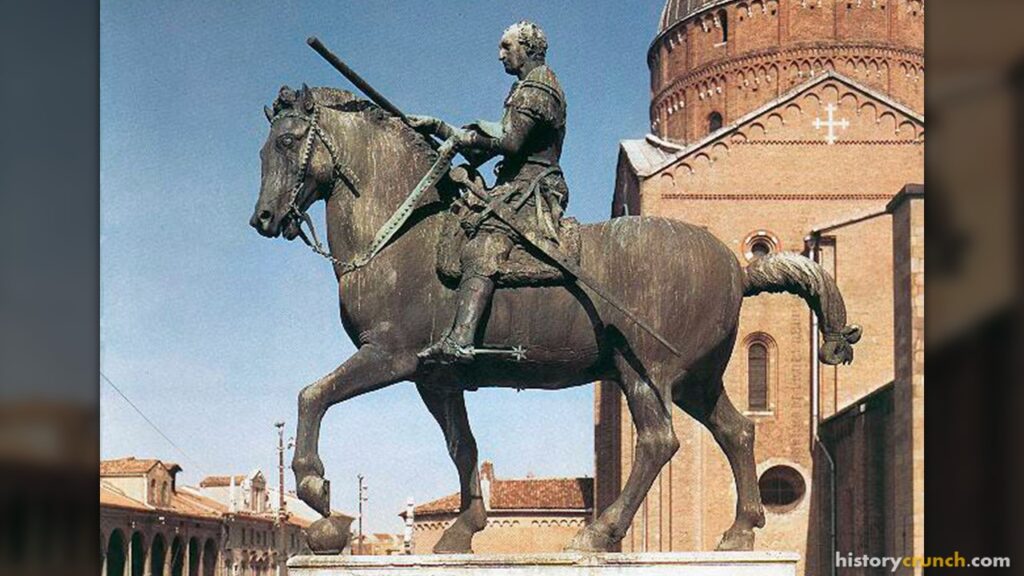
In 1450 Donatello's bronze statue of the mercenary general Erasmo da Narni, nicknamed Gattamelata, 'the honeyed cat', was set up on a high pedestal in the square outside the basilica of St Anthony in Padua. A life-size soldier on a life-size horse, it was the first free-standing equestrian statue cast since the ancient world, modeled on the Roman statue of Marcus Aurelius that Donatello had studied in Rome.
LEARN MORESHOW LESSwhy it matters · 1 key figureARTA monument to a hired soldier, in the pose of a Roman emperor, is the Renaissance idea of fame: a man could earn a statue by what he did. Every bronze general on horseback in every city square since copies this one.
Leonardo was born on April 15th, 1452 in the hills near the village of Vinci, west of Florence, the son of a notary, Ser Piero, and a peasant woman named Caterina who were not married. He was raised in his father's house, taught reading, writing and arithmetic but no Latin, and at about fourteen was placed in the Florence workshop of the painter and sculptor Andrea del Verrocchio, where he learned everything from grinding colors to casting bronze.
LEARN MORESHOW LESSwhy it matters · 1 key figurePEOPLELeonardo is the Renaissance Man, the person who did everything: painter, engineer, anatomist, inventor. His life, 1452 to 1519, runs exactly through the High Renaissance.
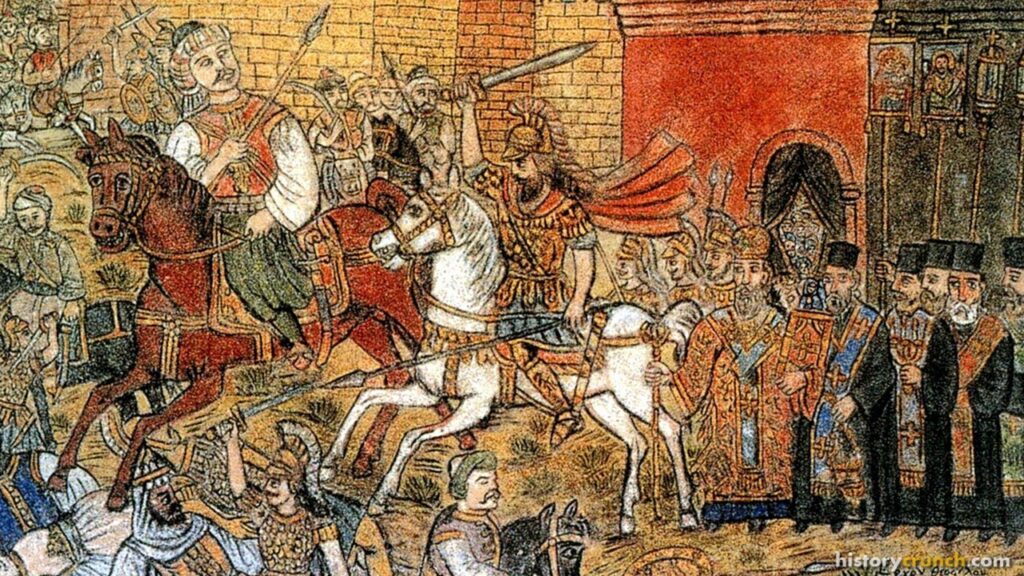
Early on May 29th, 1453, after a 53-day siege in which cannon 30 feet (9 m) long had battered the walls that had stood for a thousand years, the army of the 21-year-old Sultan Mehmed II broke into Constantinople. The last emperor, Constantine XI, threw off his purple and died fighting in the breach with his 7,000 defenders, among them 2,000 Venetians and Genoese. By evening the Hagia Sophia was a mosque and the Byzantine Empire, the eastern half of Rome, was gone.
LEARN MORESHOW LESSwhy it matters · key numbersWARHistorians often end the Middle Ages on this day. Greek scholars fled west with their manuscripts and fed the Renaissance; the Ottomans sat across the land routes to Asia, and Europe went looking for a way round by sea.
On July 17th, 1453 a French army with 300 guns destroyed the last English field army in France at Castillon in Gascony, and Bordeaux surrendered in October. After 116 years the English were left with Calais. No treaty was ever signed; the war simply stopped. Within two years England's nobles were fighting each other in the Wars of the Roses.
LEARN MORESHOW LESSwhy it mattersWARNorthern Europe was free of its great war in the same year Constantinople fell and Gutenberg's press was running. With peace, printing and a flood of scholars from the East, the Renaissance finally began to cross the Alps.
On April 9th, 1454 Venice and Milan signed a peace at Lodi that Cosimo de' Medici had worked for years to bring about, and within the year Florence, Naples and the pope joined it in an Italian League. The five great powers agreed to keep the map as it was and to defend each other against outsiders. The peace held, more or less, for forty years, until the French came over the Alps in 1494.
LEARN MORESHOW LESSwhy it matters · 1 key figurePOWERThe forty years of Lodi are the years of the Medici, of Botticelli, of the young Leonardo and Michelangelo. The Renaissance in Italy was built in a rare stretch of peace, and it broke when the peace did.
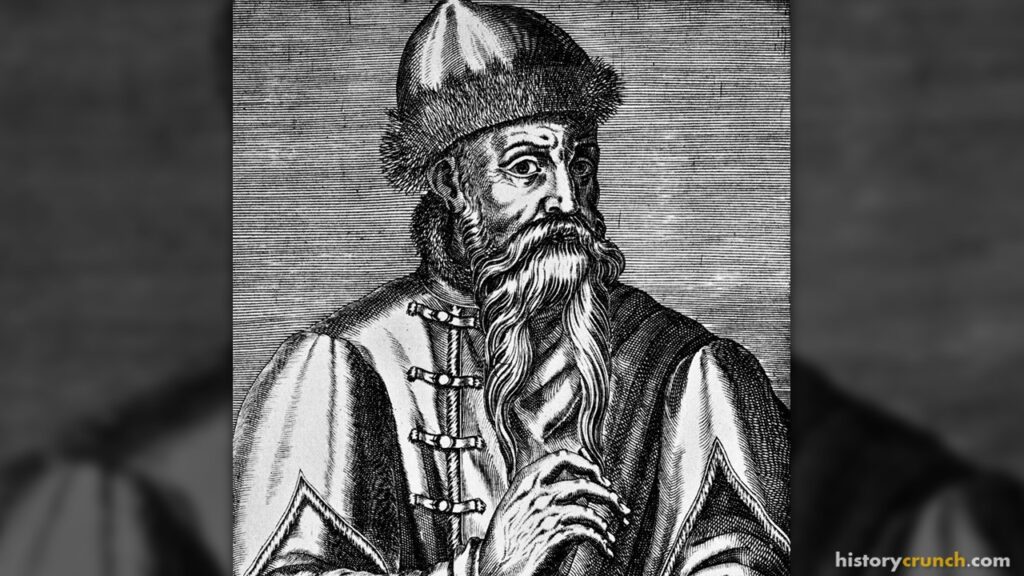
By early 1455 Gutenberg's workshop in Mainz had printed about 180 copies of the Bible in Latin, 1,286 pages in two volumes, 42 lines to a page, some on paper and some on vellum, each as beautiful as a manuscript and each identical to the others. In the same year his creditor Fust sued him for the money he had borrowed, won, and took the press and the type. Gutenberg died in 1468 with little to his name.
LEARN MORESHOW LESSwhy it matters · key numbers · 1 key figurePRINTINGThe Gutenberg Bible is the first major book printed in Europe with movable type. Within fifty years there were presses in 250 towns and about 20 million printed books, more than all the books hand-copied in the previous thousand years.
On May 22nd, 1455 the Duke of York's army cut through the streets of St Albans and killed the leaders of the king's party, opening thirty years of civil war between the houses of Lancaster and York for the English crown. Three kings were deposed, two murdered, and most of the old nobility killed before Henry Tudor won at Bosworth in 1485.
LEARN MORESHOW LESSwhy it mattersWARWhile Florence built and Mainz printed, England spent a generation killing its own nobility. The Tudor peace that followed is when the Renaissance reached England, under Henry VIII and Elizabeth.
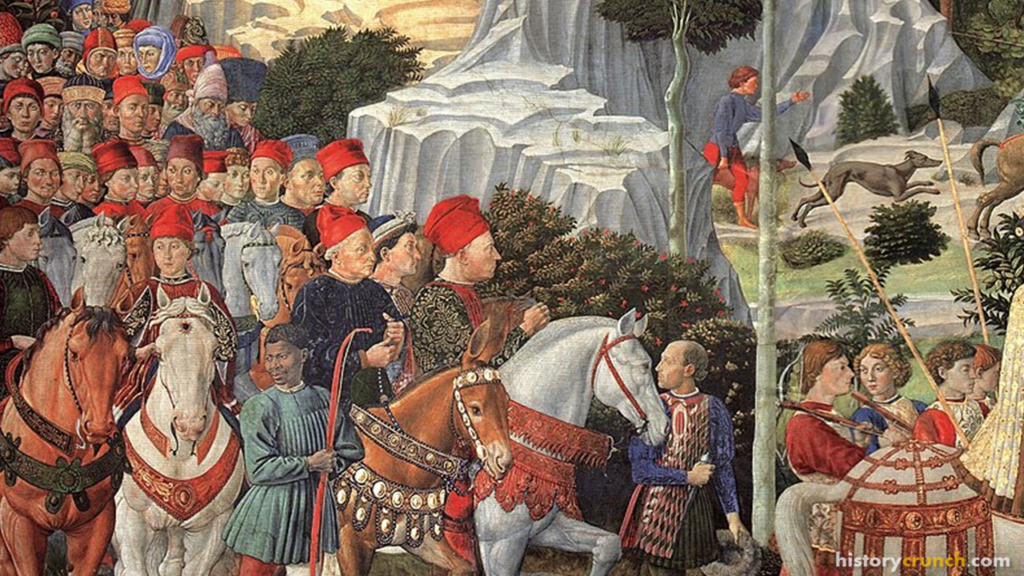
In 1459 Benozzo Gozzoli began the frescoes of the private chapel in the new Medici palace in Florence: the procession of the Magi to Bethlehem, winding through a Tuscan landscape, with the faces of the Medici family, their allies and the painter himself among the kings and courtiers, and the ten-year-old Lorenzo riding at the front in cloth of gold. The chapel was finished by 1464.
LEARN MORESHOW LESSwhy it matters · 1 key figureARTA banker's family painted into a Bible story, in their own house, in their best clothes: patronage was not charity, it was how the Medici told Florence who they were.
In 1462 Cosimo de' Medici gave the young scholar Marsilio Ficino a villa at Careggi outside Florence and a set of Greek manuscripts, and told him to translate all of Plato into Latin. Ficino finished in 1469 and read the translations aloud to a circle of friends that came to be called the Platonic Academy: poets, painters, philosophers and Lorenzo de' Medici. Botticelli's 'Birth of Venus' and 'Primavera' were painted for people in the room.
LEARN MORESHOW LESSwhy it matters · 1 key figureLETTERSPlato had been unread in the West for a thousand years. Ficino's translations made him the philosopher of the Renaissance, and the idea that beauty, love and learning lead the soul upward runs through the art of Florence from here on.
Cosimo de' Medici died at Careggi on August 1st, 1464, aged 74, after thirty years of running Florence without ever being its official head. The city voted to carve 'Pater Patriae', father of the country, the title the Romans had given Cicero, on his tomb in San Lorenzo. He had spent, his grandson later reckoned, more than 600,000 florins on buildings, charity and taxes, and had the first public library in Europe built at San Marco.
LEARN MORESHOW LESSwhy it matters · 1 key figurePEOPLECosimo invented the Renaissance patron: a private man who used a bank's profits to buy books, buildings and artists for his city, and a city for his family. His son Piero and grandson Lorenzo inherited both.
Desiderius Erasmus was born in Rotterdam, in what is now the Netherlands, on October 28th, 1466, the year is not certain, the son of a priest and a physician's daughter who were not married. Both died of plague in 1483. He was schooled by the Brethren of the Common Life, pushed into a monastery, ordained in 1492, and escaped into scholarship as soon as a bishop would pay for it.
LEARN MORESHOW LESSwhy it matters · 1 key figurePEOPLEErasmus became the most famous scholar in Europe and the leading humanist of the North. His life ran from the first printed books to the Reformation, and he was a central figure in both.
Donatello died in Florence on December 13th, 1466, aged about 80, still working, on a pension from the Medici, and was buried beside Cosimo in San Lorenzo. His last works, bronze pulpits for the church, were finished by his pupil Bertoldo di Giovanni, who later taught sculpture to the boy Michelangelo in the Medici garden.
LEARN MORESHOW LESSwhy it matters · 1 key figurePEOPLEDonatello had made sculpture human again: a nude David, a general on horseback, saints with real faces. He was the greatest sculptor of the 15th century, and Michelangelo was his heir at one remove.
Johannes Gutenberg died in Mainz on February 3rd, 1468, aged about 68. He had lost his press and his Bible to his creditor in 1455 and lived his last years on a pension from the archbishop of Mainz, which came with a court robe and a yearly supply of grain and wine. He was buried in a Franciscan church that was later destroyed, and his grave is lost. No portrait of him made in his lifetime survives.
LEARN MORESHOW LESSwhy it matters · 1 key figurePEOPLEThe man who made the most important machine of the Renaissance died in obscurity, and the credit came a generation later. By then there were presses from Lisbon to Krakow.
In 1469 the German printer Johann of Speyer was given the right to print in Venice, and within a generation the city, with its paper, capital, shipping and reach into every market, had more presses than any city in Europe: by 1500 about 150 of them, which had printed perhaps a quarter of all the books in existence. In 1494 Aldus Manutius set up there and printed the Greek classics in small, cheap editions in a new slanting type, italic.
LEARN MORESHOW LESSwhy it mattersPRINTINGVenice made the printed book a business and a thing of beauty. The pocket-sized Aldine classics, and the Greek texts that had come from Constantinople, spread the Renaissance to anyone with a few coins and Latin.
On December 2nd, 1469 Piero de' Medici died, and the next day the leading citizens of Florence asked his son Lorenzo, aged twenty, to take his father's and grandfather's place. Lorenzo, a poet, horseman and diplomat with a flat nose and a bad voice, ran the city for 23 years, kept the peace of Italy by letters and personal charm, and let the bank decay while he collected gems, manuscripts and artists.
LEARN MORESHOW LESSwhy it matters · 1 key figurePOWERUnder Lorenzo Florence had Botticelli, Ghirlandaio, Verrocchio, the young Leonardo and the boy Michelangelo, whom he took into his own house. 'Il Magnifico' is the patron the Renaissance is remembered by.
Nicolaus Copernicus was born on February 19th, 1473 in Torun, a trading city on the Vistula in the Kingdom of Poland, the youngest of four children of a copper merchant. His father died when he was ten and his uncle, later a bishop, paid for his education: the University of Krakow at eighteen, then ten years in Italy at Bologna, Padua and Ferrara, studying law, medicine and, wherever he could, the stars.
LEARN MORESHOW LESSwhy it matters · 1 key figurePEOPLECopernicus was educated by the Renaissance, in the Italy of Leonardo and Michelangelo, and used what it taught him, ancient Greek texts and mathematics, to move the Earth. The Scientific Revolution begins with him.
Michelangelo di Lodovico Buonarroti Simoni was born on March 6th, 1475 in the mountain village of Caprese, where his father was serving a six-month term as the Florentine governor. The family, minor gentry whose bank had failed, moved back to Florence within weeks, and the baby was put out to nurse with a stonecutter's wife in Settignano. He later said he had drunk in the love of chisels with her milk.
LEARN MORESHOW LESSwhy it matters · 1 key figurePEOPLEMichelangelo lived 88 years, from Lorenzo's Florence to the Counter-Reformation, and made David, the Sistine ceiling and the dome of St Peter's. He is the artist the word 'Renaissance' most often brings to mind.
In 1477 Pope Sixtus IV began rebuilding the old Cappella Magna of the Vatican palace as a plain brick box with the proportions of Solomon's Temple as the Bible gives them, 134 feet (41 m) long, 44 feet (13 m) wide and 68 feet (21 m) high, with a barrel-vaulted ceiling painted blue with gold stars. It was finished in 1480 and named for him: the Sistine Chapel. Popes are still elected in it.
LEARN MORESHOW LESSwhy it mattersBUILDINGThe Sistine Chapel was built to be the pope's own chapel and became, over the next sixty years, the most famous room in the history of painting.
On Sunday, April 26th, 1478, at the moment of the elevation of the host during High Mass in Florence Cathedral, assassins hired by the rival Pazzi bank, with the knowledge of Pope Sixtus IV, stabbed Giuliano de' Medici nineteen times and wounded his brother Lorenzo, who fought his way into the sacristy and survived. Within hours the city hanged the conspirators, including the archbishop of Pisa, from the windows of the town hall. Botticelli painted the hanged men on the wall.
LEARN MORESHOW LESSwhy it matters · 1 key figurePOWERThe conspiracy shows what Renaissance politics was under the paintings: a bank, a pope and a cathedral used for murder. It also made Lorenzo, who survived, the unchallenged master of Florence for the rest of his life.
In 1481 Lorenzo de' Medici, making peace with the pope after the Pazzi war, sent Florence's best painters to Rome: Sandro Botticelli, Domenico Ghirlandaio and Cosimo Rosselli, joined by Perugino from Umbria and his assistant Pinturicchio. In about a year they covered the side walls of the Sistine Chapel with the lives of Moses and of Christ in twelve large frescoes, with portraits of the popes above. Ghirlandaio's apprentice, seven years later, would be Michelangelo.
LEARN MORESHOW LESSwhy it mattersARTThe Sistine walls were the first great collaboration of the Renaissance and a Florentine export: the art of the Medici city went to Rome to decorate the pope's chapel, and the pope's chapel became the art capital of Europe.
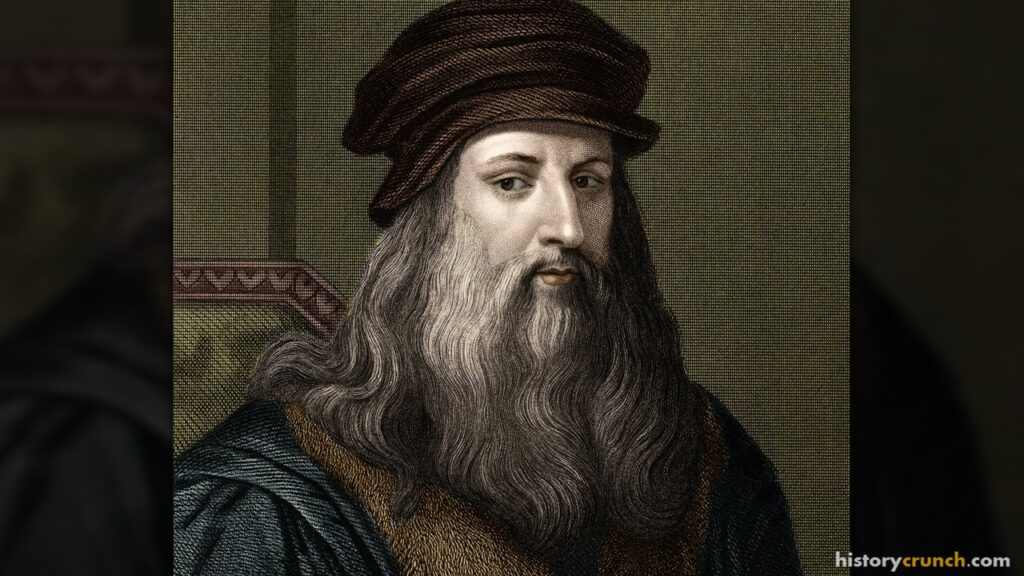
In 1482 Leonardo da Vinci, thirty, left Florence for the court of Ludovico Sforza in Milan, carrying a silver lyre in the shape of a horse's head as a gift from Lorenzo de' Medici. His letter of application to the duke listed nine kinds of war machines he could build, bridges, cannon, armored cars, and mentioned painting last. He stayed seventeen years, painted the Last Supper and the Virgin of the Rocks, designed canals, and filled notebooks with anatomy and flying machines.
LEARN MORESHOW LESSwhy it matters · 1 key figureARTLeonardo sold himself to Milan as an engineer, and the notebooks he filled there are the clearest record of the Renaissance mind: art and science as one subject. Milan's Renaissance is mostly his.
Raffaello Sanzio was born in Urbino on April 6th, 1483, or possibly March 28th, the son of Giovanni Santi, court painter and poet to the Duke of Urbino, whose small mountain court was famous across Italy for its manners. His mother died when he was eight and his father when he was eleven; he grew up in his father's workshop and was called a master painter at seventeen. In the same year, on November 10th, Martin Luther was born in Eisleben in Germany.
LEARN MORESHOW LESSwhy it matters · 2 key figuresPEOPLERaphael and Luther were born seven months apart. One painted the Vatican for the popes; the other split the Church that paid for it. Both are the Renaissance.
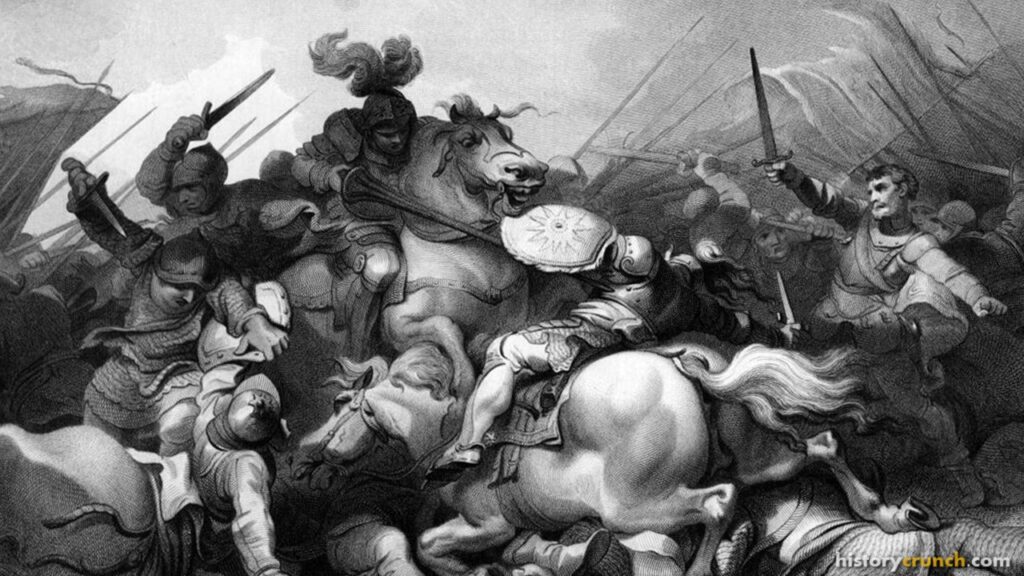
On August 22nd, 1485 Henry Tudor's small army met King Richard III's near Bosworth in Leicestershire, and when the Stanley family switched sides in the middle of the fight, Richard charged at Henry personally and was cut down, the last English king to die in battle. Henry VII was crowned on the field with Richard's circlet. His marriage to Elizabeth of York joined the two roses.
LEARN MORESHOW LESSwhy it mattersWARThe Tudor peace after Bosworth is when the Renaissance reached England: Erasmus and Holbein came to Henry VIII's court, and Shakespeare was writing under Henry's granddaughter.
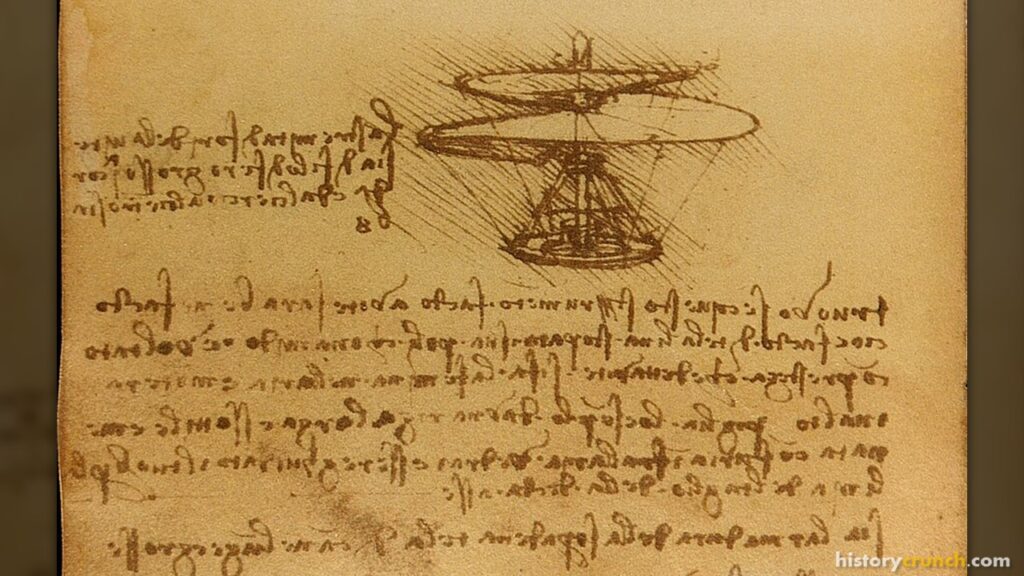
In the late 1480s, in Milan, Leonardo drew an 'aerial screw', a spiral of linen and wire about 15 feet (4.6 m) across turned by four men on a platform, which he thought would bore upward into the air the way a screw bores into wood. In the same notebooks are a parachute, a diving suit, a tank, an armored car and page after page of birds' wings. None of the flying machines was built, and none would have flown.
LEARN MORESHOW LESSwhy it matters · 1 key figureSCIENCELeonardo's inventions mostly failed or stayed on paper, but the habit behind them, watching nature closely and asking how it works, is the Renaissance turning into science. The notebooks run to about 7,000 surviving pages.
In 1490, at fifteen, Michelangelo was noticed by Lorenzo de' Medici in the sculpture garden at San Marco, where old Bertoldo taught the Medici collection of ancient marbles to promising boys. Lorenzo took him to live in the palace, sat him at his own table with Ficino, Poliziano and the poets of the Platonic Academy, and paid his father. In two years there Michelangelo carved the 'Madonna of the Stairs' and the 'Battle of the Centaurs' and had his nose broken by a jealous rival.
LEARN MORESHOW LESSwhy it matters · 2 key figuresARTMichelangelo learned sculpture from the ancients and philosophy from the Platonists at the Medici table, and both are in everything he made. Lorenzo's death in 1492 threw him out into the world.
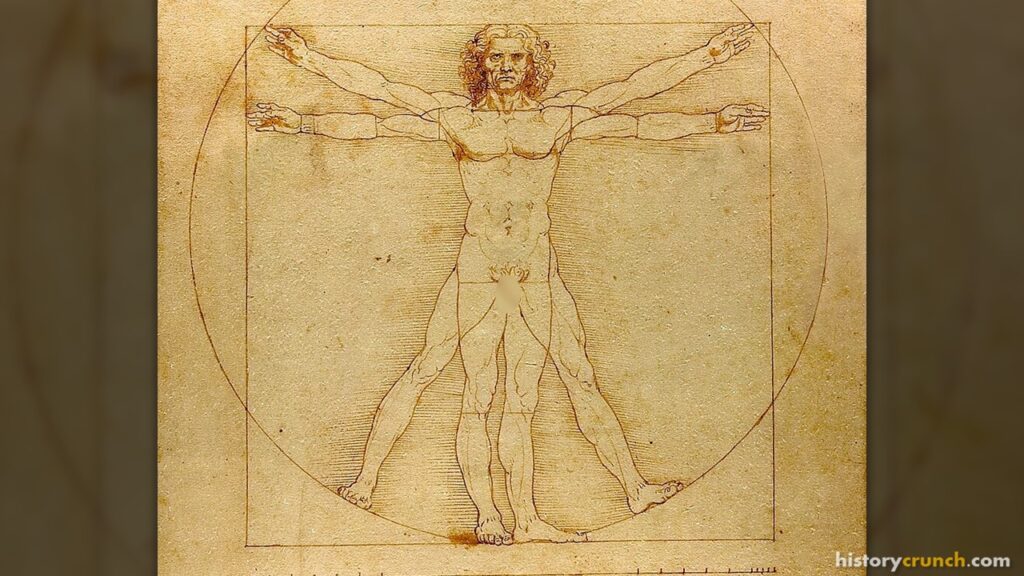
About 1490 Leonardo drew a naked man in two positions at once, arms and legs out to touch a circle and a square, to test a claim by the Roman architect Vitruvius that the perfect human body fits both. Around the figure, in his mirror writing, Leonardo set down the proportions: the span of the arms equals the height, the face is a tenth of the height, and so on. It is a pen drawing on one sheet of paper, kept in the dark in Venice.
LEARN MORESHOW LESSwhy it matters · 1 key figureSCIENCEThe drawing puts the two halves of the Renaissance on one page: the ancient text and the measured body, art and mathematics, the belief that man is the measure of all things. It is the most reproduced drawing in the world.
Lorenzo de' Medici died at Careggi on April 8th, 1492, aged 43, of the gout and kidney disease that had crippled his family for three generations. The friar Savonarola came to his deathbed, by one account to refuse him absolution unless he gave Florence back its liberty. His son Piero, twenty and arrogant, took over the city; the bank was near ruin; and the peace of Italy had lost the man who held it together.
LEARN MORESHOW LESSwhy it matters · 1 key figurePEOPLELorenzo's death is the end of the Florentine Renaissance's golden age. Within two years the French had invaded, the Medici were exiled and Savonarola ruled the city.
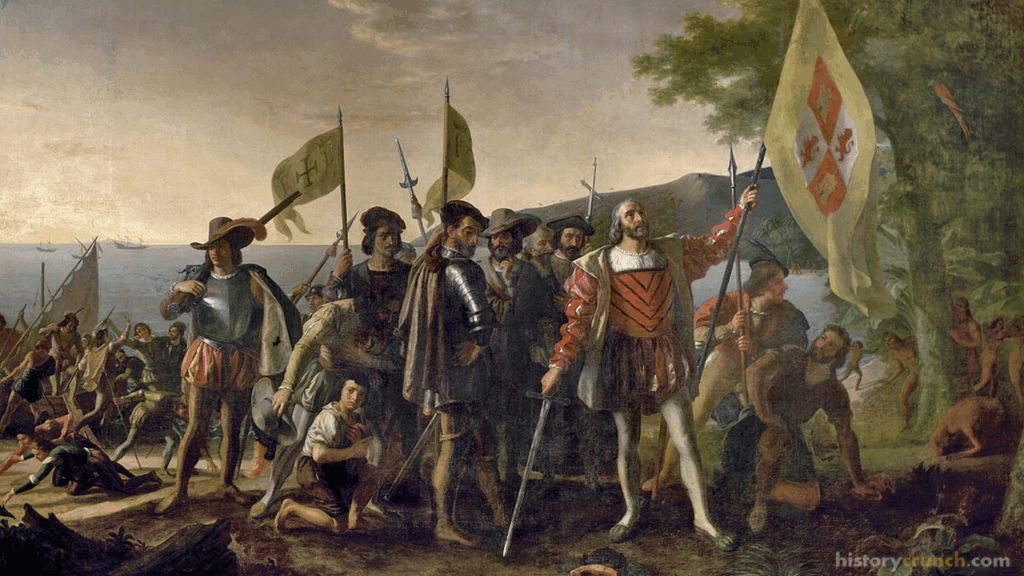
At about two in the morning of October 12th, 1492 a lookout on the Pinta sighted land, and later that day Christopher Columbus, a Genoese sailor in the pay of Spain who had promised to reach Asia by sailing west, went ashore on an island in the Bahamas he named San Salvador. He had three ships and about 90 men and had been at sea from the Canaries for 33 days. He believed until he died that he had reached the Indies.
LEARN MORESHOW LESSwhy it matters · key numbers · 1 key figureEXPLORATIONColumbus's voyage doubled the known world in a year and shifted Europe's wealth and attention from the Mediterranean to the Atlantic. The Italian cities that had made the Renaissance were, from this day, on the wrong side of the continent.
In 1494 a French army crossed the Alps, the Medici were thrown out of Florence and the peace of Italy ended. The thirty years of war that followed were also the thirty years in which Leonardo painted the Last Supper and the Mona Lisa, Michelangelo carved David and painted the Sistine ceiling, and Raphael painted the pope's rooms: the High Renaissance, made in Florence, Milan and above all Rome, where the warrior pope Julius II and the Medici pope Leo X spent money they did not have. Erasmus printed the Greek New Testament in 1516; Luther posted his theses in 1517 against the indulgences that paid for St Peter's. The chapter ends with Raphael dead at 37, Leonardo dead in France, and the emperor's unpaid soldiers sacking Rome in 1527.
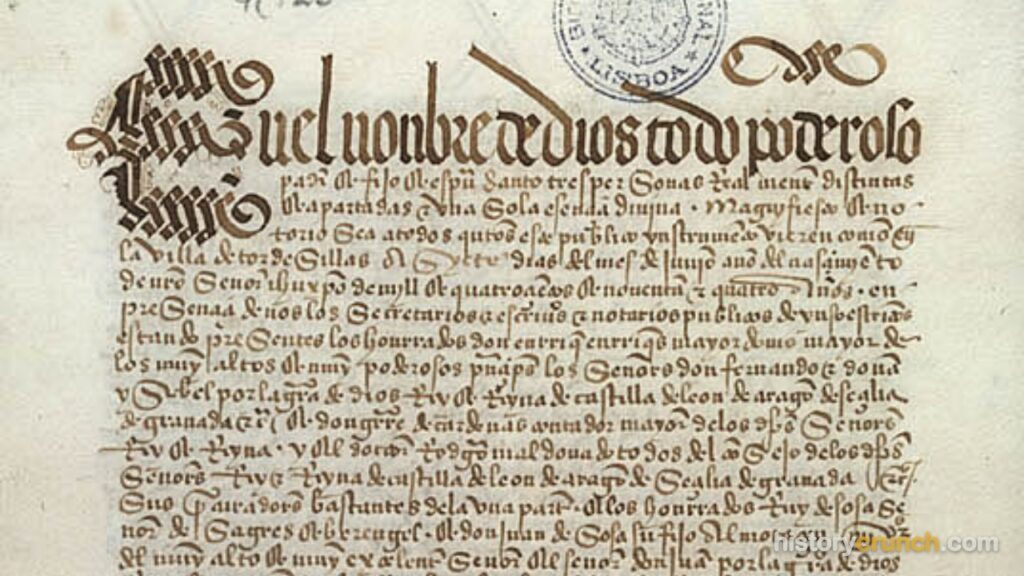
On June 7th, 1494 Spain and Portugal signed a treaty at Tordesillas dividing the lands beyond Europe along a line 370 leagues west of the Cape Verde Islands: everything west of it to Spain, everything east to Portugal. The pope, the Spanish-born Alexander VI, had proposed a line the year before; the Portuguese bargained it westward, which is why Brazil, reached in 1500, speaks Portuguese.
LEARN MORESHOW LESSwhy it mattersEXPLORATIONTwo kingdoms on the Atlantic edge of Europe divided a world the Italian city-states had no share in. The wealth of the next century would flow to Lisbon and Seville, and Italy would become the prize its neighbors fought over.
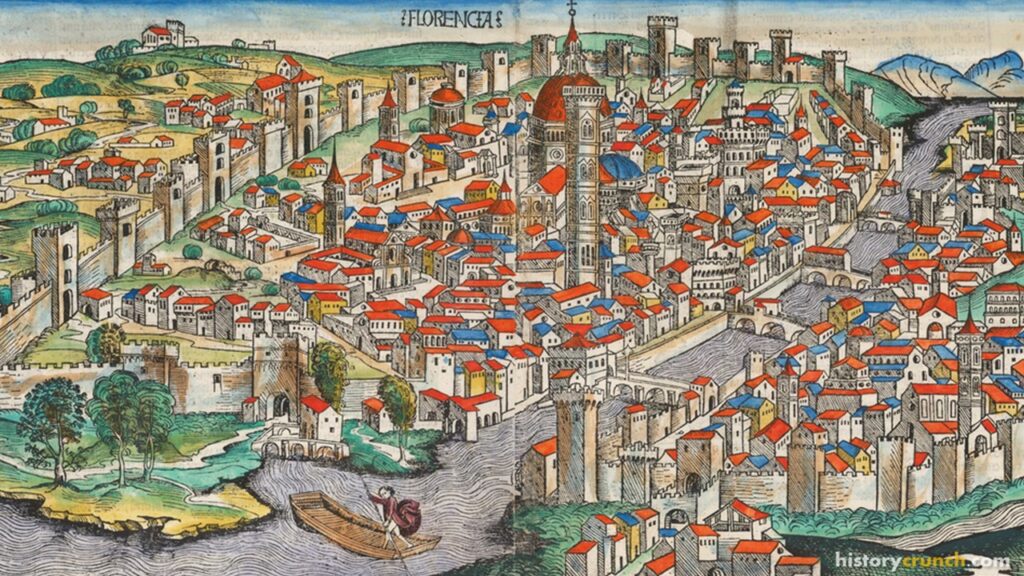
In September 1494 King Charles VIII of France crossed the Alps with about 25,000 men and the first modern siege artillery to claim the crown of Naples. Piero de' Medici surrendered Florence's fortresses without a fight, and on November 9th, 1494 the city rose, drove the Medici out and declared the republic restored. The Medici Bank collapsed with them. Charles marched through Florence and Rome and took Naples in February without a battle.
LEARN MORESHOW LESSwhy it mattersWARThe French invasion ended the forty years of peace that had made the Italian Renaissance possible. For the next sixty years France and Spain fought over Italy, and the city-states became the ground they fought on.
In 1495 Erasmus, a monk in his late twenties with permission to leave his monastery, arrived at the University of Paris to study theology, hated the medieval way it was taught, and supported himself by tutoring rich young men in Latin. The exercises he wrote for them became his first books. In 1499 a pupil took him to England, where he met Thomas More and John Colet and learned that the classics could be used to reform the Church.
LEARN MORESHOW LESSwhy it matters · 1 key figureLETTERSErasmus carried the Italian humanism of Petrarch north and turned it toward religion: read the Bible in the original as you read Cicero, and the Church's abuses will show. That idea shaped both the Reformation and its Catholic opponents.
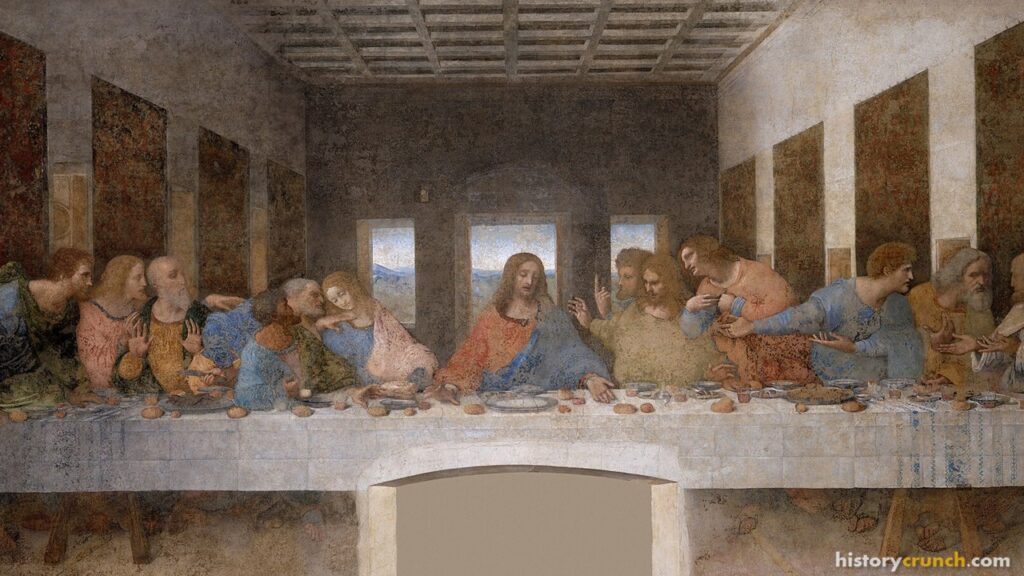
In 1495 Leonardo began painting the Last Supper on the end wall of the dining hall of the convent of Santa Maria delle Grazie in Milan, for Ludovico Sforza, who meant the church to be his family's tomb. He painted the instant after Christ says one of the twelve will betray him, every apostle reacting differently, the room's lines all meeting at Christ's head, and worked at his own pace, sometimes a whole day on a single face and then not at all, finishing about 1498.
LEARN MORESHOW LESSwhy it matters · 1 key figureARTThe Last Supper is the first painting of the High Renaissance, the moment at which perspective, anatomy and feeling all came together. Leonardo painted it on dry plaster with an experimental method, and it began to flake in his lifetime.
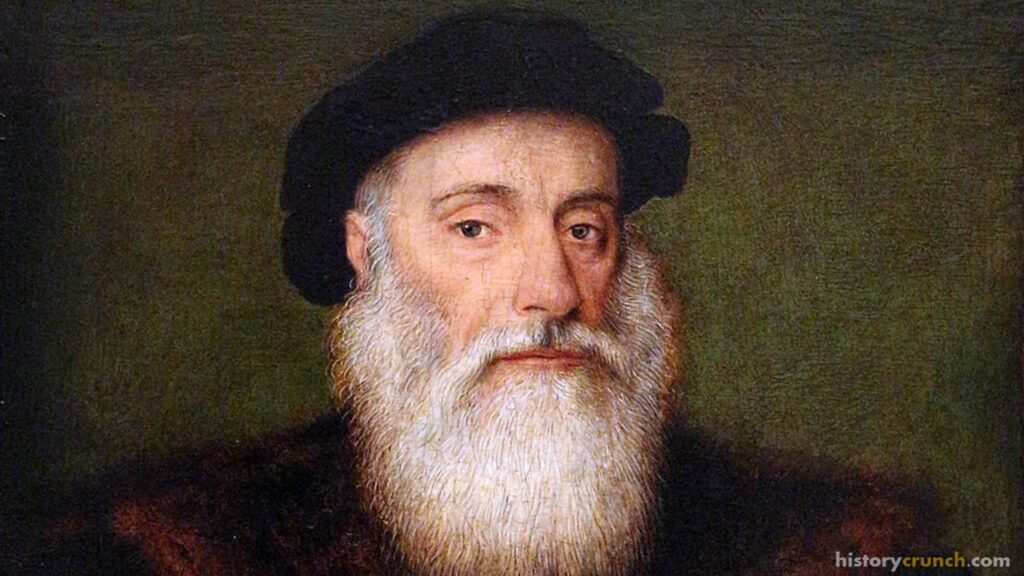
On May 20th, 1498 the Portuguese captain Vasco da Gama anchored off Calicut on the southwest coast of India, ten months out of Lisbon, having sailed round the bottom of Africa and across the Indian Ocean. He came home in 1499 with pepper and cinnamon that sold for sixty times what the voyage had cost. Portugal now had a sea road to the spices that had reached Europe for a thousand years through Venice and the Silk Road.
LEARN MORESHOW LESSwhy it mattersEXPLORATIONThe spice trade that had made Venice the richest city in Europe now went round Africa in Portuguese ships. Venice's decline, and Italy's, begins on this day as much as at Constantinople in 1453.
For four years after the Medici fell the Dominican friar Girolamo Savonarola had ruled Florence from the pulpit, preaching that God's judgment was coming, that the pope was corrupt, and that the city must give up its luxuries. On the 'bonfire of the vanities' of February 1497 the citizens burned mirrors, wigs, playing cards, pagan books and paintings, some of them Botticelli's own. Excommunicated by Alexander VI, deserted by the city, he was hanged and burned in the main square on May 23rd, 1498.
LEARN MORESHOW LESSwhy it mattersCHURCHSavonarola was the Renaissance's own reaction against itself, and his attack on a corrupt pope was heard in Germany: Luther called him a saint. Botticelli never painted a pagan subject again.
In 1499 Michelangelo, 24, finished the Pieta for a French cardinal's tomb in old St Peter's: the Virgin, young and calm, holding the dead Christ across her lap, carved from a single block of Carrara marble and polished until the stone looks like skin. When he heard visitors giving the work to another sculptor, he came back at night and cut his name across the strap on the Virgin's chest, the only work he ever signed.
LEARN MORESHOW LESSwhy it matters · 1 key figureARTThe Pieta made Michelangelo's name in Rome and shows what he could do with a subject medieval carvers had made stiff and ugly: the same grief, but in bodies that are beautiful because they are real.
On September 6th, 1499 the army of Louis XII of France, who claimed Milan through his Visconti grandmother, entered the city, and Ludovico Sforza fled over the Alps. French archers used Leonardo's clay model of a giant horse for target practice. Leonardo left in December for Mantua, Venice and Florence, taking his notebooks and his assistant Salai. Ludovico was captured the next year and died in a French prison.
LEARN MORESHOW LESSwhy it matters · 1 key figureWARMilan's Renaissance ended with its duke, and Leonardo's second Florentine period, the years of the Mona Lisa, began because he had lost his patron to a French army.
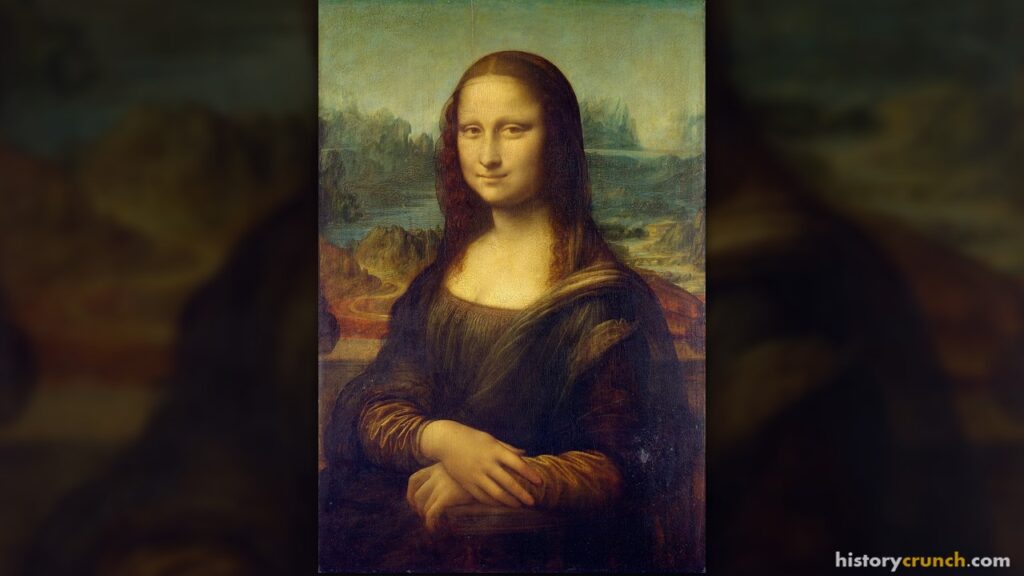
In 1503, back in Florence, Leonardo began a portrait of Lisa Gherardini, the 24-year-old wife of the silk merchant Francesco del Giocondo, a small oil painting on a poplar panel 30 inches (77 cm) high. He painted her without the usual jewels or emblems, half turned, hands folded, against an imagined landscape, and built the face from dozens of layers of glaze so thin that no brushstroke shows, a method he called sfumato, 'smoky', and modeled the hands in light and deep shadow, the chiaroscuro he had learned in Verrocchio's shop. He never delivered it and worked on it for the rest of his life.
LEARN MORESHOW LESSwhy it matters · 1 key figureARTThe Mona Lisa is the most famous painting in the world because of the thing Leonardo invented for it: a face that seems to be thinking, made by softening every edge until the expression cannot be pinned down. It is the Renaissance portrait, the individual as the subject.
On November 1st, 1503 Giuliano della Rovere, nephew of Sixtus IV, was elected Pope Julius II. He led armies in person, in armor, to win back the papal lands, and spent on art as he spent on war: he began the new St Peter's, brought Bramante, Michelangelo and Raphael to Rome, and started the Vatican's collection of ancient statues. Erasmus, who watched him ride into Bologna as a conqueror, wrote a satire of him being turned away from heaven.
LEARN MORESHOW LESSwhy it mattersCHURCHJulius II made Rome the capital of the High Renaissance in ten years, and paid for it partly by selling indulgences. The chapel ceiling and the basilica are his; so, indirectly, are Luther's theses.
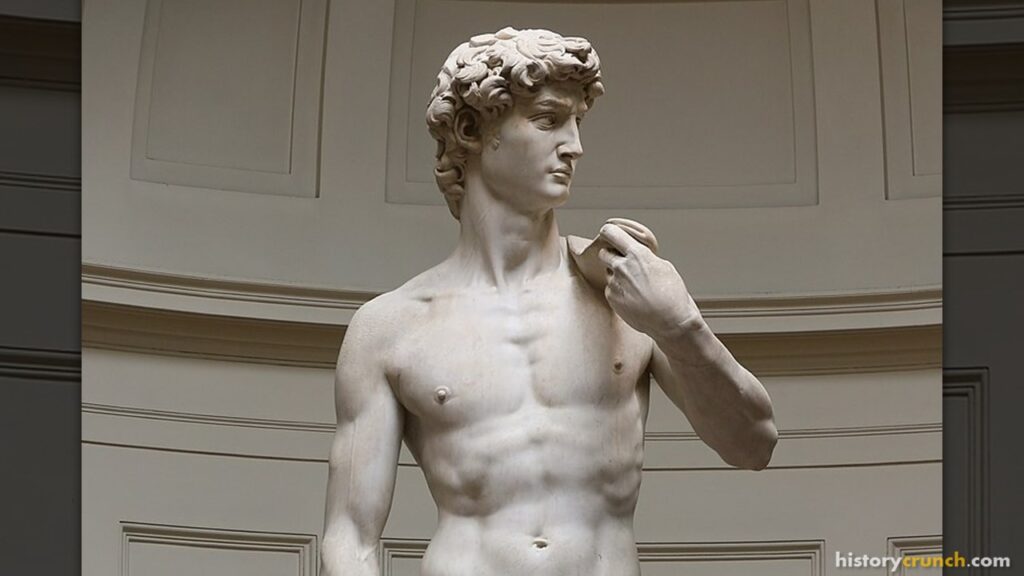
On September 8th, 1504 Michelangelo's David, 17 feet (5.2 m) of white marble, was unveiled in front of the Palazzo Vecchio in Florence after four days of moving it through the streets on rollers. The block had been quarried forty years earlier, botched by two other sculptors and left lying in the cathedral yard; Michelangelo, 26 when he began in 1501, carved from it a naked young man tense before the fight, not after it, sling over his shoulder. The republic had chosen the site as a warning to tyrants.
LEARN MORESHOW LESSwhy it matters · key numbers · 1 key figureARTDavid is the Renaissance's answer to the ancient Greeks, a nude in the classical manner but with a mind: the moment before action. Florence's republic put it outside the seat of government to say that a free city, like David, could stand up to giants.
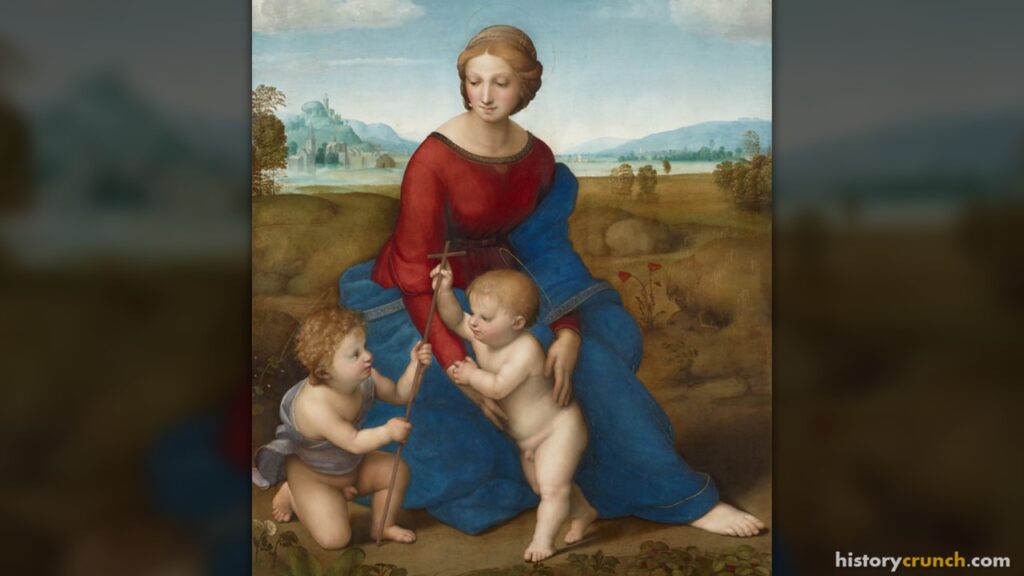
In 1506 Raphael, 23, in Florence to learn from Leonardo and Michelangelo, painted the Madonna of the Meadow for a Florentine friend: the Virgin, the child Jesus and the young John the Baptist in a gentle landscape, arranged in a pyramid as Leonardo arranged his groups, but sweeter and clearer than anything Leonardo painted. He painted about seventeen Madonnas in four years in Florence and became famous for them.
LEARN MORESHOW LESSwhy it matters · 1 key figureARTRaphael took what the two older masters had discovered, perspective, the pyramid, sfumato, and made it calm, graceful and easy to love. His Madonnas are what most people picture when they think of Renaissance painting.
On January 14th, 1506 a farmer digging in his vineyard on the Esquiline Hill in Rome found a marble group of a man and his two sons being crushed by sea serpents. Pliny the Elder had described it 1,400 years before as the greatest work of sculpture in Rome. The pope sent Michelangelo and the architect Giuliano da Sangallo to look; Michelangelo watched it lifted from the ground. Julius II bought it and put it in the Vatican garden.
LEARN MORESHOW LESSwhy it matters · 1 key figureLETTERSThe Laocoon was the ancient world coming out of the earth in front of the men who were trying to equal it. Its twisting, straining bodies are in Michelangelo's work from the Sistine ceiling onward.
On April 18th, 1506 Pope Julius II climbed down into a trench and laid the foundation stone of a new St Peter's, to replace the basilica Constantine had built in the 320s, which was falling down. Bramante's plan was a Greek cross under a dome larger than the Pantheon's. The work outlived Julius, Bramante, Raphael and Michelangelo, who designed the dome; the church was finished in 1626, 120 years later, and paid for in part by the sale of indulgences across Europe.
LEARN MORESHOW LESSwhy it mattersBUILDINGSt Peter's is the largest church in the world and the last great building of the Renaissance. The money raised for it set off the Reformation, and the church that resulted is the monument of the Church that survived it.
On April 25th, 1507 the German mapmaker Martin Waldseemuller printed a world map in twelve sheets at Saint-Die in Lorraine, the first to show the lands Columbus had found as a separate continent with an ocean on its far side, and the first to label it 'America', after the Florentine navigator Amerigo Vespucci, whose printed letters had argued that this was a new world and not Asia. The name stuck.
LEARN MORESHOW LESSwhy it mattersEXPLORATIONA printed map made in a small French town by a scholar who had never left Europe fixed the name of two continents. The printing press was now doing geography, and the Renaissance mind was redrawing the world.
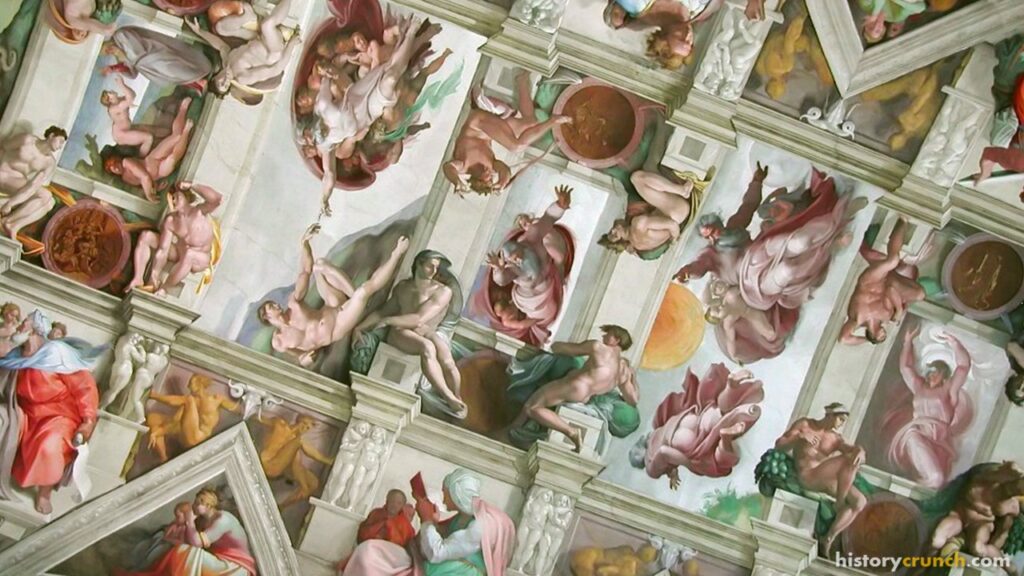
On May 10th, 1508 Michelangelo signed a contract to paint the ceiling of the Sistine Chapel for Julius II, who had abandoned the tomb the sculptor had spent three years quarrying marble for. Michelangelo protested that he was a sculptor, not a painter. He designed his own scaffold, dismissed the assistants he had hired from Florence, and painted the 5,800 square feet (540 sq m) in fresco, on wet plaster that had to be finished the day it was laid, almost alone, standing with his head bent back, paint dripping into his eyes, for four years.
LEARN MORESHOW LESSwhy it matters · 1 key figureARTThe ceiling turned a sculptor into the greatest painter of his age. The nine scenes from Genesis, the prophets and the 300 figures around them are the High Renaissance at its height.
In the autumn of 1508 Julius II, on Bramante's advice, brought the 25-year-old Raphael to Rome to decorate the suite of rooms in the Vatican where he meant to live, because he refused to sleep in the apartments of his hated predecessor Alexander VI. Raphael began with the pope's private library, the Stanza della Segnatura, and within a year the pope had the older painters' work knocked off the walls to give him the whole suite.
LEARN MORESHOW LESSwhy it matters · 1 key figureARTFor the next twelve years Raphael was the busiest artist in Europe, painting the Vatican, portraits, altarpieces and tapestries with a workshop of fifty, and the popes' rooms are the High Renaissance's most complete statement.
In 1509, staying at Thomas More's house in London, Erasmus wrote a small Latin book in about a week in which Folly, a goddess, stands up and praises herself: the world runs on foolishness, she says, and the greatest fools are the schoolmen with their arguments, the monks with their rules, the princes, and the popes who make war. It was printed in Paris in 1511 and went through 36 editions in his lifetime. The title is a pun on More's name.
LEARN MORESHOW LESSwhy it matters · 1 key figureLETTERSErasmus laughed at the Church's abuses six years before Luther attacked them, in a book that all of educated Europe read. When the Reformation came, both sides said he had laid the egg Luther hatched.
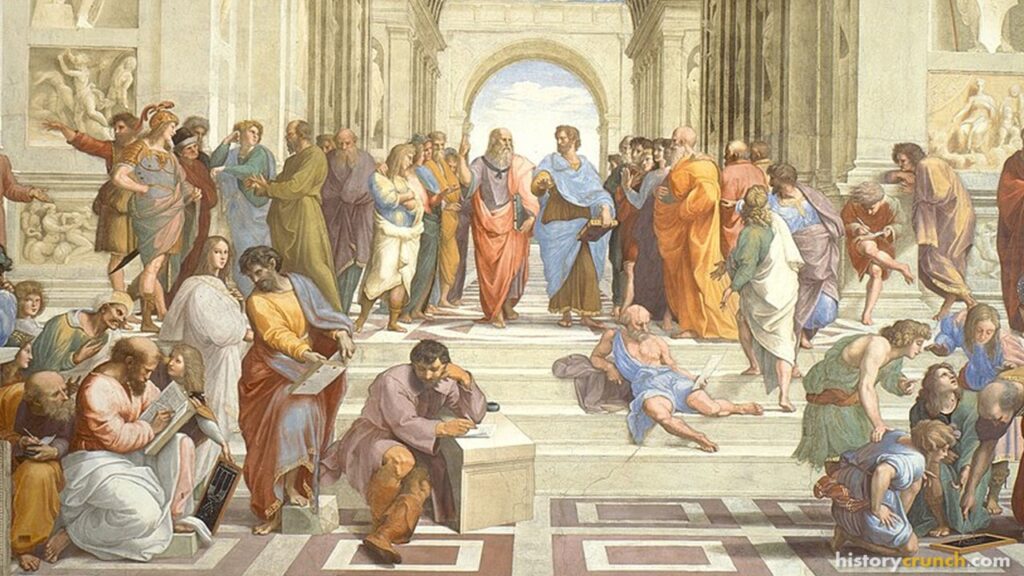
By 1511 Raphael had finished the largest wall of the pope's library: the philosophers of ancient Greece gathered under a vast Roman vault, Plato pointing to the sky and Aristotle to the earth at the center, Pythagoras, Euclid, Ptolemy and Diogenes around them. He gave Plato the face of Leonardo, put Michelangelo in as the brooding Heraclitus after seeing the Sistine ceiling half done, and painted himself at the edge, looking out.
LEARN MORESHOW LESSwhy it matters · 3 key figuresARTThe School of Athens is the Renaissance's picture of itself: pagan philosophers on the wall of the pope's own library, painted as calmly as saints, with the artists of the day among them. It is what 'rebirth' meant.
On September 1st, 1512, after Spanish troops in the pope's service had sacked the nearby town of Prato and killed thousands, Florence surrendered and the Medici, exiled since 1494, came back: Cardinal Giovanni de' Medici, Lorenzo's son, and his brother Giuliano. The republic was dissolved and its officials dismissed, among them the secretary Niccolo Machiavelli, who was tortured, released and sent to his farm, where he wrote 'The Prince'.
LEARN MORESHOW LESSwhy it mattersPOWERThe republic of David and Savonarola was over. From now on the Medici ruled Florence with foreign help, and Italy's cities were pieces in a game played by France, Spain and the popes.
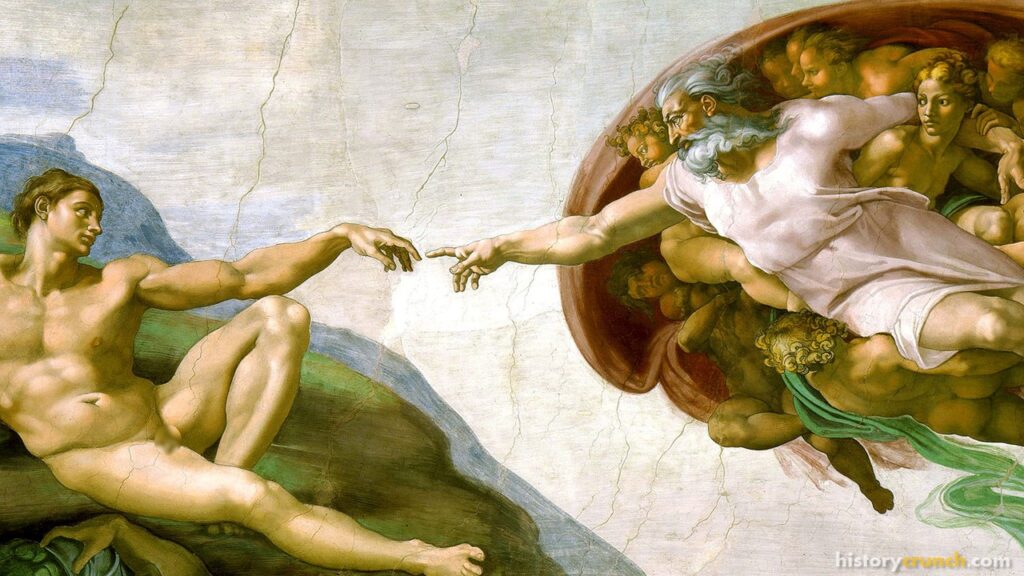
On November 1st, 1512, All Saints' Day, Julius II said Mass in the Sistine Chapel under the finished ceiling, and Rome came to look. Nine scenes from Genesis run down the middle, from God dividing light from dark to the drunkenness of Noah; the Creation of Adam, God's finger reaching for man's, is the fourth. Around them sit seven prophets and five sibyls, and above the windows the ancestors of Christ. About 300 figures in all, four years of work, one man.
LEARN MORESHOW LESSwhy it matters · key numbers · 1 key figureARTThe ceiling set the standard for every painter who came after, and its bodies, twisted, straining and larger than life, are where the calm of the High Renaissance begins to break into something stormier.
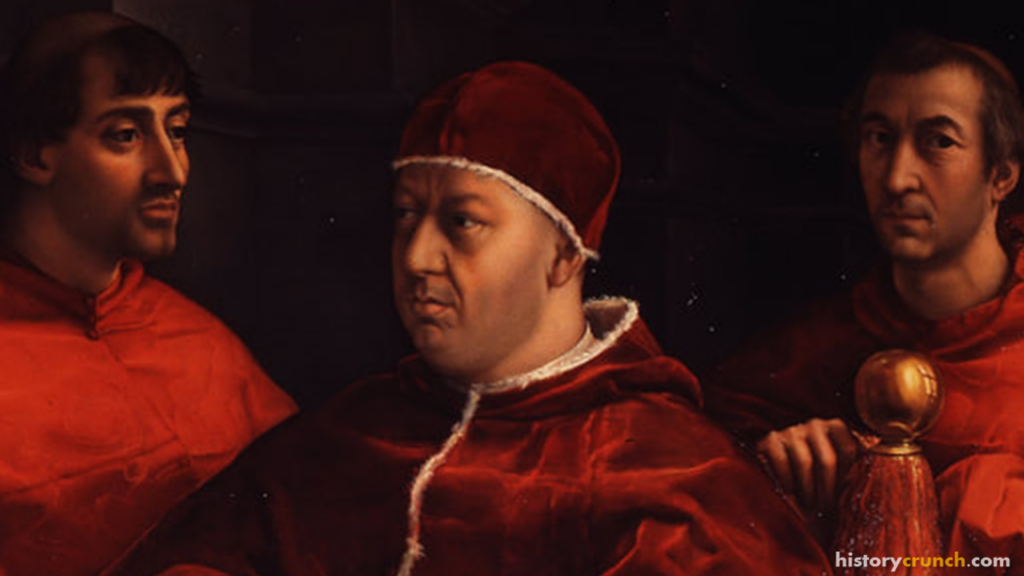
On March 11th, 1513 Giovanni de' Medici, Lorenzo the Magnificent's second son, a cardinal at thirteen and 37 now, was elected Pope Leo X. 'God has given us the papacy; let us enjoy it,' he is said to have written to his brother. He spent the treasury Julius had left on hunting, music, banquets, Raphael and the new St Peter's, and in 1515 approved the sale of a new indulgence in Germany to pay for the building.
LEARN MORESHOW LESSwhy it mattersCHURCHA Medici on the throne of St Peter is the Renaissance's triumph and its trap. Leo's spending produced Raphael's tapestries and Luther's theses in the same four years, and he did not take Luther seriously until it was too late.
On December 10th, 1513 Niccolo Machiavelli, the dismissed secretary of the Florentine republic, wrote to a friend from his farm that he had finished a short book on how princes win and keep power. It says what he had seen in fifteen years of dealing with Cesare Borgia, Louis XII and Julius II: that a ruler must seem good but be ready to do evil, that it is safer to be feared than loved, and that the ancient Romans are the only guide. He dedicated it to the Medici, hoping for a job. They did not read it.
LEARN MORESHOW LESSwhy it mattersLETTERS'The Prince' is the first book to treat politics as it is rather than as it should be, and its author's name became a word. It is the Renaissance habit of clear observation turned on power.
About 1514 Nicolaus Copernicus, a canon of Frombork Cathedral on the Baltic coast of Poland and a physician, gave a few friends a handwritten paper of some forty pages, the 'Commentariolus' or 'little commentary'. It said that the Sun, not the Earth, sits at the center, the heliocentric idea; that the Earth turns once a day and goes round the Sun once a year; and that the planets do the same. He offered no proof yet and did not put his name on it.
LEARN MORESHOW LESSwhy it matters · 1 key figureSCIENCECopernicus reached the idea that reorganized the universe by reading the ancient Greeks, some of whom had suggested it, and by doing the mathematics. He then sat on it for nearly thirty years.
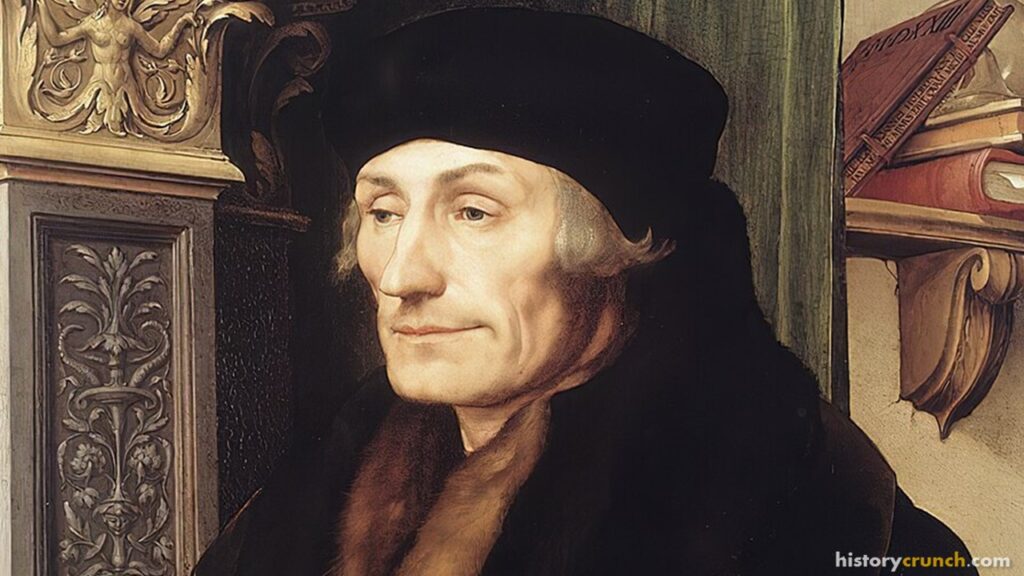
On March 1st, 1516 the printer Froben of Basel finished Erasmus's edition of the New Testament: the Greek text, the first ever printed, beside a new Latin translation that corrected hundreds of errors in the Vulgate the Church had used for a thousand years. Erasmus wrote in the preface that he wanted the plowman to sing the Gospels at his plow and the weaver to hum them at his loom. Luther used the second edition for his German Bible.
LEARN MORESHOW LESSwhy it matters · 1 key figureLETTERSReading the Bible in its original language, as Petrarch had read Cicero, was humanism applied to religion, and it proved the Church's Latin was not the last word. It is the book the Reformation was built on.
In the autumn of 1516 Leonardo, 64 and partly paralyzed in the right hand, crossed the Alps by mule at the invitation of the young King Francis I, who gave him the manor of Cloux beside the royal chateau of Amboise, a pension, and the title of first painter, engineer and architect to the king. He brought his notebooks and three paintings, among them the Mona Lisa. Francis is said to have visited him almost daily to talk.
LEARN MORESHOW LESSwhy it matters · 1 key figureARTA French king buying the greatest Italian artist is how the Renaissance came to France, and why the Mona Lisa hangs in Paris. Francis I built the chateaux of the Loire and hired the scholar Guillaume Bude to make his court a center of learning.
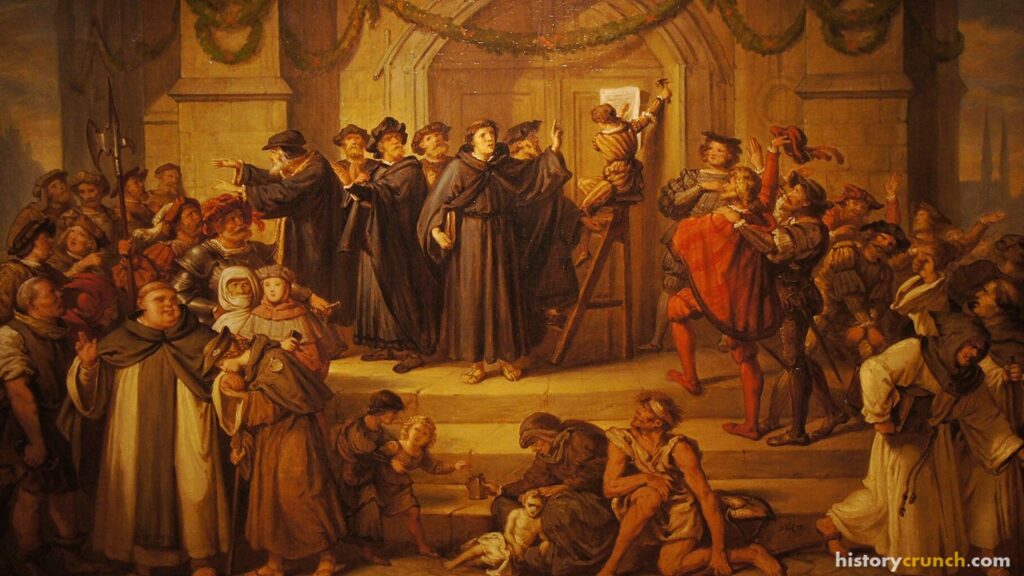
On October 31st, 1517 Martin Luther, a 33-year-old professor of Bible at the new University of Wittenberg in Saxony, sent his archbishop a list of 95 propositions in Latin against the sale of indulgences, the certificates the Church sold as reducing the punishment of sin, and by tradition nailed them to the door of the castle church. The friar Tetzel had been selling Leo X's indulgence for St Peter's nearby with the jingle 'as soon as the coin in the coffer rings, the soul from purgatory springs'. Printers had the theses across Germany within weeks.
LEARN MORESHOW LESSwhy it matters · key numbers · 1 key figureCHURCHThe Reformation begins here, and it could only have happened after Gutenberg: the theses were a university notice that became a bestseller. The Renaissance's habit of going back to the sources had reached the Church itself.
Leonardo died at Cloux on May 2nd, 1519, aged 67, leaving his notebooks and drawings to his pupil Francesco Melzi and the Mona Lisa, by most accounts, to Salai, from whom Francis I bought it. Vasari's story that the king held him as he died is probably not true; Francis was elsewhere that day. Leonardo's grave in the chateau chapel was lost when the church was demolished in the Revolution.
LEARN MORESHOW LESSwhy it matters · 1 key figurePEOPLELeonardo left about a dozen finished paintings and 7,000 pages of notes on everything from the heart to the flight of birds, unpublished for centuries. He is the Renaissance Man because he wanted to know everything, and nearly did.
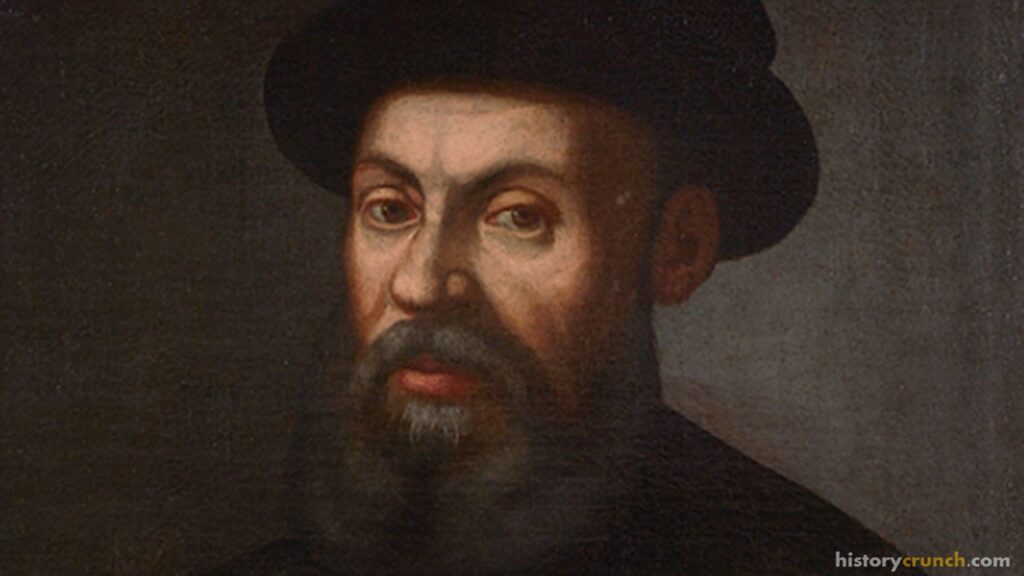
On September 20th, 1519 Ferdinand Magellan, a Portuguese captain in Spanish pay, sailed from Sanlucar with five ships and about 270 men to reach the Spice Islands by sailing west round the bottom of South America. He found the strait that bears his name, crossed a Pacific so wide his men ate leather and rats, and was killed in the Philippines in April 1521. One ship, the Victoria, with 18 men, reached Spain again on September 6th, 1522.
LEARN MORESHOW LESSwhy it mattersEXPLORATIONThe first voyage round the world proved the size of the planet and the smallness of Europe. The map of the Renaissance was now the whole globe, and the center of Europe's trade had left the Mediterranean for good.
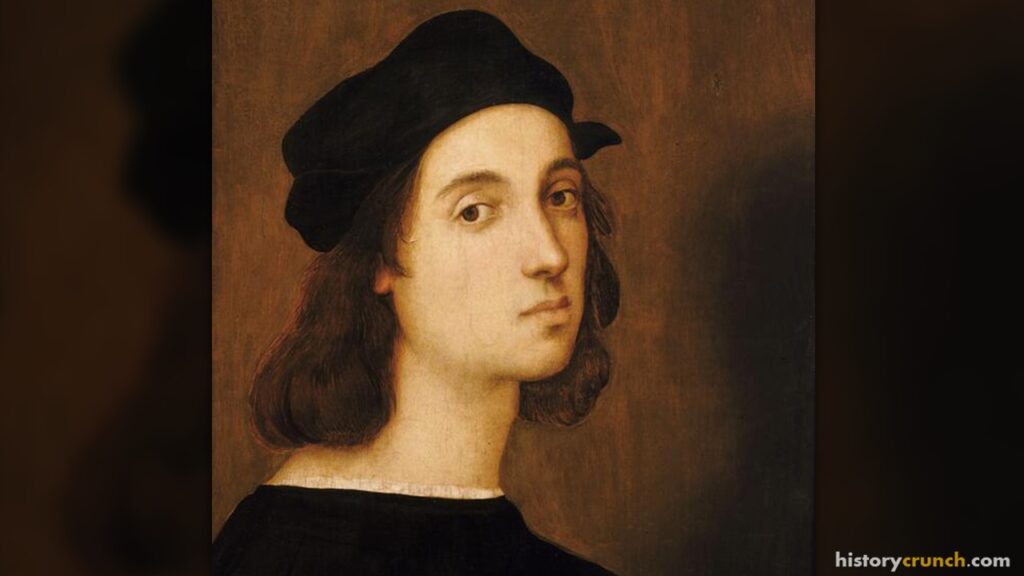
Raphael died in Rome on April 6th, 1520, his 37th birthday, after a fever of about two weeks, and was buried at his own request in the Pantheon. His last painting, the Transfiguration, stood at the head of his bed. He was the pope's chief architect, in charge of St Peter's and of all the ancient ruins of Rome, and ran the largest workshop in Italy; the whole court went to his funeral.
LEARN MORESHOW LESSwhy it matters · 1 key figurePEOPLERaphael's death is often taken as the end of the High Renaissance. His pupils scattered across Italy and Europe, and their restless, elegant style, later called Mannerism, is what came next.
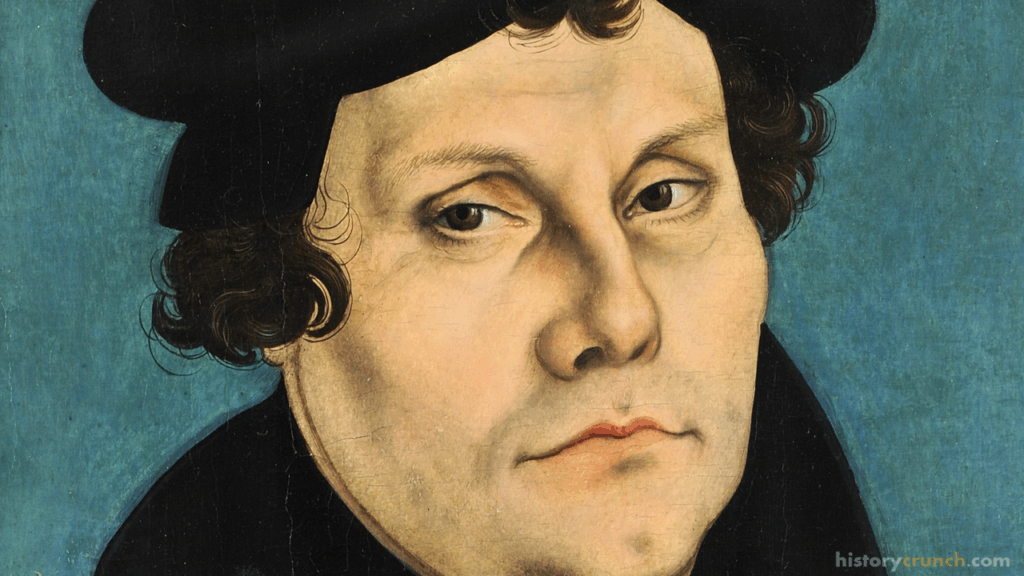
On April 18th, 1521, before the Emperor Charles V and the princes of Germany at the Diet of Worms, Martin Luther, excommunicated by Leo X in January, was shown a table of his books and asked to take them back. He answered that unless he was proved wrong by Scripture and plain reason he could not, because to go against conscience was neither safe nor right. The words 'Here I stand, I can do no other' were added in print afterward. He was outlawed, and his prince hid him in the Wartburg castle, where he translated the New Testament into German in eleven weeks.
LEARN MORESHOW LESSwhy it matters · a source · 1 key figureCHURCHA single monk telling the emperor and the pope that his own reading of the Bible outranked them is the Renaissance individual at the point where it breaks the medieval Church. Half of Europe followed him within a generation.
IN THEIR OWN WORDS“Unless I am convinced by the testimony of the Scriptures or by clear reason, I am bound by the Scriptures I have quoted and my conscience is captive to the Word of God. I cannot and will not recant anything, since it is neither safe nor right to go against conscience.”
Martin Luther at the Diet of Worms, April 18th, 1521WHAT TO NOTICEFrom the official account of the Diet. The famous 'Here I stand' sentence was added in the first printed versions.
On September 21st, 1522 Luther's translation of the New Testament into German was published at Wittenberg, unsigned, in a first printing of 3,000 copies that sold out in weeks at the price of a farmhand's wage for a week. He had worked from Erasmus's Greek, writing in the plain speech of the market and the kitchen, so that, as he said, the mother in the house and the children in the street could understand it. The whole Bible followed in 1534.
LEARN MORESHOW LESSwhy it matters · key numbers · 1 key figurePRINTINGA Bible ordinary Germans could read broke the clergy's hold on the meaning of the faith, and Luther's German became the German that is written today. The Reformation ran on print: by 1525 more than a third of all books sold in Germany were Luther's.
On May 6th, 1527 about 20,000 unpaid soldiers of the Emperor Charles V, many of them German Lutherans, broke into Rome after their commander was shot on the wall, and looted the city for a week and occupied it for nine months. Churches were stripped, the tombs of the popes opened, nuns and cardinals held for ransom, and perhaps 10,000 people killed; a soldier scratched Luther's name on Raphael's frescoes. The Medici pope Clement VII watched from the Castel Sant'Angelo, where he was besieged for a month.
LEARN MORESHOW LESSwhy it matters · key numbersWARThe Sack of Rome is the usual end date for the High Renaissance. The artists scattered, the popes learned that their city was a pawn of the great powers, and the Church of the next generation turned from patronage to discipline.
After the Sack of Rome the Renaissance moved north and changed its subject from art to religion and law. Henry VIII took the English Church for himself; Calvin, a French humanist lawyer, built a Protestant republic in Geneva; Francis I gave Bude his royal professors. Erasmus, who had hoped for reform without a split, died in 1536 with no party left; Michelangelo painted the Last Judgment on the Sistine altar wall in a mood the ceiling had not known. In 1543 Copernicus's book put the Sun at the center and Vesalius's put the human body on the dissecting table. The Church answered at Trent and with the Index; the princes of Germany agreed at Augsburg that each would choose his people's faith. Michelangelo died in 1564, three days after Galileo was born.
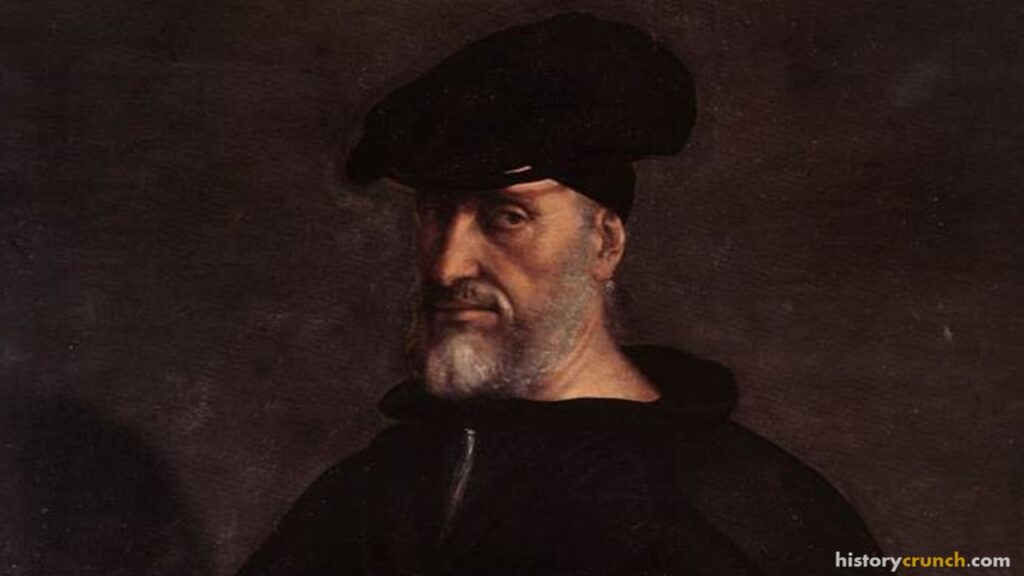
On September 12th, 1528 the Genoese admiral Andrea Doria, who had just switched his galleys from the French king to the Emperor Charles V, sailed into Genoa and drove out the French garrison. He refused to be made its lord and instead rewrote its constitution: a doge elected for two years, the great families sharing power, and the republic under Spain's protection. Genoa's bankers became the emperor's bankers.
LEARN MORESHOW LESSwhy it mattersPOWERDoria's Genoa was the last Italian republic to keep its independence, and it did so by financing Spain's empire. The silver of the Americas passed through Genoese hands for a century.
In 1528 the Venetian press of Aldus printed Baldassare Castiglione's 'The Book of the Courtier', four evenings of conversation at the court of Urbino, set in 1507, about what a perfect gentleman should be: a soldier, a scholar of Latin and Greek, a musician, a dancer, a wit, modest in everything and good at everything, with the ease Castiglione called sprezzatura, making hard things look easy. It was translated into every language of Europe.
LEARN MORESHOW LESSwhy it mattersLETTERSThe Courtier turned the humanist ideal of the all-round man into a handbook of manners for the courts of Europe. The word 'gentleman' means what it means partly because of this book.
In 1530 King Francis I of France, urged for years by his librarian Guillaume Bude, appointed the first 'royal readers', professors paid by the crown to teach Greek, Hebrew and mathematics in Paris outside the control of the university, which taught only in the medieval way. Bude had wanted a college like the one Erasmus had inspired at Louvain in 1517, teaching the three ancient languages. The readers became the College de France, which still exists.
LEARN MORESHOW LESSwhy it matters · 1 key figureLETTERSBude and Francis I brought Italian humanism to France as a state project: a royal library, royal professors, Leonardo at Amboise, chateaux on the Loire. The French Renaissance was the king's.
On August 12th, 1530, after a ten-month siege by the emperor's army, Florence surrendered. The city had driven the Medici out for a third time in 1527, after the Sack of Rome, and Michelangelo had designed its walls and served as its governor of fortifications before fleeing and hiding. The Medici pope Clement VII and the emperor installed Alessandro de' Medici as ruler; in 1532 he was made duke, and the republic that had stood since the 1100s was gone for good.
LEARN MORESHOW LESSwhy it matters · 1 key figureWARThe city that invented the Renaissance republic ended as a duchy under Spanish protection. Michelangelo left Florence for Rome in 1534 and never came back.
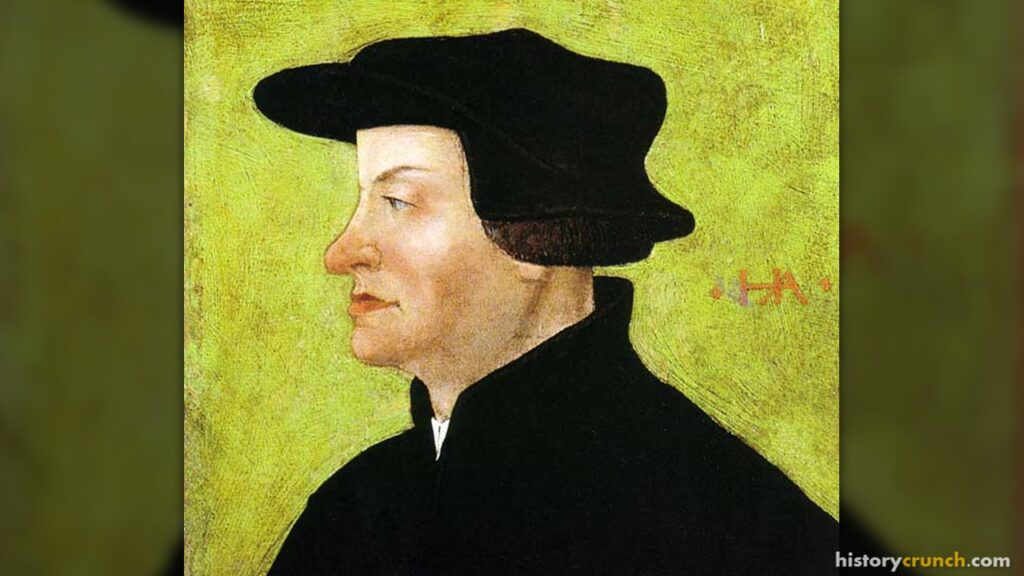
On October 11th, 1531 Huldrych Zwingli, the priest who had led Zurich out of the Catholic Church since 1519, was killed in the battle of Kappel between the Protestant and Catholic cantons of Switzerland, fighting as a chaplain with a sword in his hand. His body was quartered and burned. Zwingli had gone further than Luther, stripping the churches of images, music and the Mass, and the two had quarreled bitterly over the Lord's Supper in 1529.
LEARN MORESHOW LESSwhy it mattersCHURCHZwingli's death shows that the Reformation was several reformations that disagreed with each other, and that within fourteen years of the theses Christians were killing each other over them.
Michel Eyquem de Montaigne was born on February 28th, 1533 at the family chateau near Bordeaux, the son of a soldier and mayor whose grandfather had made the fortune in salted herring. His father, a devotee of the new learning, had him woken by music each morning and hired a German tutor who spoke to him only in Latin, so that Montaigne spoke Latin before French. At six he was sent to the best school in Bordeaux and found it a waste of time.
LEARN MORESHOW LESSwhy it matters · 1 key figurePEOPLEMontaigne was a child of the humanist experiment: a boy raised as a Roman by a father who believed in it. The man wrote the first essays and asked what all that learning was for.
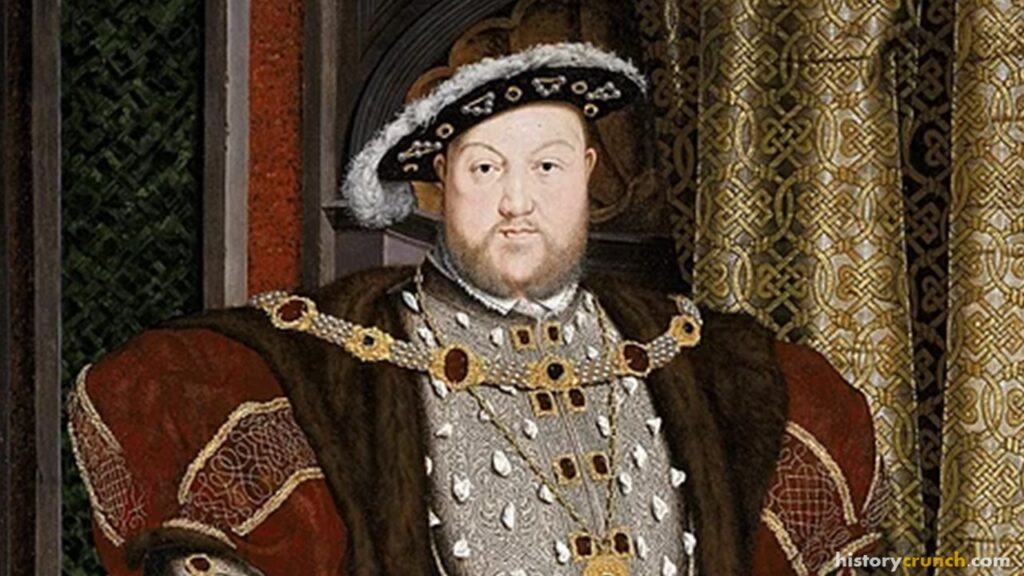
In November 1534 the English Parliament passed the Act of Supremacy, declaring that the king, and not the pope, was 'the only supreme head on earth of the Church of England'. Henry VIII, who had been named Defender of the Faith by Leo X for a book against Luther, had broken with Rome because Pope Clement VII, a prisoner of the emperor after the Sack of Rome, would not annul his marriage to the emperor's aunt Catherine of Aragon. Thomas More was beheaded the next year for refusing the oath.
LEARN MORESHOW LESSwhy it matters · 1 key figureCHURCHEngland left the Roman Church for a king's reasons, not a monk's, and kept most of the old religion at first. The English Reformation was the state taking the Church, which is what much of the Reformation, in the end, was.
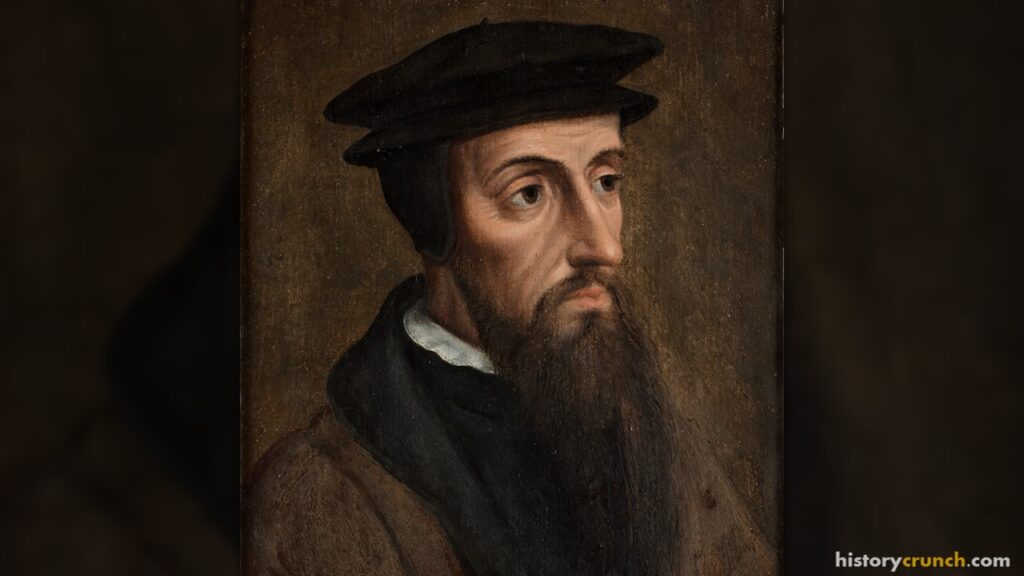
In March 1536 a printer in Basel published the 'Institutes of the Christian Religion' by John Calvin, a 26-year-old French lawyer trained in the humanist manner who had fled France after a friend's speech got him accused of heresy. It laid out the reformed faith in plain, ordered Latin: Scripture alone, God's absolute power, salvation chosen by God in advance. Later that year, passing through Geneva, he was persuaded to stay and reform it, and from 1541 he ran the city as a model Protestant republic.
LEARN MORESHOW LESSwhy it mattersCHURCHCalvin gave the Reformation its second and more disciplined form. Calvinism spread to France, Scotland, the Netherlands and New England, and its stress on hard work and self-examination shaped the modern world as much as Luther did.
Erasmus died in Basel on the night of July 11th to 12th, 1536, aged about 69, of dysentery, in the house of his printer Froben. He had spent his last twenty years attacked by both sides: Luther called him a skeptic who cared for nothing, and Rome put his books on the Index after his death. He had stayed in the Catholic Church while calling for its reform, and had written, of the war of words, that he would rather be a spectator than an actor in the tragedy.
LEARN MORESHOW LESSwhy it matters · 1 key figurePEOPLEErasmus's death is the death of the hope that the Church could be reformed by scholarship and laughter without splitting. The Renaissance's greatest scholar was left with no party.
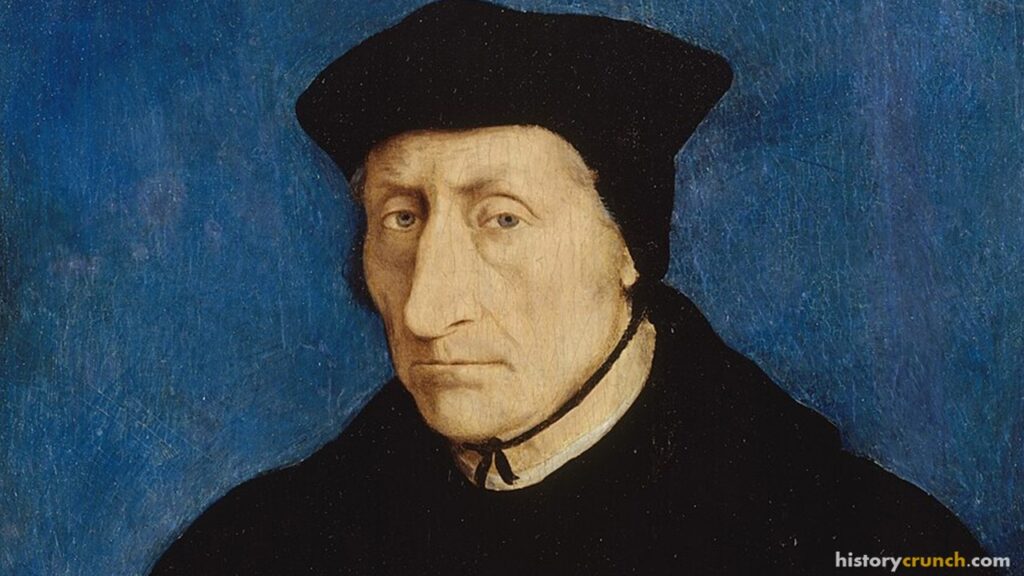
Guillaume Bude died in Paris on August 23rd, 1540, aged 73. He had been the greatest Greek scholar in France, the author of a commentary on Roman law that ran to 24 books that read the law as history rather than as scripture, and of a study of ancient coins and measures that was the first serious economic history. As the king's librarian he had built the collection at Fontainebleau that became the National Library of France, and he had persuaded the king to found the royal readers.
LEARN MORESHOW LESSwhy it matters · 1 key figurePEOPLEBude did for France what Petrarch had done for Italy: he made reading the ancients in their own languages the mark of an educated person. His library and his college outlived him by five centuries.
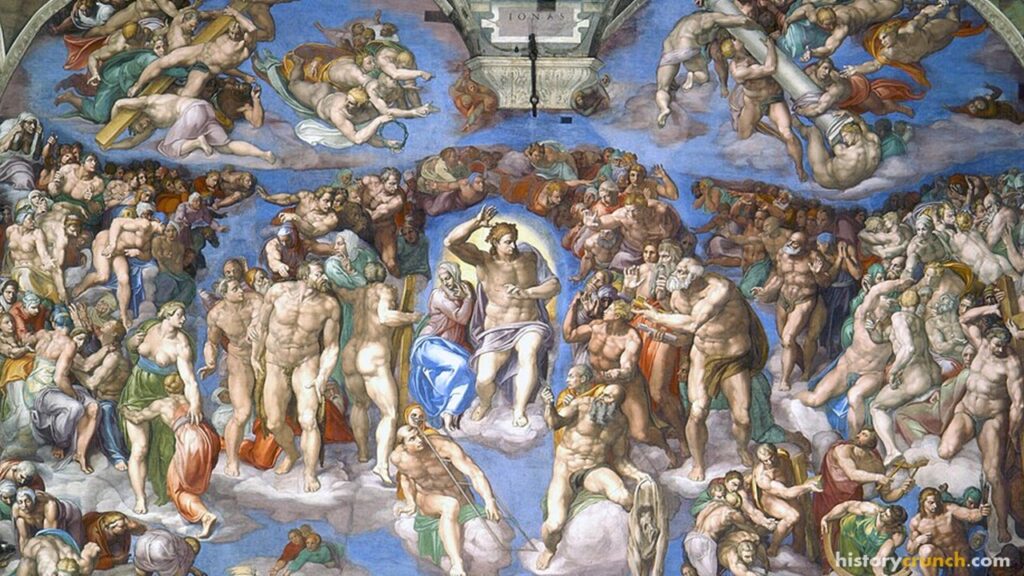
On October 31st, 1541, 29 years to the day after the ceiling, Pope Paul III unveiled the Last Judgment on the altar wall of the Sistine Chapel. Michelangelo, 66, had spent five years on it: Christ as a beardless, muscular judge, the saved rising and the damned dragged down, more than 300 naked figures on a wall 45 feet (14 m) high, and his own face hanging as the flayed skin of St Bartholomew. The pope's master of ceremonies, who complained of the nudity, was painted into hell.
LEARN MORESHOW LESSwhy it matters · 1 key figureARTThe calm of the ceiling is gone; this is a dark, crowded, frightened painting, made after the Sack of Rome and the Reformation by a man who feared for his soul. The Renaissance was changing into something else.
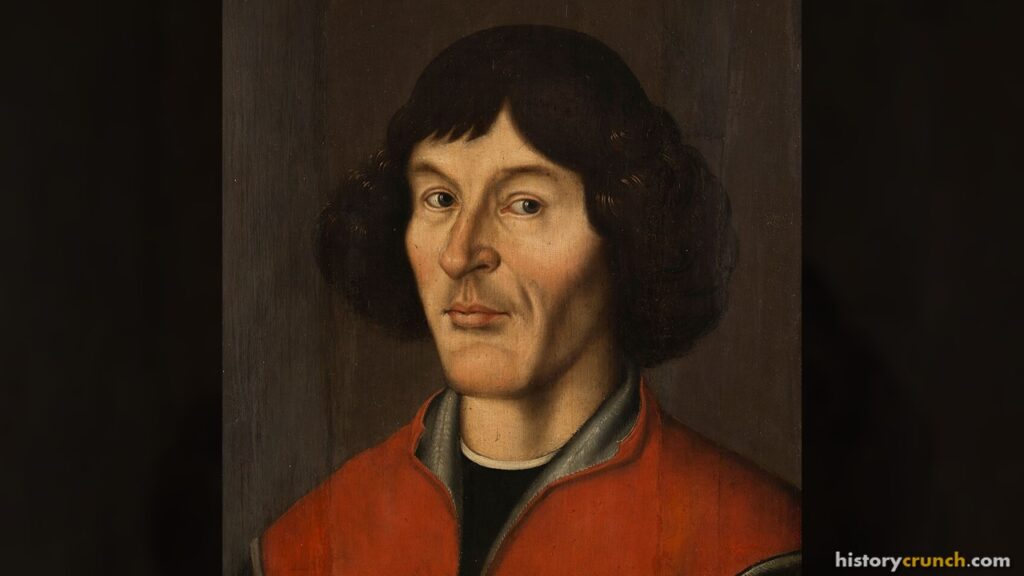
On May 24th, 1543 Nicolaus Copernicus died at Frombork, aged 70, after a stroke, and by tradition the first printed copy of 'On the Revolutions of the Heavenly Spheres' was put into his hands that day. He had held the book back for decades, afraid of ridicule, until a young Lutheran mathematician, Rheticus, came from Wittenberg in 1539 and talked him into it. It was printed in the German city of Nuremberg with an unsigned preface, added by the editor, saying the moving Earth was only a way of calculating.
LEARN MORESHOW LESSwhy it matters · key numbers · 1 key figureSCIENCEThe book that put the Sun at the center was the last act of the Renaissance and the first of the Scientific Revolution. It was written by a Polish church official reading ancient Greeks and doing sums, and it took a century to be believed.
In June 1543, a few weeks after Copernicus's book, the Basel printer Oporinus published 'On the Fabric of the Human Body' by Andreas Vesalius, a 28-year-old Flemish professor of anatomy at Padua. It had more than 200 woodcuts of skeletons and flayed men in landscapes, drawn from bodies Vesalius had dissected himself, and it corrected hundreds of errors in the Roman doctor Galen, who had worked on apes. Vesalius dedicated it to the emperor and was made his physician.
LEARN MORESHOW LESSwhy it mattersSCIENCEAnatomy from the body rather than from an ancient book is the Renaissance turning on its own founders: the humanists had revived Galen, and Vesalius, trained by them, checked him against the corpse. Leonardo had done the same in secret forty years earlier.
On December 13th, 1545 the Council of Trent opened in a town in the Alps with about thirty bishops present. It met, with long gaps, until 1563, and answered the Reformation point by point: Scripture and tradition together, salvation by faith and works, seven sacraments, the Latin Bible, the pope's authority. It also ended the sale of indulgences, ordered a seminary in every diocese, and told artists to paint clearly and decently. The Jesuits, founded in 1540, carried its decisions round the world.
LEARN MORESHOW LESSwhy it mattersCHURCHTrent is the birth of the modern Catholic Church and the end of the Renaissance papacy of Leo X. The Church that came out of it was disciplined, doctrinal and suspicious of the pagan freedom the Renaissance had enjoyed.
Martin Luther died at Eisleben on February 18th, 1546, aged 62, in the town where he had been born, having gone there in winter to settle a quarrel between two counts. His last written words, found on his table, were 'We are beggars, that is true.' He was buried in the castle church at Wittenberg, under the pulpit, near the door where the theses had gone up. Within months the emperor was at war with the Lutheran princes.
LEARN MORESHOW LESSwhy it matters · 1 key figurePEOPLELuther left half of Germany, Scandinavia and much of the rest of northern Europe outside the Roman Church, a German Bible and hymnbook, and a marriage: the monk had wed a former nun in 1525 and had six children.
On January 1st, 1547 Pope Paul III appointed Michelangelo chief architect of St Peter's, forty years after the first stone and with the walls barely above ground. He refused a salary, saying he did it for God, tore out his predecessor's additions, went back to Bramante's plan, and designed the dome, 138 feet (42 m) across, on the model of Brunelleschi's in Florence. He worked on it until he died; the dome was finished in 1590 to his design.
LEARN MORESHOW LESSwhy it matters · 1 key figureBUILDINGThe dome of St Peter's is the last work of the Renaissance and its largest, a Florentine dome raised over Rome by the last of the men who had known Lorenzo de' Medici.
In 1550 Giorgio Vasari, a painter and architect from Arezzo who worked for the Medici dukes, published the 'Lives of the Most Excellent Painters, Sculptors and Architects', biographies of about 150 artists from Cimabue and Giotto to his hero Michelangelo, the only living artist included. He told the story as a rebirth, a 'rinascita', of the arts after a thousand years of decline since Rome, rising through three ages to perfection in Michelangelo.
LEARN MORESHOW LESSwhy it matters · 1 key figureLETTERSVasari invented the idea of the Renaissance, its three stages and most of its stories, true and false. The word we use is his word, and the history of art as a subject begins with his book.
On September 25th, 1555 the Emperor Charles V, who had spent 35 years trying to hold his empire in one faith, agreed at Augsburg that each German prince could choose Lutheranism or Catholicism for his own territory, and that subjects who disagreed could move. Calvinists were not included. Charles, exhausted, gave up his crowns over the next year and retired to a monastery in Spain.
LEARN MORESHOW LESSwhy it mattersCHURCHAugsburg admitted that the Reformation could not be undone. Europe was now permanently divided by religion, and the wars that came from that division, ending in 1648, are the dark side of the century that had begun with Raphael.
In 1559 Pope Paul IV, the former head of the Roman Inquisition, issued the first papal Index of Forbidden Books: every work of Luther, Calvin and Zwingli, all of Erasmus, the Decameron, Machiavelli, the vernacular Bibles, and everything printed by 61 named printers. Owning a listed book meant excommunication. Booksellers in Rome burned their stock. Copernicus was added in 1616, Galileo in 1633; the Index was not abolished until 1966.
LEARN MORESHOW LESSwhy it mattersCHURCHThe printing press had made the Renaissance and the Reformation; the Index was the Church's attempt to take the press back. It marks the point where the open curiosity of the Renaissance met the closed door.
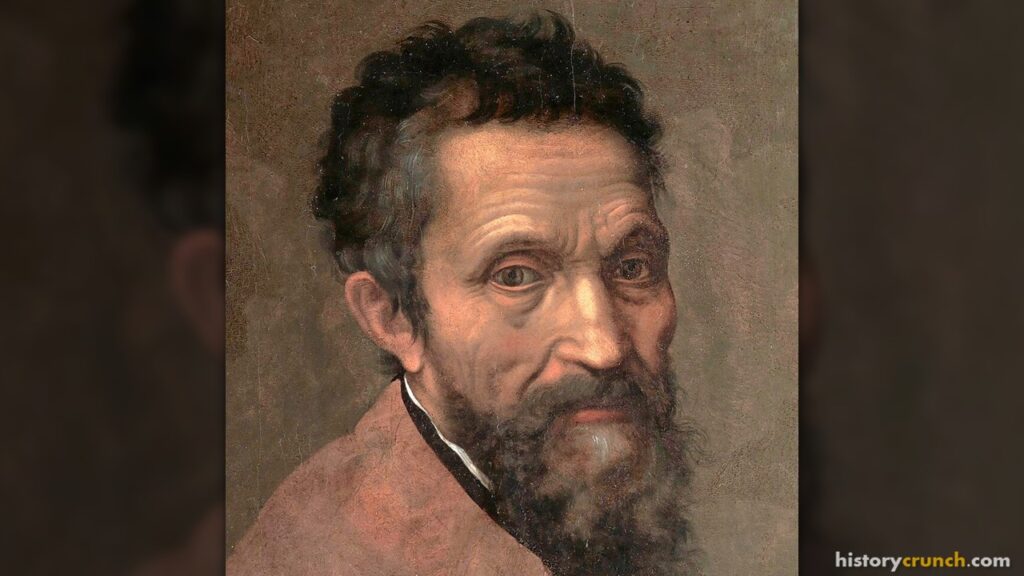
Michelangelo died in his house in Rome on February 18th, 1564, three weeks short of 89, having worked on a Pieta six days before. The pope wanted him buried in St Peter's; his nephew smuggled the body to Florence disguised as merchandise, and the city gave him a state funeral and a tomb in Santa Croce designed by Vasari. He had outlived Leonardo by 45 years and Raphael by 44, and had known Lorenzo de' Medici and Galileo's father.
LEARN MORESHOW LESSwhy it matters · 1 key figurePEOPLEMichelangelo's death closes the Renaissance in the arts; the painters who followed were his imitators until the Baroque. Three days before he died Galileo was born, and two months later Shakespeare.
The last Renaissance was made by a Frenchman writing about himself in a tower, an Englishman writing plays about Italy, and an Italian pointing a Dutch toy at the sky. Montaigne invented the essay in 1580 while France's wars of religion went on around his estate; Shakespeare's decade followed the Armada of 1588; and in 1609 Galileo showed the senators of Venice a telescope and then saw moons round Jupiter. The Church had let Copernicus's book alone for 73 years; in 1616 it banned the idea, and in 1633 it made Galileo kneel and recant. He died under house arrest in 1642, blind, having dictated the foundations of physics, and Isaac Newton was born eleven months later. The habits the Renaissance had learned from Cicero, read for yourself, look for yourself, doubt, had passed to science.
Galileo Galilei was born in Pisa on February 15th, 1564, the son of a musician who tested the rules of harmony by experiment, and William Shakespeare was baptized at Stratford-upon-Avon on April 26th, the son of a glover. Both were born in the year Michelangelo died. Galileo would be sent to Pisa to study medicine and switch to mathematics; Shakespeare would leave a grammar-school Latin education for the London theater.
LEARN MORESHOW LESSwhy it matters · 1 key figurePEOPLEThe Renaissance's last generation turned its habits, close observation, plain language, doubt about authority, on the sky and on the human heart. Galileo is where the Scientific Revolution begins in earnest; Shakespeare is the English Renaissance.
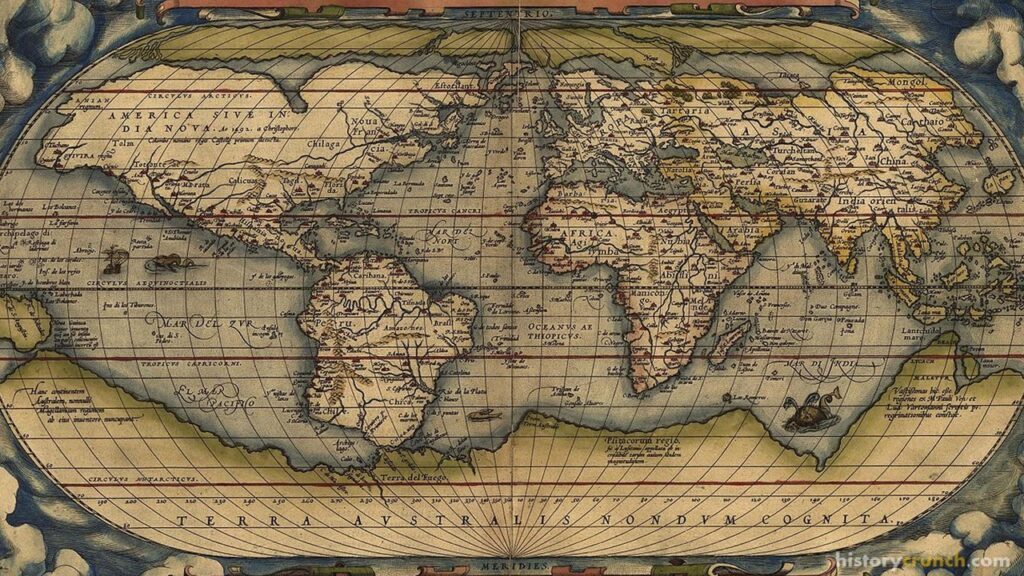
On May 20th, 1570 the Antwerp mapmaker Abraham Ortelius published the 'Theatrum Orbis Terrarum', the Theater of the World, 53 maps in one volume with the same size and style, the first modern atlas. It showed both Americas, the Pacific, and a great unknown southern continent, and named its sources. It sold in seven languages and 31 editions in his lifetime. Antwerp, not Venice, was now the printing capital of Europe.
LEARN MORESHOW LESSwhy it mattersEXPLORATIONA century after Columbus the whole world could be bought in a book, in a northern city. The Renaissance had moved from Italy to the Atlantic coast, and from the ancient world to the new one.
On October 7th, 1571 a fleet of about 200 galleys from Venice, Spain and the pope, under Don John of Austria, met an Ottoman fleet of about 250 in the Gulf of Patras off Lepanto in Greece and sank or captured most of it in four hours, the last great battle of oared ships. About 30,000 men died. Miguel de Cervantes, a soldier on a Spanish galley, lost the use of his left hand. Venice lost Cyprus anyway.
LEARN MORESHOW LESSwhy it mattersWARLepanto stopped the Ottomans at sea but did not restore Venice, whose eastern trade had gone round Africa. The city's Renaissance in Titian, Tintoretto and Veronese was the last flowering of a republic already in decline.
Before dawn on August 24th, 1572, St Bartholomew's Day, the bells of a Paris church signaled the killing of the Protestant leaders who had come to the city for a royal wedding meant to make peace between the faiths. The killing spread to the crowd and to a dozen other cities and went on for weeks; perhaps 3,000 died in Paris and 10,000 in France. Montaigne, a Catholic with Protestant friends and a Protestant brother, was 39 and began writing his Essays the same year.
LEARN MORESHOW LESSwhy it mattersCHURCHThe wars of religion in France, eight of them between 1562 and 1598, are the background to the last Renaissance writers, Montaigne above all, who asked whether anyone was certain enough of anything to kill for it.
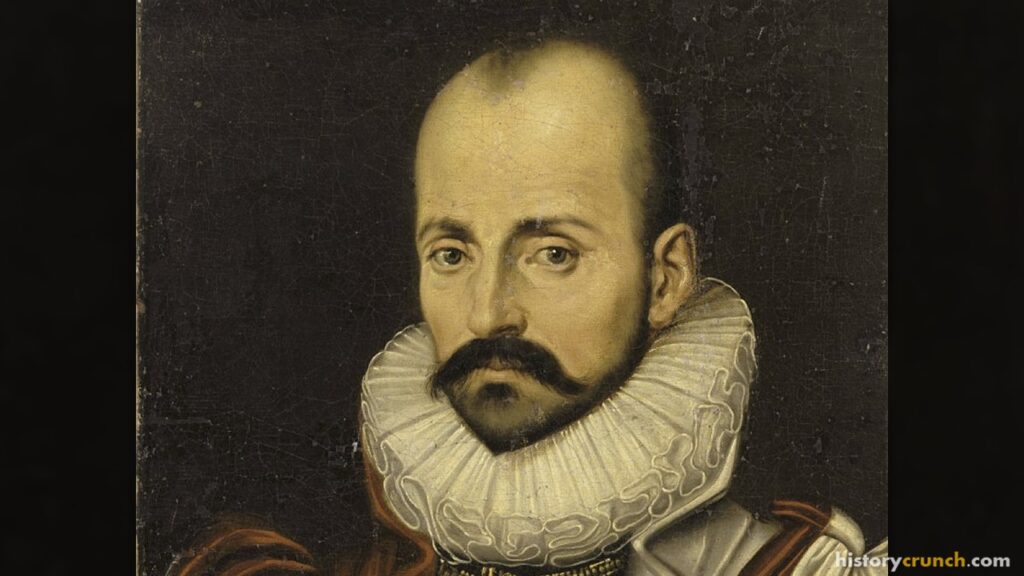
On March 1st, 1580 a printer in Bordeaux published two books of 'Essais', 'attempts', by Michel de Montaigne, who had retired to the tower of his chateau at 38 to read and think. The essays are about himself: his kidney stones, his memory, his cat, cannibals, cruelty, education, friendship, death, and above all how little anyone can be sure of. 'What do I know?' was the motto he had struck on a medal. He added a third book in 1588 and kept writing in the margins until he died.
LEARN MORESHOW LESSwhy it matters · a source · 1 key figureLETTERSMontaigne invented the essay, the form in which a person thinks on the page, and turned humanism from the study of the ancients into the study of oneself. Shakespeare read him; so did Descartes, and so does everyone who writes 'I think'.
IN THEIR OWN WORDS“I have never seen a greater monster or miracle in the world than myself.”
Michel de Montaigne, 'Of Cripples', Essays, Book III (1588)WHAT TO NOTICEMontaigne's essays are the first books in which an author sets out to describe his own mind.
On the orders of Pope Gregory XIII, Thursday, October 4th, 1582 was followed in Italy, Spain, Portugal and Poland by Friday, October 15th. The Julian calendar of Caesar had drifted ten days from the seasons over sixteen centuries, and Easter was sliding toward summer. The Jesuit astronomer Clavius fixed the leap-year rule. Protestant countries refused a pope's calendar for generations; England changed in 1752, Russia in 1918.
LEARN MORESHOW LESSwhy it mattersSCIENCEThe calendar reform was the Renaissance's astronomy applied to daily life, and the refusal of half of Europe to adopt it shows how deep the religious divide had become. It is the calendar the world uses now.
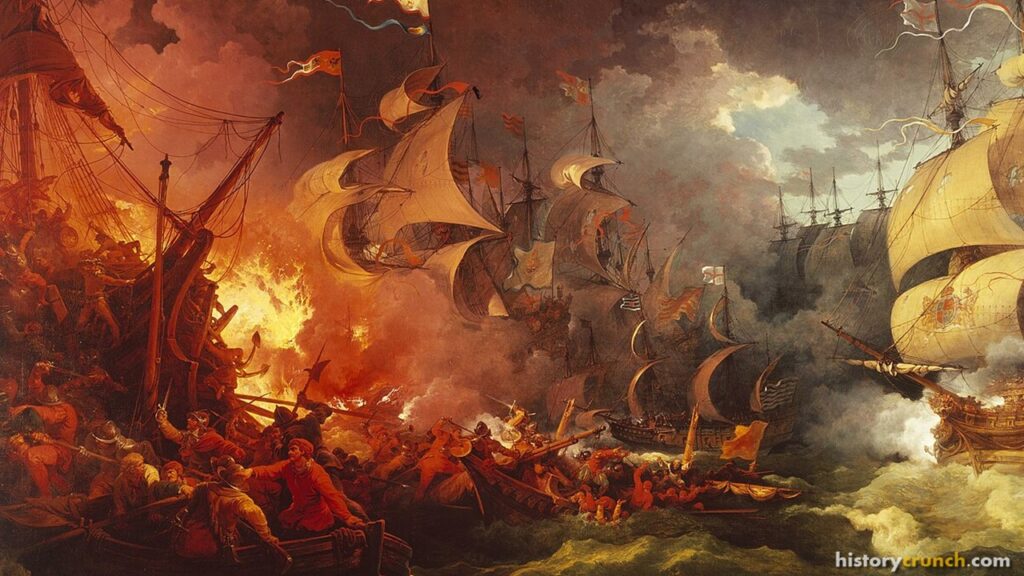
On August 8th, 1588 the English fleet, after a week of running fights up the Channel and a night attack with fireships, closed with the Spanish Armada of 130 ships off Gravelines and battered it with gunfire until the wind drove it into the North Sea. The Spanish ships went home round Scotland and Ireland, where storms wrecked dozens; about a third of the fleet and half the men were lost. Philip II's plan to land an army and restore England to Rome was over.
LEARN MORESHOW LESSwhy it mattersWARThe Armada's defeat kept England Protestant and marked the rise of the northern, Atlantic, Protestant powers, England and the Netherlands, that would carry the next age. The Renaissance in England, Shakespeare's decade, followed at once.
In 1589 Galileo, 25, without a degree, was made lecturer in mathematics at the University of Pisa, and there, according to his first biographer, dropped weights from the Leaning Tower to show that heavy and light objects fall at the same rate, which Aristotle had denied. The tower story may be a legend; the experiments, with balls rolled down ramps and timed by water clocks, were real. In 1592 he moved to Padua, in Venetian territory, where he stayed eighteen years.
LEARN MORESHOW LESSwhy it matters · 1 key figureSCIENCEGalileo's method, measure rather than argue, is the Scientific Revolution's whole idea. He got it from the Renaissance engineers and artists who had measured everything, and he turned it against the ancient authority the humanists had revived.
Michel de Montaigne died at his chateau on September 13th, 1592, aged 59, of an inflamed throat that had left him unable to speak for three days, during Mass in his bedroom. He had been mayor of Bordeaux twice, a go-between in the wars of religion, and a friend of the Protestant Henry of Navarre, who became king of France the next year. His adopted daughter published his final, much-expanded Essays in 1595.
LEARN MORESHOW LESSwhy it matters · 1 key figurePEOPLEMontaigne's death, with Shakespeare writing in London and Galileo teaching in Padua, is about where historians stop calling the period the Renaissance. The essay he invented became the thinking tool of the Enlightenment.
On February 17th, 1600 the Dominican friar and philosopher Giordano Bruno was burned alive in the Campo de' Fiori in Rome after seven years in the Inquisition's prisons, with his tongue clamped so he could not speak to the crowd. He had taught that the universe is infinite, that the stars are suns with worlds of their own, and much else the Church called heresy. A statue of him, hooded, stands on the spot, facing the Vatican.
LEARN MORESHOW LESSwhy it mattersCHURCHBruno's death showed the astronomers what open defense of the moving Earth could cost. Galileo, in Padua, kept his Copernican views private for another ten years.
In 1609 the German mathematician Johannes Kepler, imperial astronomer at Prague, published the 'New Astronomy', the result of years of calculation on the thirty years of observations of Mars left by his master Tycho Brahe. Mars did not move in a circle, as everyone from Ptolemy to Copernicus had assumed, but in an ellipse with the Sun at one focus, and it sped up as it came nearer the Sun. Kepler had found the first two laws of planetary motion.
LEARN MORESHOW LESSwhy it mattersSCIENCECopernicus had moved the Earth but kept the perfect circles of the Greeks; Kepler broke the circles and made the sky obey mathematics instead of philosophy. Newton's gravity, eighty years later, explained why.
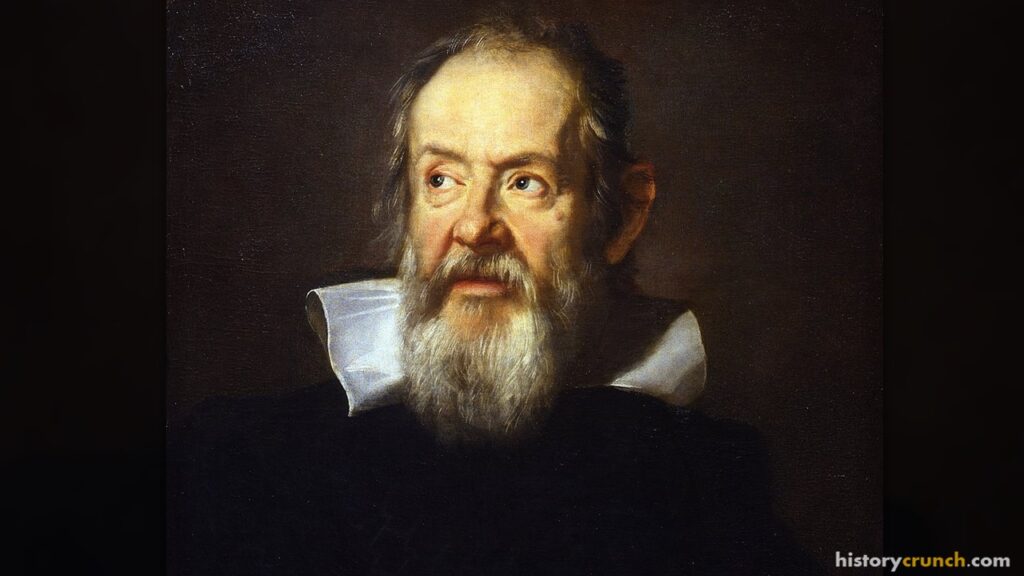
On August 21st, 1609 Galileo led the senators of Venice up the bell tower of St Mark's and showed them ships two hours out at sea through a tube of lead and two lenses that made things look eight times nearer. He had heard in June of a Dutch spectacle maker's toy that magnified three times, worked out the optics, and built better ones; by November he had one of twenty times. The senate doubled his salary and made his professorship for life. In December he turned it on the Moon.
LEARN MORESHOW LESSwhy it matters · key numbers · 1 key figureSCIENCEThe telescope was a Dutch craftsman's invention improved by an Italian mathematician and sold to a merchant republic: the Renaissance in one afternoon. What Galileo saw through it in the next four months changed what the universe was.
On March 13th, 1610 a Venetian printer issued 550 copies of Galileo's 'Sidereus Nuncius', 'The Starry Messenger', a 60-page report of what he had seen since December: mountains and valleys on the Moon, which was supposed to be a perfect sphere; ten times more stars than the eye could see; and four small lights moving round Jupiter, which he named the Medicean stars after the Grand Duke of Tuscany. Something was orbiting a body other than the Earth. The book sold out in a week.
LEARN MORESHOW LESSwhy it matters · 1 key figureSCIENCEJupiter's moons were the first hard evidence against a universe with the Earth at the center, and the book that reported them made Galileo famous across Europe in a month. Copernicus's idea now had a witness.
In September 1610 Galileo left Padua and the protection of Venice for Florence, as chief mathematician and philosopher to Grand Duke Cosimo II de' Medici, his former pupil, with no teaching duties and a large salary. Friends warned him that Florence was within reach of Rome and Venice was not. That winter he saw that Venus had phases like the Moon, which it could only have if it went round the Sun, and in 1611 he was feted in Rome and shown honor by the pope.
LEARN MORESHOW LESSwhy it matters · 1 key figureSCIENCEThe Medici, who had paid Donatello and Michelangelo, now paid for the telescope. Their patronage made Galileo's fame and, because it put him under Rome's eye, his trial.
On March 5th, 1616 the Congregation of the Index declared the doctrine that the Sun stands still and the Earth moves 'false and altogether contrary to Holy Scripture', suspended Copernicus's book until corrected, and banned a book that had tried to square the idea with the Bible. A week earlier Cardinal Bellarmine had told Galileo privately that he must not hold or defend the opinion. Galileo, who had come to Rome to argue his case, went home and kept quiet for seven years.
LEARN MORESHOW LESSwhy it matters · 1 key figureCHURCHThe Church had let Copernicus's book circulate for 73 years; now, in the middle of its war with the Protestants over who could interpret Scripture, it drew a line. The Renaissance's freedom to read the sky as one read a text was over in Italy.
In October 1620 Francis Bacon, Lord Chancellor of England, published the 'Novum Organum', the 'new instrument', to replace Aristotle's logic. Knowledge, he wrote, should be built up from carefully recorded observations and experiments to general laws, not argued down from ancient books; the mind must be cleared of its 'idols', the habits and words that distort what it sees; and the purpose of knowledge is power over nature for the relief of man's estate. He died in 1626 after stuffing a chicken with snow to test refrigeration.
LEARN MORESHOW LESSwhy it mattersSCIENCEBacon wrote the program of the Scientific Revolution: the method, the doubt about authority, and the aim of useful knowledge. The Royal Society of 1660 called itself his heir, and so did the Enlightenment.
On February 21st, 1632 Galileo's 'Dialogue Concerning the Two Chief World Systems' was published in Florence with a Church license: four days of conversation among three men, one for Copernicus, one for Aristotle, one open-minded, written in Italian rather than Latin so that anyone could follow. Galileo, 68, had thought a friendly pope, Urban VIII, would allow it. But the case for the moving Earth was overwhelming and the Aristotelian, Simplicio, was a fool, and Urban was told that Simplicio's last argument was his own.
LEARN MORESHOW LESSwhy it matters · 1 key figureSCIENCEThe Dialogue was the Renaissance argument in the Renaissance form, Plato's dialogue in the language of Boccaccio, and it was aimed at the public, not the professors. That is what made it dangerous.
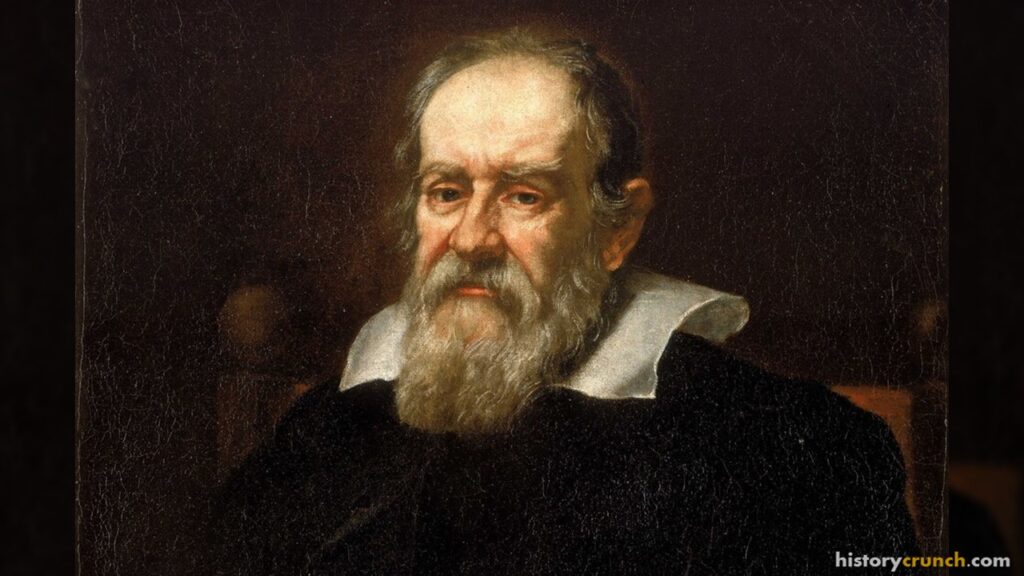
On June 22nd, 1633, in the Dominican convent of Santa Maria sopra Minerva in Rome, Galileo, 69 and ill, knelt in a penitent's white shirt before ten cardinals of the Inquisition, was found 'vehemently suspected of heresy' for holding that the Earth moves, and read aloud a recantation in which he cursed and detested his errors. He had been shown the instruments of torture. The Dialogue was banned and he was sentenced to prison, changed the next day to house arrest for the rest of his life.
LEARN MORESHOW LESSwhy it matters · a source · 1 key figureCHURCHThe trial is the emblem of the break between the Church and the new science. It ended serious astronomy in Italy for a century and sent it north to the Protestant countries where Descartes, Huygens and Newton worked.
IN THEIR OWN WORDS“And yet it moves.”
Words attributed to Galileo after his recantation, June 22nd, 1633WHAT TO NOTICEThere is no evidence Galileo said this; the story first appears more than a century later. It is on the timeline because it is what everyone remembers, and it is worth knowing that it is a legend.
In 1638 the Dutch printer Elzevir at Leiden published Galileo's 'Two New Sciences', the book he had dictated under house arrest at Arcetri, near Florence, as he went blind: the strength of materials and the mathematics of motion, with the law of falling bodies, the parabola of a cannonball, and the pendulum. The manuscript had been carried out of Italy in secret because he was forbidden to publish. Newton read it as a student.
LEARN MORESHOW LESSwhy it matters · 1 key figureSCIENCEForbidden to talk about the sky, Galileo wrote the foundation of physics instead. The book is the bridge between the Renaissance engineer and the modern scientist, and it was printed, like so much else, in the free Netherlands.
Galileo died at Arcetri on January 8th, 1642, aged 77, blind, still a prisoner of the Inquisition, with his pupils Viviani and Torricelli at his bedside. The pope forbade the Grand Duke to give him a public funeral or a monument, and he was buried in a side room of Santa Croce in Florence. In 1737 Florence moved him to a tomb in the church beside Michelangelo's; in 1992 the Church admitted the error of his condemnation.
LEARN MORESHOW LESSwhy it matters · 1 key figurePEOPLEGalileo's death is where this timeline ends, because the argument the Renaissance had started, that a person reading nature or a text for himself could overrule authority, had now passed from artists and scholars to scientists. Isaac Newton was born eleven months later.
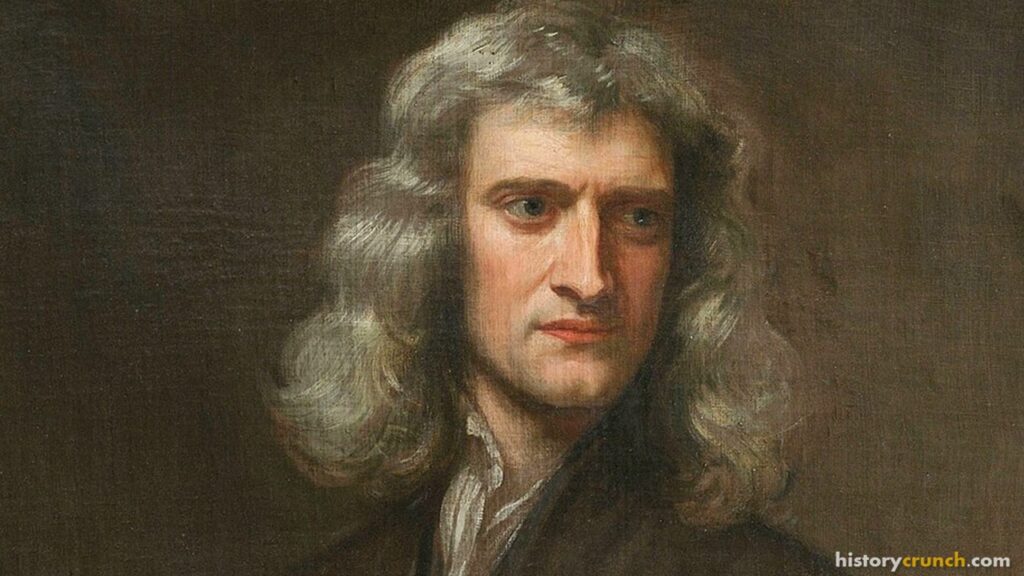
Isaac Newton was born on Christmas Day, 1642 by the old English calendar, January 4th, 1643 by the new one, at Woolsthorpe in Lincolnshire, so small his mother said he could have fit in a quart mug, three months after his father's death. He would build on Kepler's ellipses and Galileo's falling bodies to show, in 1687, that one law of gravity moved the apple and the Moon. What the Renaissance had begun by reading Cicero ended in a set of equations.
LEARN MORESHOW LESSwhy it matters · 1 key figurePEOPLENewton is the door out of this timeline into the Scientific Revolution and the Enlightenment. The habits he used, doubt, measurement, mathematics, ancient texts read critically, were three centuries old, and they were the Renaissance's.

I'm a passionate history and geography teacher with over 15 years of experience working with students in the middle and high school years. I have an Education Degree with a focus in World History. I have been writing articles for History Crunch since 2015 and love the challenge of creating historical content for young learners!

I'm the founder of History Crunch, which I first began in 2015 with a small team of like-minded professionals. I have an Education Degree with a focus in Social Studies education. I spent nearly 15 years teaching history, geography and economics in secondary classrooms to thousands of students. Now I use my time and passion researching, writing and thinking about history education for today's students and teachers.

K.L. is a content writer for History Crunch. She is a fantastic history and geography teacher that has been helping students learn about the past in new and meaningful ways since the mid-2000s. Her primary interest is Ancient History, but she is also driven by other topics, such as economics and political systems.
To cite this timeline as a source, use one of the formats below.
MLA: Beck, E., et al. “Renaissance Timeline.” HistoryCrunch, 16 September 2026, https://historycrunch.com/renaissance-timeline/.
APA: Beck, E., Millar, B., & Woida, K.L. (2026). Renaissance Timeline. HistoryCrunch. https://historycrunch.com/renaissance-timeline/
Chicago: Beck, E., B. Millar, and K.L Woida. “Renaissance Timeline.” HistoryCrunch. September 16, 2026. https://historycrunch.com/renaissance-timeline/
© History Crunch
Because the money, the ruins and the merchants were all in the same place.
Half of Florence died in 1348; the survivors were richer, freer and less sure of God.
He read a dead Roman's letters as if they were written to him, and spent his life looking for more.
In the luggage of refugees, over a century, ending with the fall of a city.
Loans to popes, quiet gifts, and a taste for buildings.
Wool, banks, a coin everyone trusted, and a republic that liked to argue.
The same sea, the same spices, the same customers, for 120 years.
Not by republics but by dukes and kings, with hired soldiers and borrowed artists.
By coming home, taxing Europe, and hiring Florentines.
The study of ancient books to live better now; not, at first, a rejection of God.
The price of a book, the number of readers, and who got to decide what was true.
A Dutch monk, a French lawyer and a Gascon landowner, each in his own century.
Someone who could do everything, and a book that told courtiers to pretend to.
A goldsmith worked it out with a mirror, a painter proved it, and a scholar wrote it down.
By digging up the Romans and then trying to beat them.
A dozen paintings, thousands of pages, and a way of looking.
Alone, in a bad temper, for 75 years.
Historians disagree about how much help Michelangelo had on the Sistine ceiling. Vasari says he sent his Florentine assistants home and did it alone; the account books show assistants paid throughout, for grinding colors, plastering and probably some of the ornament. The figures are his; the room was not empty.
Because he made the hard things Leonardo and Michelangelo discovered look calm and easy.
Yes, in Flanders, in oil, and it looked at the world even more closely.
Mountains, war, feudal lords and a Church that liked things as they were.
Peace, print, refugees, and a French king who wanted a Leonardo.
Same curiosity, same maps, same Italian sailors, different ocean.
After a civil war, with a Dutch scholar, a German painter and a king who broke with Rome.
Print, a prince, and a pope who did not read it in time.
It gave the reformers their tools, and then most humanists refused to join.
Historians disagree about how much the Renaissance caused the Reformation. One view: humanism's return to the sources and its mockery of the clergy made Luther possible and inevitable. Another: the Reformation grew from medieval religion, German politics and a monk's private crisis, and most humanists, Erasmus first, wanted nothing to do with it. Both are partly right.
With a council, a list of books, a new order of priests, and a darker Sistine wall.
A century of war in which Christians killed Christians over how to be Christian.
By reading Greeks, doing mathematics, and waiting thirty years.
He proved the Earth moved, said so in Italian, and made the pope look foolish.
The same habits, looking hard, measuring, doubting authority, turned from the body to the sky.
Pick your year: 1527, 1564, 1600, 1633 or 1642. Each says something different.
Historians disagree about whether the Renaissance was a real break with the Middle Ages at all. Burckhardt in 1860 said it invented the individual and the modern world. Medievalists have answered that the 1100s had their own renaissance, that most people's lives did not change, and that Renaissance men were as superstitious and religious as their grandfathers. The word survives because no better one has been found.
No question matches that word.
Research question 1Because the money, the ruins and the merchants were all in the same place.
Research question 2Half of Florence died in 1348; the survivors were richer, freer and less sure of God.
Research question 3He read a dead Roman's letters as if they were written to him, and spent his life looking for more.
Research question 4In the luggage of refugees, over a century, ending with the fall of a city.
Research question 5Loans to popes, quiet gifts, and a taste for buildings.
Research question 6Wool, banks, a coin everyone trusted, and a republic that liked to argue.
Research question 7The same sea, the same spices, the same customers, for 120 years.
Research question 8Not by republics but by dukes and kings, with hired soldiers and borrowed artists.
Research question 9By coming home, taxing Europe, and hiring Florentines.
Research question 10The study of ancient books to live better now; not, at first, a rejection of God.
Research question 11The price of a book, the number of readers, and who got to decide what was true.
Research question 12A Dutch monk, a French lawyer and a Gascon landowner, each in his own century.
Research question 13Someone who could do everything, and a book that told courtiers to pretend to.
Research question 14A goldsmith worked it out with a mirror, a painter proved it, and a scholar wrote it down.
Research question 15By digging up the Romans and then trying to beat them.
Research question 16A dozen paintings, thousands of pages, and a way of looking.
Research question 17Alone, in a bad temper, for 75 years.
Research question 18Because he made the hard things Leonardo and Michelangelo discovered look calm and easy.
Research question 19Yes, in Flanders, in oil, and it looked at the world even more closely.
Research question 20Mountains, war, feudal lords and a Church that liked things as they were.
Research question 21Peace, print, refugees, and a French king who wanted a Leonardo.
Research question 22Same curiosity, same maps, same Italian sailors, different ocean.
Research question 23After a civil war, with a Dutch scholar, a German painter and a king who broke with Rome.
Research question 24Print, a prince, and a pope who did not read it in time.
Research question 25It gave the reformers their tools, and then most humanists refused to join.
Research question 26With a council, a list of books, a new order of priests, and a darker Sistine wall.
Research question 27A century of war in which Christians killed Christians over how to be Christian.
Research question 28By reading Greeks, doing mathematics, and waiting thirty years.
Research question 29He proved the Earth moved, said so in Italian, and made the pope look foolish.
Research question 30The same habits, looking hard, measuring, doubting authority, turned from the body to the sky.
Research question 31Pick your year: 1527, 1564, 1600, 1633 or 1642. Each says something different.