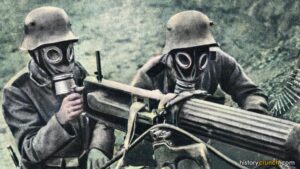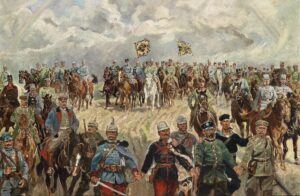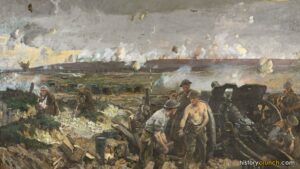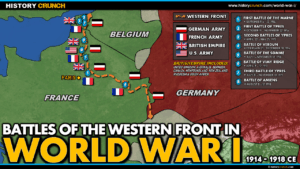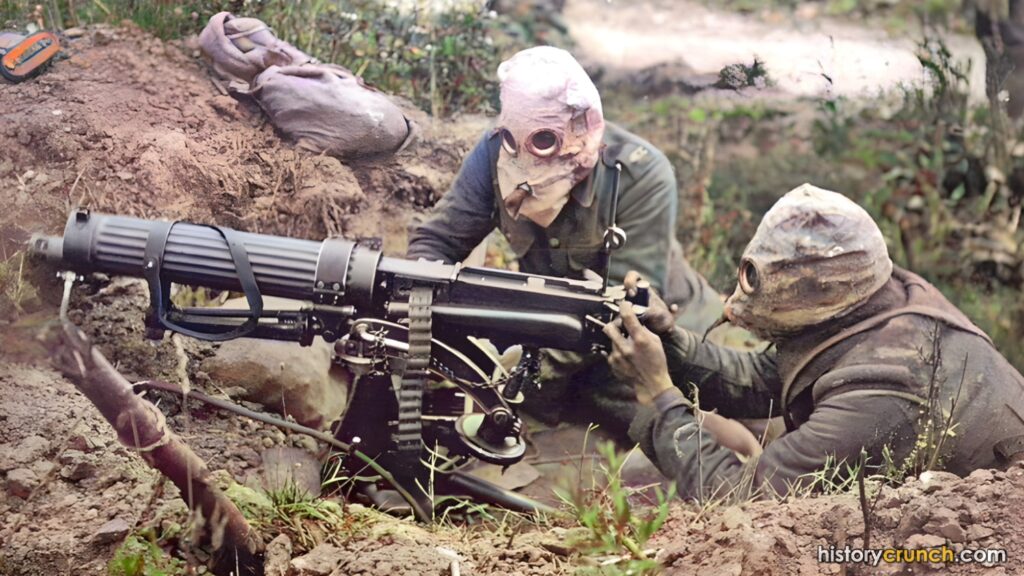
Poison gas was a devastating weapon in World War I and played a significant role in the events of the First World War. In fact, poison gas was used throughout the war as a means of trying to end the stalemateA situation where neither side can make progress or gain an advantage over the other. that resulted from trench warfare. Soldiers from all sides feared the effects of the gas and tried to protect themselves from its deadly outcome. World War I was a deadly conflict as shown by the millions of military and civil casualties it caused. The large number of casualties was the result, in part, of the development and use of weaponry that took place during the war. In all, poison gas was one of the most significant weapons of World War I alongside other important weapons, such as: airplanes, airships, machine guns, rifles, submarines, and tanks.
 FactsthatCrunch
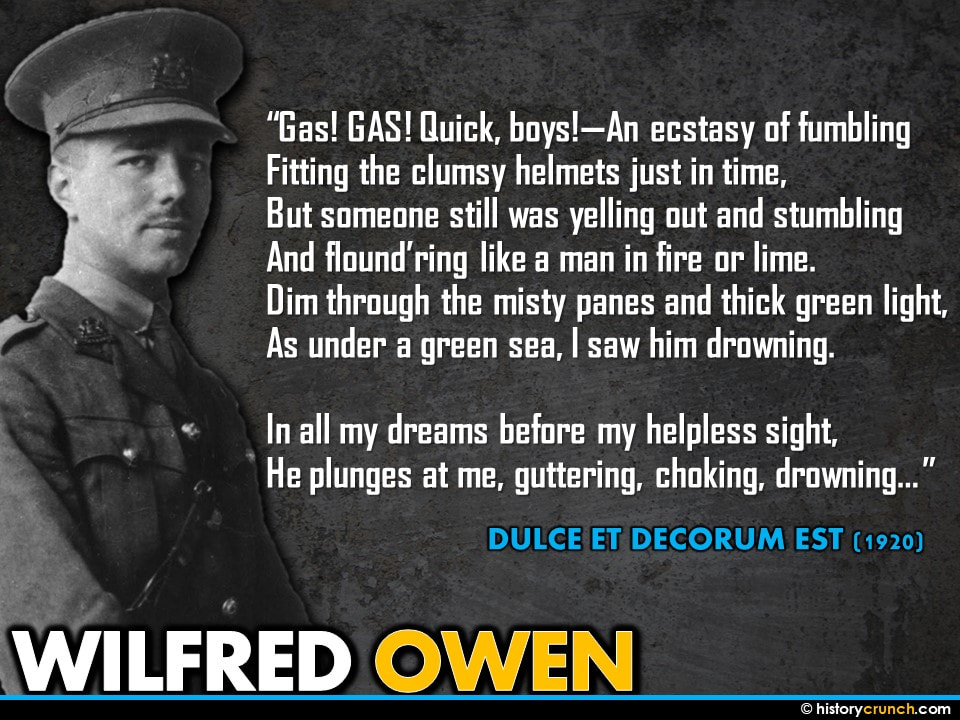
The old Lie: Dulce et decorum est Pro patria mori.
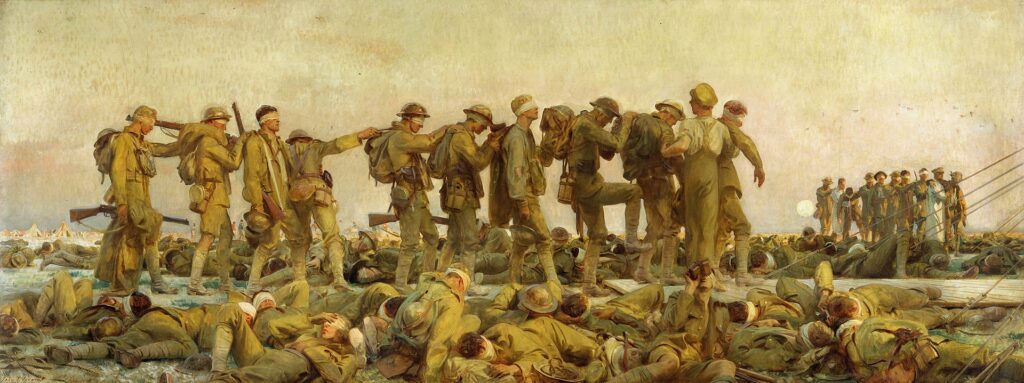
Owen was responding to wartime leaders and writers who used this Latin line from the Roman poet Horace, meaning it is sweet and proper to die for one's country, to rally the public and urge young men to enlist. After describing a soldier dying in a poison gas attack in the trenches, Owen calls the slogan a lie. His poem turned many readers against the patriotic picture of the war.
Development of Poison Gas in World War I
World War I, especially on the Western Front, was known for the stalemate conditions of trench warfare. Essentially, the trench systems created excellent conditions for the defending armies, which meant that there was very little movement by either the Allied Powers or the Central Powers. As a result, the major nations of World War I sought to find new weapons and strategies in an effort to end the stalemate and break through the enemy lines. The development and use of poison gas in World War I was related to this, as it was seen as a way to potentially break the stalemate.
In reality, the use of poison gas had been deemed a ‘war crime’ since before World War I. In fact, the Hague Conventions of 1899 and 1907 at The Hague in the Netherlands, established several ‘laws of war’. One such agreement was against the use of poison weapons in warfare. As such, the use of poison gases in World War I was highly controversial and led to a great deal of public outrage. Regardless, countries expanded their use of poison gases during the war as a means of overcoming their enemies. In fact, the armies of World War I used several different forms of poison gas throughout the war.
 FactsthatCrunch
What rules did the Hague Conventions set about poison gas before World War I?
Types of Poison Gas in World War I
Tear Gas – This was the most commonly used type of gas in World War I. In general, tear gas was any chemical that caused the soldiers to produce tears. For instance, several different types of chemicals were used in World War I to create tear-causing gases. The purpose of tear gas was to affect the enemy’s vision and force them to retreat from their positions.
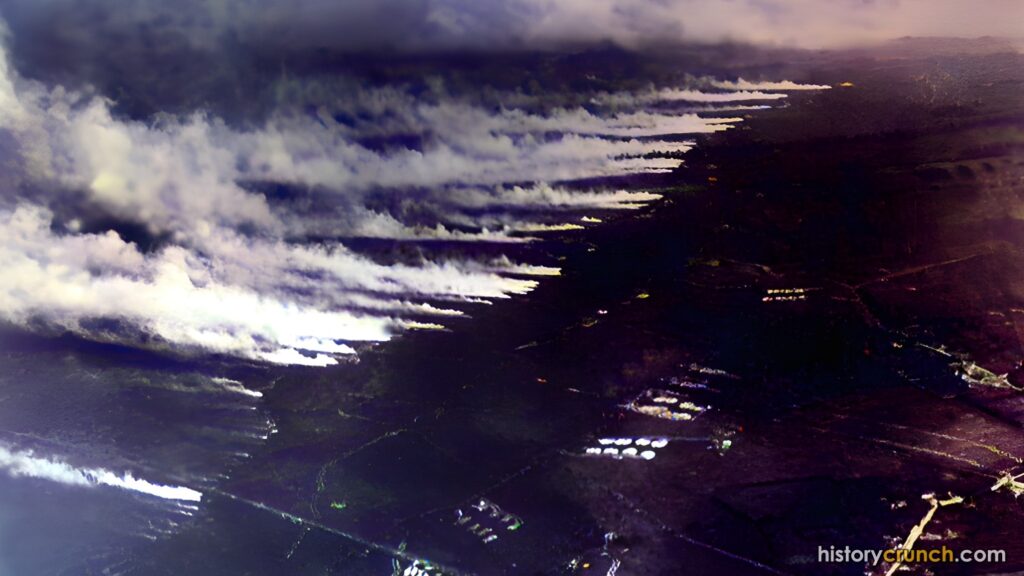
Chlorine Gas – This was the first type of poison gas used on the battlefield of World War I and led to many early casualties on the Western Front. Chlorine gas worked by entering the soldier’s airway and causing inflammation in the soldier’s airway and lungs. As such, this led to the soldier struggling to breathe. In general, soldiers who died from Chlorine gas died due to a lack of air. It also caused damage to the eyes and was known to blind soldiers. Chlorine gas was visible as a greenish cloud and most soldiers lacked the proper gas masks when it was initially used.
Phosgene Gas – This was another type of poison gas used in World War I. Phosgene gas was similar to chlorine gas in that it inflamed the soldier’s airway and lungs and generally caused people to die from a lack of air. However, phosgene gas differed from chlorine gas in that it was not visible and it was generally odorless.
This meant that soldiers who were attacked with phosgeneA colorless, nearly odorless poison gas that caused roughly 85% of all gas deaths in World War I. gas usually did not know they were breathing in the deadly gas. As such, soldiers in World War I would often take a bit of time before they put on their gas masks, causing them to breathe in large quantities of the gas. It was also heavier than air, and settled deep into the bottom of the trenches, where soldiers were hiding for protection. In fact, approximately 85% of all poison gas deaths from World War I were the result of phosgene gas.
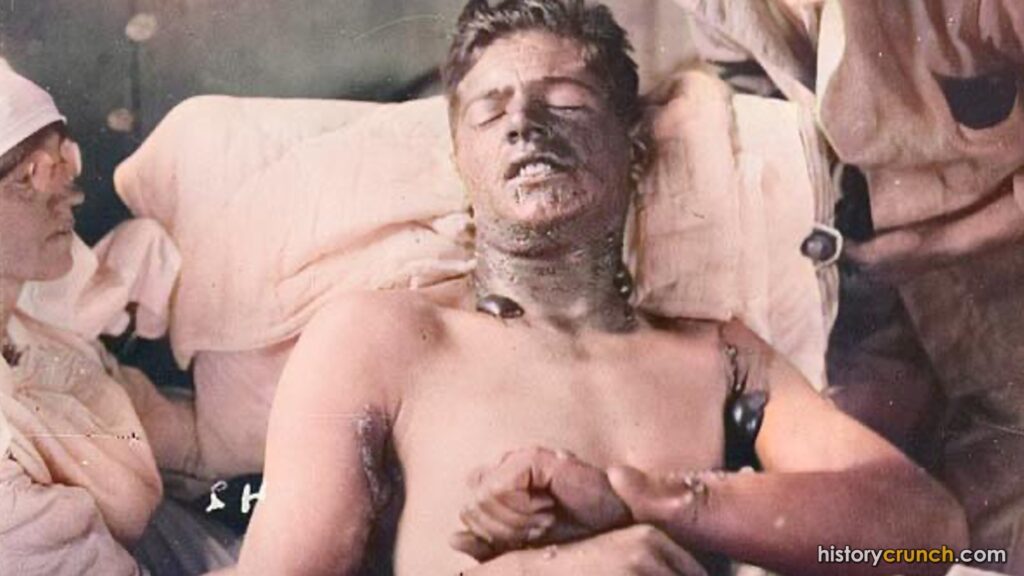
Mustard Gas – This was a devastating form of poison gas from World War I. Unlike chlorine and phosgene, gas masks were not effective against mustard gas since it also affected the surface of the skin. Soldiers who were exposed to mustard gas experienced burning of the skin, blisters, swelling of the eyes and choking. With that said, while mustard gas caused the injuries described above it rarely led to death. It was also heavier than air, and often settled into the deep parts of the trenches, where soldiers hid, slept and laid injured.
 FactsthatCrunch
History of Poison Gas in World War I
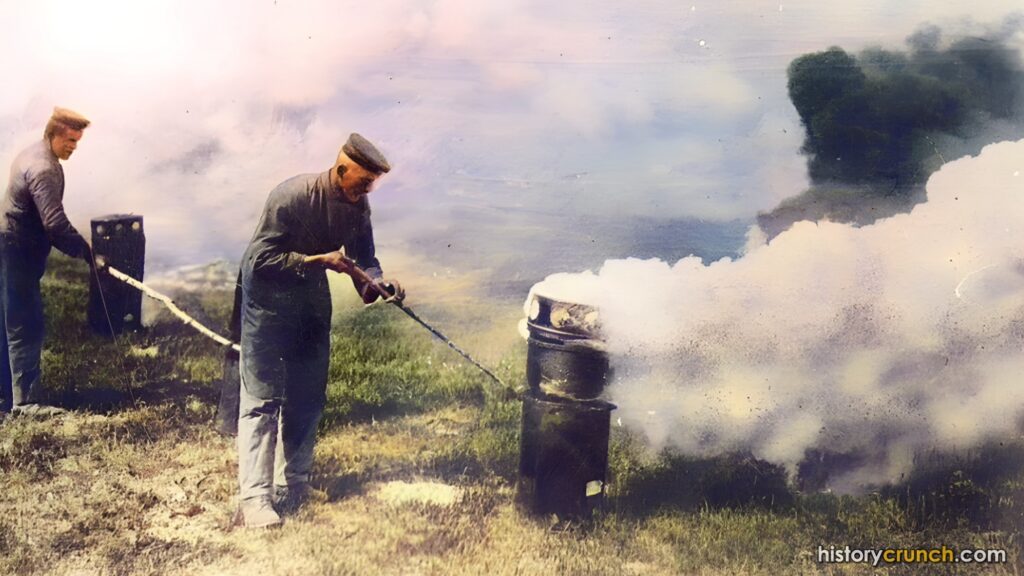
There were several different types of poison gases used on the battlefields of World War I, and not all were deadly. In fact, the most commonly used type of gas in World War I was ‘tear gas’. Several different chemicals were used to create tear gas, however they all caused the eyes to become irritated and produce tears. The French Army first used tear gas in August of 1914, when they launched 26 mm grenades filled with ethyl bromoacetate. However, the French used so little of the gas in each grenade that it was barely noticed by the Germans. The first large-scale attack that made use of tear gas was carried out by the German Army in late January of 1915. This saw the Germans use it against Russian Forces in the Battle of Bolimov.
However, World War I is famous today for the terrible effects of the lethal poison gases that were used. For instance, chlorine gas was the first lethal poison gas that was used in World War I. Chlorine gas was first used by the Germans against Allied soldiers in April of 1915 during the Second Battle of Ypres and immediately had a devastating effect on soldiers in the trenches. It caused soldiers to choke and suffocate as their lungs became inflamed from the gas. In fact, the greenish plumes of chlorine gas sent waves of fear throughout the ranks of the Allied soldiers at Ypres and caused them to scramble for safety. The effects of chlorine gas were quick and deadly. In fact, soldiers essentially died from asphyxiationDeath caused by the body being unable to get enough oxygen to breathe., which was a lack of oxygen.
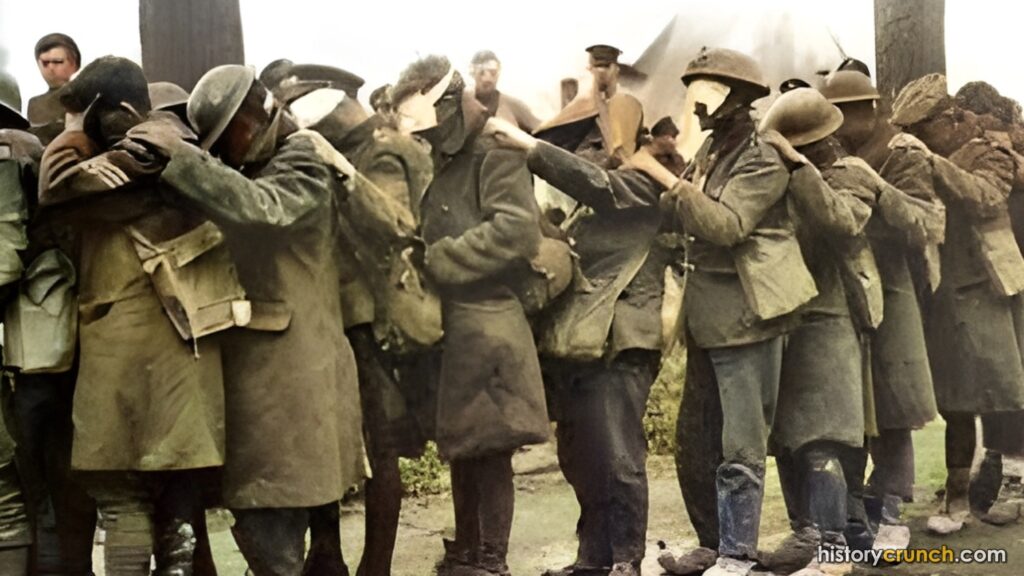
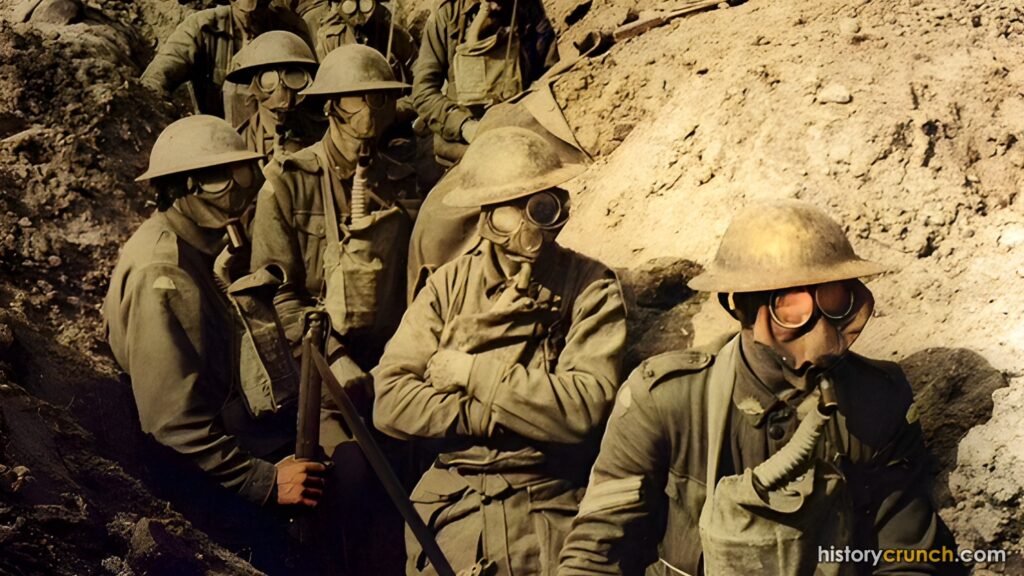
As it was the first use, soldiers were unprepared for its effects and did not have gas masks to protect themselves. Some soldiers in World War I were known to urinate on rags and cover their faces with the rags in an attempt to prevent the gas from entering their airway. While the German use of poisonous gas was criticized heavily in the Allied nations, it would eventually become a weapon used by both sides in World War I. As well, as the war progressed, soldiers were supplied with proper gas masks or gas hoods to help prevent the devastating effects of the gas. Gas masks and other measures made chlorine gas much less effective, and led the armies of World War I to search for a new and more deadly form of poison gas.
After the initial uses of chlorine gas, a new type of poison gas saw use by both sides in the battlefields of World War I. It was called phosgene gas and it was more deadly than chlorine gas. It caused soldiers to cough less at first which allowed the gas to be inhaled more readily, thus making it even more poisonous to men in the trenches. As well, unlike chlorine gas, phosgene was not visible, making it more likely that soldiers inhaled it before securing their gas masks.
Phosgene gas was first developed and used by France in 1915, but it became widely used by all of the major powers in World War I. Furthermore, phosgene gas was often combined with chlorine gas because it helped it to travel and linger in the enemy trenches. The overwhelming majority of deaths in World War I from poison gas were from phosgene gas. In fact, historians estimate that about 85% of all poison gas related deaths in the war were a result of phosgene gas.
The last significant poisonous gas that saw use in World War I was mustard gas, which the German forces first introduced into the battlefields of the war. The German Army used it extensively in the war from the battlefields of Ypres and the Third Battle of Ypres to conflicts against Russian soldiers on the Eastern Front. As stated above, mustard gas was different from chlorine and phosgene in that gas masks were not effective since it also affected the surface of the skin. Soldiers who were exposed to mustard gas would experience burning of the skin, blisters, swelling of the eyes and choking. With that said, while mustard gas caused the injuries described above it rarely led to death. However, victims of mustard gas attacks suffered a terrible and painful fate. This is because mustard gas caused terrible blistering of the skin and the mucous membranesThe moist tissue lining body passages such as the airway and mouth that mustard gas severely blistered. in the airway. While it was not necessarily the most deadly poison gas from World War I, it did capture the public’s attention and many opposed its use in the war.
 FactsthatCrunch
In what order did the first battlefield uses of poison gas in World War I happen?
Significance of Poison Gas in World War I
In the end, poison gas was an important weapon that had a significant impact on the nature of war in World War I. For instance, historians estimate that as many as 90,000 soldiers died from poison gas in the war. Most of these deaths occurred in the early years of the war, because as the war progressed the different armies developed their own countermeasuresActions or equipment developed to reduce or block the harmful effects of an enemy weapon.. For instance, as the war continued the poisonous gases lost their overall impact due to the introduction of the gas mask in 1916. Regardless, poison gases still proved significant due to the number of casualties that were created. For instance, historians estimate that as many as 1.3 million casualties resulted from the use of poison gas in World War I. Common injuries suffered by the casualties of poison gas included: temporary blindness, difficulty breathing, blisters, etc.
 FactsthatCrunch
Phosgene gas caused approximately 85 percent of all poison gas deaths in World War I, more than any other chemical weapon used in the conflict.
Phosgene was colorless and nearly odorless, so soldiers often did not realize they were breathing it in. It caused soldiers to cough less than chlorine at first, which meant larger amounts entered the lungs before anyone put on a gas mask. Because phosgene is heavier than air, it settled into the lowest parts of the trenches, where soldiers sheltered, making it especially hard to avoid.
World War I timeline · 1914 – 1918
Key Vocabulary
Stalemate
Hague Conventions
Inflammation
Asphyxiation
Phosgene
Mucous membranes
Countermeasures
Frequently Asked Questions
When was poison gas first used in World War I?
The French Army first used tear gas in August of 1914, though the amount was too small to be noticed. The first lethal gas attack came in April of 1915, when Germany released chlorine gas at the Second Battle of Ypres. Soldiers had no gas masks and were caught completely off guard.
Which poison gas caused the most deaths in World War I?
Phosgene gas caused about 85 percent of all poison gas deaths in the war. It was more dangerous than chlorine because it was invisible and nearly odorless. Soldiers often breathed in large amounts before they realized they needed their masks.
Why was poison gas used if it was against the laws of war?
Poison gas was banned by the Hague Conventions of 1899 and 1907, yet armies still used it to break the deadlock of trench warfare. The trenches favored defenders, so both sides looked for new weapons to force a breakthrough. Gas was seen as one way to drive the enemy out of their positions.
How did soldiers protect themselves from poison gas?
Soldiers were eventually given gas masks and gas hoods to keep the gas out of their airways. The gas mask, introduced in 1916, made chlorine and phosgene far less effective. Before proper masks arrived, some men urinated on rags and held them over their faces for protection.
Why was mustard gas so feared if it rarely killed?
Mustard gas was feared because gas masks could not stop it, since it also burned the skin. Victims suffered blisters, swollen eyes, choking, and painful damage to the airway. It seldom caused death, but its terrible injuries drew strong public opposition.
How many casualties did poison gas cause in World War I?
Historians estimate that as many as 1.3 million casualties resulted from poison gas during the war. About 90,000 of these were deaths, with most happening in the early years. Common injuries included temporary blindness, breathing problems, and skin blisters.
Cite This Article
To cite this article as a source, use one of the formats below.
MLA: Beck, Elias. “Poison Gas in World War I: A Detailed Summary.” HistoryCrunch, 29 September 2026, https://historycrunch.com/poison-gas-in-world-war-i/.
APA: Beck, E. (2026). Poison Gas in World War I: A Detailed Summary. HistoryCrunch. https://historycrunch.com/poison-gas-in-world-war-i/
Chicago: Beck, Elias. “Poison Gas in World War I: A Detailed Summary.” HistoryCrunch. September 29, 2026. https://historycrunch.com/poison-gas-in-world-war-i/
Sources
- Hew Strachan, The First World War.
- Fordham Modern History Sourcebook
- Margaret MacMillan, The War That Ended Peace.