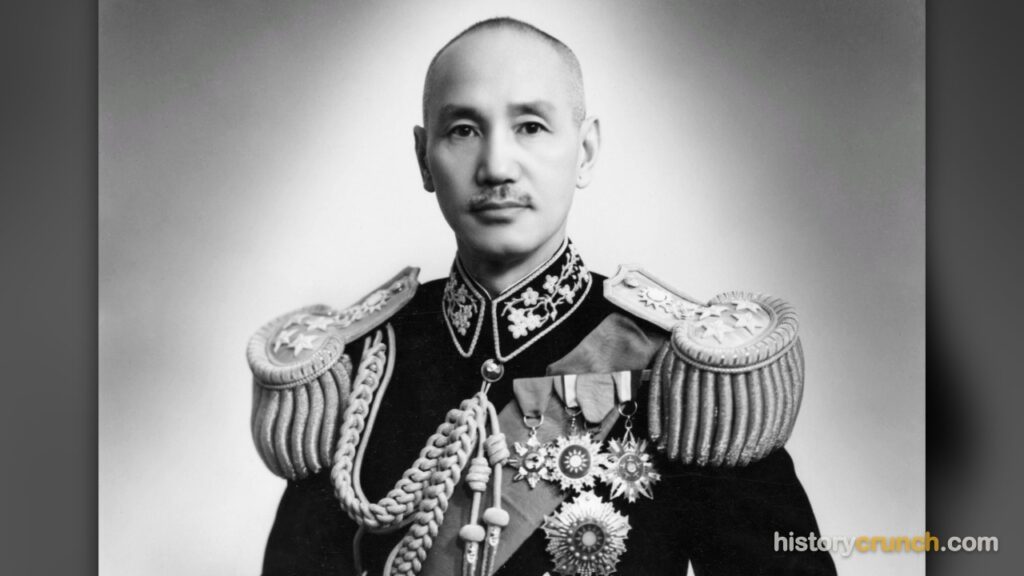
Chiang Kai-shek was one of the most important political and military figures in the history of modern China, leading the country’s Nationalist government for more than two decades and later ruling on the island of Taiwan. His long career was tied to nearly every major event that shaped China in the first half of the twentieth century, from the fall of the Qing dynasty through the rise of communism. Chiang sought to unify a divided nation, resisted a brutal Japanese invasion, and fought a long and bitter struggle against the Chinese Communists led by Mao Zedong.
In simple terms, Chiang Kai-shek was the head of the Kuomintang, or Nationalist Party, which was the political and military group that governed the Republic of China. The Kuomintang was founded to overthrow warlords and foreign control and to build a strong, united Chinese state. Chiang became its leader after the death of the party’s founder, and for many years he was the single most powerful person in the country.
Early Life and Background
Chiang Kai-shek was born on October 31st, 1887, in the coastal province of Zhejiang in eastern China. His family were salt merchants, which meant they were fairly well off compared to many of their neighbors. However, Chiang’s father died when the boy was still young, and much of his early life was shaped by his mother and grandparents.
As a boy, Chiang studied the Chinese classics and the values of Confucianism, an ancient system of thought that stressed order, duty, and respect. Yet he grew up during a time of great turmoil, when the ruling Qing dynasty was weak and China was being carved into zones of influence by foreign powers. In 1905, as a sign of his growing anger toward the Qing rulers, he cut off his long braid, a hairstyle the ruling Manchus had forced on Chinese men.
Chiang decided to pursue a military career, believing that a strong army was the key to saving China. He traveled to Japan for military training and studied there in the years before 1911. While in Japan, he joined a revolutionary group led by Sun Yat-sen, the man who would later be remembered as the founding father of the Republic of China. This decision placed Chiang firmly in the movement that hoped to sweep away the old dynasty and build a modern nation.
Rise to Power
In 1911, the Qing dynasty was overthrown in a revolution, and the Republic of China was created. Chiang returned home to take part in the fighting and became one of the early members of the Kuomintang, the Nationalist Party founded by Sun Yat-sen. In the years that followed, however, China fell into disorder, as powerful warlords controlled different regions and no single government truly ruled the whole country.
Chiang steadily gained influence within the party. In 1924, Sun Yat-sen placed him in charge of a new military school called the Whampoa Military Academy, near the southern city of Canton. This academy trained a new generation of officers loyal to the Nationalist cause, and it gave Chiang direct control over a growing and disciplined army. In fact, this command became the foundation of his later power.
When Sun Yat-sen died in 1925, a struggle broke out over who would lead the Kuomintang. Chiang used his military strength and political skill to outmaneuver his rivals, and by 1926 he had emerged as the most powerful leader of the party. As stated above, his control of the army made him nearly impossible to challenge.
The Northern Expedition and Unification
Chiang’s first great goal was to fulfill Sun Yat-sen’s dream of a united China. In 1926, he launched a military campaign known as the Northern Expedition, which sent the Nationalist army north from Canton to defeat the warlords who ruled much of the country. The campaign was aided by Soviet weapons and advisers, and at this stage the Nationalists were still allied with the Chinese Communists.
The expedition met with striking success, and by 1927 the Nationalist forces had pushed all the way to Shanghai, China’s largest city. It was at this point, however, that Chiang turned violently against his former allies. In April of 1927, he ordered a bloody purge of Communists in Shanghai, working with local police and criminal gangs to arrest and kill thousands of party members. This event, sometimes called the Shanghai Massacre, shattered the alliance between the Nationalists and Communists and marked the beginning of a long civil war.
Despite this split, the Northern Expedition continued. By 1928, Chiang’s forces had taken Beijing, and a new central government was established in the city of Nanjing. More specifically, when a powerful northern warlord’s son pledged loyalty to the Nationalists at the end of 1928, China was at last brought together under a single government, at least in name. Chiang now stood as the recognized leader of the Republic of China.
Ruling China and the War with Japan
From his capital at Nanjing, Chiang governed China between 1928 and 1937. During these years his government encouraged some economic growth in the cities and managed to reduce the number of unfair treaties and foreign concessions that had long weakened China. In reality, however, his control was far from complete, as many rural areas remained poor and were still dominated by local landlords and provincial leaders.
Throughout this period, Chiang treated the Communists as his greatest enemy. He launched repeated military campaigns against them, and in 1934 his forces surrounded the Communist bases in the south. This pressure forced the Communists to flee on the famous Long March, a retreat of thousands of miles to the north during which most of their soldiers died. It was during this march that Mao Zedong rose to become the leader of the Communist movement.
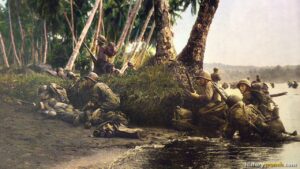
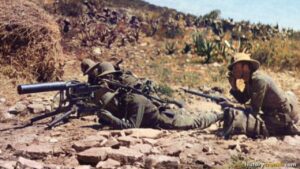
A far greater danger, however, came from Japan. In 1931, Japanese forces seized the northeastern region of Manchuria, and in 1937 they launched a full invasion of China. Chiang was pressured into forming a second uneasy alliance with the Communists to resist the invaders. The Second Sino-Japanese War was long and terrible, and Chinese cities and villages suffered massive bombing, starvation, and atrocities such as the killings at Nanjing.
When the Allies declared war on Japan in World War II, China joined the major Allied powers, and Chiang gained important military and economic support from the United States. His standing rose so high that in 1945 China became one of the five permanent members of the United Nations Security Council. His wife, Soong Mei-ling, known as Madame Chiang, became a famous figure in her own right and spoke to the United States Congress in 1943 to win support for China.
Civil War and Retreat to Taiwan
After Japan surrendered in 1945, the fragile truce between the Nationalists and the Communists quickly collapsed. Efforts by the United States to bring the two sides together failed, and full-scale civil war broke out again in 1946. At first Chiang’s forces were larger and better equipped, and they even captured the Communist headquarters in 1947.
Over time, however, the tide turned against him. The Communists won growing support from peasants by promising land reform, while Chiang’s government was weakened by corruption, poor leadership, and a collapsing economy. By 1949, the Communist armies had won a series of decisive victories, and on October 1st of that year Mao Zedong proclaimed the founding of the People’s Republic of China.
Defeated on the mainland, Chiang led the remains of his government and army to the island of Taiwan, off the coast of southeastern China. Around two million soldiers, officials, and supporters fled with him. There he re-established the Republic of China and continued to claim that his government was the rightful ruler of all China.
Later Life
On Taiwan, Chiang Kai-shek ruled in a strict, authoritarian manner for the rest of his life. He kept the island under martial law for many years, one of the longest such periods anywhere in the world, and he crushed political opposition. At the same time, his government oversaw land reform and economic development that helped Taiwan grow more prosperous.
Chiang never gave up his dream of one day retaking the mainland from the Communists, but that goal was never achieved. For many years his Republic of China held China’s seat at the United Nations, though that recognition later shifted to the People’s Republic. As he grew old, Chiang gradually withdrew from public life and spent much of his time with his family.
Chiang Kai-shek died on April 5th, 1975, still holding the office of president of the Republic of China. He was succeeded as Taiwan’s leader by his son, Chiang Ching-kuo. By the time of his death, Chiang had been the leader of Nationalist China, on the mainland and then on Taiwan, for nearly half a century.
Significance of Chiang Kai-shek
Chiang Kai-shek remains one of the most important and debated figures in modern Chinese history. To some, he was a national hero who helped unify a broken country, resisted the Japanese invasion, and stood as a firm opponent of communism. To others, he was an authoritarian dictator who led a corrupt government and ultimately lost the mainland to his rivals.
Whatever the judgment, his impact on China was enormous. He helped bring an end to the age of warlords, guided China through part of World War II, and made it a founding member of the United Nations Security Council. His defeat in the civil war also directly shaped the world that followed, since it led to the creation of the communist People’s Republic of China on the mainland.
Chiang’s flight to Taiwan created a divide that still shapes the region today. The tense relationship between Taiwan and mainland China, with both once claiming to be the true government of the nation, grew directly out of the events of 1949. For this reason, understanding Chiang Kai-shek is essential to understanding the history of both China and the wider Cold War in Asia.
Frequently Asked Questions
Who was Chiang Kai-shek?
Chiang Kai-shek was a Chinese military and political leader who headed the Nationalist government of the Republic of China. He first trained as a soldier and rose through the Kuomintang before becoming the most powerful person in China for much of the 1920s, 1930s, and 1940s. His name is sometimes written as Jiang Jieshi in the pinyin spelling system used in China today.
Why did Chiang Kai-shek and Mao Zedong become enemies?
Chiang and Mao became enemies because they had opposite visions for China’s future. Chiang and the Nationalists wanted a state led by their party and backed by business owners and landlords, while Mao and the Communists wanted a revolution built on the support of peasants and workers. Their rivalry turned deadly after Chiang purged Communists in 1927, and it grew into a civil war that lasted for decades.
Why did Chiang Kai-shek flee to Taiwan?
Chiang Kai-shek fled to Taiwan because his forces were losing the Chinese Civil War to the Communists. By 1949 the Communist armies controlled most of the mainland, so Chiang moved his government, army, and many supporters to the island for safety. From there he continued to run the Republic of China and hoped one day to return to the mainland.
What was Chiang Kai-shek’s role in World War II?
Chiang Kai-shek led China’s resistance against Japan during World War II. China had been fighting Japan since 1937, and when the wider war began, Chiang’s country became an important ally of the United States and Britain. His leadership during the conflict helped China gain a permanent seat on the United Nations Security Council in 1945.
Why is Chiang Kai-shek a controversial figure?
Chiang Kai-shek is controversial because people judge his rule in very different ways. Supporters praise him for unifying China and standing up to Japan and communism, while critics point to his harsh, one-party rule, the corruption in his government, and his crackdowns on opponents both on the mainland and on Taiwan. This mix of achievement and repression is why historians still debate his place in Chinese history.
Cite This Article
To cite this article as a source, use one of the formats below.
MLA: Millar, B. “Chiang Kai-shek: A Detailed Biography.” HistoryCrunch, 14 August 2026, https://historycrunch.com/chiang-kai-shek/.
APA: Millar, B. (2026). Chiang Kai-shek: A Detailed Biography. HistoryCrunch. https://historycrunch.com/chiang-kai-shek/
Chicago: Millar, B. “Chiang Kai-shek: A Detailed Biography.” HistoryCrunch. August 14, 2026. https://historycrunch.com/chiang-kai-shek/
Sources
- J.M. Roberts & Odd Arne Westad, The Penguin History of the World.
- Jerry Bentley & Herbert Ziegler, Traditions & Encounters: A Global Perspective on the Past.