Airships in World War I played a significant role alongside other new aircraft technology, such as airplanes. An airship is any aircraft that is ‘lighter-than-airAble to float in the sky because the gas inside is less dense than the surrounding air.’ and can operate under its own power. Airships without a rigid frame were known as ‘blimps’. Airships were first used in the 19th century and the technology of airship construction continued to improve in the decades before World War I. This included the use of rigid-airshipsAirships built with a strong internal frame beneath the outer canopy to hold their shape., which had a strong frame under the canopy of the airship. World War I was a deadly conflict as shown by the millions of military and civil casualties it caused.
The large number of casualties was the result, in part, of the development and use of weaponry that took place during the war. In all, airships were one of the most significant weapons of World War I alongside other important weapons, such as: airplanes, machine guns, poison gas, rifles, submarines and tanks.
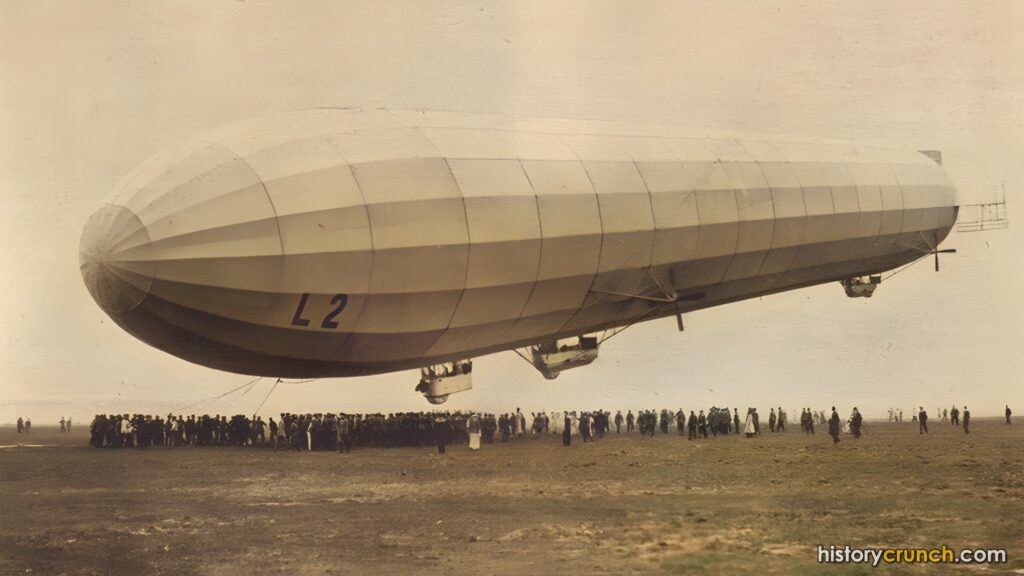

Role of Airships in World War I
Airships in World War I played a variety of important roles. For instance, airships in World War I were primarily used for either reconnaissanceMilitary observation of enemy positions, troops, or terrain to gather useful information. missions or bombing runs. Many of the European Powers of World War I used airships for these different purposes. With that said, airships never reached the popularity or versatility of airplanes in World War I. This was due to the limitations of airships in the war.
The first main limitation of the airships in World War I was that the airships were generally filled with hydrogenA highly flammable gas used to lift airships because it was cheaper and easier to obtain than helium., which gave them their ‘lighter-than-air’ quality. While heliumA safer but more expensive and less available gas that could have been used to lift airships instead of hydrogen. was safer, hydrogen was more often used because it was cheaper and more readily available. However, hydrogen is incredibly flammable and when combined with bombs and other weapons from World War I, it made the airships dangerous vehicles on the frontlines. As such, countries generally did not use airships during the frontline battles of World War I.
Second, airships were slow to maneuver and struggled to make quick adjustments, which is often needed in situations of war. This made the targeting capabilities of the airships poor. As such, while some countries used airships on bombing runs, they were most commonly used as lookouts and for reconnaissance of enemy positions.
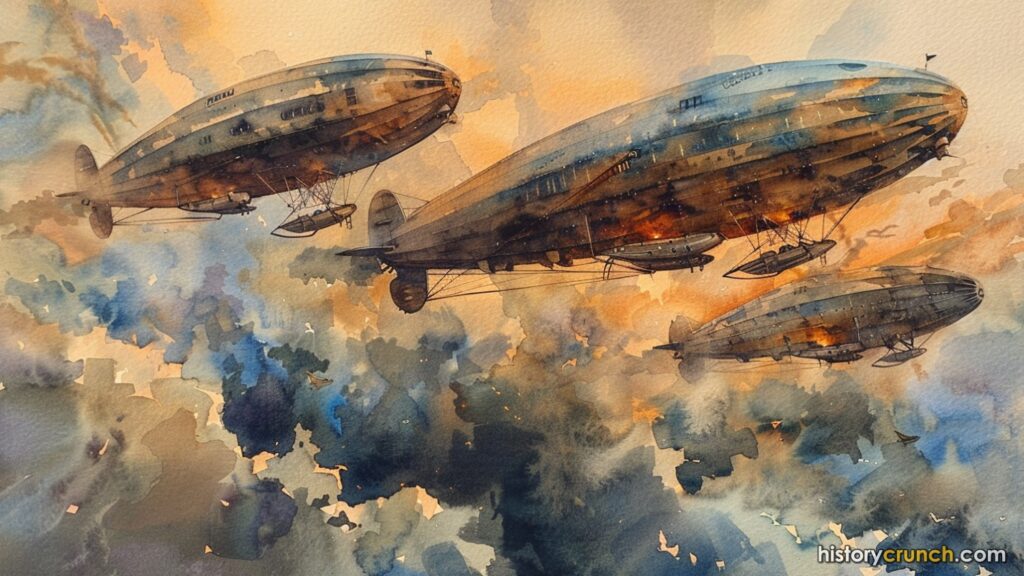
With all of that noted, Germany still famously used airships (ZeppelinsRigid airships produced by Germany, so famous that people used the name interchangeably with the word airship.) in World War I as a means of carrying out bombing raidsAttacks in which aircraft fly over enemy territory and drop bombs on targets below. against Britain. These raids first began in 1915 and continued until 1918, although airplanes took over most of the bombing from 1917. The Zeppelin bombing raids had little impact on the militaristic outcome of World War I, but proved effective in terms of creating fear and panic among the general British population. Britain ultimately countered the German bombing raids with effective defensive measures. Regardless, historians estimate that Germany carried out 51 different airship bombing raids in World War I against Britain. In all, the raids killed 557 people and injured another 1,358.
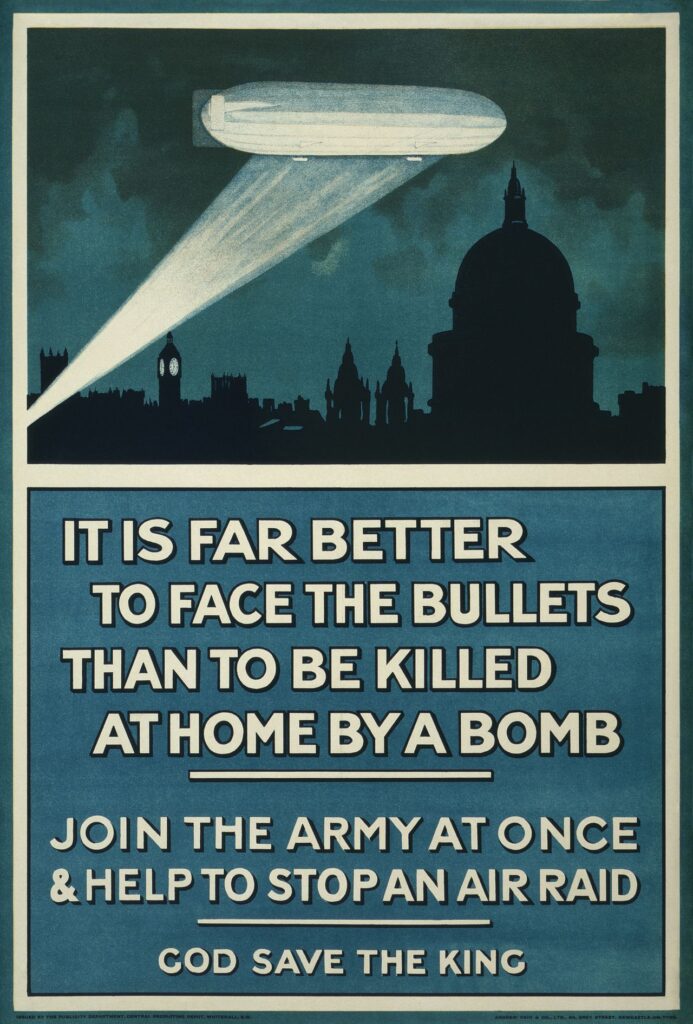
German Zeppelin raids on Britain caused widespread civilian panic but had little effect on the military outcome of World War I.
Zeppelin Airships in World War I
As stated above, most countries made use of airships during the timeframe of World War I. With that said, likely the most famous airships of World War I were the Zeppelins produced by Germany. In fact, the Zeppelins became so well known that people often used the term Zeppelin as interchangeable for airship. The Zeppelin airships were designed by Count Ferdinand von Zeppelin, a German inventor whose company built them. He introduced the development of rigid-airships for use in passenger air travel.
However, in World War I, the Zeppelin airships were used extensively by Germany in their bombing raids against Britain. Germany also used the Zeppelins as scouts in the war, in order to keep an eye out for enemy troops and artillery positions.
 FactsthatCrunch
World War I timeline · 1914 – 1918
Key Vocabulary
Lighter-than-air
Rigid-airships
Reconnaissance
Hydrogen
Helium
Zeppelins
Bombing raids
Frequently Asked Questions
What were airships used for in World War I?
Airships were used mainly for reconnaissance missions and bombing runs during World War I. They served as lookouts to spot enemy troops and artillery positions from the air. Some countries also used them for bombing raids, though they were poor at targeting.
What is an airship?
An airship is any aircraft that is lighter than air and can move under its own power. Airships without a rigid frame are known as blimps. Airships were first used in the 19th century, and the technology kept improving in the decades before World War I.
Why were airships dangerous to use in the war?
Airships were dangerous because they were usually filled with hydrogen, which is highly flammable. Hydrogen was used because it was cheaper and easier to get than the safer helium. Combined with bombs and other weapons, this made airships risky on the frontlines.
What were Zeppelins in World War I?
Zeppelins were the most famous airships of World War I, produced by Germany. They were named after Ferdinand von Zeppelin, a German inventor who developed rigid airships for passenger travel. In the war, Germany used them for bombing raids on Britain and as scouts.
How effective were the German Zeppelin bombing raids?
The Zeppelin raids had little effect on the military outcome of the war, but they spread fear among the British public. The raids began in 1915 and continued until 1918, although airplanes took over most of the bombing from 1917. Germany carried out 51 airship raids that killed 557 people and injured 1,358.
Cite This Article
To cite this article as a source, use one of the formats below.
MLA: Beck, Elias. “Airships in World War I: A Detailed Summary.” HistoryCrunch, 29 September 2026, https://historycrunch.com/airships-in-world-war-i/.
APA: Beck, E. (2026). Airships in World War I: A Detailed Summary. HistoryCrunch. https://historycrunch.com/airships-in-world-war-i/
Chicago: Beck, Elias. “Airships in World War I: A Detailed Summary.” HistoryCrunch. September 29, 2026. https://historycrunch.com/airships-in-world-war-i/
Sources
- Margaret MacMillan, The War That Ended Peace.
- Imperial War Museum