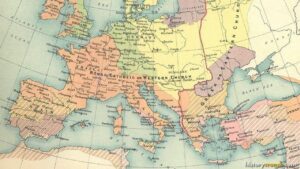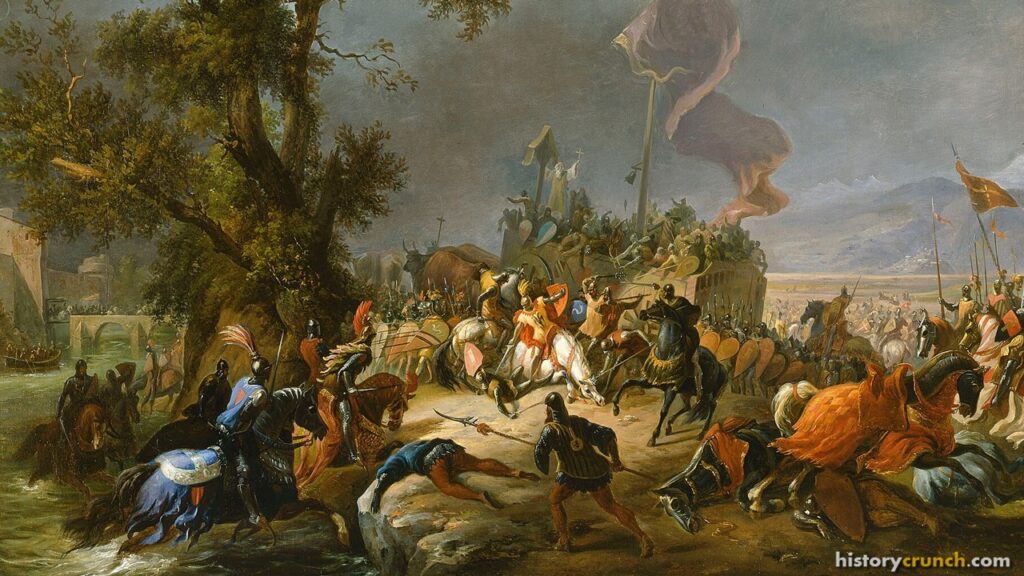
Italy in the Middle Ages was one of the most significant and complex regions in medieval Europe. Unlike England, France and the Holy Roman Empire, Italy in the Middle Ages was not a single unified kingdom but was instead divided into many different states, cities and territories, each with its own rulers and political traditions. Throughout the medieval period, Italy was home to some of the most important institutions and events of the Middle Ages, including the papacyThe office and authority of the Pope as head of the Catholic Church, based in Rome., the rise of powerful city-statesAn independent political unit centered on a single city and the territory around it. and the growth of trade and commerce. In general, Italy in the Middle Ages played a central role in the political, religious and cultural history of medieval Europe and laid the foundations for the Renaissance that followed.

What Were the Middle Ages?
The Middle Ages, also known as the Medieval Period, refers to the period of European history that stretched from the 5th century to the 15th century. More specifically, historians generally place the beginning of the Middle Ages at 476 CE, with the fall of the Western Roman Empire, and its end at approximately 1500 CE, with the start of the Renaissance. Due to its length, the Middle Ages is divided into three smaller periods, including: the Early Middle Ages, the High Middle Ages and the Late Middle Ages. Italy was involved in many of the most significant events of the Middle Ages across all three of these periods and was one of the most important regions in medieval Europe throughout the entire period.
Italy in the Early Middle Ages
The fall of the Western Roman Empire in 476 CE had an enormous impact on Italy, since Rome had been the capital of the empire and the center of Roman civilization for centuries. Following the fall of Rome, Italy was invaded and controlled by a series of different groups throughout the Early Middle Ages. For instance, the Ostrogoths, a Germanic people, established a kingdom in Italy in the late 5th century under their king Theodoric the Great. The Ostrogothic kingdom was eventually destroyed by the forces of the Byzantine Empire in the 6th century, as the Byzantine Emperor Justinian I launched a major military campaign to recapture the former western territories of the Roman Empire.
Following the Byzantine reconquest, Italy was invaded again in 568 CE by another Germanic group known as the Lombards, who established a kingdom in northern Italy known as the Lombard Kingdom. The Lombards controlled much of northern and central Italy throughout the Early Middle Ages, while the Byzantine Empire retained control of parts of southern Italy and the city of Ravenna. As well, the papacy in Rome emerged as an increasingly important political as well as religious force during this period, as the Pope stepped into the political vacuum left by the collapse of Roman imperial authority in the west. As such, the Early Middle Ages in Italy was a period of significant political instability and fragmentation, as different powers competed for control of the Italian peninsula.
FactsthatCrunchThe Ostrogoths were a Germanic people who migrated into the former territories of the Western Roman Empire after its fall in 476 CE. They established a kingdom in Italy under their king Theodoric the Great in the late 5th century. The Byzantine Empire later destroyed their kingdom during the 6th century.
The Ostrogoths ruled Italy for several decades until Byzantine Emperor Justinian I launched a military campaign to recapture the region.
Papacy and Rome in the Middle Ages
One of the most important features of Italy in the Middle Ages was the central role of the papacy in Rome. The Pope, as the head of the Catholic Church, was based in Rome throughout the Middle Ages and exercised enormous religious and political authority over Christian Europe. The presence of the papacy made Rome one of the most important cities in the medieval world and a major destination for pilgrims and religious travelers from across Europe.
Throughout the Middle Ages, the Pope played a central role in the major political events of the period. For instance, it was Pope Urban II who called for the First Crusade at the Council of Clermont in 1095 CE, launching one of the most significant events of the Middle Ages. As well, the Pope held enormous authority over the secular rulers of Europe and could use the threat of excommunicationFormal expulsion of a person from the Catholic Church, used by popes to punish or pressure rulers., which was the formal expulsion of a person from the Catholic Church, to influence the behavior of even the most powerful kings and emperors. For instance, as discussed in the Holy Roman Empire article, Pope Gregory VII excommunicated the Holy Roman Emperor Henry IV in 1076 CE, forcing him to travel to Canossa in Italy to beg for forgiveness. As such, the papacy in Rome was one of the most powerful institutions in medieval Europe and its presence in Italy gave the region enormous religious and political significance throughout the Middle Ages.
FactsthatCrunchIt is January 1077 CE, during the Middle Ages, and you are Henry IV, Holy Roman Emperor. Pope Gregory VII excommunicated you in 1076 CE, cutting you off from the Catholic Church and giving the princes of Germany grounds to remove you from power. If you remain excommunicated, the German princes will replace you as emperor and your rule will be finished.
The Rise of Italian City-States
One of the most distinctive and important features of Italy in the Middle Ages was the rise of powerful city-states. A city-state was an independent political unit centered on a single city and its surrounding territory. Unlike most of medieval Europe, where power was organized around large kingdoms and feudalRelating to a system where land and power are organized through lords and their dependent followers in a hierarchy. hierarchies, Italy developed a political system in which individual cities such as Venice, Genoa, Florence, Milan and Pisa became powerful and largely independent states in their own right.
The rise of the Italian city-states was closely connected to the growth of trade and commerce during the Middle Ages. Italy’s geographic position in the center of the Mediterranean Sea made it an ideal location for trade between Europe, the Middle East and North Africa. For instance, the port cities of Venice and Genoa became two of the most important trading cities in the medieval world, sending merchant fleets across the Mediterranean and beyond to buy and sell goods from across the known world. The Crusades also played an important role in the growth of Italian city-states. For instance, the movement of thousands of European crusaders to the Holy Land created a major demand for shipping and supplies, and Italian port cities such as Venice and Genoa grew enormously wealthy by providing these services to the crusaders. As such, the wealth generated by trade allowed the Italian city-states to develop into powerful political entities that could compete with the kingdoms and empires of the rest of Europe.
FactsthatCrunchHow did Venice and Genoa each approach their rivalry for Mediterranean trade in the Middle Ages?
Trade and Commerce in Medieval Italy
As stated above, trade and commerce were central to the history of Italy in the Middle Ages. Italian merchants were among the most active and successful traders in medieval Europe and played a major role in connecting the different regions of Europe with the trade networks of the Middle East and Asia. For instance, Italian merchants traveled extensively along the Silk Road, the ancient trade route that stretched from Europe in the west to China in the east, bringing back luxury goods such as silk, spices and precious gems that were highly valued in European markets.
Italian merchants were also important innovators in the field of finance and banking during the Middle Ages. For instance, Italian bankers developed new financial instruments such as letters of creditFinancial documents that let merchants conduct long-distance business without carrying physical gold or silver., which allowed merchants to conduct business across long distances without having to carry large amounts of gold and silver with them. These financial innovations helped make long-distance trade more practical and efficient and contributed to the growth of the European economy during the High and Late Middle Ages. As well, the city of Florence became one of the most important banking centers in medieval Europe, with powerful Florentine banking families such as the Medici providing financial services to merchants, rulers and the papacy itself. As such, Italy in the Middle Ages was not only a center of trade but also a center of financial innovation that helped transform the economy of medieval Europe.
FactsthatCrunchWhat did letters of credit allow Italian merchants to do?
Italy and the Crusades
Italy played an important role in the Crusades, which were one of the most significant events of the Middle Ages. The Crusades were a series of religious wars carried out by Christian crusaders from Europe beginning in 1095 CE, in which European knights and noblemen traveled to the Middle East in an attempt to capture the Holy Land away from Muslim people that had controlled the region for the previous centuries. Italian city-states, particularly Venice and Genoa, played a central role in the Crusades by providing the ships and supplies needed to transport crusaders and their equipment across the Mediterranean Sea to the Holy Land.
For instance, Venice played a particularly important and controversial role in the Fourth Crusade, which took place from 1202 to 1204 CE. The crusaders had contracted with Venice to provide ships to transport them to the Holy Land, but when they could not pay the agreed price, the Venetians redirected the crusade toward Constantinople, the capital of the Byzantine Empire. The crusaders attacked and sacked Constantinople in 1204 CE, which was a shocking event that caused enormous damage to the Byzantine Empire and deepened the divisions between the Catholic and Eastern Orthodox churches. As such, the involvement of Italian city-states in the Crusades had important and sometimes controversial consequences for the history of the Middle Ages.
FactsthatCrunchThe Venetians saw the sack of Constantinople as a practical solution to a financial and logistical problem. The crusaders had contracted with Venice for ships but could not pay the agreed price, so Venetian leaders steered the expedition toward the Byzantine capital instead. To the Venetians, seizing Constantinople meant recovering their costs and gaining control of key Mediterranean trade routes that would make Venice even richer and more powerful.
The Byzantine defenders saw the attack as a profound betrayal by fellow Christians. Constantinople had stood as the capital of the Byzantine Empire for nearly nine centuries, and its people regarded it as the center of Orthodox Christian civilization. The sack stripped the city of its wealth, destroyed irreplaceable buildings and holy sites, and left a wound between the Catholic and Eastern Orthodox churches that would never fully heal.
Italy and the End of the Middle Ages
Italy played a central role in bringing the Middle Ages to an end through its contribution to the Renaissance. The Renaissance was an important event in European history that stretched from the 14th century to the 17th century and led to a major shift in European thought and worldview in areas such as art, science, literature and politics. The Renaissance began in the city-states of the Italian peninsula in the 14th century, particularly in Florence, and eventually spread to all of Europe by the 16th century.
The Renaissance began in Italy for several reasons. First, the wealth generated by trade and commerce in the Italian city-states provided the economic conditions that allowed art and learning to flourish. Second, the Italian city-states had developed a relatively open and competitive political culture that encouraged new ideas and ways of thinking. Third, Italy’s close connection to the legacy of ancient Rome meant that Italian scholars had easier access to the texts and traditions of the ancient world than scholars in other parts of Europe. For instance, the Italian scholar Petrarch, who is considered the founder of the humanistA thinker who focused on rediscovering and building on the texts and ideas of ancient Greece and Rome. movement, rediscovered and built upon the works of ancient Roman philosophers such as Cicero. As such, Italy in the Middle Ages laid the essential foundations for the Renaissance that followed and was one of the most important regions in the history of European civilization.
FactsthatCrunchWhy did the Renaissance begin in Italy rather than anywhere else in Europe?
Significance of Italy in the Middle Ages
In conclusion, Italy in the Middle Ages was one of the most significant and dynamic regions in medieval Europe. From the fall of Rome and the rise of the papacy to the growth of powerful city-states and the foundations of the Renaissance, Italy played a central role in shaping the history of the Middle Ages and the world that followed. As such, understanding Italy in the Middle Ages is important for gaining a complete picture of medieval European society and for understanding how many of the key institutions, ideas and traditions of the modern world came into being.
Key Vocabulary
Papacy
Excommunication
City-state
Feudal
Letters of credit
Humanist
Silk Road
Frequently Asked Questions
Why was Italy not a unified country in the Middle Ages?
Italy was split into many separate states, cities and territories, each with its own rulers. Unlike England or France, it had no single king ruling the whole peninsula. After Rome fell in 476 CE, groups like the Ostrogoths, Byzantines and Lombards each controlled different parts. This division lasted for centuries and shaped Italian politics throughout the period.
What were the Italian city-states?
Italian city-states were independent political units built around a single city and the land around it. Venice, Genoa, Florence, Milan and Pisa were among the most powerful. They grew rich and strong through trade rather than through large kingdoms or feudal systems. Their wealth let them compete with the kingdoms and empires of the rest of Europe.
Why was the papacy so powerful in medieval Italy?
The Pope led the Catholic Church from Rome and held huge religious and political power across Europe. He stepped into the gap left after Roman imperial rule collapsed in the west. The Pope could even threaten kings with excommunication, which meant being expelled from the Church. In 1076 CE, Pope Gregory VII used this against Holy Roman Emperor Henry IV.
How did Italian cities help the Crusades?
Venice and Genoa supplied the ships and goods needed to carry crusaders across the Mediterranean Sea. Moving thousands of people created huge demand, and these cities grew wealthy by meeting it. Venice played a controversial part in the Fourth Crusade from 1202 to 1204 CE. When crusaders could not pay, the Venetians steered them to attack Constantinople instead.
Why did the Renaissance begin in Italy?
The Renaissance started in Italian city-states, especially Florence, in the 14th century. Wealth from trade gave people money to support art and learning. Italy’s competitive political culture also welcomed new ideas and ways of thinking. Its close ties to ancient Rome gave scholars like Petrarch easy access to old Roman texts.
How did Italian merchants change banking and trade?
Italian bankers created new tools such as letters of credit for long-distance business. These let merchants trade without carrying large amounts of gold and silver. Florence became a major banking center, with families like the Medici lending to rulers and the papacy. These ideas made trade across Europe safer and more efficient.
Cite This Article
To cite this article as a source, use one of the formats below.
MLA: Millar, B. “Italy in the Middle Ages: A Detailed Summary.” HistoryCrunch, 14 October 2026, https://historycrunch.com/italy-in-the-middle-ages/.
APA: Millar, B. (2026). Italy in the Middle Ages: A Detailed Summary. HistoryCrunch. https://historycrunch.com/italy-in-the-middle-ages/
Chicago: Millar, B. “Italy in the Middle Ages: A Detailed Summary.” HistoryCrunch. October 14, 2026. https://historycrunch.com/italy-in-the-middle-ages/
Sources
- Fordham Medieval Sourcebook
- Barbara Rosenwein, A Short History of the Middle Ages.
- The Met (Heilbrunn Timeline): medieval art